

Author: Devanssh Mehta
Abstract
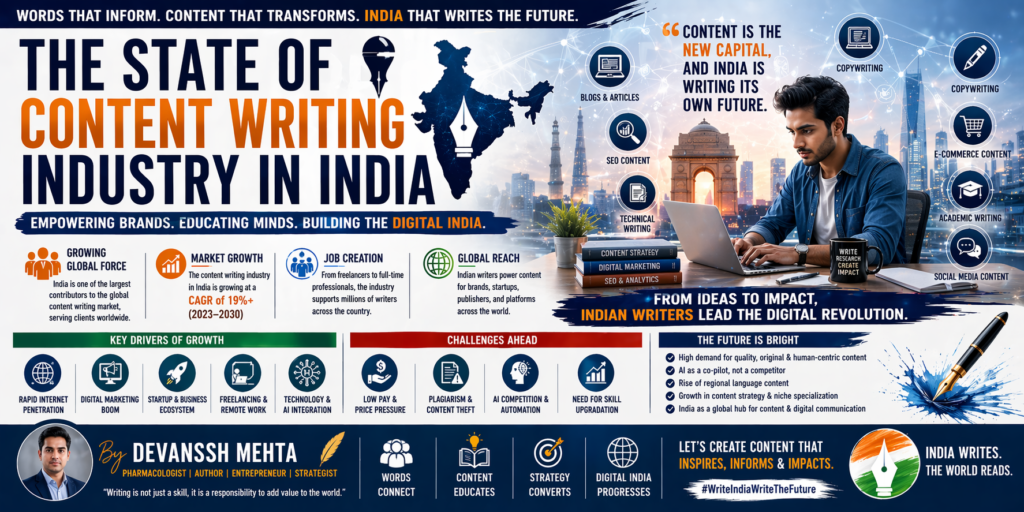
The rapid digital transformation of the global economy has fundamentally reshaped the way information is produced, distributed, and consumed. Within this evolving landscape, the content writing industry has emerged as a critical component of digital communication, marketing strategy, and knowledge dissemination. Businesses, governments, educational institutions, and digital platforms increasingly rely on high-quality written content to engage audiences, establish authority, and drive economic growth.
India has witnessed an extraordinary expansion of its content writing industry over the past decade. The convergence of affordable internet access, the proliferation of digital platforms, the expansion of the startup ecosystem, and the rise of search engine-driven marketing strategies has created unprecedented demand for skilled content writers. Indian content writers today contribute to diverse sectors including digital marketing, journalism, academic publishing, corporate communications, technical documentation, and creative storytelling.
This article presents a comprehensive analysis of the state of the content writing industry in India. It explores the historical evolution of the sector, the technological forces shaping its development, the economic opportunities it creates, and the challenges that writers and organizations must address in an increasingly competitive digital marketplace. Particular attention is given to the role of artificial intelligence, search engine optimization (SEO), and the globalization of digital content services.
The study argues that India is uniquely positioned to become a global hub for content writing and digital knowledge production. However, achieving this potential requires strategic investments in education, professional training, intellectual property protection, and ethical standards in digital publishing.
1. Introduction
The twenty-first century has been characterized by an unprecedented explosion of digital information. As businesses, institutions, and individuals increasingly migrate to online platforms, the importance of written content has grown dramatically. Websites, blogs, social media posts, newsletters, academic publications, marketing materials, and technical documentation all rely on the expertise of skilled content writers.
Content writing is no longer a peripheral activity confined to journalism or creative literature. Instead, it has evolved into a sophisticated professional discipline that integrates communication skills, marketing strategy, technological literacy, and data analytics.
The emergence of search engine optimization (SEO), digital marketing, and content-driven branding strategies has significantly expanded the demand for professional writers. Organizations now recognize that high-quality content plays a central role in building brand authority, improving search engine rankings, and engaging target audiences.
India has become one of the most dynamic markets for digital content production. The country’s rapidly expanding internet population, thriving startup ecosystem, and globally competitive information technology industry have created fertile ground for the growth of content writing services.
Indian content writers increasingly serve both domestic and international markets, contributing to a global digital knowledge economy. From multinational corporations to emerging startups, organizations across the world rely on Indian writers to produce digital content for websites, blogs, marketing campaigns, and educational platforms.
Understanding the current state of the content writing industry in India therefore requires examining a complex interplay of technological innovation, economic opportunity, cultural transformation, and policy development.
2. Historical Evolution of the Content Writing Industry in India
2.1 Pre-Digital Foundations
Before the rise of the internet, professional writing in India was primarily associated with traditional media industries such as newspapers, magazines, book publishing, and advertising agencies. Writers worked as journalists, editors, copywriters, and authors producing content for print distribution.
The traditional publishing industry played a vital role in shaping intellectual discourse and cultural expression. However, opportunities for writers were relatively limited due to the centralized nature of media institutions and the high barriers to entry in publishing.
Most writers relied on established media organizations to reach audiences, and freelance opportunities were comparatively scarce.
2.2 Emergence of Digital Content Writing
The expansion of the internet in the early twenty-first century initiated a profound transformation in the Indian writing industry. As businesses began establishing online presence through websites and blogs, demand for digital content increased significantly.
Digital content writing introduced new forms of professional specialization, including:
- blog writing
- website content development
- SEO writing
- product descriptions
- digital marketing copy
- social media content
Unlike traditional publishing, digital content writing allowed individuals to work remotely and collaborate with organizations across geographical boundaries.
Freelance writing platforms and digital marketplaces enabled Indian writers to access global clients, creating new income opportunities.
3. Digital Transformation and the Growth of the Content Writing Industry
3.1 Internet Penetration and Digital Infrastructure
One of the most important drivers of the content writing industry in India has been the rapid expansion of internet access. Over the past decade, the number of internet users in India has grown dramatically, reaching hundreds of millions of individuals.
Affordable smartphones and low-cost mobile data have enabled widespread internet adoption across urban and rural regions.
This digital connectivity has created a massive demand for online content in various domains including:
- e-commerce
- education
- finance
- healthcare
- entertainment
As organizations compete for visibility in digital environments, content writing has become a crucial component of marketing and communication strategies.
3.2 Rise of Digital Marketing Ecosystems
The growth of digital marketing has significantly increased the demand for professional content writers. Businesses rely on content marketing to attract customers, build brand credibility, and improve search engine rankings.
Content marketing strategies typically involve producing informative and engaging content that addresses consumer needs and interests.
Common forms of digital marketing content include:
- blog articles
- landing pages
- email newsletters
- case studies
- white papers
- social media posts
Professional content writers play a central role in developing these materials.
4. Types of Content Writing in India
The Indian content writing industry encompasses a wide range of professional specializations.
4.1 SEO Content Writing
SEO writing focuses on creating content optimized for search engine algorithms. Writers incorporate relevant keywords, headings, and structured formatting to improve search visibility.
SEO content writers must understand:
- search engine algorithms
- keyword research techniques
- user intent analysis
- content optimization strategies
SEO writing has become one of the most in-demand skills in the digital marketing industry.
4.2 Technical Writing
Technical writing involves producing documentation that explains complex technological or scientific concepts.
Examples include:
- software manuals
- user guides
- API documentation
- engineering reports
India’s strong IT industry has created significant demand for technical writers.
4.3 Academic and Research Writing
Academic writing is another important segment of the content writing industry. Writers assist with research papers, literature reviews, thesis editing, and scholarly publications.
Universities, research institutions, and educational platforms increasingly rely on professional writers for academic content development.
4.4 Creative and Storytelling Content
Creative writing remains a vital component of the content industry. Writers produce narratives for entertainment, advertising, and brand storytelling.
Creative content formats include:
- scripts
- storytelling blogs
- brand narratives
- fiction and literary works
Storytelling has become an essential tool for building emotional connections with audiences.
5. The Role of Freelancing in the Content Writing Industry
Freelancing has become one of the defining characteristics of the modern content writing industry in India.
Digital platforms enable writers to connect directly with clients around the world. Freelance writers often work remotely and manage multiple projects simultaneously.
Advantages of freelance writing include:
- flexible work schedules
- access to global clients
- independence from traditional employment structures
However, freelancing also presents challenges such as income instability and competition from global writers.
6. Artificial Intelligence and Content Writing
Artificial intelligence has begun to influence the content writing industry in significant ways.
AI-powered tools can generate text, assist with grammar correction, and analyze search engine trends.
These technologies have raised concerns about the future role of human writers.
However, AI systems still struggle to replicate:
- creative storytelling
- emotional nuance
- complex critical analysis
As a result, the future of content writing will likely involve collaboration between human creativity and AI-driven tools.
7. Economic Impact of the Content Writing Industry in India
The content writing industry contributes to India’s broader digital economy by creating employment opportunities and supporting digital marketing services.
Thousands of writers work for:
- digital marketing agencies
- media companies
- e-commerce platforms
- technology firms
Freelance content writing also provides income opportunities for students, professionals, and independent entrepreneurs.
The expansion of India’s startup ecosystem has further increased demand for high-quality digital content.
8. Challenges Facing the Content Writing Industry
Despite its rapid growth, the content writing industry faces several challenges.
Low Compensation
Many entry-level writers receive relatively low compensation compared to other professional fields.
Content Saturation
The enormous volume of online content makes it difficult for writers to achieve visibility.
Intellectual Property Concerns
Unauthorized reproduction and plagiarism remain significant issues in digital publishing.
AI Competition
The emergence of AI-generated content raises questions about the long-term sustainability of certain writing roles.
9. Opportunities for Future Growth
Despite these challenges, the future of the content writing industry in India remains highly promising.
Emerging opportunities include:
- educational content creation
- digital journalism
- technical documentation
- content strategy consulting
- multilingual content development
India’s linguistic diversity provides unique opportunities for content production in regional languages.
10. Strategic Importance of Content Writing for India
Content writing is not merely a professional activity; it represents an essential component of the digital knowledge economy.
High-quality written content supports:
- education and knowledge dissemination
- digital marketing and entrepreneurship
- scientific communication
- cultural storytelling
India’s ability to produce globally competitive digital content will influence its position in the global knowledge economy.
11. Policy Recommendations
To strengthen the content writing industry, several strategic initiatives should be considered:
Education and Training
Universities should incorporate digital writing and content marketing courses into their curricula.
Professional Standards
Industry organizations should develop ethical guidelines for digital publishing.
Intellectual Property Protection
Stronger copyright enforcement can protect writers from plagiarism.
Support for Regional Content
Government programs should encourage content creation in regional languages.
12. Future Outlook
The future of the content writing industry will be shaped by technological innovation, globalization, and evolving consumer behavior.
Emerging trends include:
- AI-assisted writing
- immersive storytelling
- interactive educational content
- personalized content experiences
As digital platforms continue to evolve, the demand for skilled writers capable of producing authoritative and engaging content will remain strong.
Conclusion
The content writing industry in India has evolved from a modest segment of the traditional publishing sector into a vibrant and rapidly expanding component of the digital economy.
Driven by internet expansion, digital marketing strategies, and technological innovation, the demand for professional writers continues to grow across multiple industries.
While challenges such as low compensation, content saturation, and technological disruption remain significant, the long-term prospects for the industry are highly promising.
India’s large population of educated, English-proficient professionals positions the country as a potential global leader in digital content production.
The future of the industry will depend on the ability of writers, organizations, and policymakers to embrace technological change while preserving the essential human creativity that defines meaningful communication.
References
- Cunningham, S. & Craig, D. (2021). Social media entertainment and the creator economy.
- OECD (2023). Digital economy outlook.
- Deloitte (2023). Digital media trends report.
- PwC (2024). Global entertainment and media outlook.
- McKinsey Global Institute (2024). Digital transformation and future of work.
- Statista (2024). Global content marketing statistics.
- IBEF (2024). Digital economy of India report.
- World Economic Forum (2023). The future of digital platforms.
- HubSpot Research (2024). Content marketing industry report.
- Gartner (2023). The future of digital marketing and content strategy.