
A Guide to Effective Communication
Introduction
Communication is one of the most fundamental skills required for personal development, professional success, leadership, and healthy relationships. Every human interaction involves communication, whether through spoken words, written messages, body language, facial expressions, gestures, or digital platforms. The quality of communication often determines whether ideas are understood, relationships are strengthened, conflicts are resolved, and objectives are achieved.
Effective communication is not merely the ability to speak fluently. It is the ability to express ideas clearly, listen attentively, understand different perspectives, respond appropriately, and create mutual understanding. A highly educated or technically competent individual may still struggle professionally if he or she cannot communicate effectively.
In modern society, communication has become even more important. Organizations operate across geographical boundaries, teams increasingly work through digital platforms, and professionals interact with people from different cultural, social, and professional backgrounds. Consequently, communication requires not only language proficiency but also emotional intelligence, adaptability, professionalism, and technological awareness.
Effective communication should therefore be regarded as a lifelong competency rather than a single skill.
1. Meaning of Effective Communication
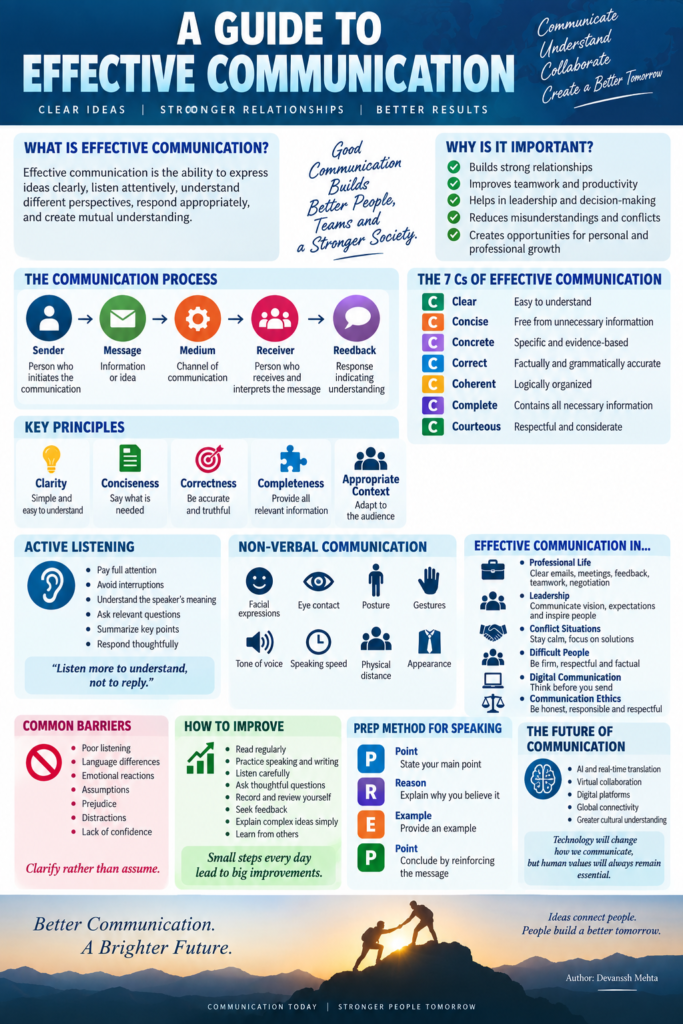
Effective communication occurs when information, ideas, emotions, or instructions are transmitted in such a manner that the intended meaning is understood accurately by the receiver.
The communication process generally involves:
- Sender – the individual initiating the communication.
- Message – the information or idea being communicated.
- Encoding – converting thoughts into words, symbols, or gestures.
- Medium – the channel through which communication occurs.
- Receiver – the individual receiving the message.
- Decoding – interpreting the message.
- Feedback – the response indicating whether the message was understood.
- Context – the circumstances surrounding the communication.
Communication becomes effective when these components function together with minimum misunderstanding.
2. Importance of Effective Communication
Effective communication provides benefits across almost every area of life.
Personal Benefits
Good communication helps individuals:
- Build meaningful relationships
- Express emotions appropriately
- Develop confidence
- Resolve disagreements
- Establish trust
- Understand other people
- Avoid unnecessary misunderstandings
Professional Benefits
In professional environments, communication contributes to:
- Better teamwork
- Effective leadership
- Improved productivity
- Clear delegation
- Successful negotiations
- Better customer relationships
- Faster problem-solving
- Improved decision-making
- Strong professional reputation
Leadership Benefits
A leader must communicate vision, expectations, responsibilities, priorities, and organizational objectives. Leadership without effective communication becomes difficult because people cannot consistently act upon objectives they do not understand.
Therefore, communication is one of the foundations of leadership.
3. Principles of Effective Communication
Several principles can significantly improve communication quality.
3.1 Clarity
The message should be easy to understand.
Avoid unnecessary complexity, ambiguous expressions, and excessive technical terminology when communicating with a general audience.
Instead of saying:
“We need to operationalize the aforementioned strategic intervention.”
A clearer statement would be:
“We need to implement this strategy.”
Clarity reduces confusion and improves execution.
3.2 Conciseness
Effective communication should contain sufficient information without unnecessary repetition.
A concise communicator asks:
- What does the other person need to know?
- What is the most important point?
- What action is required?
- Which information can be omitted?
Conciseness is particularly important in professional communication.
3.3 Correctness
Information should be factually and grammatically accurate.
Incorrect information can produce:
- Poor decisions
- Loss of credibility
- Professional misunderstandings
- Financial consequences
- Operational failures
Accuracy is particularly important in scientific, medical, legal, financial, and administrative communication.
3.4 Completeness
A message should contain the information necessary for the receiver to understand the situation and act appropriately.
For example, instead of saying:
“Please complete the report soon.”
A better instruction would specify:
- What report?
- What information is required?
- Who is responsible?
- What is the deadline?
- Where should it be submitted?
Completeness transforms vague communication into actionable communication.
3.5 Appropriate Context
The same message may need to be communicated differently depending upon the audience and situation.
Communication with:
- A senior officer
- A colleague
- A customer
- A child
- A professor
- A patient
- A government official
may require different levels of formality, technical detail, and explanation.
An effective communicator therefore adapts communication to the audience.
4. Active Listening
One of the most neglected components of communication is listening.
Communication is not simply speaking. Listening is equally important.
Active listening involves:
- Paying full attention
- Avoiding unnecessary interruptions
- Maintaining appropriate eye contact
- Understanding the speaker’s meaning
- Asking relevant questions
- Clarifying uncertainty
- Summarizing important points
- Responding thoughtfully
A person who listens carefully gains information that a person who is constantly preparing a response may miss.
The 70/30 Principle
As a practical guideline, during many conversations it can be useful to spend more time listening than speaking. However, the precise balance should depend upon the situation.
Good communication is not a competition to determine who speaks the most.
5. Non-Verbal Communication
A significant part of communication occurs without words.
Important elements include:
- Facial expressions
- Eye contact
- Posture
- Hand gestures
- Physical distance
- Tone of voice
- Speaking speed
- Pauses
- Appearance
- Body orientation
For example, a person may verbally say that they are confident while displaying nervous posture, avoiding eye contact, and speaking hesitantly.
Such inconsistencies can reduce credibility.
Therefore, effective communication requires alignment between words, tone, and body language.
6. Voice and Tone
The same words can communicate completely different meanings depending upon tone.
An effective communicator should develop control over:
- Volume
- Pitch
- Speed
- Pronunciation
- Pauses
- Emotional intensity
Professional communication should generally be:
- Calm
- Respectful
- Confident
- Clear
- Controlled
Speaking loudly does not necessarily demonstrate authority. True authority is often demonstrated through clarity, composure, competence, and self-control.
7. Emotional Intelligence and Communication
Emotional intelligence plays an important role in effective communication.
A person with strong emotional intelligence can:
- Understand personal emotions.
- Regulate emotional reactions.
- Recognize the emotions of others.
- Respond appropriately.
- Maintain relationships during disagreement.
For example, responding to criticism with immediate anger may escalate a situation. A more effective approach is to pause, understand the criticism, determine whether it contains useful information, and respond rationally.
Emotional control does not mean suppressing emotions. It means managing emotions intelligently.
8. Asking Effective Questions
Good questions improve the quality of communication.
Useful questions include:
Open-ended questions
These encourage detailed responses.
Examples:
- “What do you think about this approach?”
- “What challenges are you facing?”
- “How can we improve the situation?”
Clarifying questions
These prevent misunderstanding.
Examples:
- “Do you mean that the deadline is Friday?”
- “Could you explain that point further?”
- “Which option would you prefer?”
Analytical questions
These help identify causes and solutions.
Examples:
- “Why did this problem occur?”
- “What are the major risks?”
- “What alternatives do we have?”
An effective communicator does not hesitate to ask questions when clarification is required.
9. Communication in Professional Life
Professional communication should demonstrate clarity, respect, discipline, and accountability.
Important professional communication skills include:
- Writing effective emails
- Conducting meetings
- Giving presentations
- Delegating responsibilities
- Negotiating
- Providing feedback
- Handling customers
- Communicating with senior management
- Managing difficult conversations
Professional Email Communication
A good professional email should generally contain:
- Clear subject
- Appropriate greeting
- Purpose of communication
- Relevant information
- Required action
- Deadline when applicable
- Professional closing
Avoid unnecessarily long emails when a short and clear message is sufficient.
10. Communication in Leadership
Leadership communication requires more than giving instructions.
A leader must communicate:
- Vision
- Mission
- Objectives
- Priorities
- Expectations
- Responsibilities
- Feedback
- Recognition
- Corrective action
Effective leaders explain why something matters rather than merely telling people what to do.
A leader who communicates clearly creates alignment. A leader who communicates poorly creates uncertainty.
Leadership communication should therefore combine authority with empathy.
11. Communication During Conflict
Conflict is inevitable in human relationships and organizations.
Poor communication can transform a minor disagreement into a major conflict.
During difficult conversations:
- Remain calm.
- Listen before responding.
- Avoid personal attacks.
- Focus on the issue rather than the individual.
- Use factual language.
- Avoid unnecessary accusations.
- Acknowledge legitimate concerns.
- Explain your perspective clearly.
- Search for common ground.
- Work toward a practical solution.
Instead of saying:
“You always create problems.”
A constructive communicator might say:
“This particular issue has created difficulties. Let us understand what happened and determine how we can prevent it in the future.”
The objective of communication during conflict should be resolution rather than victory.
12. Dealing with Difficult People
Some individuals may be aggressive, manipulative, disrespectful, unreasonable, or persistently negative.
Effective communication with difficult people requires:
- Emotional control
- Firm boundaries
- Polite language
- Factual communication
- Limited unnecessary engagement
- Documentation when appropriate
- Avoidance of provocative arguments
Being respectful does not require being submissive.
A strong communicator can be calm and firm simultaneously.
13. Communication Barriers
Several factors can interfere with effective communication.
Common barriers include:
- Poor listening
- Language differences
- Emotional reactions
- Assumptions
- Prejudice
- Fear
- Lack of confidence
- Information overload
- Ambiguous language
- Cultural differences
- Technical problems
- Distractions
- Poor timing
One of the most dangerous barriers is assumption.
People frequently assume that others understand their intentions without clearly communicating them.
The solution is simple:
Clarify rather than assume.
14. Digital Communication
Modern communication increasingly occurs through:
- Messaging applications
- Video conferences
- Social media
- Collaboration platforms
- Online meetings
Digital communication creates efficiency but also introduces new risks.
Before sending a digital message, consider:
- Is it necessary?
- Is the wording clear?
- Could it be misunderstood?
- Is the tone appropriate?
- Does it contain confidential information?
- Does the recipient need to take action?
A message written in anger can create consequences long after the emotion has disappeared.
Therefore, think before you send.
15. Communication Ethics
Communication should be guided by ethical principles.
Important principles include:
- Honesty
- Respect
- Confidentiality
- Responsibility
- Fairness
- Transparency
- Accuracy
- Accountability
Effective communication should not be confused with manipulation.
A person may possess excellent communication skills but use them dishonestly. Such communication may produce short-term results but ultimately destroys trust.
The highest form of communication combines competence with character.
16. How to Improve Communication Skills
Communication can be systematically developed.
Daily practices
- Read high-quality books and articles.
- Expand vocabulary naturally through reading.
- Practice speaking clearly.
- Record yourself speaking and identify weaknesses.
- Listen carefully during conversations.
- Ask thoughtful questions.
- Practice explaining complex ideas simply.
- Write regularly.
- Learn to summarize information.
- Request constructive feedback.
A simple daily exercise
Choose one topic each day and explain it in:
- 30 seconds
- 2 minutes
- 5 minutes
This exercise develops clarity, structure, confidence, and adaptability.
17. The PREP Method for Speaking
A useful structure for answering questions or presenting an opinion is PREP:
P – Point
State your main point.
R – Reason
Explain why you believe it.
E – Example
Provide an appropriate example.
P – Point
Conclude by reinforcing the main message.
For example:
Point: Exercise is important for productivity.
Reason: Regular physical activity can improve energy and concentration.
Example: A professional who exercises regularly may find it easier to maintain focus during demanding work.
Point: Therefore, exercise can contribute not only to physical fitness but also to effective professional performance.
This structure helps prevent rambling and makes communication easier to follow.
18. The 7 Cs of Effective Communication
A useful framework is the 7 Cs:
- Clear – easy to understand
- Concise – free from unnecessary information
- Concrete – specific and evidence-based
- Correct – accurate
- Coherent – logically organized
- Complete – sufficiently informative
- Courteous – respectful
Applying these principles can substantially improve both spoken and written communication.
19. Communication and Personal Development
Communication improvement often produces broader improvements in personality.
As communication skills develop, individuals may become:
- More confident
- More disciplined
- More socially aware
- More emotionally intelligent
- Better listeners
- Better negotiators
- Better leaders
- More persuasive
- More professionally effective
However, communication should not become an exercise in impressing others.
The objective is not to appear intelligent.
The objective is to make ideas understood and create constructive human interaction.
20. The Future of Communication
Technology is rapidly changing communication.
Artificial intelligence, real-time translation, virtual environments, automated communication systems, and advanced collaboration platforms will increasingly influence how individuals and organizations exchange information.
However, technology cannot eliminate the fundamental human requirements of communication.
Trust, empathy, judgment, ethics, emotional intelligence, and human understanding will remain essential.
Future professionals will therefore need a combination of:
- Communication skills
- Digital literacy
- AI literacy
- Critical thinking
- Emotional intelligence
- Cultural awareness
- Ethical judgment
The most effective communicator of the future will not necessarily be the person who speaks the most or uses the most advanced technology. It will be the person who can combine technology with human understanding.
Conclusion
Effective communication is one of the most valuable capabilities that an individual can develop. It influences relationships, education, professional performance, leadership, negotiation, conflict resolution, and personal growth.
The foundation of effective communication is simple: speak clearly, listen carefully, understand others, control emotions, adapt to the audience, communicate honestly, and take responsibility for the message.
Excellent communication is not achieved overnight. It develops through continuous practice, observation, feedback, reading, listening, writing, and real-world experience.
Ultimately, communication is more than the exchange of words. It is the process through which people exchange ideas, understanding, emotions, expectations, values, and trust.
A person who learns to communicate effectively gains a powerful instrument for improving both personal life and professional achievement. A leader who communicates effectively can inspire people. A professional who communicates clearly can create value. A citizen who communicates responsibly can strengthen society.
Therefore, effective communication should not be treated merely as a soft skill. It is a fundamental life skill, a professional competency, and a cornerstone of effective leadership.