

Building Officer-Like Qualities: A Comprehensive Guide to Leadership, Character, and Professional Excellence
Introduction
Officer-like qualities are not merely a collection of impressive personality traits. They represent a broader framework of character, leadership, discipline, courage, responsibility, emotional maturity, social effectiveness, and intellectual competence that enables an individual to perform effectively under pressure and to earn the confidence of others. Although the expression “officer-like qualities” is often associated with military or civil-service leadership, the underlying principles are applicable to professionals, managers, entrepreneurs, administrators, academics, healthcare professionals, and ordinary citizens.
A person with officer-like qualities does not necessarily need to possess a commanding personality. True officer-like behaviour is demonstrated through responsible action, sound judgment, self-control, integrity, initiative, teamwork, adaptability, and concern for the larger objective. The essence is not domination over others but the ability to lead oneself and contribute constructively to a group.
Building these qualities is therefore a long-term process. It requires deliberate practice, self-observation, exposure to difficult situations, continuous learning, and a willingness to correct one’s weaknesses.
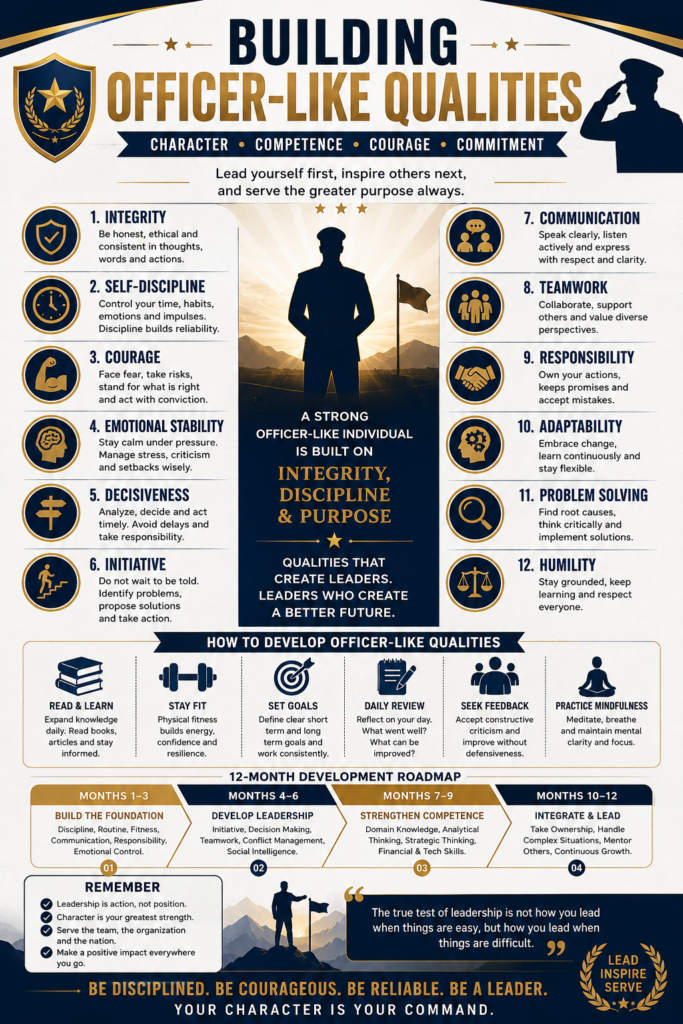
1. Understanding the Foundation of Officer-Like Qualities
Officer-like qualities begin with character. Knowledge and intelligence can make a person competent, but character determines how that competence is used.
A strong foundation consists of integrity, honesty, responsibility, discipline, humility, courage, respect, fairness, and emotional stability. These qualities influence every subsequent aspect of leadership.
The first principle is simple:
Lead yourself before attempting to lead others.
An individual who cannot regulate his own emotions, manage his time, control impulsive behaviour, fulfil commitments, or accept criticism will find it difficult to lead others effectively.
Self-leadership therefore becomes the first training ground for officer-like qualities.
2. Develop Strong Self-Discipline
Discipline is one of the most important foundations of professional character. It means doing what needs to be done even when motivation is absent.
Self-discipline can be developed through consistent routines involving:
- punctuality;
- proper planning;
- completion of commitments;
- controlled use of technology and social media;
- regular physical activity;
- continuous learning;
- orderly personal and professional conduct;
- financial responsibility; and
- consistent sleep and work routines.
The objective should not be to create an excessively rigid lifestyle. Instead, discipline should create predictability and reliability.
A disciplined person becomes someone others can depend upon.
3. Build Courage
Courage is frequently misunderstood as the absence of fear. In reality, courage is the ability to act appropriately despite fear, uncertainty, discomfort, or potential criticism.
Officer-like courage has several dimensions.
Physical courage
This involves maintaining composure and taking appropriate action during physically demanding or dangerous circumstances.
Moral courage
Moral courage is the willingness to stand for what is right even when doing so is inconvenient or unpopular.
Intellectual courage
This involves questioning assumptions, admitting that one may be wrong, considering opposing evidence, and changing one’s position when facts demand it.
Emotional courage
Emotional courage means facing disappointment, rejection, embarrassment, failure, loneliness, and criticism without allowing them to destroy one’s functioning.
A courageous person does not seek unnecessary conflict. The highest form of courage is controlled action rather than reckless aggression.
4. Develop Emotional Stability
Leadership requires emotional regulation.
An officer-like individual should be capable of remaining reasonably composed when confronted with criticism, provocation, failure, disagreement, or unexpected problems.
Emotional stability can be strengthened through a simple sequence:
Pause → Observe → Evaluate → Respond.
Instead of reacting immediately, create a small psychological gap between an event and your response.
For example, when someone criticizes you, do not immediately retaliate. Ask:
- Is there any truth in the criticism?
- Is the criticism useful?
- Is the person acting in good faith?
- What response protects my dignity and objective?
- Is responding actually necessary?
This approach converts emotional reactions into deliberate decisions.
5. Develop Decisiveness
Effective leaders eventually have to make decisions despite incomplete information.
Decisiveness does not mean making rapid decisions about everything. It means knowing when to analyse, when to consult, and when to act.
A useful decision-making framework is:
Define the problem → Gather relevant facts → Identify options → Evaluate consequences → Decide → Act → Review.
Avoid two opposite tendencies:
- impulsive decision-making; and
- endless analysis without action.
A mature professional understands that some decisions require extensive analysis while others require timely execution.
6. Strengthen Responsibility and Accountability
One of the clearest indicators of maturity is the ability to accept responsibility.
When something goes wrong, an immature person immediately looks for someone to blame. A responsible person asks:
“What was my role, what can I correct, and what can I do differently next time?”
Accountability does not mean accepting blame for everything. It means accurately identifying one’s responsibilities and owning them.
A strong professional should:
- keep promises;
- acknowledge mistakes;
- correct errors quickly;
- avoid unnecessary excuses;
- communicate problems early;
- accept legitimate criticism; and
- give credit to others when they contribute to success.
Reliability builds professional trust.
7. Develop Initiative
Initiative means acting constructively without waiting for someone else to provide every instruction.
For example, instead of merely identifying a problem, an individual with initiative might identify the problem, investigate its causes, propose solutions, and begin implementing an appropriate solution after obtaining necessary approval.
Initiative can be developed through a daily question:
“What useful action can I take without being told?”
However, initiative must be balanced with judgment. Acting independently does not mean ignoring authority, procedures, safety requirements, or organizational responsibilities.
8. Improve Communication Skills
An officer-like professional must communicate clearly.
Communication includes much more than speaking confidently. It involves:
- listening;
- clarity;
- appropriate tone;
- concise expression;
- body language;
- written communication;
- questioning;
- negotiation;
- conflict management; and
- adapting communication to different audiences.
A strong communicator avoids unnecessary aggression and unnecessary submissiveness.
The ideal communication style is firm, respectful, clear, and purposeful.
One useful principle is:
Be soft on people but firm on principles.
9. Develop Social Intelligence
Leadership is fundamentally relational. People must be understood, respected, and coordinated.
Social intelligence includes understanding:
- people’s motivations;
- group dynamics;
- interpersonal boundaries;
- cultural differences;
- emotional cues;
- power structures;
- cooperation and conflict;
- appropriate professional behaviour.
Social intelligence does not mean manipulating people. It means understanding people well enough to interact with them intelligently and ethically.
A socially intelligent person knows when to speak, when to listen, when to disagree, and when to remain silent.
10. Build Teamwork
A genuine leader does not attempt to demonstrate superiority at every opportunity.
Teamwork requires the ability to:
- cooperate;
- share responsibility;
- trust competent colleagues;
- resolve disagreements;
- support weaker team members;
- recognise others’ contributions;
- accept different perspectives; and
- prioritise collective objectives.
A leader should create an environment where people can perform at their best.
The best leadership question is therefore not:
“How can I appear superior?”
It is:
“How can I help the team achieve the objective?”
11. Develop Adaptability
Modern professional environments change rapidly. Technology, markets, regulations, organizations, social expectations, and professional requirements continually evolve.
Adaptability means remaining effective when circumstances change.
It can be developed by deliberately exposing yourself to unfamiliar situations, learning new skills, interacting with different types of people, and periodically questioning established assumptions.
A useful mindset is:
“The objective remains important, but the method may need to change.”
Adaptability should not be confused with lack of principles. Principles should remain stable while strategies can evolve.
12. Strengthen Problem-Solving Ability
An officer-like person should become a solution-oriented thinker.
When confronted with a problem, avoid immediately asking:
“Who is responsible?”
First ask:
“What exactly has happened, why has it happened, and what can realistically be done?”
A systematic problem-solving approach includes:
Problem identification → Root-cause analysis → Prioritisation → Options → Risk assessment → Action → Monitoring.
This approach is particularly valuable in administration, healthcare, business, research, defence, and public service.
13. Develop Intellectual Competence
Leadership without knowledge can become dangerous. An individual must continuously improve his intellectual capabilities.
Important areas include:
- general awareness;
- professional expertise;
- analytical reasoning;
- financial literacy;
- technological literacy;
- communication;
- current affairs;
- ethics;
- organizational knowledge; and
- decision science.
Reading should therefore become a lifelong habit.
However, reading alone is insufficient. Knowledge must be converted into judgment and action.
14. Build Professional Integrity
Professional integrity means maintaining ethical standards even when nobody is watching.
It includes:
- honesty in documentation;
- truthful representation of qualifications;
- respect for confidentiality;
- avoidance of conflicts of interest;
- responsible use of authority;
- fair treatment of colleagues;
- respect for intellectual property;
- avoidance of plagiarism and fabrication; and
- compliance with applicable laws and professional standards.
Reputation is built slowly and can be damaged quickly.
Therefore, an officer-like professional should consistently ask:
“Would I be comfortable defending this action publicly and ethically?”
15. Cultivate Humility
Confidence and humility are not opposites.
Healthy confidence says:
“I can contribute.”
Humility says:
“I may still have something to learn.”
An effective leader can acknowledge expertise without becoming arrogant. He or she can receive criticism without collapsing psychologically and accept praise without becoming dependent on it.
Humility also makes learning easier because it reduces defensiveness.
16. Develop Physical Fitness and Personal Presentation
Physical fitness can support energy, resilience, discipline, and confidence.
A sensible programme may include regular walking, cardiovascular exercise, strength training, mobility work, adequate nutrition, and sufficient rest, adapted to individual circumstances.
Professional presentation is also important. Clothing, grooming, posture, hygiene, and body language influence first impressions.
However, appearance should support—not replace—character.
A polished appearance may create an impression; consistent behaviour creates reputation.
17. Improve Time Management
Time management is essentially priority management.
An officer-like professional should distinguish between:
- urgent and important work;
- important but non-urgent work;
- low-value activities;
- distractions; and
- activities that should be delegated or eliminated.
A practical daily system is:
Identify the three most important objectives → schedule them → execute them before low-value distractions → review the day.
Consistency matters more than elaborate productivity systems.
18. Learn to Handle Criticism
Criticism is inevitable for anyone who takes responsibility.
The mature response is neither to accept every criticism nor to reject every criticism.
Classify criticism into three categories:
Useful criticism: contains information that can improve performance.
Subjective criticism: reflects another person’s preference or perspective.
Destructive criticism: primarily attempts to insult, provoke, or undermine.
The correct response differs in each case.
Useful criticism should be incorporated. Subjective criticism can be considered without overreacting. Destructive criticism often deserves boundaries rather than prolonged engagement.
19. Develop Conflict-Management Skills
Conflict is unavoidable wherever people work together.
An officer-like individual should not unnecessarily escalate disagreements.
A useful conflict-management sequence is:
Understand → Clarify → De-escalate → Establish facts → Identify interests → Negotiate → Decide → Document when necessary.
The objective should be resolution rather than personal victory.
When a conflict cannot be resolved constructively, maintaining professional boundaries and using appropriate institutional mechanisms may be more effective than continuing personal confrontation.
20. Develop Situational Awareness
Situational awareness means understanding what is happening around you and anticipating what could happen next.
It involves three stages:
Perception: What is happening?
Comprehension: What does it mean?
Projection: What is likely to happen next?
This skill is valuable in management, healthcare, administration, business, security, and everyday life.
It can be improved by observing environments carefully, listening more than speaking in unfamiliar situations, checking facts, and considering second-order consequences.
21. Develop Strategic Thinking
Strategic thinking involves looking beyond immediate events.
Instead of asking only:
“What should I do today?”
ask:
“Where will this decision take me six months, two years, or five years from now?”
Strategic thinking requires understanding objectives, resources, constraints, risks, opportunities, competition, stakeholders, and long-term consequences.
It transforms leadership from reactive behaviour into purposeful action.
22. Build Resilience
Resilience is the capacity to recover from setbacks while learning from them.
Failure should be treated as information rather than as a permanent identity.
A resilient individual asks:
- What happened?
- What was under my control?
- What was outside my control?
- What did I learn?
- What should I change?
- What should I continue?
- What is the next constructive action?
The goal is not to become emotionally insensitive. It is to become capable of functioning effectively despite adversity.
23. Practise Respectful Assertiveness
Assertiveness occupies the middle ground between passivity and aggression.
A passive person may fail to protect legitimate interests. An aggressive person may damage relationships and create unnecessary conflict.
An assertive professional can say:
“I understand your position, but I disagree.”
“I cannot commit to that deadline, but I can offer an alternative.”
“I am willing to discuss the issue, but I would like us to keep the conversation respectful.”
This form of communication protects dignity without unnecessarily attacking others.
24. Develop Ethical Use of Authority
Authority should be understood as a responsibility rather than a privilege.
A person with leadership responsibility should avoid:
- humiliation;
- intimidation;
- arbitrary decisions;
- favouritism;
- misuse of confidential information;
- retaliation;
- unnecessary displays of power.
The strongest authority often comes from competence and character rather than fear.
People should follow a leader because they trust the leader’s judgment and fairness—not merely because they are afraid of punishment.
25. Build a Culture of Continuous Improvement
Officer-like qualities should be treated as developmental rather than fixed.
At the end of each week, conduct a personal review:
What did I do well?
Where did I lose discipline?
Where did I react emotionally?
Did I keep my commitments?
Did I treat people respectfully?
What difficult situation did I handle well?
What mistake should not be repeated?
What skill should I improve next week?
This creates a feedback loop for personal development.
A Practical 12-Month Development Framework
Months 1–3: Build the foundation
Focus on punctuality, discipline, personal organisation, communication, physical fitness, emotional regulation, and responsibility.
Months 4–6: Develop leadership capacity
Focus on initiative, teamwork, decision-making, conflict management, social intelligence, and public speaking.
Months 7–9: Develop professional competence
Strengthen domain knowledge, analytical thinking, strategic thinking, financial literacy, technology skills, and professional networking.
Months 10–12: Integrate the qualities
Take responsibility for increasingly complex projects. Practise decision-making under uncertainty, mentor others where appropriate, seek constructive feedback, and evaluate your progress objectively.
The Officer-Like Daily Routine
A practical routine can be built around five principles:
Morning: plan priorities and mentally prepare for the day.
Work period: focus on important tasks and communicate clearly.
Interaction: listen carefully, remain respectful, and avoid unnecessary conflict.
Evening: review accomplishments, failures, commitments, and unfinished responsibilities.
Long-term: continuously improve knowledge, health, character, relationships, and professional competence.
The objective is not to imitate a stereotypical officer. It is to develop the underlying qualities that make responsible leadership possible.
The Most Important Qualities to Prioritise
If someone wants to focus on the highest-value qualities first, the following ten provide a strong foundation:
- Integrity
- Self-discipline
- Courage
- Emotional stability
- Responsibility
- Decisiveness
- Initiative
- Communication
- Teamwork
- Adaptability
These qualities reinforce one another. Discipline improves reliability; reliability creates trust; trust improves leadership; leadership improves teamwork; teamwork improves organisational effectiveness.
Conclusion
Building officer-like qualities is ultimately a process of self-mastery followed by responsible leadership. It is not about appearing powerful, dominating conversations, wearing impressive clothing, or seeking social status. It is about becoming dependable when circumstances become difficult.
A genuinely officer-like individual demonstrates courage without recklessness, confidence without arrogance, authority without abuse, discipline without rigidity, ambition without selfishness, and compassion without weakness.
The most powerful transformation occurs when these qualities become habitual rather than performative. When a person consistently keeps commitments, controls reactions, communicates respectfully, takes responsibility, makes thoughtful decisions, learns continuously, supports colleagues, and acts according to ethical principles, leadership qualities gradually become part of his or her character.
Ultimately, the objective should be simple:
Be disciplined enough to lead yourself, courageous enough to face difficulty, intelligent enough to make sound decisions, humble enough to keep learning, and responsible enough to use your abilities for the benefit of others.
That combination forms the foundation of genuine officer-like character and enduring professional leadership.