

Learnings from the Indian Army: A Review of Leadership, Discipline, Resilience, Teamwork and Nation-Building
Abstract
The Indian Army represents one of the world’s largest and most diverse military institutions and provides an important organisational model for studying leadership, discipline, resilience, teamwork, ethical responsibility and service orientation. Although military institutions operate under circumstances fundamentally different from civilian organisations, several principles developed through military training and organisational culture have broader relevance for professional, social and personal life. This review article examines major learnings that can be derived from the Indian Army, including disciplined execution, leadership by example, responsibility, courage, teamwork, adaptability, physical and mental preparedness, respect for institutional hierarchy, decision-making under uncertainty, emotional control, integrity, commitment to mission, continuous learning and national service. Contemporary research on Indian military leadership and human-resource management suggests that traditional military values remain important while modern warfare increasingly demands adaptive leadership, technological competence, collaborative decision-making and evidence-based human-resource practices. The article argues that the most valuable civilian lesson from the Indian Army is not militarisation of everyday life but the disciplined integration of individual competence with collective responsibility.
Keywords: Indian Army, leadership, discipline, courage, resilience, teamwork, military ethos, professionalism, organisational behaviour, officer-like qualities, human-resource management, nation-building
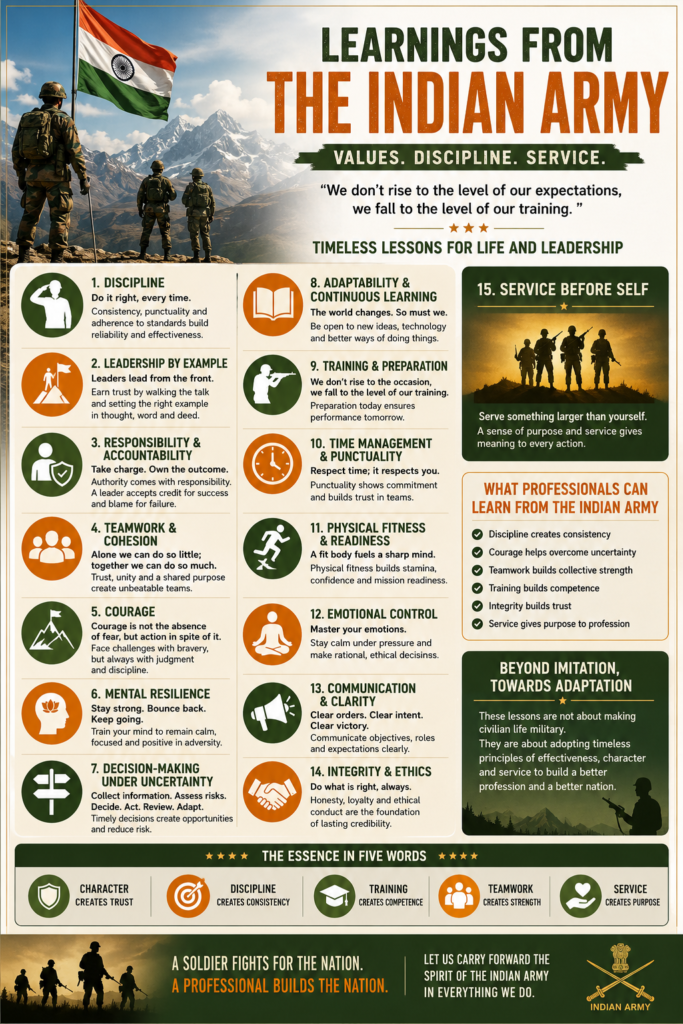
1. Introduction
The Indian Army is not merely a fighting organisation; it is also a complex institution built around leadership, training, discipline, cohesion, responsibility and service. Its personnel operate in environments ranging from deserts and high-altitude mountains to forests, border areas and humanitarian-disaster settings. Such environments require individuals to function effectively despite uncertainty, physical hardship, limited resources and significant responsibility.
The organisational lessons emerging from the Indian Army therefore extend beyond military operations. Leadership scholars have increasingly examined military organisations because they provide valuable settings for understanding decision-making under pressure, team cohesion, trust, leadership development and organisational resilience. Research on Indian military leadership has specifically explored how veterans understand leadership practices in preparing and leading soldiers in combat.
At the same time, the Indian military environment is evolving. Recent research highlights challenges associated with technological change, recruitment, retention, leadership development, organisational culture and changing workforce expectations. Thus, the lessons from the Indian Army should not be understood as static traditions. They represent an evolving combination of enduring values and adaptive organisational practices.
2. Discipline as a Foundation of Effectiveness
Perhaps the most visible lesson from military life is the importance of discipline. Discipline means much more than obedience to orders. At its highest level, it is the capacity to perform the required task correctly and consistently even when motivation is low, circumstances are uncomfortable or immediate supervision is absent.
For civilian professionals, discipline can be translated into punctuality, preparation, consistency, adherence to standards, responsible use of resources and completion of commitments. A disciplined professional does not depend entirely on mood or external pressure. Instead, behaviour is governed by clearly established standards.
The broader lesson is therefore:
Motivation may initiate performance, but discipline sustains performance.
This principle is particularly relevant in professional environments where long-term success depends on repetitive execution rather than occasional bursts of enthusiasm.
3. Leadership by Example
Military leadership places considerable emphasis on the credibility of the leader. A leader who demands standards from subordinates while failing to demonstrate those standards personally risks losing trust.
This principle has broad relevance to business, healthcare, academia and public administration. Leaders should demonstrate punctuality, ethical conduct, competence, accountability and resilience before expecting these qualities from their teams.
Contemporary military-leadership research reinforces the importance of trust, cohesion, psychological safety, coaching and mentoring in effective small-team leadership. A recent quasi-randomized study of Army squad-leader development found improvements in leadership knowledge, trust, cohesion, psychological safety, coaching and mentoring following structured leadership training.
Thus, effective leadership is not simply authority over others. It is the ability to create an environment in which others can perform effectively.
4. Responsibility and Accountability
The military teaches an unusually strong relationship between authority and responsibility. Individuals occupying leadership positions are expected to accept responsibility for decisions and for the performance of their teams.
This provides an important lesson for civilian organisations. Authority without accountability can produce organisational dysfunction. A manager who wants decision-making power must also accept responsibility for outcomes.
A mature professional therefore asks:
What was my responsibility?
rather than immediately asking:
Who is responsible for the failure?
This shift from blame to accountability can significantly improve organisational learning.
5. Teamwork and Collective Identity
Military effectiveness depends on coordinated collective action. Individual excellence is valuable, but isolated individual excellence cannot substitute for team cohesion.
The Indian Army’s regimental and unit traditions demonstrate the importance of belonging, mutual trust and collective identity. Research on the Indian Armed Forces identifies patriotism and unit loyalty as important motivational elements, while contemporary reforms continue to raise questions about how organisational cohesion can be preserved during structural change.
The civilian lesson is equally important. High-performing organisations require individuals who can subordinate personal ego to legitimate collective objectives.
A successful team therefore requires:
individual competence + mutual trust + shared purpose + coordinated action.
6. Courage and the Management of Fear
Courage is frequently misunderstood as the absence of fear. In reality, meaningful courage involves acting responsibly despite fear, uncertainty or discomfort.
The military environment provides an extreme illustration of this principle. For civilians, courage may involve accepting difficult responsibilities, speaking honestly, confronting unethical behaviour, admitting mistakes, taking calculated professional risks or continuing constructive action despite criticism.
Courage must nevertheless be combined with judgment. Recklessness is not courage. Military professionalism demonstrates that courage should operate within discipline, training, ethical boundaries and mission requirements.
7. Mental Resilience
Military personnel are trained to function under physical and psychological pressure. This provides an important lesson about resilience: resilience is not simply toughness; it is the ability to recover, adapt and continue functioning after adversity.
Research on military morale emphasises the importance of sustaining motivation and collective identity over time rather than merely generating temporary enthusiasm.
For civilians, resilience can be developed through preparation, realistic expectations, emotional regulation, physical fitness, supportive relationships, reflection and continuous skill development.
The objective should not be to become emotionally insensitive. Rather, it should be to become capable of maintaining sound judgment when emotions and circumstances become difficult.
8. Decision-Making Under Uncertainty
Military leaders frequently have to make decisions with incomplete information. This creates a powerful lesson for business and professional life.
Perfect information rarely exists. Effective decision-making therefore requires:
- collecting the best available information;
- identifying the mission or objective;
- evaluating risks;
- considering alternatives;
- making a timely decision;
- communicating it clearly;
- monitoring the consequences; and
- adapting when new information emerges.
This is particularly relevant to entrepreneurs and managers, because excessive hesitation can itself become a strategic risk.
9. Adaptability and Continuous Learning
A modern army cannot depend exclusively on historical methods. Changes in technology, warfare, geopolitics, cyber capabilities, information operations and organisational structures require continuous adaptation.
Recent research on the Indian Armed Forces describes a changing security environment and highlights the importance of technological transformation, leadership development and organisational adaptation.
The lesson for professionals is straightforward: past success does not guarantee future relevance.
Professionals should therefore continually update their knowledge, learn new technologies, study emerging trends and remain open to revising established methods.
10. Training and Preparation
One of the strongest military lessons is that performance during a crisis depends heavily upon preparation before the crisis.
Training converts theoretical knowledge into practical capability. Repetition develops automaticity, while realistic exercises expose weaknesses before they become catastrophic.
Research into Army leadership development similarly demonstrates that structured training can improve leadership-related competencies, particularly trust-building, coaching, mentoring and team cohesion.
Civilian organisations can apply this principle through simulations, professional development, emergency planning, communication exercises, leadership programmes and continuous technical education.
Preparation reduces dependence on improvisation.
11. Time Management and Punctuality
Military culture places strong emphasis on time because operational effectiveness frequently depends upon coordination. One person’s delay can affect an entire team.
In civilian life, punctuality communicates reliability. Repeated lateness can damage trust even when technical competence is high.
The lesson is not that every activity must be rigidly scheduled. Rather, important commitments should be respected and time should be treated as a finite organisational resource.
12. Physical Fitness and Operational Readiness
The relationship between physical fitness and professional performance is another important military lesson. Physical preparedness contributes to stamina, alertness and the ability to function under demanding circumstances.
For civilians, this does not mean adopting military-level physical conditioning. It means recognising that physical health, sleep, nutrition, exercise and recovery influence cognitive performance and professional effectiveness.
A useful concept is readiness: being prepared before circumstances demand performance.
13. Emotional Control
Leadership requires emotional regulation. Decisions made impulsively during anger, fear or frustration can have consequences for entire teams.
Military environments reinforce the importance of maintaining composure under pressure. For civilian leaders, emotional control means being able to listen before reacting, separate facts from emotions and communicate firmly without becoming abusive or destructive.
Emotional control should not be confused with emotional suppression. Effective leaders recognise emotions while preventing those emotions from unnecessarily controlling decisions.
14. Communication and Clarity
Military operations require clear communication because ambiguity can create serious consequences. Orders, responsibilities, objectives and reporting structures must be understood.
The civilian equivalent is equally important. A professional should communicate:
what needs to be done, why it matters, who is responsible, when it must be completed and what standard is expected.
Good communication also requires listening. Leadership is not simply issuing instructions; it involves understanding the people who must execute them.
15. Respect for Hierarchy Without Losing Initiative
Military organisations necessarily contain hierarchy because command relationships must remain clear. However, effective modern organisations increasingly recognise the importance of initiative at lower levels.
Recent research on the Indian Armed Forces highlights the importance of adaptive leadership and greater empowerment of subordinate leaders as warfare becomes more complex.
The broader lesson is that hierarchy and initiative are not necessarily opposites. A healthy organisation can maintain clear authority while encouraging responsible initiative within defined boundaries.
16. Integrity and Ethical Conduct
Military service is fundamentally associated with responsibility to the nation and the lawful chain of command. Integrity is therefore central to professional credibility.
For civilians, integrity means telling the truth, keeping commitments, avoiding conflicts of interest, accepting mistakes and refusing unethical shortcuts.
Professional success obtained through dishonesty is strategically fragile. Reputation, trust and institutional credibility are long-term assets.
17. Sacrifice and Service Orientation
The military provides one of the clearest institutional examples of service before self. Service personnel accept significant personal obligations in pursuit of a larger mission.
The civilian translation should not be understood as unlimited self-sacrifice. Rather, it means developing a sense of purpose beyond personal convenience.
Doctors serve patients. Teachers serve students. Scientists serve knowledge and society. Public servants serve citizens. Entrepreneurs create value through products and services.
The central principle is:
A meaningful profession connects personal competence with a purpose larger than personal gain.
18. Leadership in Extreme Situations
Military leadership provides a particularly useful environment for studying leadership under extreme conditions. Research examining leaders operating in life-threatening circumstances found that sense-making, communication and training become particularly important when leaders must function under intense uncertainty.
This has implications for civilian crisis leadership. During organisational crises, employees look to leaders not merely for instructions but for interpretation: What is happening? What matters most? What should we do next?
Therefore, crisis leadership requires both decision-making and meaning-making.
19. Motivation and Morale
Military effectiveness depends heavily on morale. Research concerning motivation within the Indian Armed Forces has identified both intrinsic and extrinsic motivational factors among personnel and cadets.
This provides an important lesson for managers. Money alone does not create sustainable commitment. Employees also value recognition, belonging, competence, meaningful work, autonomy, development opportunities and respect.
A strong organisation therefore manages both:
extrinsic motivation — salary, rewards and career progression;
and
intrinsic motivation — purpose, mastery, belonging, pride and contribution.
20. Mentoring and Development of Subordinates
Military organisations traditionally rely heavily on experienced personnel developing junior members. This principle is highly transferable to civilian institutions.
A leader’s legacy should not be measured only by personal achievements but also by the number of capable people developed under that leader.
Mentoring can transfer technical knowledge, organisational culture, judgment and professional ethics. Contemporary Army leadership research likewise identifies coaching and mentoring as important leadership-development outcomes.
21. Institutional Loyalty and National Integration
The Indian Army provides an important example of an institution operating across India’s extraordinary linguistic, regional and cultural diversity. Its organisational identity can create a common professional purpose among individuals from different backgrounds.
This has broader implications for Indian organisations. Institutional identity can provide a framework through which diversity becomes a source of strength rather than fragmentation.
Research on India’s civil-military relationship has also examined how institutional arrangements and organisational practices have contributed to keeping the military subordinate to democratic political authority.
This demonstrates another important lesson: professional strength must coexist with constitutional responsibility.
22. What Professionals Can Learn from the Indian Army
The major lessons can be synthesised into a professional framework:
| Military-derived principle | Civilian application |
|---|---|
| Discipline | Consistent execution |
| Leadership by example | Model desired behaviour |
| Courage | Responsible action despite uncertainty |
| Teamwork | Collaborative performance |
| Accountability | Ownership of outcomes |
| Training | Continuous professional development |
| Readiness | Preparation before crisis |
| Adaptability | Continuous innovation |
| Integrity | Ethical decision-making |
| Communication | Clear objectives and expectations |
| Resilience | Recovery from setbacks |
| Service | Purpose beyond personal gain |
| Mentoring | Developing future leaders |
| Cohesion | Building trust and belonging |
| Initiative | Empowering responsible decision-making |
23. Limitations of Applying Military Lessons to Civilian Life
Military organisations should not be copied mechanically into civilian institutions. The military operates under distinctive legal, operational and ethical circumstances. Civilian organisations generally require greater flexibility, participation, experimentation and individual autonomy.
Consequently, the objective should not be to make civilian life militaristic. Instead, useful principles should be adapted intelligently.
For example, discipline should not become authoritarianism; hierarchy should not become suppression of dissent; loyalty should not become unquestioning obedience; courage should not become recklessness; and resilience should not mean ignoring legitimate psychological or physical needs.
The most productive approach is therefore selective adaptation rather than direct imitation.
24. The Future of Indian Army-Inspired Leadership
The future military environment is increasingly technological, interconnected and multidimensional. Research on the Indian Armed Forces indicates that leadership development, human-resource management and organisational culture must evolve alongside technological and strategic transformation.
Future leadership is therefore likely to require the integration of traditional military virtues—discipline, courage, loyalty and responsibility—with modern competencies such as data literacy, technological understanding, strategic thinking, psychological awareness, collaborative leadership and adaptability.
This combination can be described as values-based adaptive leadership.
The strongest future leader will not simply be the most authoritative individual. Rather, it will be the person capable of maintaining ethical standards and organisational cohesion while adapting intelligently to changing circumstances.
25. Conclusion
The Indian Army offers a rich institutional case study in disciplined performance, leadership, teamwork, resilience, preparation, courage, accountability and service. Its most important lesson is that excellence is rarely produced by individual talent alone. It emerges when competence is combined with discipline, character, teamwork and a clearly understood mission.
For civilian professionals, the deepest lesson is therefore not to imitate military life but to internalise its transferable principles. A disciplined person becomes more reliable; a courageous person becomes more capable of confronting uncertainty; a responsible leader develops stronger teams; continuous training creates adaptability; integrity creates trust; and service orientation gives professional activity a broader purpose.
The contemporary Indian military itself is evolving, and recent research indicates that traditional values must increasingly be combined with evidence-based leadership development, technological competence, human-resource innovation and adaptive organisational culture.
Ultimately, the most enduring learning from the Indian Army can be expressed through five interconnected principles:
Character creates trust.
Discipline creates consistency.
Training creates competence.
Teamwork creates collective strength.
Service creates purpose.
These principles are relevant not only to soldiers and officers but also to entrepreneurs, scientists, doctors, administrators, teachers, managers and citizens seeking to build effective and responsible lives.
References
- Thite, M., De, S., & Shah, S. (2025). Human resource challenges in Indian Armed Forces: View from the top. IIMB Management Review, 38(1), 100636.
- Fisher, K., & Chhina, H. (2016). Indian military leadership: An exploratory study. ResearchGate.
- Gutierrez, I. A., Smith, C. D., Adrian, A. L., & Allard, Y. S. (2025/2026). Developing Effective Small Team Army Leaders: A Quasi-Randomized Controlled Trial of the Squad Leader Development Course. Armed Forces & Society, 52(3), 935–959.
- Dixon, D. P., Weeks, M., Boland, R., & Perelli, S. (2017). Making Sense When It Matters Most: An Exploratory Study of Leadership In Extremis. Journal of Leadership & Organizational Studies, 24(3).
- Wilkinson, S. I. (2015). Army and Nation: The Military and Indian Democracy since Independence. Harvard University Press.
- Balu, L. (2018). Factors Affecting Work Motivation of Permanent Commissioned Officers in the Indian Army.
- An Exploratory Study of Motivation Within Working Environment of Armed Forces. AIMT Journal of Management, 7(2), 2018.
- Reflections on Sustaining Morale and Combat Motivation in Soldiers. Defence Institute of Psychological Research-related research publication, 2021.
- Best HR Practices in the Corporate Sector and the Indian Armed Forces: A Comparative Study. International Journal of Humanities, Education, Psychology and Social Sciences, 2016.