

By Devanssh Mehta
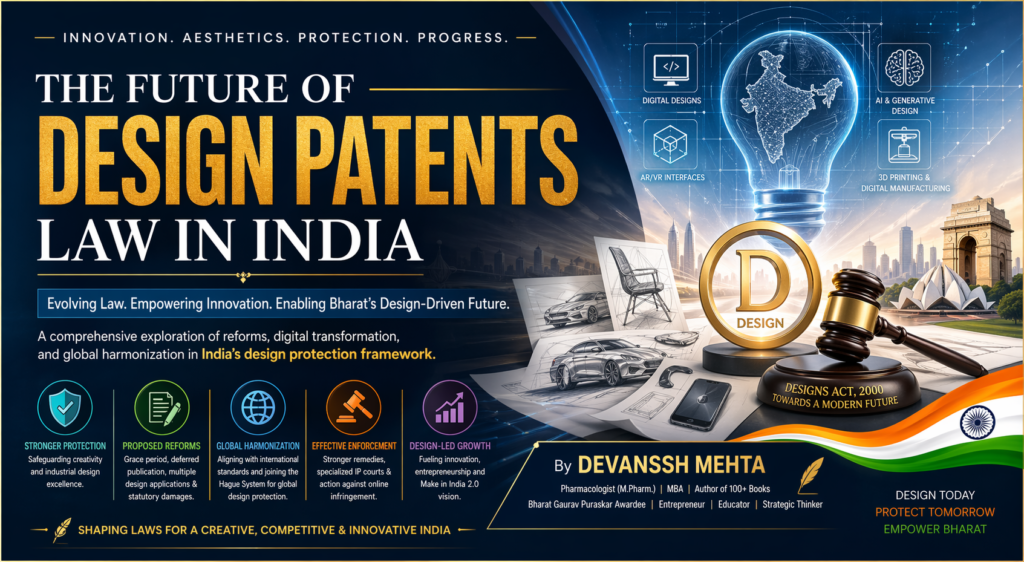
1. Introduction: The Strategic Importance of Design Protection
In the contemporary global economy, intellectual property has emerged as one of the most decisive determinants of industrial competitiveness. While patents traditionally protect technological inventions and trademarks safeguard brand identity, industrial design protection occupies a unique and strategic position at the intersection of technology, aesthetics, and consumer psychology. The visual appearance of products—from smartphones and automobiles to medical devices and digital interfaces—often determines consumer preference and commercial success.
India, aspiring to emerge as a global manufacturing and innovation hub under initiatives such as “Make in India”, “Digital India”, and “Startup India,” must continuously modernize its intellectual property regime to support industrial creativity and technological design innovation. Design law in India is primarily governed by the Designs Act, 2000, which replaced the colonial-era Patent and Designs Act, 1911 and aligned the country with the obligations of the TRIPS Agreement under the World Trade Organization.
However, the global design ecosystem has undergone profound transformations since the enactment of the Designs Act, 2000. The rise of digital interfaces, virtual environments, artificial intelligence–generated designs, immersive technologies, and digital manufacturing has fundamentally altered the nature of design itself.
Consequently, India stands at a critical juncture where its design protection framework must evolve to accommodate the realities of the digital economy while simultaneously promoting innovation, entrepreneurship, and global competitiveness.
The future of design patent law in India will likely be shaped by five major forces:
- Digital and virtual design protection
- Global harmonization with international design systems
- Procedural modernization and ease of registration
- Strengthening enforcement and remedies
- Integration of design rights within the broader innovation ecosystem
This article explores these dimensions in depth and evaluates how Indian design law is likely to evolve over the coming decades.
2. Conceptual Foundations of Industrial Design Protection
Industrial design law protects the visual appearance of products rather than their functional aspects. A design typically includes the shape, configuration, pattern, ornamentation, or composition of lines or colours applied to an article that appeals to the eye.
The fundamental rationale behind design protection lies in three principles:
2.1 Encouragement of Creativity
Design law rewards designers for their creative efforts by granting exclusive rights to exploit the visual aspects of their products.
2.2 Prevention of Unfair Competition
Design protection prevents competitors from copying distinctive product appearances and thereby protects market differentiation.
2.3 Economic Development
Industrial design contributes significantly to product value, consumer trust, and brand recognition.
In sectors such as:
- consumer electronics
- automobiles
- fashion and textiles
- packaging
- medical devices
design innovation often determines market leadership.
For India, design law holds particular significance because the country’s manufacturing sector increasingly depends on design-led differentiation rather than cost advantage alone.
3. Evolution of Design Law in India
The trajectory of Indian design law reflects the evolution of industrial policy and global trade norms.
3.1 Colonial Origins
The earliest design protection framework in India was embedded in the Patent and Designs Act, 1911, which largely mirrored British intellectual property legislation.
This framework primarily served colonial industrial interests and offered limited protection to domestic designers.
3.2 The Designs Act, 2000
India modernized its design law through the Designs Act, 2000, which sought to:
- comply with the TRIPS Agreement
- streamline design registration
- enhance legal clarity
- encourage industrial innovation
The Act protects new or original designs applied to articles by industrial processes, provided the design is visually appealing and not purely functional.
The duration of protection is:
- 10 years initially
- extendable by 5 additional years
Thus, design protection in India lasts up to 15 years.
3.3 Administrative Framework
Design registrations in India are administered by the Controller General of Patents, Designs and Trade Marks (CGPDTM) under the Ministry of Commerce and Industry.
Despite improvements in recent years, several structural challenges remain, including:
- procedural delays
- limited awareness among SMEs
- weak enforcement mechanisms
- ambiguity regarding digital designs
These limitations have prompted policymakers to reconsider the design protection framework.
4. Emerging Challenges in the Modern Design Landscape
The global transformation of design practices has exposed significant limitations in the existing Indian legal framework.
4.1 Digital Design Revolution
Modern products increasingly rely on screen-based design elements, including:
- graphical user interfaces (GUIs)
- icons
- animations
- virtual interfaces
- augmented reality environments
However, the current Designs Act primarily focuses on physical articles, creating uncertainty about the protection of purely digital designs.
This gap has become particularly significant in industries such as:
- software
- gaming
- mobile applications
- digital healthcare devices
- smart appliances
4.2 Artificial Intelligence and Generative Design
Artificial intelligence is now capable of generating complex product designs autonomously.
AI-based generative design tools are used in:
- automotive engineering
- aerospace components
- industrial manufacturing
- medical device design
This raises important legal questions:
- Who owns AI-generated designs?
- Can a machine-generated design qualify as “original”?
- Should AI be recognized as a designer?
Indian design law currently lacks clear answers to these questions.
4.3 Rapid Prototyping and 3D Printing
Technologies such as 3D printing and digital fabrication enable rapid reproduction of product designs.
This creates new challenges in:
- detecting design infringement
- controlling counterfeit production
- enforcing design rights internationally
Traditional enforcement models may prove inadequate in such contexts.
5. Proposed Reforms in the Indian Design Protection Framework
Recognizing these challenges, the Government of India has initiated discussions on reforming the Designs Act.
In 2026, the Department for Promotion of Industry and Internal Trade (DPIIT) released a concept note proposing major amendments to the Designs Act, 2000 to modernize the design protection framework.
These reforms represent the most significant transformation in Indian design law since 2000.
5.1 Protection of Virtual Designs
One of the most important proposed reforms is the explicit recognition of virtual and digital designs.
The government proposes to expand the definitions of “design” and “article” to include:
- graphical user interfaces
- icons
- animations
- augmented reality interfaces
- virtual environments
This would allow digital designs to be protected even without a physical product embodiment.
Such reform would bring India closer to global design protection regimes in jurisdictions such as:
- European Union
- United States
- Japan
- South Korea
5.2 Introduction of a Grace Period
Currently, public disclosure of a design before filing may destroy novelty.
The proposed reform introduces a 12-month grace period, allowing designers to publicly disclose their designs before filing for registration without losing protection.
This change would particularly benefit:
- startups
- independent designers
- early-stage innovators
who often showcase products before seeking legal protection.
5.3 Deferred Publication
Another proposed reform allows applicants to defer publication of design applications for up to 30 months.
This enables designers to maintain secrecy during product development and marketing strategies.
5.4 Multiple Design Applications
The reforms propose allowing multiple designs to be filed within a single application.
This significantly reduces administrative costs and aligns Indian practice with international systems.
5.5 Statutory Damages
Design enforcement in India currently relies heavily on civil litigation.
The proposed reforms introduce statutory damages, which would strengthen enforcement mechanisms and deter infringement.
5.6 International Harmonization
India is also considering joining the Hague System for International Registration of Industrial Designs, which would allow designers to obtain protection in multiple countries through a single application.
This step would greatly benefit Indian exporters and global design businesses.
6. The Digital Future of Design Protection
The next generation of design law will increasingly focus on digital ecosystems rather than purely physical products.
6.1 GUI and Interface Design
In the digital age, the user interface often defines product identity.
For example:
- smartphone interfaces
- automobile dashboard displays
- medical device control panels
- smart home device interfaces
Recognizing these as protectable designs is crucial for innovation.
6.2 Virtual Reality and Metaverse Design
Future design law must address visual creations within:
- virtual reality
- augmented reality
- metaverse platforms
Such environments may contain purely digital products whose design requires legal protection.
6.3 Dynamic Designs
Traditional design law protects static visual features.
However, digital products increasingly rely on dynamic design elements, such as animation and motion effects.
Modern legal frameworks must accommodate such dynamic aesthetics.
7. Strengthening Enforcement and Judicial Interpretation
Design law reform must also address enforcement challenges.
7.1 Faster Dispute Resolution
India must develop specialized intellectual property courts capable of handling design disputes efficiently.
7.2 Border Enforcement
Counterfeit products often replicate product design.
Stronger coordination between:
- customs authorities
- intellectual property offices
- industry stakeholders
is necessary to prevent design piracy.
7.3 Online Marketplaces and Design Infringement
E-commerce platforms frequently host products that imitate protected designs.
Future legal frameworks must impose greater liability on digital marketplaces for design infringement.
8. Design Law and India’s Innovation Economy
Industrial design protection has profound implications for economic development.
India’s transition toward design-driven manufacturing will require stronger legal frameworks.
Key sectors include:
- electronics manufacturing
- medical devices
- automobiles
- consumer goods
- defense equipment
Design innovation will become a strategic competitive advantage.
9. Design Law and Start-up Ecosystems
Startups increasingly rely on design as a key differentiator.
Examples include:
- wearable technology companies
- consumer electronics startups
- digital product companies
Accessible design protection will empower such innovators to compete globally.
10. Comparative Perspectives: Global Design Law Trends
India’s future design law reforms must be understood in the context of global developments.
European Union
The EU has one of the most advanced design protection systems, including:
- Community Design Rights
- Unregistered design protection
United States
The US protects designs through design patents, which provide strong enforcement mechanisms.
Japan and South Korea
These countries have expanded design protection to include graphical user interfaces and digital designs.
India’s reforms aim to align its framework with such international standards.
11. Policy Implications for India
The modernization of design law must be accompanied by broader policy initiatives:
1. Design Education
India must strengthen design education through institutions such as:
- National Institute of Design
- IIT design programs
2. Design Innovation Funding
Government incentives should encourage design-led product development.
3. Public Awareness
Many Indian SMEs remain unaware of design protection.
Awareness programs are essential.
12. Future Outlook: Design Law in India by 2040
Looking ahead, the Indian design protection system will likely evolve in the following ways:
- Recognition of digital and AI-generated designs
- Full integration with international design registration systems
- Stronger enforcement through specialized IP courts
- AI-assisted design examination by patent offices
- Integration with digital manufacturing ecosystems
Design protection will become a key pillar of India’s innovation economy.
13. Conclusion
The future of design patent law in India lies at the intersection of technological innovation, economic policy, and global intellectual property governance.
The proposed reforms to the Designs Act represent a significant step toward modernizing the country’s design protection regime. By recognizing digital designs, introducing procedural flexibility, and aligning with international standards, India is preparing its legal framework for the design-driven economy of the twenty-first century.
For a country aspiring to become a global manufacturing and innovation powerhouse, robust design protection is not merely a legal necessity—it is a strategic economic imperative.
If implemented effectively, the evolution of design law in India will empower designers, stimulate creativity, strengthen industrial competitiveness, and position the country as a global leader in design innovation.