

Strategic Industry Analysis
Introduction: Bollywood at a Strategic Crossroads
The Hindi film industry—popularly known as Bollywood—has historically been one of the most influential cultural industries in the world. Producing hundreds of films annually and shaping the imagination of millions across India, South Asia, the Middle East, Africa, and the diaspora, Bollywood has long functioned not merely as an entertainment industry but as a cultural institution and economic ecosystem.
In the early decades of the twenty-first century, however, the Bollywood industry entered a phase of structural transformation. Digital platforms, global competition, changing audience preferences, technological disruptions, and new distribution models have fundamentally altered the cinematic landscape.
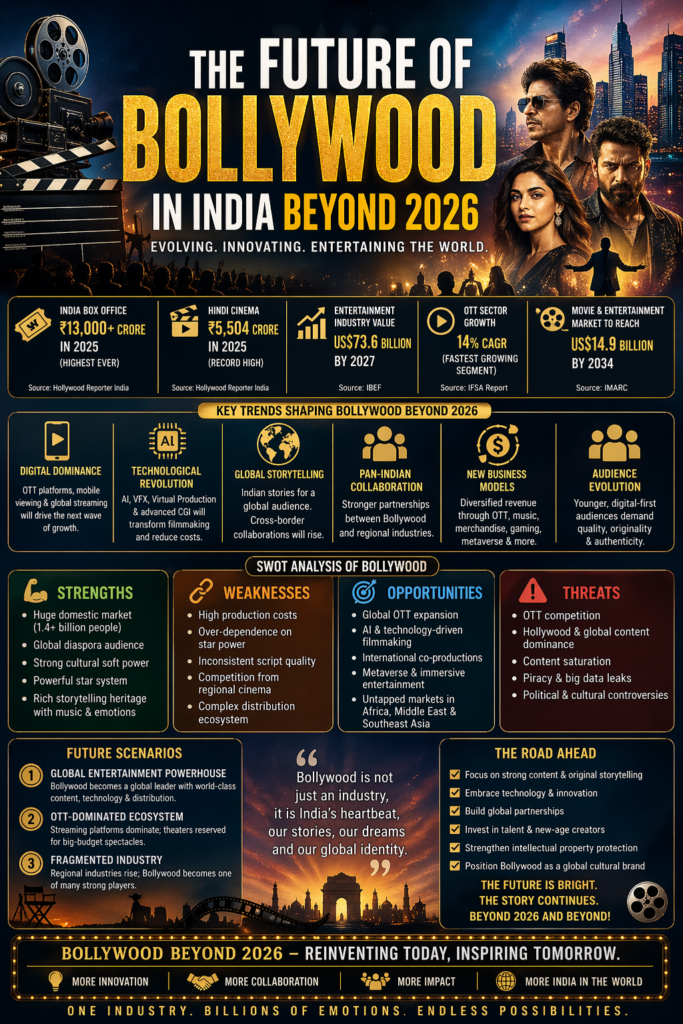
Recent data shows that India’s overall box office crossed ₹13,000 crore in 2025, with Hindi cinema contributing around ₹5,504 crore, the highest annual gross in its history. (The Hollywood Reporter India)
At the same time, the broader media and entertainment industry in India is projected to grow rapidly, reaching nearly US$73.6 billion by 2027 and continuing strong growth thereafter. (India Brand Equity Foundation)
These developments suggest that Bollywood is not declining—it is evolving.
Beyond 2026, Bollywood will operate in an environment shaped by five powerful forces:
- Digital streaming and OTT platforms
- Globalization of storytelling
- Technological innovation (AI, VFX, virtual production)
- Rise of regional cinema competition
- Changing audience psychology
This article presents a comprehensive strategic analysis of Bollywood’s future beyond 2026, including its economic trajectory, technological evolution, industry restructuring, and SWOT analysis.
1. Historical Evolution of Bollywood
1.1 The Golden Era (1950–1970)
Bollywood’s golden age was characterized by legendary filmmakers such as:
- Guru Dutt
- Raj Kapoor
- Mehboob Khan
- Bimal Roy
Films from this era were deeply influenced by:
- Post-independence nationalism
- Socialist ideals
- Cultural identity formation
Cinema functioned as a mirror of Indian society.
1.2 The Mass Cinema Era (1970–1990)
The emergence of Amitabh Bachchan’s “Angry Young Man” persona reflected rising social frustrations.
Themes included:
- Corruption
- Poverty
- Revenge narratives
- Working-class heroism
Bollywood became India’s dominant mass entertainment medium.
1.3 Liberalization and Globalization (1990–2010)
India’s economic liberalization transformed Bollywood.
Key changes included:
- Corporate financing of films
- Rise of multiplex culture
- Overseas diaspora markets
Movies like Dilwale Dulhania Le Jayenge and Lagaan symbolized Bollywood’s global appeal.
1.4 Digital Disruption (2010–2025)
The arrival of streaming platforms dramatically changed the industry.
Major OTT players include:
- Netflix
- Amazon Prime Video
- Disney+ Hotstar
- JioCinema
Streaming content consumption exploded due to India’s mobile-first internet ecosystem, with over 82% of OTT viewing occurring on mobile devices. (pioneeronline.com)
The result was a shift toward content-driven storytelling.
2. Current State of Bollywood (2025–2026)
The Bollywood ecosystem currently consists of five major segments:
- Theatrical releases
- OTT streaming
- Music rights
- Satellite television
- Brand integrations and advertising
Box Office Revival
Blockbusters such as Dhurandhar 2 demonstrated Bollywood’s continuing commercial power, crossing ₹1000 crore domestically. (The Times of India)
Multiplex chains also reported rising profits due to strong film lineups and increased audience footfall. (Reuters)
However, industry experts warn that structural challenges remain, including rising production costs and audience fragmentation. (The Economic Times)
3. Economic Outlook of Bollywood Beyond 2026
3.1 Industry Growth
The Indian movie and entertainment market is projected to grow from $6.3 billion in 2025 to nearly $14.9 billion by 2034, with an annual growth rate of around 9.7%. (IMARC Group)
This expansion will be driven by:
- OTT distribution
- International markets
- Advertising revenue
- Digital rights sales
3.2 Hybrid Distribution Model
Industry experts predict that Bollywood will adopt a hybrid theatrical-digital model.
- Big-budget films → theatrical release first
- Mid-budget films → simultaneous OTT releases
- Small films → OTT-first strategy
This model allows producers to maximize revenue streams.
3.3 Globalization of Indian Cinema
Bollywood is increasingly targeting global markets such as:
- Middle East
- United States
- Europe
- Southeast Asia
- Africa
Streaming platforms allow Bollywood content to reach global audiences instantly.
4. Technological Transformation of Bollywood
4.1 Artificial Intelligence in Filmmaking
AI will revolutionize filmmaking in areas such as:
- Script development
- Visual effects
- Editing
- Marketing analytics
AI-generated simulations may also reduce production costs.
4.2 Virtual Production
Virtual production technologies used in Hollywood—like LED volume stages—will increasingly be adopted by Bollywood.
Benefits include:
- Faster production cycles
- Lower costs
- Enhanced visual realism
4.3 Advanced VFX and CGI
India is becoming a global hub for VFX outsourcing.
Future Bollywood films will feature:
- Large-scale digital worlds
- High-end animation
- Sci-fi storytelling
5. Cultural Transformation of Bollywood Storytelling
5.1 Rise of Realistic Narratives
Audience preferences are shifting toward:
- Social dramas
- Biographical films
- Crime thrillers
- Political narratives
5.2 Female-Centric Cinema
Women-led narratives are growing rapidly.
Examples include films exploring:
- Gender justice
- Professional women
- Social reform movements
5.3 Pan-Indian Cinema
Bollywood is increasingly collaborating with regional industries.
The concept of pan-Indian films is replacing language-based cinema divisions.
6. Impact of OTT Platforms on Bollywood
OTT platforms are the most disruptive force in the industry.
The OTT sector is projected to grow at around 14% annually, becoming the fastest-growing segment of Indian media. (IFSA Network)
Benefits of OTT
- Global reach
- Creative freedom
- Niche storytelling
- Data-driven content creation
Challenges
- Fragmented audiences
- Decline in theatrical footfalls
- Increased competition
7. Competition from Regional Cinema
Regional film industries have grown significantly:
- Telugu cinema
- Tamil cinema
- Malayalam cinema
- Kannada cinema
Their storytelling innovation has challenged Bollywood’s dominance.
However, Hindi cinema still maintains the largest share of the Indian box office at about 41%. (The Hollywood Reporter India)
8. Changing Audience Psychology
Indian audiences are now:
- More digitally connected
- More critical of content quality
- More open to global cinema
This means Bollywood must compete with:
- Hollywood films
- Korean dramas
- Japanese anime
- International streaming content
9. Emerging Business Models
Bollywood’s future will include diversified revenue streams.
Key revenue sources
- OTT licensing
- Digital music rights
- International theatrical releases
- Merchandise and branding
- Gaming and metaverse integrations
10. SWOT Analysis of Bollywood Beyond 2026
Strengths
1. Massive Domestic Market
India has over 1.4 billion people, representing a huge audience base.
2. Global Diaspora Audience
Indian diaspora communities across the world consume Bollywood content.
3. Cultural Soft Power
Bollywood acts as a global cultural ambassador of India.
4. Strong Star System
Actors continue to attract massive fan followings.
5. Diverse Storytelling Traditions
Bollywood integrates music, drama, romance, and action.
Weaknesses
1. High Production Costs
Large budgets increase financial risk.
2. Dependence on Star Power
Many films rely excessively on celebrity actors.
3. Script Quality Issues
Poor storytelling has led to box office failures.
4. Competition from Regional Films
South Indian cinema often produces more innovative content.
5. Fragmented Distribution Ecosystem
Balancing theatrical and OTT strategies remains challenging.
Opportunities
1. Global Streaming Platforms
Digital platforms enable worldwide distribution.
2. AI-Driven Film Production
Technology can significantly reduce costs.
3. International Co-Productions
Collaborations with Hollywood and European studios.
4. Metaverse and Immersive Entertainment
Future cinema experiences may include virtual worlds.
5. Regional Content Integration
Bollywood can collaborate with regional industries.
Threats
1. OTT Competition
Streaming platforms are altering audience habits.
2. Rising Hollywood Influence
Global films compete directly with Bollywood releases.
3. Content Saturation
Too many films dilute audience attention.
4. Piracy
Digital piracy remains a major financial threat.
5. Cultural Backlash
Political controversies sometimes affect film releases.
11. Strategic Future Scenarios for Bollywood
Scenario 1: Global Entertainment Powerhouse
Bollywood becomes a global film industry comparable to Hollywood.
Drivers:
- High-quality storytelling
- Technological innovation
- Global distribution
Scenario 2: OTT-Dominated Ecosystem
Streaming platforms dominate the industry.
Theatrical releases become limited to big-budget spectacles.
Scenario 3: Fragmented Industry
Regional industries dominate the Indian market.
Bollywood becomes just one component of a broader ecosystem.
12. Policy and Government Support
Government initiatives supporting cinema include:
- Film production incentives
- International film festivals
- Tax benefits for studios
These policies will shape Bollywood’s future.
13. Bollywood as India’s Cultural Diplomacy Tool
Bollywood serves as soft power diplomacy.
Through cinema, India exports:
- Culture
- Music
- Fashion
- Language
Countries in Africa and the Middle East have historically embraced Bollywood films.
14. Future Trends Shaping Bollywood
Key trends beyond 2026
- AI-generated cinema
- Virtual reality storytelling
- Global streaming dominance
- Pan-Indian collaborations
- International film franchises
Conclusion: Bollywood Beyond 2026
The future of Bollywood will not be defined by decline but by reinvention.
The industry stands at the intersection of:
- Technology
- Culture
- Economics
- Global storytelling
While challenges exist—especially from OTT platforms and regional competition—the opportunities are far greater.
If Bollywood successfully embraces:
- Innovation
- Global storytelling
- Technological transformation
- Creative excellence
it will emerge as one of the world’s most influential entertainment industries.
The coming decades may witness Bollywood evolving from a national film industry into a global cultural powerhouse, shaping narratives not only about India but about humanity itself.