

Author: Devanssh Mehta
Abstract
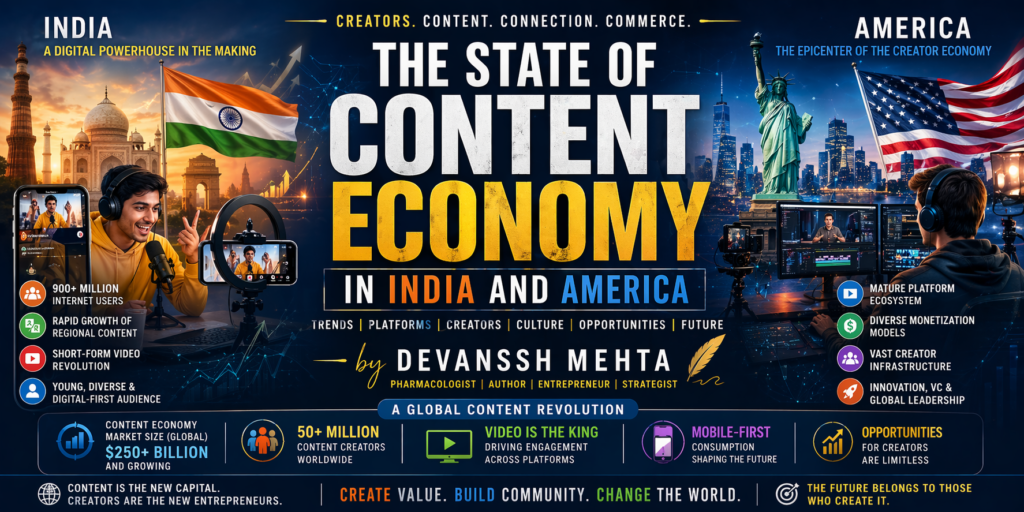
The global economy is undergoing a profound transformation driven by the rapid expansion of digital technologies and the proliferation of online platforms. Within this evolving digital landscape, the content economy has emerged as one of the most influential drivers of cultural production, economic value creation, and digital entrepreneurship. The content economy refers to the ecosystem in which creators, platforms, brands, and audiences interact to produce, distribute, and monetize digital content across a wide range of mediums including video, audio, text, and immersive experiences.
India and the United States represent two of the most significant and dynamic hubs of the modern content economy. While the United States pioneered the creator economy through platforms such as YouTube, Netflix, and social media networks, India has experienced explosive growth due to widespread smartphone adoption, affordable internet access, and the emergence of regional-language digital ecosystems. Together, these two nations illustrate distinct but interconnected models of digital content development.
This article presents a comprehensive analysis of the state of the content economy in India and America. It examines technological drivers, monetization models, platform ecosystems, regulatory frameworks, cultural dynamics, and the emerging role of artificial intelligence in shaping the future of content production and consumption.
The study argues that the content economy is evolving from a fragmented digital marketplace into a sophisticated global industry characterized by data-driven personalization, platform dominance, creator empowerment, and new forms of digital entrepreneurship. The future of the content economy will depend on the ability of creators, companies, and policymakers to balance innovation, sustainability, and ethical responsibility in the digital era.
1. Introduction
The twenty-first century has witnessed the rise of a new economic paradigm centered on the creation, distribution, and consumption of digital content. Unlike traditional media industries that relied on centralized production and broadcast distribution models, the contemporary content economy is characterized by decentralized creativity, digital platforms, and direct audience engagement.
Digital content now influences almost every dimension of modern life, including entertainment, education, politics, commerce, and social communication. Video streaming services, podcasts, blogs, online courses, social media platforms, and gaming ecosystems have collectively transformed the global information landscape.
The emergence of the creator economy—a subset of the content economy—has empowered millions of individuals to monetize their creativity, expertise, and personal narratives through digital platforms. Content creators today function as entrepreneurs, educators, entertainers, and influencers who shape public discourse and cultural trends.
The United States remains the global epicenter of the digital content economy, hosting many of the world’s largest technology companies and content platforms. Silicon Valley has played a pivotal role in developing the infrastructure that enables digital content creation and distribution.
India, on the other hand, has emerged as one of the fastest-growing content markets in the world. The convergence of digital infrastructure development, a young population, and increasing internet penetration has created an environment conducive to rapid expansion of digital content industries.
Together, these two nations provide valuable insights into the evolving dynamics of the global content economy.
2. Historical Evolution of the Content Economy
2.1 Traditional Media Economy
Before the digital revolution, content production was largely controlled by centralized institutions such as television networks, film studios, publishing houses, and news organizations. These institutions functioned as gatekeepers, determining which content reached audiences.
The traditional media economy was characterized by:
- High production costs
- Limited distribution channels
- Editorial control by large institutions
- Passive audience participation
While this system produced influential cultural products, it restricted creative participation to a relatively small group of professionals.
2.2 Emergence of the Digital Content Economy
The advent of the internet fundamentally disrupted traditional media structures. Digital technologies enabled individuals to publish content online without the need for institutional backing.
The rise of digital platforms such as:
- blogging websites
- video-sharing platforms
- social media networks
- podcast hosting services
democratized content production and distribution.
Individuals with minimal resources could now reach global audiences, giving rise to the modern creator economy.
3. The Content Economy in the United States
3.1 Platform Dominance
The United States hosts many of the world’s largest digital platforms, including major video-sharing networks, streaming services, and social media companies. These platforms serve as the backbone of the modern content economy.
American technology companies have built sophisticated ecosystems that support content creation, distribution, and monetization. These ecosystems include advertising networks, recommendation algorithms, analytics tools, and creator partnership programs.
The platform-centric model has enabled millions of creators to build sustainable digital careers.
3.2 Creator Economy Expansion
The creator economy in the United States has evolved into a multi-billion-dollar industry. Millions of creators generate income through advertising revenue, brand partnerships, subscriptions, merchandise sales, and digital products.
Creators in the United States operate across diverse sectors including:
- entertainment
- education
- finance
- health and wellness
- technology
Many creators have successfully transformed their digital presence into entrepreneurial ventures.
3.3 Venture Capital and Creator Infrastructure
One of the defining characteristics of the American content economy is the availability of venture capital funding for creator-focused startups.
Companies have emerged that provide infrastructure for creators, including:
- subscription platforms
- content management tools
- digital community platforms
- creator analytics systems
These services enable creators to scale their businesses beyond platform dependence.
4. The Content Economy in India
4.1 Rapid Digital Expansion
India has experienced one of the fastest digital transformations in the world. The introduction of affordable mobile data and inexpensive smartphones has brought hundreds of millions of new users online.
This digital expansion has dramatically increased demand for localized digital content.
India now hosts one of the largest online populations globally, creating immense opportunities for content creators.
4.2 Regional Language Content Revolution
One of the most distinctive features of the Indian content economy is the prominence of regional language content.
Unlike the English-dominated digital ecosystem of earlier years, today’s Indian internet users increasingly consume content in languages such as:
- Hindi
- Tamil
- Telugu
- Bengali
- Marathi
This linguistic diversity has created opportunities for creators to reach audiences previously underserved by mainstream media.
4.3 Short-Form Video Ecosystems
Short-form video platforms have become central to the Indian content economy.
These platforms enable creators to produce highly engaging content that can quickly reach millions of viewers. Short-form video content often focuses on entertainment, lifestyle, comedy, and educational themes.
The accessibility of these platforms has lowered barriers to entry for aspiring creators.
5. Comparative Analysis: India vs America
5.1 Market Maturity
The United States represents a mature digital content market with well-developed monetization systems and institutional support for creators.
India, in contrast, represents a rapidly expanding but still evolving ecosystem.
However, India’s growth rate suggests that it could become one of the largest content economies in the world.
5.2 Monetization Models
Creators in the United States benefit from diverse monetization mechanisms including:
- advertising revenue
- subscriptions
- paid memberships
- brand sponsorships
- digital product sales
Indian creators rely heavily on advertising and brand partnerships, although subscription-based models are gradually emerging.
5.3 Cultural Content Dynamics
American digital content often emphasizes global themes and entertainment-oriented storytelling.
Indian digital content frequently integrates cultural narratives, social commentary, and educational content reflecting the country’s diverse socio-cultural landscape.
6. Technology as the Engine of the Content Economy
6.1 Artificial Intelligence in Content Creation
Artificial intelligence is increasingly being used to assist in content creation, editing, and distribution.
AI-powered tools can generate text, images, videos, and music, significantly reducing production costs.
These technologies enable creators to scale content production while maintaining creative quality.
6.2 Algorithmic Distribution
Digital platforms rely on complex recommendation algorithms to distribute content to users.
These algorithms analyze user behavior to determine which content is most relevant to individual audiences.
Algorithmic distribution has dramatically increased the visibility of independent creators.
6.3 Data Analytics
Data analytics allows creators and platforms to understand audience preferences, optimize content strategies, and improve engagement.
Advanced analytics tools provide insights into viewer demographics, watch time, engagement patterns, and revenue performance.
7. Monetization Strategies in the Content Economy
The sustainability of the content economy depends on effective monetization mechanisms.
Common revenue models include:
Advertising Revenue
Platforms share advertising income with creators based on viewership metrics.
Brand Partnerships
Companies collaborate with creators to promote products and services.
Subscription Models
Creators offer exclusive content to paying subscribers.
Digital Products
Creators sell e-books, courses, and digital resources.
Merchandise
Branded merchandise provides additional income streams.
8. Social and Cultural Impact of the Content Economy
The rise of digital content creators has reshaped cultural production and social communication.
Content creators influence:
- consumer behavior
- political discourse
- cultural trends
- educational knowledge dissemination
In many cases, digital creators have become influential public figures with large and loyal audiences.
9. Challenges in the Content Economy
Despite its rapid growth, the content economy faces several significant challenges.
Platform Dependency
Creators often rely heavily on a single platform for income, making them vulnerable to algorithm changes.
Content Saturation
The enormous volume of digital content makes it difficult for creators to gain visibility.
Monetization Inequality
A small percentage of creators capture the majority of revenue.
Mental Health Concerns
The pressure to produce constant content can negatively affect creators’ mental well-being.
10. The Future of the Content Economy
The future of the content economy will likely involve several transformative developments.
AI-Assisted Creativity
Artificial intelligence will become an integral tool for creators.
Immersive Content
Virtual reality and augmented reality will enable immersive storytelling experiences.
Decentralized Content Platforms
Blockchain-based platforms may allow creators to maintain ownership of their content.
Global Creator Collaborations
Cross-border collaborations will expand the global reach of digital content.
11. Strategic Opportunities for India
India has the potential to become one of the largest content economies in the world.
Key opportunities include:
- development of regional content industries
- expansion of digital education platforms
- growth of creator-led entrepreneurship
- global distribution of Indian cultural narratives
India’s creative industries could become major contributors to the country’s digital economy.
12. Conclusion
The content economy represents one of the most significant transformations of the digital age. The convergence of technology, creativity, and entrepreneurship has created unprecedented opportunities for individuals and organizations to produce and distribute digital content.
The United States has established itself as the global leader in platform development and creator infrastructure, while India is emerging as one of the fastest-growing digital content markets.
The future of the content economy will depend on technological innovation, sustainable monetization models, and the ability of creators to build authentic relationships with audiences.
As digital technologies continue to evolve, the content economy will increasingly shape the cultural, economic, and intellectual landscape of the twenty-first century.
References
- Cunningham, S. & Craig, D. (2021). Creator culture: An introduction to global social media entertainment.
- Srnicek, N. (2017). Platform capitalism.
- Kaye, D. & Gray, J. (2021). The platform economy and digital labor.
- OECD (2023). Digital economy outlook.
- PwC (2024). Global entertainment and media outlook.
- Statista (2024). Global creator economy statistics.
- Deloitte (2023). Digital media trends survey.
- IBEF (2024). India digital economy report.
- World Economic Forum (2023). The future of digital platforms.
- McKinsey Global Institute (2024). The future of digital work.