
Ten Tips and Tricks for Effective Pharmaceutical Marketing
Introduction
The pharmaceutical industry operates in one of the most competitive and highly regulated business environments in the world. Unlike traditional consumer marketing, pharmaceutical marketing requires a careful balance between scientific evidence, ethical responsibility, regulatory compliance, and commercial objectives. Healthcare professionals, hospitals, pharmacies, and patients increasingly expect accurate, transparent, and value-driven information rather than aggressive promotional campaigns.
The rapid advancement of digital technologies, artificial intelligence, personalized medicine, and omnichannel communication has transformed the way pharmaceutical companies engage with healthcare stakeholders. Successful pharmaceutical marketers now need to combine scientific expertise with customer-centric strategies to build long-term trust and sustainable business growth.
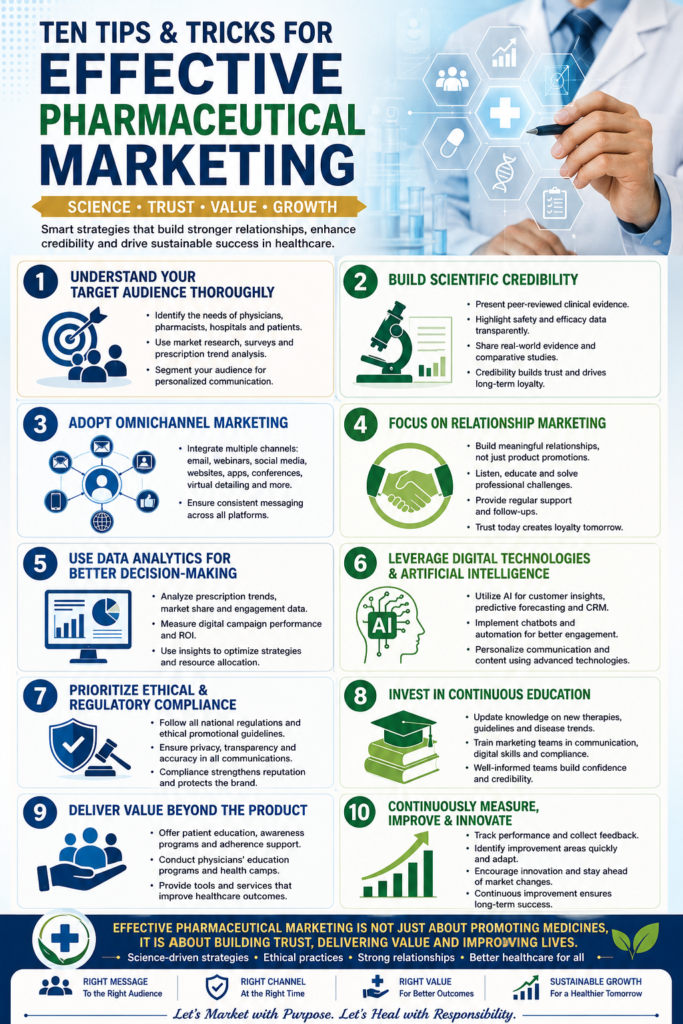
This article presents ten practical tips and proven strategies that can significantly improve the effectiveness of pharmaceutical marketing while maintaining ethical standards and enhancing brand credibility.
1. Understand Your Target Audience Thoroughly
Effective pharmaceutical marketing begins with understanding the needs, preferences, and expectations of the target audience. Different stakeholders require different communication strategies.
For example:
- Physicians seek strong clinical evidence and treatment outcomes.
- Pharmacists value product quality, availability, and affordability.
- Hospitals focus on cost-effectiveness and procurement efficiency.
- Patients prefer easy-to-understand health information and treatment benefits.
Conducting market research, physician surveys, prescription trend analysis, and customer segmentation allows marketers to create highly targeted campaigns that address specific needs rather than adopting a one-size-fits-all approach.
2. Build Scientific Credibility
Scientific credibility is the strongest marketing asset in the pharmaceutical industry. Healthcare professionals make prescribing decisions based primarily on evidence rather than promotional claims.
Pharmaceutical marketers should:
- Present peer-reviewed clinical evidence.
- Highlight safety and efficacy data.
- Use comparative clinical studies.
- Share real-world evidence whenever available.
- Provide transparent risk-benefit information.
Scientific accuracy builds trust, encourages long-term relationships, and strengthens brand reputation.
3. Adopt Omnichannel Marketing
Modern pharmaceutical marketing extends far beyond face-to-face medical representative visits.
A successful omnichannel strategy integrates:
- Email marketing
- Professional webinars
- Medical conferences
- Social media
- Mobile applications
- Company websites
- Virtual detailing
- Digital brochures
- Online continuing medical education (CME)
Consistent messaging across multiple channels increases engagement and improves brand recall while offering healthcare professionals greater flexibility in how they access information.
4. Focus on Relationship Marketing Instead of Product Selling
Healthcare professionals value meaningful professional relationships more than promotional activities.
Effective pharmaceutical marketers should:
- Listen actively to customer concerns.
- Provide educational support.
- Offer evidence-based solutions.
- Maintain regular communication.
- Respect physicians’ time.
- Deliver consistent after-sales support.
Long-term trust often generates higher prescription loyalty than short-term promotional campaigns.
5. Use Data Analytics for Better Decision-Making
Data-driven marketing enables pharmaceutical companies to identify opportunities and optimize promotional strategies.
Useful marketing metrics include:
- Prescription trends
- Customer engagement rates
- Market share
- Sales growth
- Geographic performance
- Digital campaign effectiveness
- Physician segmentation
- Return on marketing investment (ROMI)
Advanced analytics help marketers allocate resources efficiently and continuously refine their campaigns.
6. Leverage Digital Technologies and Artificial Intelligence
Artificial intelligence is transforming pharmaceutical marketing by enabling personalized communication and predictive insights.
Applications include:
- Customer behavior analysis
- Predictive sales forecasting
- Automated customer support
- Personalized content recommendations
- Marketing automation
- AI-powered chatbots
- Digital customer relationship management (CRM)
Organizations that embrace digital innovation can improve operational efficiency while delivering more relevant experiences to healthcare professionals.
7. Prioritize Ethical and Regulatory Compliance
Compliance should never be viewed as an obstacle to marketing success. Instead, it is a foundation for sustainable growth.
Effective pharmaceutical marketing requires adherence to:
- National drug regulations
- Ethical promotional guidelines
- Advertising standards
- Patient privacy laws
- Medical claims regulations
- Pharmacovigilance requirements
Transparent communication minimizes legal risks while strengthening professional credibility.
8. Invest in Continuous Education
Healthcare evolves rapidly, making continuous learning essential for pharmaceutical marketers.
Regular training should include:
- New therapeutic developments
- Clinical guidelines
- Disease epidemiology
- Competitor analysis
- Digital marketing skills
- Communication techniques
- Regulatory updates
- Artificial intelligence applications
Well-trained marketing professionals can confidently engage healthcare providers with scientifically accurate and commercially relevant discussions.
9. Deliver Value Beyond the Product
Successful pharmaceutical companies increasingly differentiate themselves through value-added services rather than product features alone.
Examples include:
- Disease awareness campaigns
- Patient education materials
- Medication adherence programs
- Clinical updates
- Physician training workshops
- Health screening initiatives
- Digital health tools
- Educational webinars
Providing comprehensive healthcare solutions enhances customer satisfaction and strengthens brand loyalty.
10. Continuously Measure, Improve, and Innovate
Marketing excellence requires continuous evaluation rather than one-time planning.
Organizations should regularly assess:
- Campaign performance
- Customer satisfaction
- Prescription growth
- Market penetration
- Digital engagement
- Competitor activities
- Sales representative productivity
Collecting feedback from physicians, pharmacists, and healthcare institutions allows companies to identify improvement opportunities and adapt quickly to changing market conditions.
Continuous innovation ensures long-term competitiveness in the rapidly evolving pharmaceutical landscape.
Emerging Trends in Pharmaceutical Marketing
The future of pharmaceutical marketing will increasingly be influenced by technological innovation and personalized healthcare. Several trends are reshaping the industry, including artificial intelligence, machine learning, precision medicine, digital therapeutics, wearable health technologies, telemedicine integration, predictive analytics, and real-world evidence generation. Companies that successfully integrate these innovations into their marketing strategies will gain significant competitive advantages.
Furthermore, sustainability, patient-centric communication, transparency, and outcome-based healthcare models are expected to become central components of pharmaceutical brand positioning in the coming years.
Conclusion
Effective pharmaceutical marketing extends far beyond promoting medicines. It is a strategic process that combines scientific knowledge, ethical responsibility, customer understanding, digital innovation, and continuous improvement. Organizations that prioritize evidence-based communication, meaningful customer relationships, regulatory compliance, and technology-driven decision-making are better positioned to achieve sustainable growth in an increasingly competitive healthcare environment.
The ten tips discussed in this article provide a practical framework for pharmaceutical professionals, marketers, entrepreneurs, and healthcare organizations seeking to improve marketing effectiveness. By focusing on value creation rather than product promotion alone, pharmaceutical companies can build lasting trust with healthcare professionals and patients while contributing positively to improved healthcare outcomes.