

Latest Industry Trends in the Automobile Industry (2026)
Introduction
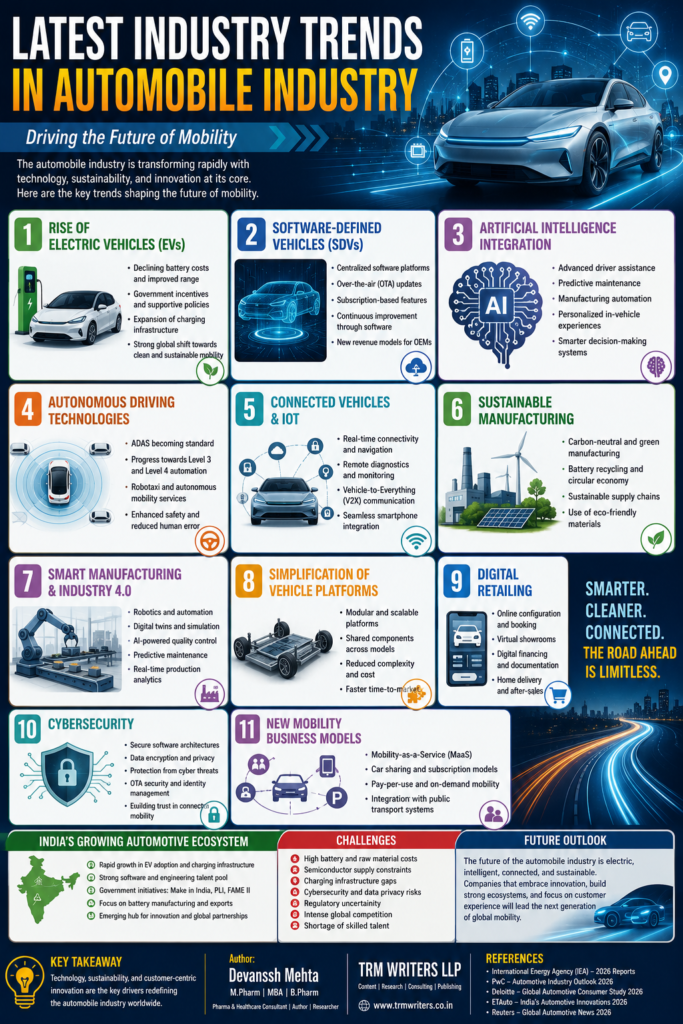
The global automobile industry is undergoing one of the most significant transformations in its history. Once driven primarily by mechanical engineering and manufacturing excellence, the industry is now being reshaped by software, artificial intelligence (AI), electrification, sustainability, connectivity, and digital business models. Modern vehicles are evolving into intelligent, connected, and software-driven mobility platforms rather than simply serving as means of transportation.
Governments across the world are introducing stricter emission regulations, while consumers increasingly demand safer, smarter, and environmentally friendly vehicles. Simultaneously, technological innovations and changing customer preferences are compelling manufacturers to redesign products, optimize supply chains, and invest heavily in research and development. These developments are redefining competition within the global automotive sector.
1. Rise of Electric Vehicles (EVs)
Electric vehicles remain one of the strongest growth drivers of the automotive industry. Continuous improvements in lithium-ion battery technology, declining battery costs, and expansion of charging infrastructure have accelerated EV adoption worldwide.
Manufacturers are investing billions of dollars in dedicated EV platforms while governments continue offering incentives and regulatory support to reduce carbon emissions. Alongside fully electric vehicles, hybrid vehicles continue to play an important transitional role in several markets where charging infrastructure is still developing. Industry analysts expect EV adoption to continue expanding over the coming decade as battery technology improves and ownership costs decline.
2. Software-Defined Vehicles (SDVs)
Perhaps the most revolutionary trend is the emergence of Software-Defined Vehicles (SDVs). Unlike conventional vehicles where hardware determined most functionality, SDVs rely on centralized software platforms that can continuously receive updates throughout their lifecycle.
Key characteristics include:
- Over-the-air (OTA) software updates
- Digital cockpit systems
- Subscription-based premium features
- Cloud connectivity
- AI-powered diagnostics
- Continuous performance improvements
This transformation allows manufacturers to improve vehicle functionality long after purchase, creating recurring revenue streams while enhancing customer experience. The International Energy Agency identifies SDVs as a defining technological shift in the automotive industry.
3. Artificial Intelligence Integration
Artificial intelligence has become deeply integrated across the automotive value chain.
Major AI applications include:
- Driver assistance systems
- Predictive maintenance
- Manufacturing automation
- Quality inspection
- Vehicle personalization
- Energy management
- Autonomous driving algorithms
- Customer service automation
AI is enabling vehicles to become smarter while simultaneously improving manufacturing productivity, reducing costs, and enhancing safety.
4. Autonomous Driving Technologies
Advanced Driver Assistance Systems (ADAS) continue to evolve toward higher levels of driving automation.
Modern vehicles increasingly include:
- Adaptive cruise control
- Lane keeping assistance
- Automated parking
- Emergency braking
- Traffic sign recognition
- Driver monitoring systems
Commercial robotaxi deployments are expanding in several global cities, particularly in China and the United States, although fully autonomous consumer vehicles remain under development. Automakers are accelerating partnerships with AI companies to advance Level 3 and Level 4 autonomous technologies.
5. Connected Vehicles and Internet of Things (IoT)
Connectivity has become a standard feature rather than a luxury.
Modern connected vehicles offer:
- Real-time navigation
- Remote diagnostics
- Vehicle tracking
- Smartphone integration
- Cloud-based infotainment
- Emergency assistance
- Predictive maintenance alerts
- Vehicle-to-cloud communication
Future developments are expected to include greater integration with smart cities, intelligent traffic systems, and Vehicle-to-Everything (V2X) communication.
6. Sustainable Manufacturing
Sustainability has become a strategic priority across the automotive industry.
Leading manufacturers are focusing on:
- Carbon-neutral manufacturing
- Renewable energy utilization
- Battery recycling
- Circular economy practices
- Sustainable supply chains
- Lightweight materials
- Reduced water consumption
- Green logistics
Environmental, Social, and Governance (ESG) performance increasingly influences investment decisions, regulatory compliance, and consumer purchasing behavior.
7. Smart Manufacturing and Industry 4.0
Digital manufacturing technologies are transforming automobile production facilities.
Key technologies include:
- Industrial robots
- Digital twins
- Predictive maintenance
- AI-powered quality control
- Collaborative robots (Cobots)
- Industrial Internet of Things (IIoT)
- Cloud manufacturing
- Real-time production analytics
These technologies improve production efficiency, reduce downtime, enhance quality, and lower operational costs.
8. Simplification of Vehicle Platforms
Automobile manufacturers are simplifying vehicle architectures to reduce costs and improve profitability.
Current strategies include:
- Modular vehicle platforms
- Shared components
- Reduced model complexity
- Common battery platforms
- Standardized electronics
This approach enables manufacturers to produce multiple vehicle models from common platforms while reducing development costs and improving manufacturing efficiency.
9. Digital Retailing
Automotive retail is becoming increasingly digital.
Consumers now expect:
- Online vehicle configuration
- Virtual showrooms
- Digital financing
- Home delivery
- Online servicing appointments
- AI-powered customer support
Manufacturers are adopting omnichannel sales models that integrate physical dealerships with digital customer experiences.
10. Cybersecurity
As vehicles become increasingly connected, cybersecurity has become a major industry priority.
Manufacturers are investing in:
- Secure software architectures
- Data encryption
- OTA security
- Intrusion detection systems
- Identity management
- Privacy protection
Strong cybersecurity frameworks are essential to maintain consumer trust and protect connected vehicle ecosystems.
11. India’s Growing Automotive Ecosystem
India is rapidly emerging as a global automotive engineering and innovation hub.
Key growth areas include:
- Electric mobility
- Automotive software development
- Connected vehicles
- Hydrogen mobility research
- Battery manufacturing
- Export-oriented manufacturing
- AI-enabled automotive engineering
India’s skilled workforce, expanding domestic market, and government initiatives such as “Make in India” continue to strengthen its position in the global automotive industry.
Challenges Facing the Industry
Despite rapid technological progress, several challenges remain:
- High battery costs
- Semiconductor supply constraints
- Charging infrastructure expansion
- Cybersecurity risks
- Regulatory uncertainty
- Intense global competition
- Rising raw material prices
- Skilled workforce shortages
Successfully addressing these challenges will determine the long-term competitiveness of automotive manufacturers.
Future Outlook
The future automobile industry will be defined by intelligent, connected, electric, and software-centric mobility. Artificial intelligence, cloud computing, advanced batteries, autonomous driving, and sustainable manufacturing will continue to reshape business models. Traditional manufacturers are increasingly collaborating with technology companies to accelerate innovation, while new entrants are challenging established players through software-first strategies.
Vehicles of the future will function as continuously evolving digital platforms, offering personalized services, enhanced safety, and seamless connectivity. Companies capable of integrating engineering excellence with software innovation, sustainability, and customer-centric digital experiences will lead the next generation of global mobility.
Conclusion
The automobile industry has entered a transformative era driven by electrification, software-defined vehicles, artificial intelligence, autonomous driving, digital manufacturing, and sustainability. These trends are fundamentally changing vehicle design, production processes, customer engagement, and competitive dynamics. While significant challenges remain, the industry’s long-term outlook is highly promising. Organizations that embrace innovation, invest in advanced technologies, and prioritize environmental sustainability will be best positioned to thrive in the rapidly evolving global automotive landscape.
References
- International Energy Agency (2026). Global EV Outlook 2026.
- International Energy Agency (2026). Vehicle Software and Software-Defined Vehicles.
- PwC (2026). Automotive Industry Outlook 2026.
- Deloitte India (2026). Global Automotive Consumer Study – India.
- ETAuto (2026). India’s Automotive Innovations.
- Reuters (2026). Volkswagen Expands AI Self-Driving Partnership in China.