

How to Increase Mental Concentration and Stamina in 30 Days: A Practical Science-Based Guide
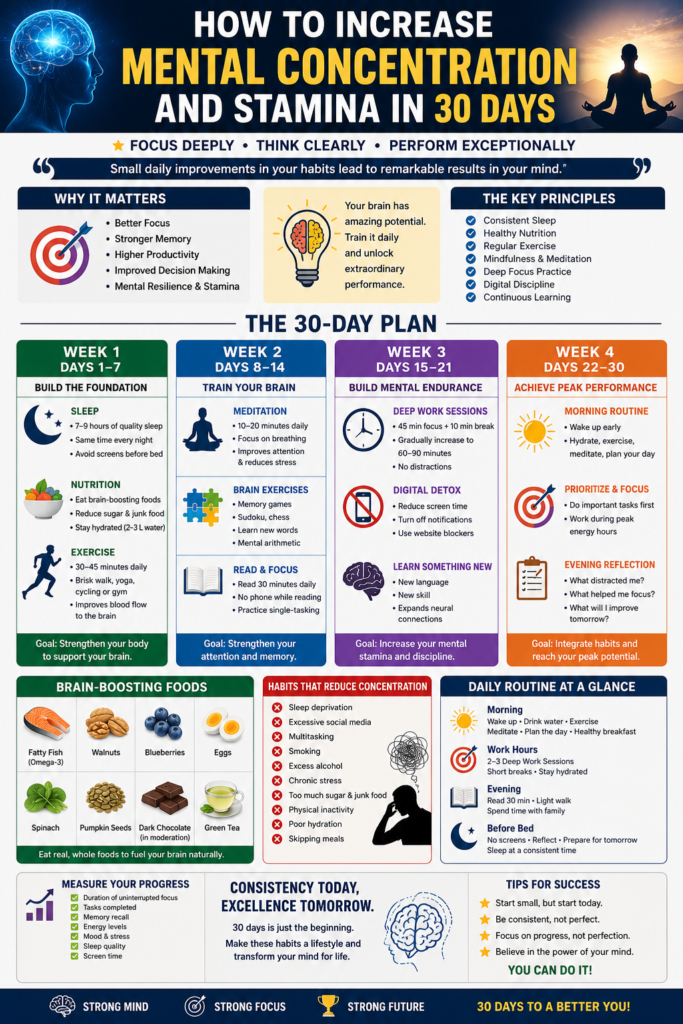
Introduction
Mental concentration and mental stamina are among the most valuable skills in today’s fast-paced world. Whether you are a student preparing for competitive examinations, a healthcare professional managing long shifts, an entrepreneur making strategic decisions, or an athlete seeking peak performance, your ability to focus deeply and sustain cognitive performance determines your success.
Modern lifestyles expose us to constant digital distractions, irregular sleep, poor nutrition, chronic stress, and information overload. These factors reduce attention span, impair memory, and contribute to mental fatigue. Fortunately, the brain possesses remarkable neuroplasticity—the ability to adapt and strengthen itself through consistent habits.
A dedicated 30-day program can significantly improve concentration, working memory, mental endurance, and cognitive resilience. While dramatic transformations take longer than one month, noticeable improvements in focus, productivity, and mental clarity are achievable with disciplined practice.
Understanding Mental Concentration and Mental Stamina
Mental concentration is the ability to direct attention toward a specific task while resisting distractions. Mental stamina refers to the brain’s capacity to maintain high-quality cognitive performance over extended periods without experiencing excessive fatigue.
Strong concentration enables better learning, quicker decision-making, improved creativity, and enhanced problem-solving. Mental stamina allows individuals to remain productive during long work sessions, examinations, research projects, and demanding professional responsibilities.
Week 1 (Days 1–7): Build the Foundation
The first week focuses on optimizing your body’s biological systems that support brain function.
Sleep
Aim for 7–9 hours of quality sleep each night. During deep sleep, the brain consolidates memories, removes metabolic waste, and restores neural connections.
Sleep tips include:
- Sleep at the same time every day.
- Avoid caffeine after late afternoon.
- Keep the bedroom cool and dark.
- Avoid screens for one hour before bedtime.
Hydration
Even mild dehydration reduces concentration.
Drink approximately 2–3 liters of water daily, adjusting for climate and activity level.
Nutrition
Consume foods that support brain health:
- Eggs
- Fish rich in omega-3 fatty acids
- Almonds and walnuts
- Green leafy vegetables
- Berries
- Oats
- Yogurt
- Fruits
- Lentils
- Whole grains
Reduce:
- Sugary drinks
- Processed snacks
- Excess alcohol
- Excessive fast food
Exercise
Perform 30–45 minutes of moderate exercise daily.
Options include:
- Brisk walking
- Cycling
- Swimming
- Strength training
- Yoga
Exercise increases cerebral blood flow and promotes the release of brain-derived neurotrophic factor (BDNF), which supports learning and memory.
Week 2 (Days 8–14): Train Your Brain
The second week focuses on strengthening attention.
Meditation
Practice mindfulness meditation for 10–20 minutes daily.
Focus on:
- Your breathing
- Body awareness
- Present-moment attention
When your mind wanders, gently return your attention without judgment.
Research has shown that mindfulness training can improve sustained attention and reduce mind wandering.
Reading Practice
Read challenging books for 30 minutes without checking your phone.
Gradually increase reading duration.
Memory Exercises
Practice:
- Memorizing lists
- Learning new vocabulary
- Mental arithmetic
- Visualization
- Chess
- Sudoku
- Crossword puzzles
Limit Multitasking
Complete one task at a time.
Research consistently shows that multitasking reduces productivity and increases errors.
Week 3 (Days 15–21): Build Mental Endurance
Once concentration improves, begin increasing mental workload.
Deep Work Sessions
Schedule uninterrupted work sessions.
Example:
- 45 minutes focused work
- 10 minutes break
Gradually extend sessions to:
- 60 minutes
- 75 minutes
- 90 minutes
Digital Detox
Reduce unnecessary screen time.
Disable:
- Social media notifications
- Unnecessary phone alerts
- Background applications
Use website blockers if required.
Learn Something New
Learning stimulates multiple brain regions.
Examples include:
- New language
- Coding
- Musical instrument
- Scientific topics
- Professional certification
Novel learning strengthens neural networks.
Week 4 (Days 22–30): Achieve Peak Mental Performance
This week integrates all previous habits.
Morning Routine
Wake up early.
Spend the first hour:
- Hydrating
- Stretching
- Exercising
- Meditating
- Planning the day
Avoid checking social media immediately after waking.
Prioritize Important Tasks
Complete demanding cognitive work during periods of highest alertness, often in the morning.
Practice Deliberate Focus
Choose one major task daily.
Commit to completing it before switching to another significant activity.
Reflect Each Evening
Spend five minutes answering:
- What distracted me today?
- What helped me focus?
- What will I improve tomorrow?
Daily reflection reinforces productive habits.
Brain-Boosting Foods
Certain nutrients support healthy brain function:
- Salmon and sardines (omega-3 fats)
- Eggs (choline)
- Blueberries (antioxidants)
- Spinach (folate)
- Pumpkin seeds (magnesium and zinc)
- Walnuts
- Dark chocolate (in moderation)
- Green tea (L-theanine with caffeine)
A balanced diet is more effective than relying on supplements unless a deficiency has been identified.
Habits That Reduce Concentration
Avoid these common concentration killers:
- Sleep deprivation
- Excessive social media use
- Continuous multitasking
- Smoking
- Heavy alcohol consumption
- Chronic stress
- Excess sugar intake
- Physical inactivity
- Poor hydration
- Skipping meals
Reducing these habits often improves focus as much as adding new positive habits.
Daily 30-Day Routine
Morning
- Wake at a consistent time.
- Drink water.
- Exercise for 30–45 minutes.
- Meditate for 10–20 minutes.
- Eat a protein-rich breakfast.
Afternoon
- Complete two or three focused work sessions.
- Take short movement breaks.
- Stay hydrated.
Evening
- Read for 30 minutes.
- Limit screen exposure before bed.
- Reflect on the day.
- Sleep at a consistent time.
Measuring Progress
Track your improvement by noting:
- Duration of uninterrupted focus
- Number of tasks completed
- Reading comprehension
- Memory recall
- Energy levels
- Mood
- Screen time
- Sleep quality
Small, consistent gains over 30 days can accumulate into substantial improvements.
Common Mistakes
Many people expect immediate results. Mental performance develops through repetition and consistency. Other common mistakes include trying to change too many habits at once, sacrificing sleep to work longer, and relying solely on caffeine instead of building sustainable routines.
Conclusion
Improving mental concentration and stamina is a gradual process that depends on healthy sleep, balanced nutrition, regular exercise, mindfulness, focused work, and continuous learning. A structured 30-day plan can help establish habits that enhance attention, reduce mental fatigue, and improve overall cognitive performance. While one month is only the beginning, maintaining these practices over the long term can lead to lasting improvements in productivity, resilience, and mental well-being.
Selected References
- Goleman D. Focus: The Hidden Driver of Excellence. HarperCollins; 2013.
- Medina J. Brain Rules. Pear Press; 2014.
- Clear J. Atomic Habits. Avery; 2018.
- Ratey JJ, Hagerman E. Spark: The Revolutionary New Science of Exercise and the Brain. Little, Brown; 2008.
- Diamond A, Ling DS. Review of interventions designed to improve executive functions. Developmental Cognitive Neuroscience. 2016;18:34–48.
- Posner MI, Rothbart MK. Attention, self-regulation, and consciousness. Philosophical Transactions of the Royal Society B. 1998;353(1377):1915–1927.
- World Health Organization. Guidelines on physical activity and sedentary behaviour. 2020.