

From Exploration to Settlement — Reimagining Humanity’s Next Frontier Beyond Earth
1. Context: Humanity’s Eternal Quest Beyond Earth
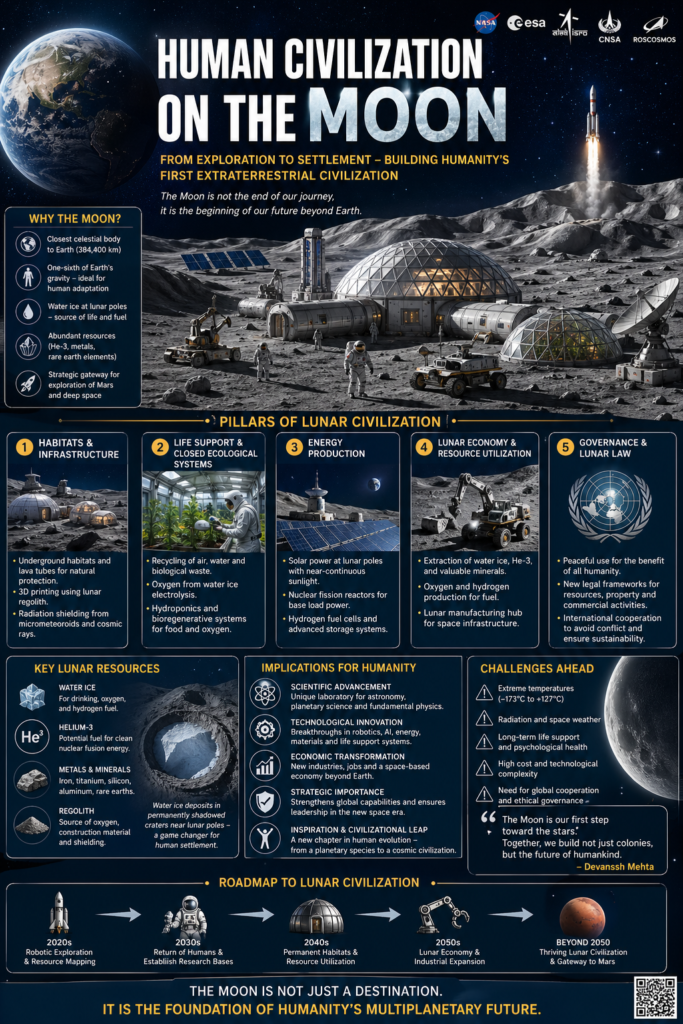
For millennia, the Moon has inspired human imagination—appearing in mythology, poetry, astronomy, and philosophy as a distant yet familiar celestial companion. However, with the rapid advancement of space technology in the twenty-first century, the Moon is no longer merely an object of observation. It has emerged as the most realistic destination for humanity’s first extraterrestrial civilization.
The twenty-first century has witnessed a renewed global interest in lunar exploration. Nations and private enterprises increasingly view the Moon not only as a scientific laboratory but also as a strategic gateway for the expansion of human civilization into space. The emergence of advanced launch systems, reusable rockets, autonomous robotics, artificial intelligence, and in-situ resource utilization technologies has transformed the concept of lunar settlement from speculative fiction into a plausible scientific objective.
Major space powers such as the NASA, European Space Agency, China National Space Administration, Indian Space Research Organisation, and Roscosmos are actively developing programs aimed at establishing a sustained human presence on the Moon. Simultaneously, private companies such as SpaceX and Blue Origin are advancing launch technologies that could dramatically reduce the cost of space travel.
In this context, the Moon is gradually being reconceptualized as the first stepping stone for a multiplanetary human civilization.
2. Background: The Scientific and Technological Foundations of Lunar Settlement
The modern vision of lunar civilization traces its origins to the historic Apollo 11 Moon Landing in 1969, when astronauts Neil Armstrong and Buzz Aldrin became the first humans to walk on the Moon. This event marked not only a technological triumph but also a symbolic demonstration of humanity’s ability to reach beyond Earth.
Subsequent missions revealed critical insights about the lunar environment:
- The Moon possesses one-sixth of Earth’s gravity.
- It has no breathable atmosphere.
- Surface temperatures vary dramatically from −173°C during lunar night to +127°C during lunar day.
- The lunar surface is covered with regolith, a fine dust-like soil containing oxygen, silicon, aluminum, and metals.
- Significant deposits of water ice exist in permanently shadowed craters near the lunar poles.
These discoveries profoundly altered scientific thinking about lunar habitability. Water ice, in particular, has immense strategic importance because it can be converted into oxygen for breathing and hydrogen for rocket fuel.
In recent years, robotic missions such as Chandrayaan‑3 by the Indian Space Research Organisation and the Artemis Program led by NASA have revitalized lunar exploration with the explicit objective of preparing for long-term human presence.
These developments indicate that humanity is entering a new era of lunar science and engineering.
3. Analytical Core: Key Pillars for the Development of Lunar Civilization
The possibility of establishing a human civilization on the Moon depends on several interconnected scientific and technological domains.
3.1 Lunar Habitats and Infrastructure
The most immediate requirement for lunar civilization is the creation of safe and sustainable habitats capable of protecting humans from extreme environmental conditions.
The Moon lacks an atmosphere, exposing astronauts to:
- Cosmic radiation
- Solar particle events
- Micrometeorite impacts
Future lunar habitats will likely be constructed beneath the lunar surface or inside lava tubes, which naturally shield inhabitants from radiation. Advanced technologies such as 3D printing using lunar regolith are also being explored to construct buildings directly on the Moon without transporting large amounts of material from Earth.
Several research groups propose inflatable habitats reinforced with regolith layers to create durable living environments.
3.2 Life Support Systems and Closed Ecological Cycles
A permanent lunar settlement must sustain life independently for extended periods. This requires closed-loop ecological systems capable of recycling air, water, and biological waste.
Key components include:
- Oxygen generation through electrolysis of lunar water ice
- Hydroponic agriculture for food production
- Advanced waste recycling technologies
- Artificial photosynthetic systems
Experiments on the International Space Station have already demonstrated partial closed ecological systems that recycle water and air.
Future lunar bases may integrate bioregenerative life-support systems, where plants produce oxygen and food while absorbing carbon dioxide.
3.3 Energy Production
Reliable energy supply is essential for any lunar civilization. The Moon experiences 14 days of continuous sunlight followed by 14 days of darkness, creating major energy challenges.
Potential solutions include:
- Large-scale solar farms near the lunar poles, where sunlight is nearly continuous
- Nuclear fission reactors designed for space environments
- Energy storage systems using hydrogen fuel cells
Polar regions are particularly attractive for settlement because they combine continuous sunlight and nearby water ice deposits.
3.4 Lunar Economy and Resource Utilization
For a lunar civilization to become sustainable, it must develop an economic foundation.
The Moon possesses several valuable resources:
- Helium-3, a potential fuel for future nuclear fusion reactors
- Rare earth elements and metals
- Oxygen extracted from lunar regolith
- Water ice usable for fuel production
Helium-3 has attracted particular attention because it could enable clean fusion energy with minimal radioactive waste. Some scientists estimate that lunar reserves of helium-3 could potentially supply Earth’s energy needs for centuries.
The Moon may also serve as a manufacturing hub for space infrastructure, including satellites and spacecraft components, because launching materials from the Moon requires far less energy than from Earth.
3.5 Governance and Lunar Law
The emergence of lunar settlements raises profound political and legal questions. The existing framework for space governance originates from the Outer Space Treaty of 1967, which prohibits national sovereignty claims over celestial bodies.
However, the treaty does not clearly define rules regarding:
- Resource extraction
- Lunar property rights
- Commercial activities in space
As lunar missions expand, the international community will need to develop new legal frameworks to ensure that the Moon remains a shared heritage of humanity rather than a domain of geopolitical conflict.
4. Implications: Transforming Humanity’s Future
The successful establishment of human civilization on the Moon would have profound implications for science, economics, and global civilization.
4.1 Scientific Transformation
Lunar bases would function as extraordinary laboratories for astrophysics, planetary science, and fundamental physics. The Moon’s far side, shielded from Earth’s radio interference, is considered one of the best locations in the solar system for radio astronomy.
Moreover, studying the Moon’s geology could reveal valuable insights into the early history of the Earth–Moon system and the formation of the solar system.
4.2 Strategic and Geopolitical Dimensions
The Moon may become a critical arena of strategic competition among major powers. Control over lunar infrastructure, communication networks, and resource extraction technologies could influence the future balance of power in space.
However, cooperative international frameworks could transform the Moon into a symbol of global scientific collaboration, much like Antarctica.
4.3 Technological Spillover to Earth
Technologies developed for lunar survival—such as advanced recycling systems, autonomous robotics, and energy-efficient habitats—could revolutionize sustainability practices on Earth.
Thus, the quest for lunar civilization may indirectly help humanity address challenges such as climate change, resource scarcity, and energy sustainability.
4.4 Philosophical and Civilizational Significance
Perhaps the most profound implication of lunar civilization lies in its philosophical meaning. Establishing a permanent human presence beyond Earth would mark a new evolutionary phase in the history of life on our planet.
Humanity would no longer be confined to a single planetary environment but would become a spacefaring civilization capable of expanding into the broader cosmos.
5. Conclusion: The Moon as the First Chapter of Humanity’s Cosmic Future
The prospect of human civilization on the Moon represents one of the most transformative scientific ambitions of the twenty-first century. While formidable challenges remain—ranging from radiation protection and life-support systems to economic sustainability and governance—the rapid progress of space technology suggests that lunar settlement may become a reality within the coming decades.
The Moon is not merely a distant celestial body; it is increasingly emerging as the gateway to humanity’s extraterrestrial future. From lunar bases, humanity may one day launch missions to Mars, asteroids, and beyond.
In this sense, the establishment of lunar civilization is not simply an engineering project—it is a civilizational milestone that redefines the destiny of humankind.
The Moon may thus become the first outpost of human civilization beyond Earth, marking the beginning of a new era in which humanity transforms from a planetary species into a truly cosmic civilization. 🌕🚀