

Subtitle:
Understanding the Scientific, Clinical, and Strategic Dimensions of Antimicrobial Resistance in the 21st Century
Introduction: The Silent Pandemic Threatening Modern Medicine
In the landscape of modern medical science, few challenges pose as profound and far-reaching a threat as antibiotic resistance. Since the discovery of Penicillin by Alexander Fleming in 1928, antibiotics have been hailed as one of the greatest medical breakthroughs in human history. These life-saving drugs transformed healthcare by enabling the effective treatment of bacterial infections that were once fatal, dramatically reducing mortality rates and allowing the safe performance of surgeries, organ transplantation, and chemotherapy.
However, nearly a century after the antibiotic revolution began, the world faces a paradoxical and alarming situation. The very drugs that once revolutionized medicine are gradually losing their effectiveness due to the rapid emergence of antimicrobial resistance (AMR). Bacteria are evolving mechanisms to evade the effects of antibiotics, rendering standard treatments ineffective and allowing infections to persist and spread.
According to global health authorities such as the World Health Organization, antimicrobial resistance is now considered one of the top ten global public health threats facing humanity. Without decisive action, the world may enter a post-antibiotic era, where common infections, minor injuries, and routine surgical procedures once again become life-threatening.
This article explores the scientific basis, clinical implications, global epidemiology, and strategic solutions to the growing crisis of antibiotic resistance.
Historical Background: From Antibiotic Miracle to Emerging Crisis
The discovery and widespread use of antibiotics in the mid-20th century marked the beginning of a transformative era in medicine. Drugs such as Penicillin, Streptomycin, and Tetracycline rapidly became the cornerstone of infectious disease treatment.
These medications dramatically reduced deaths from bacterial infections such as:
- Pneumonia
- Tuberculosis
- Sepsis
- Wound infections
- Bacterial meningitis
However, even during the early years of antibiotic use, scientists recognized that bacteria possess remarkable evolutionary adaptability. Alexander Fleming himself warned in his Nobel Prize lecture in 1945 that misuse of antibiotics could lead to resistant bacterial strains.
Over the decades, the widespread and often inappropriate use of antibiotics in human medicine, veterinary medicine, and agriculture has accelerated the emergence of resistant organisms.
Today, resistant pathogens such as:
- Methicillin-resistant Staphylococcus aureus (MRSA)
- Klebsiella pneumoniae producing carbapenemases
- Mycobacterium tuberculosis resistant to multiple drugs
have become major clinical challenges across the globe.
Scientific Basis of Antibiotic Resistance
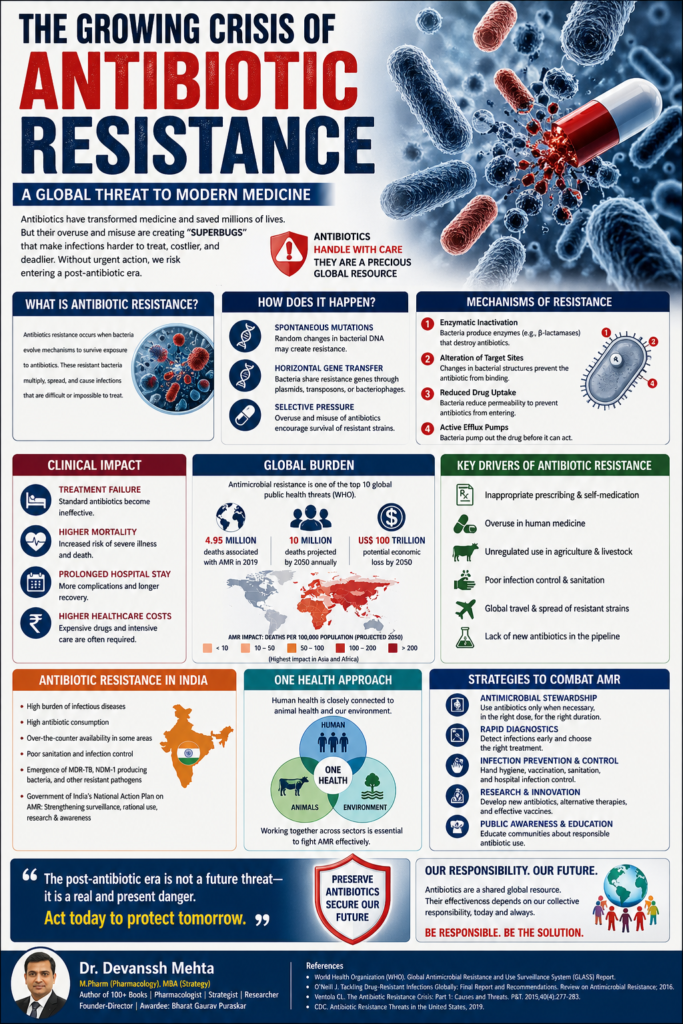
Antibiotic resistance arises through genetic and biochemical adaptations that allow microorganisms to survive exposure to antimicrobial agents.
Genetic Mechanisms
Bacteria can acquire resistance through:
- Spontaneous mutations in chromosomal genes
- Horizontal gene transfer, including plasmids, transposons, and bacteriophages
- Selective pressure created by antibiotic exposure
These mechanisms enable bacteria to develop traits that neutralize or evade antibiotics.
Biochemical Mechanisms of Resistance
Several molecular strategies allow bacteria to resist antibiotics:
1. Enzymatic Drug Inactivation
Some bacteria produce enzymes that destroy antibiotic molecules. For example, β-lactamases break down β-lactam antibiotics such as Penicillin and cephalosporins.
2. Alteration of Target Sites
Mutations may modify the bacterial structures that antibiotics target, preventing drug binding.
3. Reduced Drug Uptake
Changes in bacterial cell membranes may prevent antibiotics from entering the cell.
4. Active Drug Efflux
Efflux pumps can actively remove antibiotics from bacterial cells before they exert their effect.
These sophisticated mechanisms illustrate the dynamic evolutionary arms race between microorganisms and modern pharmacotherapy.
Clinical Consequences of Antibiotic Resistance
Antibiotic resistance has profound implications for clinical medicine.
Treatment Failure
Resistant infections are more difficult to treat because standard antibiotics become ineffective. Physicians are forced to use second-line or third-line drugs, which may be more toxic, expensive, and less accessible.
Increased Mortality
Drug-resistant infections are associated with significantly higher mortality rates compared to susceptible infections.
Prolonged Hospitalization
Patients infected with resistant organisms often require longer hospital stays, increasing healthcare costs and resource utilization.
Complications in Advanced Medical Procedures
Antibiotics are essential for many modern medical interventions, including:
- Organ transplantation
- Cancer chemotherapy
- Intensive care procedures
- Major surgeries
Without effective antibiotics, the safety of these procedures becomes compromised.
Global Epidemiology of Antimicrobial Resistance
Antimicrobial resistance is now a global health crisis affecting both developed and developing nations.
The World Health Organization estimates that millions of infections each year are caused by drug-resistant bacteria, and projections suggest that antimicrobial resistance could lead to millions of deaths annually by 2050 if current trends continue.
Regions with high antibiotic misuse, limited healthcare infrastructure, and inadequate regulatory systems are particularly vulnerable.
Low- and middle-income countries often face challenges such as:
- Over-the-counter availability of antibiotics
- Inadequate diagnostic facilities
- Poor infection control practices
- Lack of antimicrobial stewardship programs
These factors contribute to the accelerated emergence and spread of resistant organisms.
Antibiotic Resistance in India: A Growing Public Health Concern
India represents one of the world’s largest consumers of antibiotics and is considered a hotspot for antimicrobial resistance.
Several factors contribute to this situation:
- High population density
- Unregulated antibiotic sales in some areas
- Inappropriate prescribing practices
- Extensive use of antibiotics in livestock and agriculture
- Inadequate sanitation and infection control
Multidrug-resistant tuberculosis caused by resistant strains of Mycobacterium tuberculosis has become a major challenge in the region.
Recognizing the severity of the problem, the Government of India has launched national initiatives such as the National Action Plan on Antimicrobial Resistance, aimed at strengthening surveillance, promoting rational drug use, and improving infection control practices.
Antibiotic Use in Agriculture and Veterinary Medicine
The use of antibiotics is not limited to human medicine. Large quantities of antimicrobial agents are used in animal husbandry and agriculture to promote growth and prevent disease in livestock.
This practice creates selective pressure that encourages the development of resistant bacteria in animals. These resistant organisms can subsequently spread to humans through:
- Food consumption
- Environmental contamination
- Direct animal contact
Addressing antibiotic resistance therefore requires a One Health approach, recognizing the interconnected nature of human, animal, and environmental health.
Strategies to Combat Antibiotic Resistance
Combating antimicrobial resistance requires a comprehensive and multidisciplinary approach.
Antimicrobial Stewardship
Antimicrobial stewardship programs aim to ensure that antibiotics are used only when necessary and in the correct manner.
Key components include:
- Evidence-based prescribing
- Appropriate dosing and duration
- Use of narrow-spectrum antibiotics whenever possible
- Continuous monitoring of resistance patterns
Development of New Antibiotics
Pharmaceutical research is essential to develop novel antibiotics capable of overcoming resistant pathogens. However, antibiotic discovery has slowed significantly due to scientific and economic challenges.
Encouraging innovation through public-private partnerships and government incentives is therefore critical.
Rapid Diagnostic Technologies
Advanced diagnostic tools can help physicians identify infections quickly and determine the most appropriate treatment.
This reduces unnecessary antibiotic use and improves clinical outcomes.
Infection Prevention and Control
Basic measures such as hand hygiene, vaccination, sanitation, and hospital infection control play a vital role in preventing the spread of resistant organisms.
Ethical and Policy Dimensions of Antibiotic Resistance
Antibiotic resistance is not merely a scientific challenge; it is also a societal and ethical issue. Antibiotics are a shared global resource, and their misuse in one region can have consequences for the entire world.
Governments, healthcare professionals, pharmaceutical companies, and patients all share responsibility for preserving the effectiveness of these life-saving drugs.
International collaboration, regulatory oversight, and public awareness campaigns are essential for addressing this crisis.
Conclusion: Preserving the Future of Antibiotic Therapy
The growing crisis of antibiotic resistance represents one of the most serious threats to global health in the 21st century. The extraordinary success of antibiotics in the past century has created a false sense of security, leading to their overuse and misuse across multiple sectors.
Unless urgent action is taken, humanity risks losing one of the most powerful tools in modern medicine. Combating antimicrobial resistance requires scientific innovation, responsible prescribing practices, global cooperation, and public education.
Antibiotics are a precious and finite medical resource. Preserving their effectiveness is not only a scientific imperative but also a moral responsibility for the global healthcare community.
The battle against antibiotic resistance will ultimately determine whether modern medicine continues to advance—or whether it faces a dangerous return to the pre-antibiotic era.