

The Silent Backbone of Modern Healthcare
Introduction: Diagnostics as the Foundation of Medical Decision-Making
Modern medicine is fundamentally dependent on accurate and timely diagnosis. Before a physician prescribes treatment, performs surgery, or recommends preventive care, a reliable diagnosis must be established. In this context, the diagnostic industry forms the critical backbone of healthcare systems, guiding nearly every clinical decision.
In India, the diagnostic industry has evolved into a rapidly expanding healthcare segment that includes pathology laboratories, radiology centers, molecular diagnostic facilities, and digital health platforms. The sector has experienced significant transformation over the past two decades, driven by technological innovation, increasing healthcare awareness, and rising prevalence of chronic diseases.
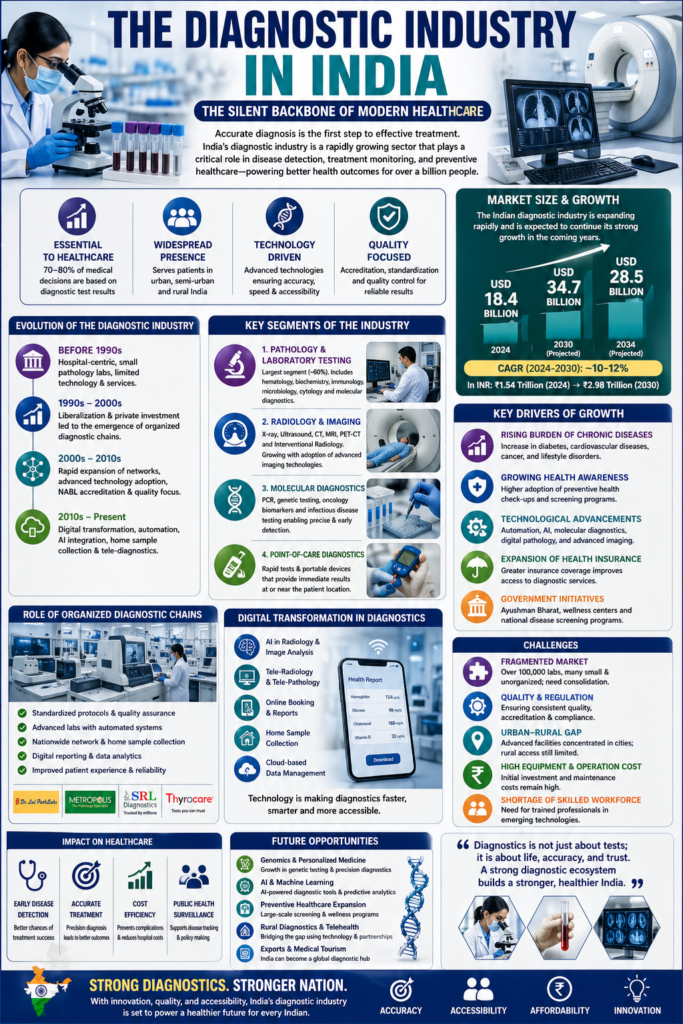
The Indian diagnostic services market has grown substantially and is expected to continue expanding rapidly. Estimates suggest that the industry could reach USD 34–35 billion by 2030, growing at a compound annual growth rate (CAGR) of around 10–12% annually. (TechSci Research)
This article provides a comprehensive exploration of the structure, evolution, market dynamics, challenges, and future opportunities of the diagnostic industry in India.
1. Evolution of the Diagnostic Industry in India
Early Phase: Fragmented and Hospital-Centric
Historically, diagnostic services in India were primarily provided by hospital laboratories and small independent pathology labs. Diagnostic testing was limited mainly to basic investigations such as:
- Blood tests
- Urine analysis
- X-rays
- Microscopic examinations
The sector remained highly fragmented, with limited technological infrastructure and minimal standardization.
Liberalization and Private Sector Expansion
The liberalization of the Indian economy during the 1990s significantly influenced the healthcare and diagnostic sectors. Private investment led to the establishment of organized diagnostic chains and corporate laboratories.
Major national diagnostic chains emerged during this period, including:
- Dr. Lal PathLabs
- Metropolis Healthcare
- SRL Diagnostics
- Thyrocare Technologies
These companies introduced:
- Standardized laboratory practices
- Nationwide sample collection networks
- Advanced diagnostic technologies
- Quality certifications such as NABL accreditation
As a result, the diagnostics industry gradually transitioned from a fragmented service sector into an organized healthcare industry.
2. Market Size and Economic Importance
The diagnostic industry has become a major component of India’s healthcare economy.
Current Market Size
Recent industry reports indicate that:
- The diagnostic laboratory market was valued at approximately USD 18.4 billion in 2024. (TechSci Research)
- It is expected to reach nearly USD 34.7 billion by 2030, reflecting strong long-term growth. (TechSci Research)
- The diagnostic laboratories sector alone could grow to USD 28.5 billion by 2034. (IMARC Group)
In Indian currency terms, the industry is projected to expand from ₹1.54 trillion in 2024 to nearly ₹2.98 trillion by 2030. (Business Wire)
Role in Healthcare Delivery
Diagnostics play a crucial role in healthcare systems.
Globally, it is estimated that 70–80% of medical decisions are based on diagnostic test results. In India, diagnostic services are essential for:
- Disease detection
- Monitoring treatment outcomes
- Screening and preventive healthcare
- Public health surveillance
Therefore, the diagnostic industry directly influences clinical accuracy, treatment success, and healthcare efficiency.
3. Structure of the Diagnostic Industry
The Indian diagnostic sector consists of several interconnected segments.
3.1 Pathology and Laboratory Testing
Pathology represents the largest segment of the diagnostics market, accounting for nearly 60% of total diagnostic services in India. (Perpetuity Website)
Common laboratory tests include:
- Hematology tests
- Biochemistry tests
- Immunology tests
- Microbiology testing
- Molecular diagnostics
Pathology tests form the first line of diagnosis for most diseases, making them indispensable in clinical practice.
3.2 Radiology and Imaging
Radiology constitutes another major segment of the diagnostic ecosystem.
Key imaging technologies include:
- X-ray imaging
- Ultrasound scanning
- Computed tomography (CT)
- Magnetic resonance imaging (MRI)
- Positron emission tomography (PET)
The radiology market in India is expected to grow at a CAGR of approximately 11–13% over the next several years, reflecting increasing demand for imaging services. (Whalesbook)
3.3 Molecular Diagnostics
Advances in biotechnology have transformed diagnostics through molecular testing.
Examples include:
- PCR-based testing
- Genetic screening
- Cancer biomarker detection
- Infectious disease diagnostics
Molecular diagnostics gained tremendous importance during the COVID-19 pandemic, which dramatically expanded PCR testing infrastructure across India.
3.4 Point-of-Care Diagnostics
Point-of-care diagnostics involve tests performed at or near the patient’s location.
Examples include:
- Rapid blood glucose testing
- Pregnancy tests
- Rapid antigen tests
- Portable diagnostic devices
These technologies enable faster diagnosis, especially in rural and resource-limited settings.
4. Key Drivers of Growth
Several factors are driving the expansion of the diagnostic industry in India.
Rising Burden of Chronic Diseases
India faces a growing burden of non-communicable diseases, including:
- Diabetes
- Cardiovascular diseases
- Cancer
- Kidney disorders
These conditions require continuous monitoring through laboratory tests and imaging studies.
Increasing Preventive Healthcare Awareness
The Indian population is increasingly adopting preventive healthcare practices such as:
- Annual health check-ups
- Screening programs
- Lifestyle disease monitoring
This shift toward preventive healthcare has significantly increased demand for diagnostic services.
Technological Advancements
Technological innovation has revolutionized diagnostics.
Important developments include:
- Artificial intelligence in radiology
- Digital pathology
- Automated laboratory systems
- Genomic diagnostics
These technologies are improving both accuracy and efficiency of diagnostic services.
Expansion of Health Insurance
Government initiatives such as Ayushman Bharat have expanded healthcare coverage for millions of Indians.
Insurance coverage increases access to diagnostic services and improves early disease detection.
5. Role of Organized Diagnostic Chains
Corporate diagnostic chains have played a transformative role in the industry.
Key advantages of organized diagnostic companies include:
- Standardized testing protocols
- Advanced laboratory infrastructure
- Nationwide logistics networks
- Digital reporting systems
These companies operate central laboratories supported by hundreds of satellite collection centers, enabling efficient diagnostic service delivery.
6. Digital Transformation of Diagnostics
Digital technologies are reshaping the diagnostic landscape.
Major innovations include:
Artificial Intelligence
AI is being used in radiology to:
- Detect tumors in medical images
- Identify early signs of diseases
- Improve diagnostic accuracy
AI-based diagnostic tools are already being deployed in Indian healthcare systems to analyze medical images and detect multiple diseases with high accuracy. (arXiv)
Tele-Radiology
Tele-radiology enables radiologists to interpret scans remotely, addressing shortages of specialists in rural areas.
Home Sample Collection
Diagnostic companies increasingly offer home sample collection services, making testing more convenient for patients.
7. Challenges Facing the Diagnostic Industry
Despite strong growth, the diagnostic industry faces several challenges.
Fragmented Market Structure
India has more than 100,000 diagnostic laboratories, many of which are small and unorganized. (Aspire Circle)
This fragmentation leads to:
- Quality inconsistencies
- Pricing variations
- Limited standardization
Regulatory and Quality Control Issues
Maintaining consistent quality across thousands of laboratories remains a challenge.
Accreditation systems such as NABL certification are essential for ensuring reliable diagnostic practices.
Urban–Rural Healthcare Gap
Most advanced diagnostic facilities are concentrated in urban centers.
Rural areas often lack access to:
- Advanced imaging technologies
- Molecular diagnostic testing
- Specialized laboratories
Addressing this gap is critical for equitable healthcare access.
8. Future Opportunities
The diagnostic industry in India has enormous future potential.
Genomics and Personalized Medicine
Advances in genomics are enabling personalized healthcare.
Genetic diagnostics can help identify:
- Disease susceptibility
- Cancer mutations
- Pharmacogenomic responses
Artificial Intelligence-Driven Diagnostics
AI will play a major role in future diagnostics by enabling:
- Automated image interpretation
- Predictive disease detection
- Clinical decision support systems
Preventive Healthcare Expansion
As healthcare awareness increases, preventive screening programs will significantly expand the diagnostic market.
Rural Healthcare Infrastructure
Government initiatives and telemedicine platforms are expected to expand diagnostic access to rural populations.
Conclusion: Diagnostics as the Future Engine of Healthcare
The diagnostic industry represents one of the most dynamic and transformative segments of India’s healthcare ecosystem. As medicine becomes increasingly data-driven, diagnostics will continue to serve as the foundation of evidence-based medical practice.
India’s diagnostic sector is experiencing rapid expansion due to rising healthcare awareness, technological advancements, and growing demand for preventive medicine. With projections indicating sustained double-digit growth over the coming decade, the industry is poised to become a central pillar of India’s healthcare infrastructure.
However, achieving this potential will require addressing key challenges such as regulatory standardization, quality assurance, and equitable access to diagnostic services across urban and rural regions.
If these issues are successfully addressed, the Indian diagnostic industry will not only strengthen national healthcare systems but also emerge as a global leader in affordable, technology-driven medical diagnostics.