

From Generics Leadership to Global Pharmaceutical Innovation
Introduction: The Strategic Importance of the Indian Pharmaceutical Sector
The pharmaceutical industry represents one of the most strategically significant sectors of the Indian economy, combining scientific innovation, industrial capability, healthcare delivery, and global trade influence. Over the past five decades, India has evolved from a largely import-dependent pharmaceutical market into one of the most powerful pharmaceutical manufacturing hubs in the world. Today, India is often described as the “Pharmacy of the World,” a term reflecting its immense contribution to affordable medicines and vaccines across the globe. (Wikipedia)
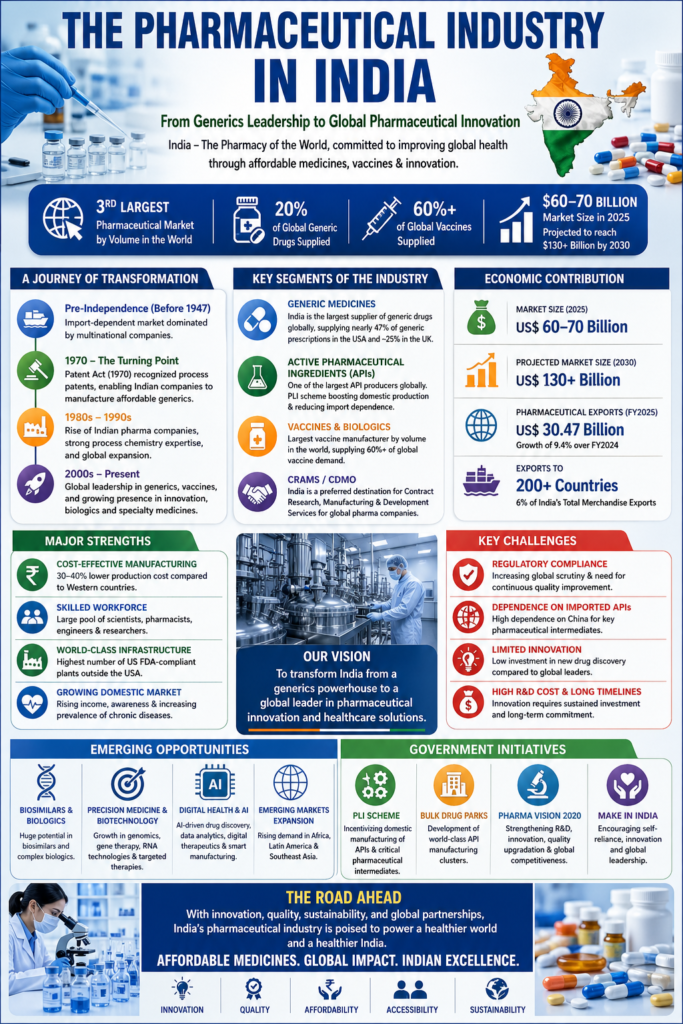
The Indian pharmaceutical industry plays a critical role in both domestic healthcare and global public health. With a market size exceeding $60 billion in 2025 and projected growth toward $130 billion by 2030, the sector is expected to remain one of the fastest-growing pharmaceutical markets globally. (Arcweb)
More importantly, India has built a unique global reputation for producing high-quality, affordable generic medicines, supplying nearly 20% of the world’s generic drugs and over 60% of global vaccines. (The Economic Times)
This article provides a comprehensive exploration of the structure, evolution, economic significance, opportunities, and future challenges of the pharmaceutical industry in India.
1. Historical Evolution of the Indian Pharmaceutical Industry
1.1 Pre-Independence Era: Colonial Dependency
Before India gained independence in 1947, the pharmaceutical market was dominated by multinational corporations. Most medicines were imported, making drugs expensive and inaccessible to the majority of the population.
Key characteristics of the pre-independence pharmaceutical sector included:
- Heavy dependence on foreign pharmaceutical firms
- Minimal domestic manufacturing capacity
- Limited scientific research infrastructure
- High prices of essential medicines
Consequently, access to life-saving drugs was extremely restricted.
1.2 The Patent Act of 1970: A Turning Point
A major transformation occurred with the introduction of the Indian Patent Act of 1970, which recognized process patents rather than product patents for pharmaceuticals.
This legislative change enabled Indian pharmaceutical companies to:
- Reverse-engineer patented drugs
- Manufacture affordable generic medicines
- Build domestic research and manufacturing capacity
As a result, several Indian pharmaceutical companies emerged as global leaders in generic drug manufacturing.
Prominent companies that grew during this period include:
- Sun Pharmaceutical Industries
- Cipla
- Dr. Reddy’s Laboratories
- Lupin
- Aurobindo Pharma
- Torrent Pharmaceuticals
These companies developed strong expertise in process chemistry and cost-efficient production.
2. Current Structure of the Indian Pharmaceutical Industry
India’s pharmaceutical ecosystem is vast and highly diversified.
The country hosts approximately 3,000 pharmaceutical companies and more than 10,500 manufacturing units, making it one of the largest pharmaceutical production networks in the world. (Wikipedia)
The sector broadly consists of four major segments.
2.1 Generic Medicines
Generic medicines constitute the backbone of India’s pharmaceutical sector.
India is the largest global supplier of generic drugs, providing affordable medicines to healthcare systems worldwide. (Brickwork Ratings)
Indian companies supply:
- Nearly 47% of generic prescriptions in the United States
- Approximately 25% of medicines in the United Kingdom
The success of Indian generics is attributed to:
- Cost-efficient manufacturing
- Strong chemistry expertise
- Large-scale production facilities
- Regulatory approvals from agencies such as the US FDA and EMA
2.2 Active Pharmaceutical Ingredients (APIs)
APIs represent the raw materials used to manufacture pharmaceutical drugs.
India is one of the largest producers of APIs globally. However, the sector faces a challenge due to dependence on imports of certain key intermediates, particularly from China.
To address this vulnerability, the Government of India launched the Production Linked Incentive (PLI) scheme, aiming to boost domestic API production and reduce import dependence. (IMARC Group)
2.3 Vaccines and Biologics
India is the largest vaccine manufacturer by volume in the world, producing more than 60% of global vaccine supplies. (Wikipedia)
Major vaccine manufacturers include:
- Serum Institute of India
- Bharat Biotech
- Biological E
- Panacea Biotec
These companies played a critical role during the COVID-19 pandemic, supplying billions of vaccine doses worldwide.
2.4 Contract Research and Manufacturing (CRAMS/CDMO)
India has also emerged as a major hub for contract research and manufacturing services.
Global pharmaceutical companies increasingly outsource:
- Clinical trials
- Drug development
- Manufacturing
to Indian companies due to:
- Lower costs
- Skilled scientific workforce
- Advanced manufacturing infrastructure
3. Economic Contribution of the Pharmaceutical Industry
The pharmaceutical sector is a major contributor to India’s economy.
Market Size
- Approximately $60–70 billion market size in 2025 (Arcweb)
- Expected to reach $145 billion by 2032 (Fortune Business Insights)
Export Performance
India exports pharmaceuticals to more than 200 countries worldwide. (Wikipedia)
Key export statistics include:
- $30.47 billion pharmaceutical exports in FY2025 (Organiser)
- Approximately 6% contribution to India’s total merchandise exports (Bain)
Major export destinations include:
- United States
- Europe
- Africa
- Latin America
- Southeast Asia
4. Major Strengths of the Indian Pharmaceutical Industry
4.1 Cost-Effective Drug Manufacturing
India offers one of the lowest drug manufacturing costs globally.
Production costs in India are estimated to be 30–40% lower than in Western countries, enabling Indian firms to dominate the generic medicines market.
4.2 Skilled Scientific Workforce
India produces thousands of graduates annually in fields such as:
- Pharmacy
- Biotechnology
- Chemical engineering
- Pharmacology
This strong talent base supports research, manufacturing, and regulatory operations.
4.3 Large Manufacturing Infrastructure
India has the highest number of US FDA-compliant manufacturing plants outside the United States, highlighting its regulatory compliance capabilities. (The Economic Times)
This has allowed Indian pharmaceutical companies to supply medicines to highly regulated markets worldwide.
4.4 Expanding Domestic Healthcare Market
India’s growing middle class, rising healthcare awareness, and increasing life expectancy are driving domestic pharmaceutical demand.
Chronic diseases such as:
- Diabetes
- Cardiovascular disorders
- Cancer
are contributing to rapid pharmaceutical market growth.
5. Challenges Facing the Indian Pharmaceutical Industry
Despite its impressive achievements, the Indian pharmaceutical industry faces several challenges.
5.1 Regulatory Compliance and Quality Concerns
International regulators are increasingly scrutinizing pharmaceutical manufacturing standards.
Compliance with regulatory agencies such as:
- US FDA
- European Medicines Agency
- WHO
requires continuous improvement in quality systems.
Recent global scrutiny has pushed Indian companies to strengthen quality assurance and regulatory compliance frameworks. (The Economic Times)
5.2 Dependence on Imported APIs
India imports a significant proportion of certain pharmaceutical intermediates from China.
This dependency poses risks related to:
- Supply chain disruptions
- Price volatility
- Geopolitical tensions
5.3 Limited Innovation in New Drug Discovery
While India dominates the generic medicines sector, its presence in new drug discovery and innovation remains limited.
Developing novel drugs requires:
- Large investments
- Long research timelines
- Advanced clinical research infrastructure
However, increasing investment in biotechnology and pharmaceutical R&D is gradually improving India’s innovation capacity.
6. Emerging Opportunities for the Indian Pharmaceutical Industry
6.1 Biosimilars and Biologics
Biopharmaceuticals represent one of the fastest-growing segments in global healthcare.
India has strong potential in biosimilars, which are lower-cost versions of biological medicines.
6.2 Precision Medicine and Biotechnology
Advances in genomics and personalized medicine are opening new opportunities in:
- Targeted cancer therapies
- Gene therapy
- RNA-based medicines
Indian pharmaceutical companies are increasingly investing in biotechnology platforms.
6.3 Digital Health and Artificial Intelligence
The integration of artificial intelligence into drug discovery is transforming pharmaceutical research.
Indian companies are adopting:
- AI-driven drug design
- Data-driven clinical trials
- Digital healthcare platforms
6.4 Expansion into Emerging Markets
Emerging economies in Africa, Latin America, and Southeast Asia present significant opportunities for Indian pharmaceutical exports.
Demand for affordable medicines in these regions is rising rapidly.
7. Government Policies Supporting the Pharmaceutical Sector
The Government of India has implemented several initiatives to strengthen the pharmaceutical industry.
Key initiatives include:
Production Linked Incentive (PLI) Scheme
Encourages domestic manufacturing of APIs and critical pharmaceutical intermediates.
Pharma Vision 2020
Aims to make India a global leader in pharmaceutical innovation.
Bulk Drug Parks Initiative
Supports the development of large-scale API manufacturing clusters.
These policies aim to transform India from a generic medicines powerhouse into a global innovation hub.
8. Future Outlook of the Indian Pharmaceutical Industry
The future of the Indian pharmaceutical industry appears highly promising.
Key growth drivers include:
- Expanding global demand for generic medicines
- Increasing prevalence of chronic diseases
- Rising healthcare spending
- Advances in biotechnology and biologics
- Growing pharmaceutical exports
Industry projections suggest that the Indian pharmaceutical sector could reach over $130 billion by 2030, reinforcing its position as a major global pharmaceutical hub. (Arcweb)
Conclusion: India’s Journey Toward Pharmaceutical Leadership
The Indian pharmaceutical industry represents one of the most remarkable success stories in the global healthcare landscape. From a modest beginning in the post-independence era to becoming the world’s largest supplier of generic medicines, India has demonstrated how scientific expertise, industrial capability, and strategic policy reforms can transform a national industry into a global powerhouse.
However, the next phase of growth will require a transition from volume-driven generics to innovation-driven pharmaceutical leadership. Investments in research and development, biotechnology, regulatory excellence, and digital health technologies will determine India’s future role in the global pharmaceutical ecosystem.
If these transformations are successfully implemented, India will not only remain the pharmacy of the world but may also emerge as one of the leading centers of pharmaceutical innovation and drug discovery in the 21st century.