
Reimagining Leadership Through Analytical Foresight, Knowledge Integration, and Strategic Awareness in the Age of Complexity
Abstract
In an increasingly interconnected and volatile global economy, traditional models of corporate leadership are undergoing a profound transformation. The rise of technological disruption, geopolitical uncertainty, data-driven decision-making, and global competition demands a new paradigm of leadership rooted in what may be termed corporate intelligence—the capacity of leaders and organizations to gather, analyze, interpret, and strategically deploy information for sustainable competitive advantage. Corporate intelligence extends beyond conventional business analytics; it integrates strategic foresight, geopolitical awareness, technological literacy, ethical reasoning, and interdisciplinary thinking. This article explores the concept of corporate intelligence as a critical capability for the next generation of leaders. It examines its theoretical foundations, structural components, operational mechanisms, and strategic implications for corporations operating in a complex global environment. Particular emphasis is placed on the role of knowledge-driven leadership, data ecosystems, artificial intelligence, and ethical governance in shaping intelligent organizations capable of navigating uncertainty and driving innovation. The discussion highlights how future leaders must evolve from operational managers into strategic thinkers who can synthesize information, anticipate risks, and create resilient institutional strategies.
Keywords: Corporate intelligence, strategic leadership, decision science, business strategy, data analytics, organizational intelligence, leadership development, innovation management
1. Introduction
The landscape of corporate leadership is undergoing a dramatic transformation in the twenty-first century. The rapid expansion of global markets, technological innovation, digital transformation, and geopolitical complexity has fundamentally altered how organizations compete, innovate, and survive. Traditional managerial approaches that relied primarily on operational efficiency and hierarchical authority are increasingly inadequate in a world characterized by volatility, uncertainty, complexity, and ambiguity.
Modern corporations operate within an environment where information flows at unprecedented speed, technological disruption reshapes industries overnight, and strategic decisions must be made in conditions of incomplete knowledge. In such an environment, the success of organizations depends not merely on resources or capital but on their ability to interpret complex information and transform it into actionable strategic insight.
This capability is increasingly recognized as corporate intelligence.
Corporate intelligence represents the integration of analytical reasoning, strategic foresight, competitive awareness, and organizational learning within corporate leadership. It refers to the systematic process through which organizations gather, analyze, and apply information related to markets, competitors, technologies, regulatory frameworks, and geopolitical developments in order to guide strategic decision-making.
For the next generation of leaders, corporate intelligence is not an optional skill but a foundational requirement. Leadership in the modern era requires the ability to synthesize diverse streams of information—from economic indicators and technological trends to regulatory changes and social dynamics—and translate them into strategic direction.
The emergence of artificial intelligence, big data analytics, and digital knowledge networks further amplifies the importance of corporate intelligence. These technologies provide unprecedented access to data, yet the strategic value of data lies not in its volume but in the quality of interpretation and the wisdom of leadership decisions.
Thus, the future of corporate leadership will be defined by individuals and organizations capable of cultivating deep strategic awareness, integrating interdisciplinary knowledge, and deploying intelligence-driven decision frameworks.
2. Understanding the Concept of Corporate Intelligence
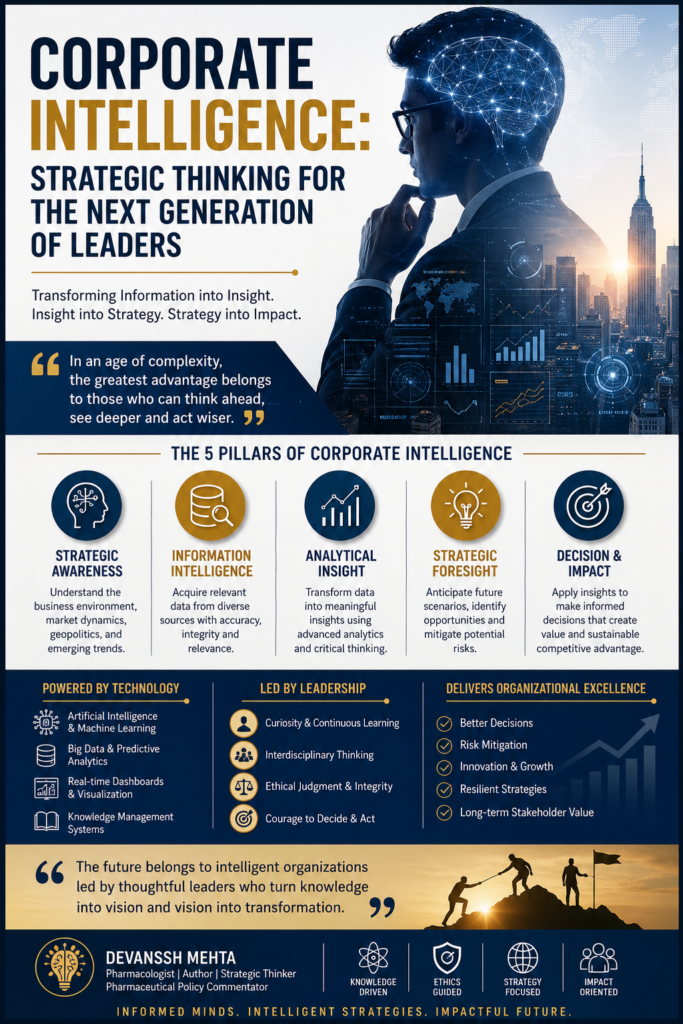
Corporate intelligence can be broadly defined as the systematic acquisition, analysis, and strategic application of information relevant to organizational decision-making and long-term competitiveness.
Unlike traditional business intelligence, which often focuses on historical data analysis and operational metrics, corporate intelligence encompasses a broader spectrum of strategic awareness. It integrates insights from multiple domains, including:
- Market dynamics
- Technological innovation
- Regulatory developments
- Economic trends
- Geopolitical environments
- Social and cultural shifts
In essence, corporate intelligence functions as the strategic nervous system of an organization, enabling leaders to sense changes in the external environment and respond proactively rather than reactively.
The concept shares intellectual roots with fields such as strategic management, competitive intelligence, decision science, and organizational learning. However, corporate intelligence goes beyond these disciplines by emphasizing the integration of information across multiple domains of influence.
At its core, corporate intelligence involves three fundamental processes:
- Information acquisition – gathering relevant data from internal and external sources.
- Analytical interpretation – transforming raw data into meaningful insights.
- Strategic application – using insights to guide decision-making and organizational strategy.
Organizations that excel in corporate intelligence develop the capacity to detect emerging trends, anticipate competitive threats, identify innovation opportunities, and adapt rapidly to changing conditions.
3. Strategic Thinking as the Foundation of Corporate Intelligence
While corporate intelligence relies heavily on data and analytical systems, its ultimate effectiveness depends on the quality of strategic thinking among leadership.
Strategic thinking represents a cognitive discipline that enables leaders to perceive patterns within complex environments, identify long-term implications of present decisions, and formulate coherent strategies that align organizational resources with future opportunities.
Unlike operational thinking, which focuses on immediate tasks and short-term performance metrics, strategic thinking emphasizes broader perspectives and systemic understanding.
Key attributes of strategic thinkers include:
- Long-term orientation
- Analytical reasoning
- Scenario planning capabilities
- Pattern recognition
- Interdisciplinary knowledge integration
Strategic thinking allows leaders to move beyond reactive management and embrace proactive planning. Instead of responding to events after they occur, strategic leaders anticipate shifts in markets, technologies, and regulatory frameworks.
In the context of corporate intelligence, strategic thinking acts as the interpretive mechanism through which information is transformed into insight.
Without strategic thinking, data remains fragmented and decision-making becomes reactive. With strategic thinking, information becomes a tool for anticipating the future and shaping organizational destiny.
4. The Architecture of Corporate Intelligence Systems
Developing effective corporate intelligence requires the establishment of institutional structures and technological systems capable of supporting knowledge-driven decision-making.
Corporate intelligence systems typically consist of several interconnected components.
Data Infrastructure
Modern corporations generate vast volumes of data through operational processes, customer interactions, supply chains, and digital platforms. Data infrastructure enables the collection, storage, and processing of this information in structured formats.
Cloud computing, distributed databases, and advanced analytics platforms have significantly enhanced the ability of organizations to manage large-scale data ecosystems.
Analytical Platforms
Analytical tools transform raw data into actionable insights. These tools include predictive analytics, machine learning algorithms, simulation models, and visualization platforms that help leaders interpret complex information patterns.
Predictive analytics, for example, can forecast market demand trends or identify potential supply chain disruptions before they occur.
Knowledge Integration Mechanisms
Corporate intelligence requires the integration of knowledge across different organizational departments. Research and development teams, marketing divisions, financial analysts, and regulatory experts must collaborate to produce holistic strategic insights.
Cross-functional communication platforms and knowledge management systems play an essential role in facilitating this integration.
Decision Support Systems
Decision support systems provide structured frameworks that assist leaders in evaluating alternative strategic options. These systems incorporate quantitative models, risk assessment tools, and scenario analysis frameworks that help organizations evaluate potential outcomes of strategic decisions.
Together, these components form the structural backbone of corporate intelligence, enabling organizations to convert information into strategic advantage.
5. The Role of Artificial Intelligence in Corporate Intelligence
The rapid advancement of artificial intelligence has profoundly expanded the capabilities of corporate intelligence systems.
Artificial intelligence technologies—including machine learning, natural language processing, and predictive modeling—enable organizations to analyze vast datasets at speeds far beyond human capacity.
AI-driven corporate intelligence systems can perform tasks such as:
- Monitoring global news and regulatory developments
- Detecting emerging market trends
- Identifying competitive movements
- Analyzing consumer behavior patterns
- Forecasting supply chain disruptions
For example, machine learning algorithms can analyze historical sales data, economic indicators, and consumer sentiment to forecast future market demand with high accuracy.
Natural language processing systems can analyze millions of documents, research papers, and news reports to identify emerging technological innovations or regulatory risks.
However, the integration of artificial intelligence into corporate intelligence does not eliminate the need for human judgment. On the contrary, the strategic interpretation of AI-generated insights remains fundamentally dependent on leadership expertise.
Human leaders must evaluate the broader strategic implications of analytical outputs, consider ethical considerations, and align decisions with organizational values.
Thus, the future of corporate intelligence lies in the synergy between human strategic thinking and machine analytical capabilities.
6. Ethical Dimensions of Corporate Intelligence
The growing power of corporate intelligence systems raises important ethical questions regarding data usage, privacy, and corporate responsibility.
Organizations possess unprecedented access to sensitive information about customers, markets, and competitors. The misuse of such information can undermine public trust and create significant reputational risks.
Ethical corporate intelligence requires adherence to several key principles:
- Transparency in data practices
- Respect for privacy and data protection regulations
- Responsible use of analytical technologies
- Integrity in competitive intelligence activities
Corporate leaders must recognize that intelligence-driven decision-making must be balanced with ethical governance.
In sectors such as healthcare and pharmaceuticals, where data often includes sensitive patient information, ethical considerations become even more critical.
Responsible corporate intelligence strengthens organizational credibility and fosters long-term trust among stakeholders.
7. Leadership Development for the Age of Corporate Intelligence
Preparing the next generation of leaders for intelligence-driven organizations requires a fundamental rethinking of leadership education and professional development.
Future corporate leaders must possess competencies that extend far beyond traditional business administration.
Key capabilities include:
- Data literacy and analytical reasoning
- Strategic foresight and scenario planning
- Technological awareness
- Ethical decision-making
- Interdisciplinary thinking
Educational institutions and corporate training programs must therefore emphasize cross-disciplinary learning that integrates business strategy, technology, economics, and social sciences.
Leaders must also cultivate intellectual curiosity and continuous learning habits. In rapidly evolving industries, knowledge becomes obsolete quickly, and leadership effectiveness depends on the ability to continuously update strategic understanding.
Mentorship programs, executive education initiatives, and interdisciplinary collaboration can help develop leaders capable of navigating complex information landscapes.
8. Corporate Intelligence in the Context of Emerging Economies
For emerging economies such as India, corporate intelligence holds particular strategic significance.
Rapid economic development, expanding technological sectors, and increasing integration into global markets create both opportunities and challenges for corporations operating in these environments.
Indian corporations must navigate regulatory complexity, evolving consumer markets, global competition, and technological transformation simultaneously.
Corporate intelligence can help organizations in emerging economies:
- Identify new market opportunities
- Adapt to regulatory reforms
- Compete with global multinational corporations
- Develop innovation-driven business models
India’s pharmaceutical industry provides an illustrative example. As the country transitions from a generics-dominated industry toward innovation-driven drug discovery and biotechnology development, corporate intelligence will become increasingly important.
Companies must monitor global regulatory trends, intellectual property landscapes, clinical research developments, and technological innovations to remain competitive.
Thus, corporate intelligence becomes not merely a managerial tool but a strategic national capability supporting industrial development and global competitiveness.
9. The Strategic Future of Corporate Intelligence
Looking ahead, corporate intelligence will continue to evolve as technological capabilities expand and global business environments become increasingly complex.
Several emerging trends are likely to shape the future of corporate intelligence.
First, the integration of artificial intelligence and predictive analytics will enable organizations to forecast market dynamics with greater accuracy.
Second, real-time data ecosystems will allow corporations to monitor global developments continuously and respond rapidly to emerging risks.
Third, interdisciplinary collaboration between business strategists, data scientists, technologists, and policy experts will become essential for generating comprehensive strategic insights.
Fourth, ethical governance frameworks will play an increasingly important role in ensuring responsible use of corporate intelligence systems.
Ultimately, the organizations that thrive in the future will be those capable of transforming information into wisdom and strategic foresight.
10. Conclusion
Corporate intelligence represents a transformative paradigm in modern organizational leadership. In an era defined by information abundance, technological disruption, and geopolitical complexity, the ability to gather, analyze, and strategically apply knowledge has become a fundamental determinant of corporate success.
For the next generation of leaders, corporate intelligence is not merely a technical capability but a strategic mindset that integrates analytical reasoning, ethical awareness, and long-term vision.
Organizations that cultivate intelligence-driven leadership will be better equipped to anticipate change, manage uncertainty, and create sustainable competitive advantage.
As corporations navigate the complexities of the twenty-first century, the integration of corporate intelligence into leadership practice will shape not only business success but also the broader trajectory of global economic development.
The leaders of tomorrow must therefore evolve beyond traditional managerial roles and embrace a new identity: strategic thinkers capable of transforming knowledge into vision, and vision into transformative action.
References
Porter, M. E. (2008). Competitive strategy: Techniques for analyzing industries and competitors. Free Press.
Davenport, T., & Harris, J. (2017). Competing on analytics: Updated, with a new introduction. Harvard Business Review Press.
Kaplan, R., & Norton, D. (2004). Strategy maps: Converting intangible assets into tangible outcomes. Harvard Business School Press.
Mintzberg, H. (1994). The rise and fall of strategic planning. Free Press.
Grant, R. M. (2016). Contemporary strategy analysis. Wiley.