

Re-examining Whether Democratic Governance Aligns with India’s Historical Mind, Social Diversity, and Strategic Future
Introduction: The Question That Shapes a Nation
Few political questions carry as much intellectual weight as the inquiry: Is democracy suitable for India? At first glance, the question appears paradoxical. India is widely recognized as the world’s largest democracy, a nation that conducts elections involving hundreds of millions of voters and sustains a vibrant political culture across thousands of communities. Yet the deeper philosophical question remains significant: Is democracy merely a borrowed institutional framework adopted after independence, or is it inherently compatible with India’s civilizational ethos?
To answer this question meaningfully, one must move beyond simplistic political narratives and examine the issue through multiple lenses—historical, sociological, philosophical, administrative, and strategic. India is not merely a modern nation-state formed in the twentieth century; it is an ancient civilization with a pluralistic culture, deeply embedded traditions of debate, and complex social hierarchies. The suitability of democracy must therefore be evaluated not only through electoral statistics but also through the broader dynamics of governance, social cohesion, economic development, and ethical leadership.
This article examines democracy in India from a comprehensive perspective, exploring its historical roots, structural strengths, operational challenges, and future trajectory. Ultimately, the question is not simply whether democracy suits India, but how India can refine democracy to reflect its civilizational wisdom while addressing contemporary realities.
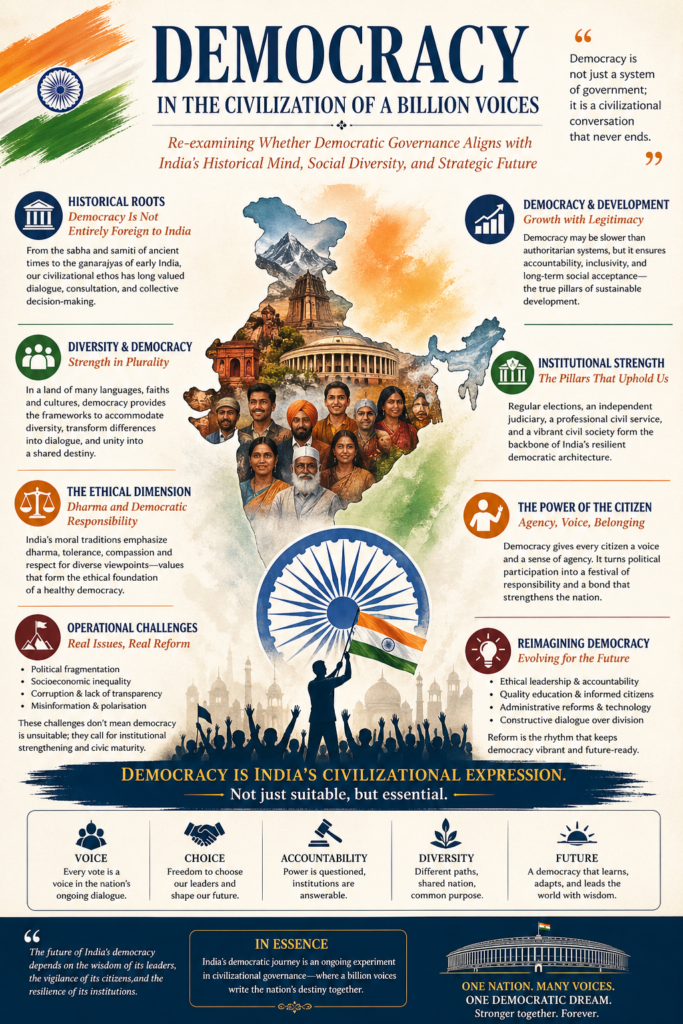
Historical Foundations: Democracy Is Not Entirely Foreign to India
A common misconception in political discourse is that democracy was introduced to India by colonial institutions or Western political philosophy. In reality, elements of democratic governance existed in the Indian subcontinent long before modern constitutional systems emerged.
Ancient Indian political traditions reveal several examples of participatory governance. The sabha and samiti mentioned in early Vedic literature were assemblies that participated in decision-making processes within communities. In certain regions of ancient India, republic-like political entities known as ganarajyas existed, where councils of elders or representatives collectively governed territories.
These early systems were not identical to modern liberal democracy; however, they demonstrated an important cultural feature of Indian civilization: a tradition of dialogue, consultation, and collective decision-making. Even classical Indian philosophical traditions—from Buddhist councils to debates among scholars in ancient universities—emphasized intellectual pluralism and the legitimacy of dissent.
Thus, when India adopted democratic governance after independence in 1947, it was not merely importing a foreign political model. Instead, it was revitalizing a cultural instinct toward deliberative governance within the framework of a modern constitutional state.
Diversity and Democracy: The Structural Compatibility
India’s most distinctive feature is its extraordinary diversity. The nation contains hundreds of languages, multiple religions, numerous ethnic groups, and varied cultural traditions. In such a complex social landscape, the choice of political system becomes critically important.
Democracy possesses a unique capacity to accommodate diversity without imposing uniformity. By allowing citizens to participate in governance through elections, representation, and public debate, democracy creates mechanisms through which diverse voices can coexist within a shared political structure.
In authoritarian systems, diversity often becomes a source of instability because centralized power struggles to accommodate cultural plurality. Democracy, by contrast, transforms diversity into a source of political negotiation and institutional dialogue.
India’s federal structure illustrates this principle effectively. States enjoy considerable autonomy in cultural and administrative matters while remaining part of a unified national framework. This arrangement allows different regions to preserve their identities while contributing to national development.
Therefore, from a structural perspective, democracy appears particularly suited to a civilization as pluralistic as India.
The Ethical Dimension: Democracy and the Indian Moral Tradition
Another dimension often overlooked in political discussions is the relationship between democracy and India’s ethical traditions. Indian philosophy, across multiple schools of thought, emphasizes dharma—ethical responsibility in social conduct.
Democracy ideally functions when citizens and leaders uphold moral responsibility toward society. Electoral mechanisms alone cannot guarantee good governance; they must be accompanied by ethical leadership, accountability, and respect for institutional integrity.
India’s moral traditions encourage values such as dialogue, tolerance, compassion, and respect for plural viewpoints. These values resonate strongly with the normative foundations of democracy. When practiced authentically, democracy becomes not merely a political system but a moral framework for collective decision-making.
However, this ethical dimension also exposes one of democracy’s vulnerabilities. When political discourse deteriorates into populism, corruption, or divisive rhetoric, democratic institutions can lose credibility. Therefore, the success of democracy in India depends not only on constitutional structures but also on the ethical culture of political leadership and citizenship.
The Operational Challenges of Democracy in India
While democracy aligns well with India’s civilizational ethos and social diversity, its practical functioning faces significant challenges.
One of the most persistent issues is political fragmentation. With numerous political parties representing regional, ideological, and identity-based interests, coalition politics often becomes complex. While pluralism is essential for representation, excessive fragmentation can sometimes slow policy implementation and create administrative uncertainty.
Another challenge arises from socioeconomic inequality. Democracy presumes that citizens participate as informed decision-makers. However, disparities in education, income, and access to information can distort electoral behavior. In some regions, political mobilization may occur through identity politics rather than policy-based debate.
Corruption remains another critical concern. When political financing lacks transparency or when administrative institutions become vulnerable to patronage networks, democratic credibility suffers.
Additionally, the rapid expansion of digital communication has introduced new complexities. Social media platforms amplify political narratives but can also spread misinformation, polarizing public discourse.
These challenges do not necessarily indicate that democracy is unsuitable for India; rather, they highlight the need for institutional refinement and civic maturity.
Democracy and Development: A Strategic Debate
A recurring argument in political discourse suggests that authoritarian systems may deliver faster economic development than democratic ones. Examples of rapid industrial growth in certain centralized regimes often fuel this debate.
However, the relationship between governance systems and development is far more complex. While centralized authority may accelerate certain infrastructure projects, it often suppresses public accountability and civil liberties.
India’s democratic model offers a different developmental philosophy—growth accompanied by institutional legitimacy and social participation. Development decisions undergo debate, judicial scrutiny, and public engagement. Although this process may appear slower, it often results in policies that enjoy broader societal acceptance.
Moreover, India’s democratic environment has nurtured a vibrant entrepreneurial ecosystem, a dynamic civil society, and a flourishing media landscape. These elements contribute significantly to long-term innovation and economic resilience.
Thus, rather than hindering development, democracy can serve as a foundation for sustainable and inclusive growth.
The Institutional Strength of Indian Democracy
One of the remarkable achievements of India’s political system is the durability of its democratic institutions. Despite social tensions, economic challenges, and regional complexities, India has maintained a functioning democratic structure for decades.
Regular elections, an independent judiciary, a professional civil service, and a constitution that guarantees fundamental rights collectively form the backbone of this system. These institutions act as safeguards against the concentration of power and ensure continuity of governance.
Furthermore, India’s democratic culture extends beyond formal political institutions. Civil society organizations, academic discourse, public activism, and investigative journalism all contribute to a vibrant democratic ecosystem.
This institutional resilience demonstrates that democracy in India is not merely symbolic—it is deeply embedded in the nation’s political life.
The Psychological Dimension: Democracy and the Indian Citizen
Another important factor in evaluating democracy’s suitability is the psychological relationship between citizens and governance.
Democracy provides individuals with a sense of political agency. Citizens participate in shaping national policies through voting, public debate, and civic engagement. This participation fosters a sense of belonging and responsibility toward the nation.
In societies where governance is centralized and citizens lack political voice, frustration and alienation may accumulate over time. Democracy, despite its imperfections, offers channels for peaceful political expression and conflict resolution.
India’s massive voter participation rates illustrate the psychological attachment citizens feel toward democratic processes. Elections are often celebrated as civic festivals, reflecting the deep emotional connection between citizens and the democratic system.
Reimagining Democracy for India’s Future
While democracy is fundamentally compatible with India’s civilizational ethos, the system must continuously evolve to address emerging challenges.
Strengthening democratic governance requires improvements in several areas:
Political ethics and leadership accountability must become central priorities. Transparent governance builds public trust and enhances institutional legitimacy.
Educational advancement plays a critical role in nurturing informed citizens capable of engaging in thoughtful political decision-making.
Administrative reforms can improve efficiency while maintaining democratic oversight. Technology-driven governance models may enhance transparency and reduce bureaucratic inefficiencies.
Constructive political dialogue should replace divisive rhetoric, ensuring that democratic competition remains rooted in policy debates rather than identity conflicts.
By integrating these reforms, India can transform democracy from a procedural system into a strategic instrument of national development and civilizational renewal.
Conclusion: Democracy as a Civilizational Expression
The question of whether democracy is suitable for India ultimately reveals a deeper insight: democracy is not merely compatible with India—it reflects many of the nation’s core civilizational values.
India’s long tradition of intellectual debate, cultural diversity, ethical philosophy, and collective deliberation aligns naturally with democratic principles. Although challenges persist in governance, political ethics, and socioeconomic equality, these challenges do not undermine the suitability of democracy. Instead, they underscore the need for continuous refinement of democratic institutions.
India’s democratic journey is therefore not a completed project but an ongoing experiment in civilizational governance. The future of this experiment will depend on the wisdom of its leaders, the vigilance of its citizens, and the resilience of its institutions.
In the final analysis, democracy in India is not simply a political arrangement—it is the collective voice of a civilization learning to govern itself in the modern world.