

How Purposeful Messaging Shapes Leadership, Institutions, and the Future of Societies
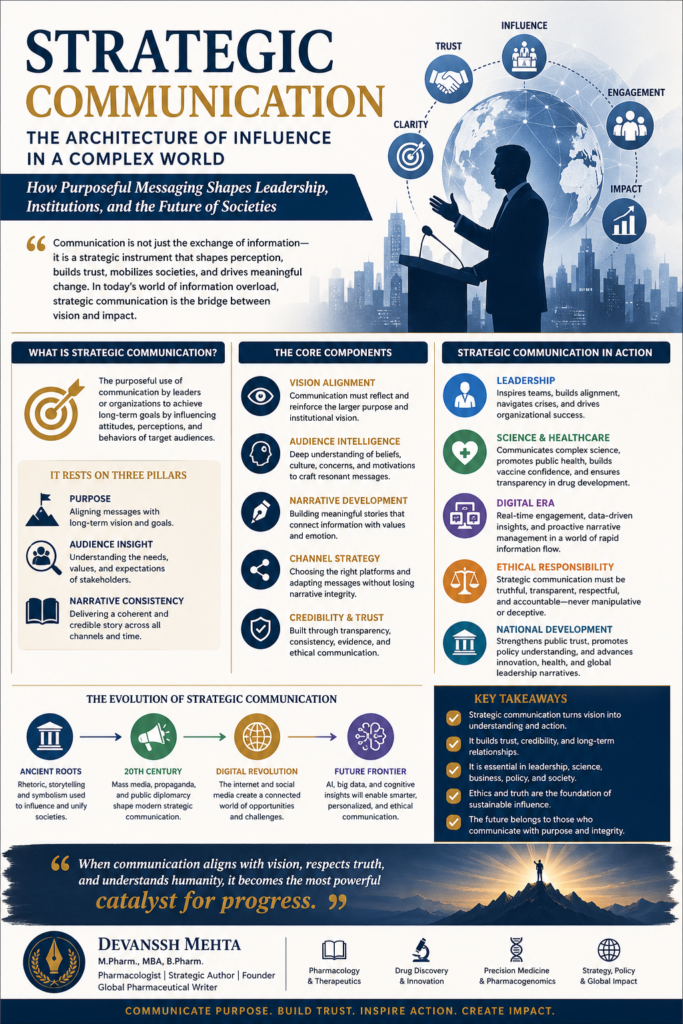
Introduction: Communication as a Strategic Instrument of Power
Throughout human civilization, communication has never been merely a process of exchanging words. It has always been a strategic instrument that shapes perception, mobilizes societies, builds institutions, and directs the course of history. From political revolutions to corporate transformations, from military strategies to public health campaigns, the ability to communicate effectively and strategically has often determined the difference between success and failure.
In the modern era, the importance of strategic communication has expanded dramatically. The world now operates in an environment characterized by information overload, digital connectivity, geopolitical competition, and rapidly evolving societal expectations. In such a complex landscape, communication cannot remain spontaneous or reactive. It must be deliberate, coherent, evidence-driven, and aligned with long-term objectives.
Strategic communication therefore represents a sophisticated discipline that integrates psychology, sociology, leadership, policy, and technology to craft messages that influence perception, inspire trust, and guide collective behavior.
Understanding strategic communication is essential not only for governments and corporations but also for scientists, healthcare professionals, educators, and thought leaders who seek to shape meaningful societal outcomes.
The Conceptual Foundations of Strategic Communication
Strategic communication can be broadly defined as the purposeful use of communication by organizations or leaders to achieve specific long-term goals by influencing attitudes, perceptions, and behaviors of target audiences.
Unlike routine communication, which may involve simple information exchange, strategic communication involves a carefully designed architecture of messaging built upon three foundational pillars:
- Purpose
- Audience Insight
- Narrative Consistency
Purpose ensures that communication aligns with broader institutional or leadership goals. Audience insight allows communicators to understand the psychological, cultural, and social contexts of their stakeholders. Narrative consistency ensures that communication remains coherent across multiple platforms and timeframes.
When these elements are integrated effectively, communication evolves from a tactical activity into a strategic capability that can shape entire ecosystems of thought and action.
Historical Evolution of Strategic Communication
The roots of strategic communication can be traced to ancient civilizations where rulers, philosophers, and military leaders recognized the importance of messaging in shaping public opinion.
Ancient empires used symbolism, storytelling, and rhetoric to legitimize authority and maintain social cohesion. Religious institutions developed sophisticated communication systems to transmit moral and philosophical teachings across generations.
During the twentieth century, strategic communication became more formally institutionalized, particularly in the fields of politics, military operations, and corporate governance.
The two World Wars demonstrated the immense power of coordinated messaging through propaganda, psychological operations, and public diplomacy. Governments realized that winning the battle of perception could be as important as winning the battlefield itself.
In the late twentieth and early twenty-first centuries, the emergence of mass media, the internet, and social media platforms transformed the communication landscape. Information could now spread globally within seconds, dramatically increasing both opportunities and risks associated with messaging.
Today, strategic communication is practiced across multiple sectors including government policy, healthcare systems, global business, scientific communities, and international diplomacy.
The Strategic Components of Effective Communication
Effective strategic communication is built upon a sophisticated framework that integrates several interconnected components.
Vision Alignment
Every strategic communication effort must begin with a clear understanding of the institutional or leadership vision. Messaging must consistently reinforce the overarching purpose of the organization or movement.
When communication becomes disconnected from vision, it risks becoming fragmented and ineffective.
Audience Intelligence
Strategic communication requires deep insight into the belief systems, cultural values, expectations, and concerns of target audiences. Different stakeholders interpret information differently depending on their experiences and worldviews.
Understanding these psychological and sociological dynamics allows communicators to craft messages that resonate authentically.
Narrative Development
Humans understand the world primarily through stories and narratives. Strategic communicators therefore construct narratives that connect information with meaning, values, and emotion.
A strong narrative provides coherence across multiple messages and reinforces long-term institutional identity.
Channel Strategy
In the digital era, communication channels are diverse and constantly evolving. Strategic communicators must select platforms carefully, ensuring that messages reach audiences through the most effective mediums.
These channels may include:
- Traditional media
- Social media platforms
- Institutional publications
- Scientific journals
- Public speeches
- Digital campaigns
Each channel requires adaptation of messaging style while preserving the core narrative.
Credibility and Trust
Trust is the currency of strategic communication. Without credibility, even the most sophisticated messaging strategies will fail.
Credibility emerges from transparency, consistency, evidence-based communication, and ethical leadership.
Strategic Communication in Leadership
Leadership and communication are inseparable. Leaders who fail to communicate strategically often struggle to mobilize followers, articulate vision, or navigate crises.
Strategic communication in leadership involves several key competencies:
Clarity of Vision
Leaders must translate complex strategic objectives into clear, inspiring messages that people can understand and embrace.
Emotional Intelligence
Effective communication requires awareness of the emotional climate of stakeholders. Messages that acknowledge fears, aspirations, and uncertainties tend to resonate more deeply.
Consistency
Frequent changes in messaging can undermine trust. Strategic leaders maintain consistent communication frameworks, even as circumstances evolve.
Crisis Communication
During crises, communication becomes even more critical. Strategic leaders must provide accurate information quickly while maintaining calm, confidence, and transparency.
The COVID-19 pandemic provided a global demonstration of how strategic communication can influence public health compliance, social trust, and national resilience.
Strategic Communication in Science and Healthcare
Scientific and medical communities increasingly recognize the importance of strategic communication. Discoveries in pharmacology, biotechnology, and medicine must be communicated effectively to policymakers, clinicians, and the public.
Poor communication of scientific information can lead to misinterpretation, misinformation, and public mistrust.
In fields such as pharmacology and drug development, strategic communication plays a crucial role in areas including:
- Clinical trial transparency
- Drug safety awareness
- Public health campaigns
- Vaccine confidence
- Regulatory communication
For instance, during global vaccination programs, effective communication strategies are essential for addressing public concerns, combating misinformation, and promoting informed decision-making.
Scientists and healthcare professionals must therefore develop communication competencies alongside technical expertise.
Digital Transformation and the New Communication Landscape
The digital revolution has dramatically altered how information flows through society. Social media platforms, instant messaging systems, and online media networks have created an environment where information spreads at unprecedented speed.
While this connectivity offers enormous opportunities for engagement, it also presents serious challenges.
Misinformation, disinformation, and algorithm-driven information bubbles can distort public understanding of complex issues.
Strategic communication in the digital age therefore requires:
- Real-time responsiveness
- Data-driven audience insights
- Digital reputation management
- Proactive narrative development
Organizations that fail to adapt to this evolving landscape risk losing control over their public narrative.
Ethical Dimensions of Strategic Communication
While strategic communication can be a powerful instrument of influence, it also raises important ethical questions.
Communication strategies must avoid manipulation, deception, and exploitation of psychological vulnerabilities. Ethical strategic communication emphasizes:
- Truthfulness
- Transparency
- Respect for audience autonomy
- Accountability
In democratic societies, ethical communication practices are essential for maintaining public trust in institutions.
Similarly, in scientific and healthcare contexts, ethical communication ensures that information about medicines, therapies, and research findings remains accurate and responsible.
Strategic communication should therefore be understood not merely as a tool of persuasion but as a discipline rooted in ethical responsibility and societal trust.
Strategic Communication and National Development
Nations increasingly rely on strategic communication to advance national priorities. Governments employ communication strategies to promote economic development, public health, innovation ecosystems, and global diplomacy.
Public policy initiatives require clear messaging to ensure that citizens understand the goals, benefits, and responsibilities associated with national programs.
For emerging economies such as India, strategic communication can play a crucial role in promoting:
- Scientific literacy
- Pharmaceutical innovation
- Public health awareness
- Digital transformation
- Global leadership narratives
By articulating coherent national narratives, governments can mobilize citizens and institutions toward collective progress.
Future Directions: Communication in the Age of Artificial Intelligence
The future of strategic communication will be profoundly influenced by advances in artificial intelligence, big data analytics, and cognitive science.
AI-driven tools can analyze audience sentiment, predict communication outcomes, and personalize messaging at scale. These technologies may enable unprecedented levels of precision in communication strategies.
However, they also introduce new ethical and regulatory challenges related to privacy, algorithmic bias, and information manipulation.
The next generation of strategic communicators will therefore need to combine technological literacy with ethical wisdom to navigate this evolving landscape responsibly.
Conclusion: Communication as a Strategic Capability for the Future
Strategic communication is far more than a professional skill. It is a fundamental capability that shapes leadership effectiveness, institutional credibility, and societal progress.
In a world defined by complexity, uncertainty, and rapid change, organizations and leaders must learn to communicate not only clearly but strategically and ethically.
When communication aligns with vision, respects truth, and understands human psychology, it becomes a powerful catalyst for progress.
From government policy to scientific discovery, from corporate leadership to public health initiatives, strategic communication serves as the architecture through which ideas transform into action and vision transforms into reality.
Ultimately, the future will belong to those leaders and institutions that recognize communication not as a peripheral activity, but as a core strategic function that guides societies toward knowledge, trust, and collective advancement.