

By Devanssh Mehta
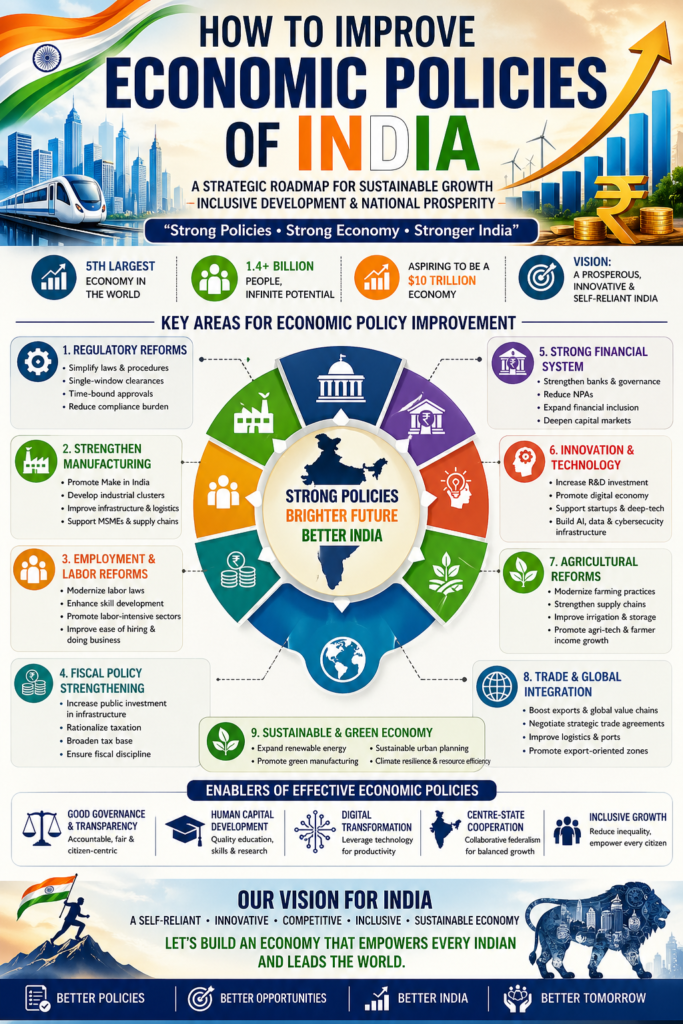
Introduction: The Imperative of Economic Policy Reform in India
India stands at a defining moment in its economic history. Over the past three decades, the country has transitioned from a closed, state-dominated economy to one of the most dynamic emerging markets in the world. With a population exceeding 1.4 billion, a rapidly expanding digital ecosystem, a vibrant entrepreneurial culture, and a growing middle class, India possesses enormous economic potential. Yet, despite these strengths, the Indian economy continues to face structural challenges that limit its ability to achieve sustained high growth and equitable development.
Economic policies form the backbone of any nation’s development strategy. They determine how resources are allocated, how industries evolve, how employment opportunities are created, and how innovation flourishes. In India’s case, the complexity of governance, diversity of regional economies, and socio-economic inequalities make economic policymaking both challenging and critically important.
The question therefore arises: How can India improve its economic policies to accelerate growth, reduce inequality, strengthen global competitiveness, and ensure long-term sustainability?
This article provides a comprehensive and strategic analysis of the reforms necessary to enhance India’s economic policy framework. It explores the structural challenges of the Indian economy, identifies areas requiring reform, and proposes actionable policy solutions aimed at creating a resilient and prosperous economic future.
Understanding the Foundations of India’s Economic Policy Framework
Historical Evolution of Economic Policy in India
To understand how India can improve its economic policies, it is essential to examine the historical evolution of economic governance in the country.
The Planned Economy Era (1947–1991)
After gaining independence in 1947, India adopted a socialist-inspired economic model characterized by centralized planning, public sector dominance, and heavy regulation of private enterprise. The government established the Planning Commission and introduced Five-Year Plans to guide national development.
Key features of this period included:
- Extensive industrial licensing (License Raj)
- State ownership of key industries
- Protectionist trade policies
- Import substitution strategy
While these policies helped build basic industrial infrastructure, they also created inefficiencies, bureaucratic delays, and limited competitiveness.
Economic Liberalization (1991 Reforms)
India’s economic landscape underwent a dramatic transformation in 1991 when the government initiated liberalization reforms to address a severe balance-of-payments crisis.
Key reforms included:
- Deregulation of industries
- Reduction in import tariffs
- Opening sectors to foreign investment
- Financial sector reforms
These changes unleashed the power of private enterprise and integrated India into the global economy.
The Modern Economic Phase (2000–Present)
Since the early 2000s, India has experienced rapid economic expansion driven by technology, services, and globalization. Major policy initiatives have included:
- Goods and Services Tax (GST)
- Digital India
- Startup India
- Make in India
- Production Linked Incentive (PLI) schemes
Despite these reforms, India still faces numerous structural barriers that hinder optimal economic performance.
Structural Challenges in India’s Economic Policy Framework
Regulatory Complexity and Bureaucratic Barriers
One of the most persistent challenges in India’s economic environment is excessive regulatory complexity. Businesses often face multiple layers of approvals, compliance requirements, and bureaucratic procedures.
The result is:
- High transaction costs
- Delays in project approvals
- Reduced investor confidence
Although reforms such as ease-of-doing-business initiatives have improved the situation, many regulatory bottlenecks remain.
Policy Recommendation
India must pursue deep administrative reforms, including:
- Simplification of regulatory frameworks
- Digitalization of government services
- Time-bound approvals for business licenses
- Reduction of redundant regulations
A transparent regulatory ecosystem would significantly enhance investor confidence.
Weak Manufacturing Base
Manufacturing contributes only around 15–17% of India’s GDP, significantly lower than countries such as China, South Korea, or Vietnam.
This limits:
- Job creation
- Export competitiveness
- Industrial diversification
India’s manufacturing sector faces several constraints:
- High logistics costs
- Fragmented supply chains
- Infrastructure gaps
- Complex labor regulations
Policy Recommendation
To strengthen manufacturing, India must implement:
- Industrial cluster development
- Logistics modernization
- Labor market reforms
- Technology adoption incentives
Additionally, strengthening initiatives such as Make in India and PLI schemes can help transform India into a global manufacturing hub.
Employment Generation and Labor Market Reform
India’s demographic dividend represents both an opportunity and a challenge. Each year millions of young people enter the workforce, but the economy struggles to create sufficient high-quality jobs.
The key issues include:
- High informal employment
- Skill mismatches
- Low labor productivity
Policy Recommendation
Improving employment outcomes requires:
- Modernizing labor laws
- Expanding vocational education
- Encouraging labor-intensive industries
- Strengthening apprenticeship programs
The government must also promote sectors such as textiles, electronics, renewable energy, and tourism, which have high employment potential.
Reforming Fiscal Policy for Sustainable Economic Growth
Strengthening Public Investment
Public investment in infrastructure plays a critical role in economic development. Roads, railways, ports, and digital infrastructure significantly influence productivity and competitiveness.
India has made significant progress in infrastructure development, yet the investment gap remains substantial.
Policy Recommendation
India must increase strategic public investments in:
- Transportation infrastructure
- Renewable energy
- Urban development
- Digital connectivity
- Water management systems
Public-private partnerships (PPPs) can also be leveraged to finance large infrastructure projects.
Rationalizing Taxation Policy
A well-designed tax system is essential for economic efficiency and revenue generation.
India has implemented major tax reforms including:
- Goods and Services Tax (GST)
- Corporate tax reductions
However, challenges remain such as:
- Complex compliance procedures
- Tax disputes
- Informal sector taxation issues
Policy Recommendation
Tax policy improvements should include:
- Simplifying GST structures
- Reducing litigation in tax disputes
- Enhancing digital tax administration
- Broadening the tax base
A predictable tax environment encourages investment and economic expansion.
Strengthening India’s Financial System
Banking Sector Reform
India’s banking sector plays a vital role in financing economic growth. However, public sector banks have historically struggled with:
- Non-performing assets (NPAs)
- Governance challenges
- Limited credit availability
Policy Recommendation
Key reforms include:
- Strengthening bank governance
- Expanding financial inclusion
- Improving risk management frameworks
- Encouraging private sector participation
Digital banking and fintech innovations also provide new opportunities to expand credit access.
Capital Market Development
A robust capital market enables companies to raise long-term financing for expansion and innovation.
India’s stock markets have grown significantly, yet many small and medium enterprises still lack access to capital.
Policy Recommendation
India must:
- Expand SME stock exchanges
- Improve venture capital ecosystems
- Encourage pension funds and insurance funds to invest in equities
- Strengthen corporate governance frameworks
A deeper capital market will accelerate economic growth.
Innovation and Technology Policy
Investing in Research and Development
Innovation is a key driver of modern economic competitiveness. Countries that invest heavily in research and development tend to achieve higher productivity and technological leadership.
India currently spends less than 1% of GDP on R&D, which is significantly lower than many developed economies.
Policy Recommendation
India should increase R&D spending to at least 2–3% of GDP by encouraging collaboration between:
- Universities
- Research institutions
- Industry
Innovation clusters and technology parks can further stimulate research commercialization.
Digital Economy Expansion
India’s digital revolution has transformed sectors such as finance, commerce, and governance.
Key achievements include:
- Digital payments ecosystem
- Aadhaar-based identity system
- UPI transactions growth
However, digital infrastructure gaps still exist in rural areas.
Policy Recommendation
India must invest in:
- Nationwide broadband connectivity
- AI and data infrastructure
- Cybersecurity frameworks
- Digital literacy programs
A strong digital economy will enhance productivity and innovation.
Agricultural Policy Reforms
Agriculture remains a critical sector for India, employing nearly half of the population. However, agricultural productivity remains relatively low.
Major challenges include:
- Fragmented land holdings
- Inefficient supply chains
- Price volatility
- Climate risks
Policy Recommendation
Agricultural reforms should focus on:
- Modern irrigation systems
- Agricultural technology adoption
- Farm mechanization
- Strengthening agricultural markets
Encouraging agri-tech startups and improving farmer access to credit can significantly improve rural incomes.
Trade and Global Economic Integration
Export Promotion Strategy
India’s export performance has improved but still lags behind major exporting nations.
Key barriers include:
- Logistics inefficiencies
- Trade policy uncertainty
- Limited participation in global value chains
Policy Recommendation
India must pursue a comprehensive export strategy by:
- Reducing logistics costs
- Negotiating strategic trade agreements
- Developing export-oriented industrial zones
- Supporting high-value manufacturing exports
Integration into global supply chains will enhance India’s economic resilience.
Sustainable Economic Policy and Environmental Considerations
Economic development must balance growth with environmental sustainability.
India faces significant environmental challenges including:
- Air pollution
- Water scarcity
- Climate change impacts
Policy Recommendation
Economic policies must incorporate:
- Renewable energy expansion
- Green manufacturing
- Sustainable urban planning
- Carbon reduction strategies
A green economy offers new opportunities for innovation and job creation.
Institutional Reforms and Governance Improvements
Strong institutions are essential for effective economic policymaking.
India must strengthen:
- Policy coordination between central and state governments
- Judicial efficiency in commercial disputes
- Transparency in regulatory systems
Institutional reforms will significantly improve economic governance.
The Role of Entrepreneurship and Startups
India has emerged as one of the world’s leading startup ecosystems. However, startups still face challenges such as:
- Access to capital
- Regulatory barriers
- Market entry difficulties
Policy Recommendation
Economic policies should encourage entrepreneurship by:
- Simplifying startup regulations
- Expanding venture capital access
- Promoting innovation hubs
- Supporting deep-tech startups
Entrepreneurship will be a key driver of India’s future economic transformation.
Building Human Capital for Economic Progress
Economic development ultimately depends on the quality of human capital.
India must invest heavily in:
- Education reform
- Skill development programs
- Higher education research
Improving human capital will enhance productivity and economic competitiveness.
Strategic Vision for India’s Economic Future
India’s economic policy must evolve from short-term growth strategies to a long-term national development vision.
The strategic goals for India’s economic future should include:
- Becoming a global manufacturing powerhouse
- Achieving technological leadership
- Reducing economic inequality
- Ensuring environmental sustainability
If implemented effectively, these goals can transform India into one of the world’s leading economic powers.
Conclusion: Towards a Resilient and Prosperous Indian Economy
Improving economic policies in India requires a multidimensional approach that integrates fiscal discipline, regulatory reforms, technological innovation, human capital development, and sustainable growth strategies.
India possesses immense economic potential. However, realizing this potential requires bold policy reforms, visionary leadership, and strong institutional frameworks.
By simplifying regulations, strengthening manufacturing, investing in innovation, modernizing agriculture, and enhancing global trade integration, India can unlock unprecedented economic growth and prosperity.
The coming decades will determine whether India can transform its demographic dividend into an engine of economic leadership. With the right economic policies, the nation can emerge not only as a major global economy but also as a model of inclusive and sustainable development.