

Triple Negative Breast Cancer: Biology, Clinical Challenges, and the Future of Precision Oncology
By Devanssh Mehta (M.Pharm., MBA, B.Pharm.)
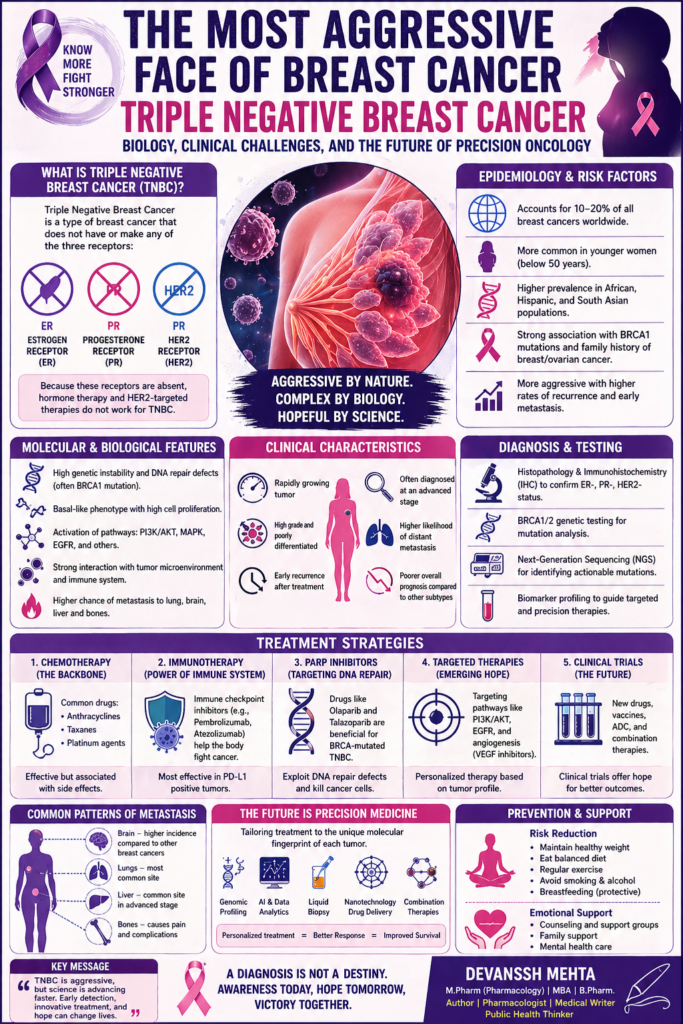
Introduction: When Breast Cancer Defies Conventional Therapy
Breast cancer remains one of the most extensively studied diseases in modern medicine, yet it continues to challenge clinicians, researchers, and patients alike. Advances in molecular biology have revealed that breast cancer is not a single disease but rather a heterogeneous group of malignancies, each characterized by distinct biological behavior and therapeutic responsiveness.
Among these variants, Triple Negative Breast Cancer (TNBC) represents one of the most aggressive and therapeutically challenging subtypes. Unlike other forms of breast cancer that respond to hormonal therapy or targeted HER2 treatments, TNBC lacks the three receptors that most modern therapies depend upon. Consequently, it has historically been treated with limited therapeutic options, primarily chemotherapy.
Triple negative breast cancer derives its name from the absence of three key receptors:
- Estrogen receptor (ER)
- Progesterone receptor (PR)
- Human epidermal growth factor receptor 2 (HER2)
This receptor-negative profile fundamentally alters the therapeutic landscape for patients diagnosed with this condition. Without these molecular targets, many of the highly effective treatments used in other breast cancer subtypes become ineffective.
As a result, TNBC has long been associated with rapid tumor growth, early metastasis, and poorer clinical outcomes compared to other breast cancer variants. However, the story of TNBC is not merely one of clinical difficulty. It is also a narrative of scientific innovation, molecular discovery, and the relentless pursuit of new therapeutic strategies.
In recent years, advances in genomics, immunotherapy, and targeted therapies have begun to reshape the treatment paradigm for this disease. The scientific community now recognizes TNBC not as a single entity but as a spectrum of biologically distinct tumors, each potentially vulnerable to specific therapeutic interventions.
Understanding triple negative breast cancer therefore requires a multidisciplinary perspective that integrates molecular oncology, pharmacology, immunology, and clinical medicine. This article explores the biology, clinical characteristics, treatment strategies, and future prospects surrounding this formidable form of cancer.
Understanding Breast Cancer Heterogeneity
Breast cancer classification has evolved dramatically over the past few decades. Traditionally, tumors were categorized based on histological features observed under a microscope. However, the emergence of molecular oncology has transformed our understanding of the disease.
Today, breast cancers are broadly categorized into several molecular subtypes based on receptor expression:
- Hormone receptor-positive (ER/PR positive) cancers
- HER2-positive cancers
- Triple negative breast cancers
Hormone receptor-positive tumors depend on estrogen or progesterone signaling for growth, allowing them to be treated with endocrine therapies such as selective estrogen receptor modulators or aromatase inhibitors.
HER2-positive cancers overexpress the HER2 receptor, making them susceptible to targeted monoclonal antibodies and tyrosine kinase inhibitors.
Triple negative breast cancers, however, lack all three receptors, leaving clinicians without the therapeutic leverage provided by these molecular targets.
This receptor-negative status profoundly influences disease biology, making TNBC more aggressive, genetically unstable, and prone to early recurrence.
Epidemiology and Global Burden
Triple negative breast cancer accounts for approximately 10–20% of all breast cancer cases worldwide. Although this proportion may appear modest, the aggressive nature of TNBC means it contributes disproportionately to breast cancer mortality.
Several epidemiological trends have been observed in TNBC:
- Higher prevalence among younger women
- Greater incidence in African and South Asian populations
- Strong association with BRCA1 gene mutations
- Increased occurrence in patients with genetic predisposition to breast cancer
In India, where breast cancer incidence is steadily rising, TNBC constitutes a significant proportion of newly diagnosed cases. Several studies have suggested that the frequency of TNBC in Indian women may be higher than in Western populations, potentially due to genetic, environmental, and demographic factors.
The burden of TNBC extends beyond biological aggression. Patients often face emotional and psychological stress due to the unpredictable course of the disease and the limited availability of targeted treatments.
Molecular Biology of Triple Negative Breast Cancer
The biological complexity of TNBC arises from its genomic instability and molecular heterogeneity.
Unlike receptor-positive tumors that rely on specific signaling pathways, TNBC is characterized by multiple dysregulated cellular mechanisms, including:
- DNA repair defects
- Altered cell cycle regulation
- Increased proliferation
- Immune microenvironment interactions
One of the most important molecular features associated with TNBC is the BRCA1 mutation pathway.
BRCA1 plays a crucial role in DNA repair through homologous recombination. When this gene is mutated, cells accumulate genetic damage, increasing the risk of malignant transformation.
Interestingly, tumors with BRCA1 mutations exhibit heightened sensitivity to drugs that exploit DNA repair defects, such as PARP inhibitors.
In addition to BRCA mutations, TNBC tumors often display activation of several oncogenic pathways, including:
- PI3K/AKT signaling
- MAPK pathways
- EGFR overexpression
These molecular alterations provide potential therapeutic targets for emerging drug therapies.
Pathological Characteristics
Triple negative breast cancers often exhibit distinctive pathological features.
These tumors are frequently:
- High grade
- Poorly differentiated
- Highly proliferative
- Associated with central necrosis
Microscopically, TNBC tumors may demonstrate basal-like characteristics, meaning they resemble the basal epithelial cells found in normal breast ducts.
This basal-like phenotype is associated with increased expression of cytokeratins and epidermal growth factor receptors, further highlighting the aggressive nature of these tumors.
Clinical Presentation
Patients with triple negative breast cancer often present with rapidly growing breast masses.
Common clinical features include:
- Palpable breast lump
- Breast swelling or pain
- Skin dimpling
- Nipple discharge
- Enlarged lymph nodes in the axilla
Compared to hormone receptor-positive cancers, TNBC tumors tend to grow faster and may reach a significant size before detection.
Another important clinical characteristic of TNBC is its pattern of metastasis.
TNBC is more likely to spread to:
- Lungs
- Brain
- Liver
- Bone
Brain metastases are particularly concerning because they significantly complicate treatment and reduce survival outcomes.
Diagnosis and Molecular Testing
Accurate diagnosis of triple negative breast cancer requires a combination of histopathological evaluation and molecular testing.
Immunohistochemistry is used to determine receptor status.
A tumor is classified as triple negative when it shows:
- No expression of estrogen receptors
- No expression of progesterone receptors
- No overexpression of HER2 receptors
Additional diagnostic techniques may include:
- Genetic testing for BRCA mutations
- Next-generation sequencing
- Biomarker analysis
These tools help clinicians identify potential therapeutic targets and personalize treatment strategies.
Treatment Strategies
The treatment of triple negative breast cancer has traditionally relied on chemotherapy.
Chemotherapeutic agents such as anthracyclines and taxanes remain the cornerstone of therapy for many patients. These drugs target rapidly dividing cells and can significantly reduce tumor burden.
However, chemotherapy alone often fails to provide long-term disease control in aggressive TNBC cases.
Recent advances in oncology have introduced several promising therapeutic approaches.
Immunotherapy
Immune checkpoint inhibitors have emerged as an important treatment option for certain TNBC patients.
These drugs work by blocking proteins that suppress immune responses, allowing the immune system to recognize and attack cancer cells.
PARP Inhibitors
PARP inhibitors exploit the DNA repair defects present in BRCA-mutated tumors.
By blocking alternative DNA repair pathways, these drugs induce catastrophic DNA damage in cancer cells, leading to cell death.
Targeted Therapies
Researchers are investigating drugs that target specific signaling pathways involved in TNBC progression.
Examples include inhibitors of:
- PI3K/AKT pathways
- EGFR signaling
- Angiogenesis
The Role of Precision Medicine
The future of TNBC treatment lies in precision oncology.
Rather than treating all TNBC patients with identical therapies, precision medicine aims to tailor treatment based on the unique molecular profile of each tumor.
Advanced genomic technologies now allow scientists to analyze thousands of genes simultaneously, identifying vulnerabilities that may be exploited therapeutically.
This approach represents a fundamental shift in cancer treatment—from generalized therapy to highly personalized intervention.
Psychological and Social Dimensions
Beyond its biological complexity, TNBC carries profound emotional implications for patients and families.
The aggressive nature of the disease often generates anxiety, uncertainty, and psychological distress. Many patients struggle with concerns about recurrence, treatment side effects, and long-term survival.
Holistic cancer care must therefore address not only the biological disease but also the psychological well-being of patients.
Support networks, counseling services, and survivorship programs play an essential role in helping patients navigate their journey through cancer treatment.
Public Health and Prevention
While TNBC cannot always be prevented, several strategies can reduce overall breast cancer risk.
These include:
- Early screening
- Genetic counseling
- Lifestyle modifications
- Public awareness campaigns
In countries like India, improving breast cancer screening programs could significantly reduce mortality by enabling earlier detection.
Future Directions in Research
The scientific landscape surrounding TNBC is evolving rapidly.
Emerging research areas include:
- Cancer vaccines
- Nanotechnology-based drug delivery
- Artificial intelligence in oncology
- Epigenetic therapies
- Tumor microenvironment modulation
These innovations hold the promise of transforming TNBC from a highly aggressive disease into a manageable and potentially curable condition.
Ethical Reflections: Science, Compassion, and the Human Fight Against Cancer
The battle against triple negative breast cancer extends beyond laboratories and hospitals.
It reflects humanity’s broader struggle against diseases that challenge our scientific understanding and emotional resilience.
Every discovery in oncology represents not merely a technical achievement but a step toward alleviating human suffering.
Patients with TNBC embody remarkable courage, confronting a disease that demands both medical innovation and profound compassion.
Conclusion: Transforming Challenge into Scientific Opportunity
Triple negative breast cancer stands as one of the most formidable challenges in modern oncology. Its aggressive nature, complex biology, and limited traditional treatment options have historically made it a difficult disease to manage.
Yet the scientific community is gradually unraveling its mysteries.
Advances in molecular biology, genomics, and immunotherapy are opening new therapeutic possibilities that were unimaginable only a decade ago.
The future of TNBC treatment will likely depend on precision medicine, targeted therapies, and interdisciplinary collaboration between scientists, clinicians, and public health experts.
Ultimately, the story of triple negative breast cancer is not solely about disease—it is about scientific perseverance, human resilience, and the relentless quest to transform knowledge into healing.
Because within every cancer challenge lies an opportunity for discovery—and within every discovery lies hope.
✍️ Devanssh Mehta
M.Pharm (Pharmacology), MBA, B.Pharm.
Author | Pharmacologist | Medical Writer | Public Health Thinker