

Engineering the Future of India in the Age of Innovation, Intelligence, and Industrial Transformation
Introduction: The Changing Identity of the Indian Engineer
Engineering has historically been regarded as one of the most influential pillars of national development. From bridges and highways to satellites and supercomputers, engineers have shaped the infrastructure, industries, communication systems, defense technologies, healthcare equipment, and digital ecosystems that define modern civilization. In India, engineering occupies a unique cultural and economic position. For decades, it has represented ambition, intellectual achievement, social mobility, technological progress, and economic aspiration.
However, the engineering profession in India is currently undergoing a profound transformation. The traditional image of an engineer confined to factories, construction sites, or coding cubicles is rapidly evolving into something far more multidimensional. The engineer of the twenty-first century is no longer merely a technical worker. The future engineer is becoming an innovator, entrepreneur, strategist, researcher, data scientist, artificial intelligence architect, sustainability expert, cybersecurity analyst, robotics developer, product designer, startup founder, and global problem solver.
India today stands at the center of one of the world’s largest technological revolutions. The rise of artificial intelligence, automation, machine learning, robotics, quantum computing, electric mobility, semiconductor manufacturing, biotechnology, renewable energy, space technology, Industry 4.0, smart infrastructure, and digital governance is fundamentally reshaping engineering careers across the nation.
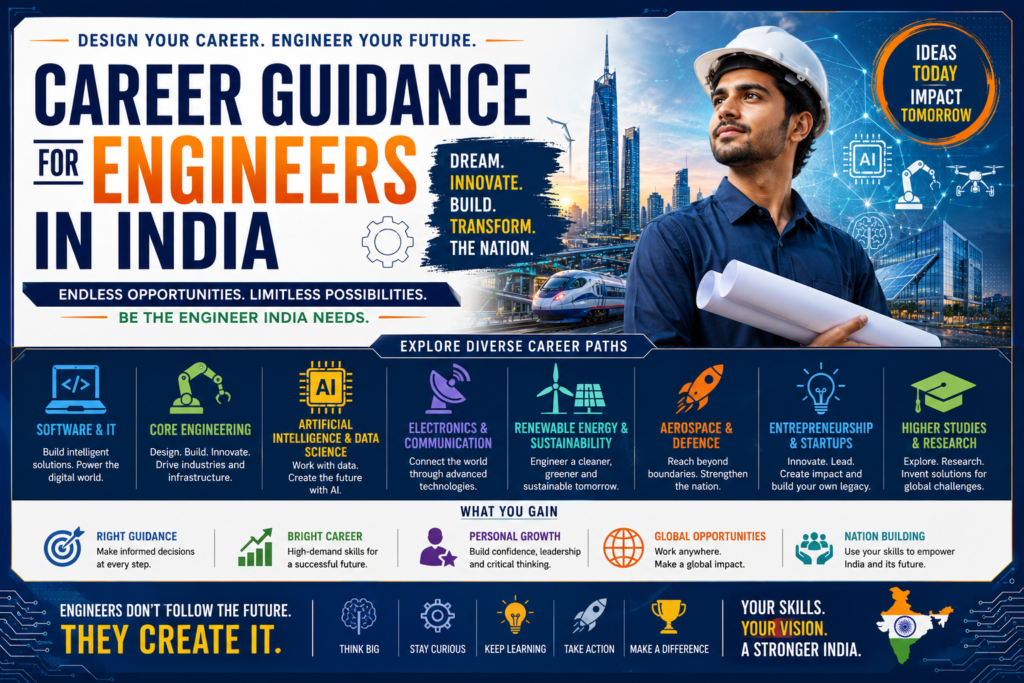
Simultaneously, India possesses one of the largest youth populations in the world. Every year, millions of students pursue engineering education through institutions ranging from premier Indian Institutes of Technology (IITs) and National Institutes of Technology (NITs) to private universities and regional engineering colleges. Yet despite this enormous educational ecosystem, a substantial number of engineering graduates remain uncertain about career direction, skill development, specialization choices, industry expectations, entrepreneurship opportunities, or emerging technological domains.
This paradox reveals a critical truth: engineering education alone is no longer sufficient. Career success in modern India requires strategic adaptability, interdisciplinary intelligence, technological foresight, continuous upskilling, and innovation-oriented thinking.
Career guidance for engineers in India must therefore evolve beyond simplistic advice such as “learn coding” or “get campus placement.” The future engineer must understand the rapidly changing technological landscape and identify where his or her skills align within the evolving global economy.
This article presents a comprehensive and futuristic roadmap for engineers in India, exploring educational pathways, specialization opportunities, emerging technologies, entrepreneurship, higher studies, research careers, financial growth strategies, mental resilience, and the future identity of engineering professionals in a rapidly transforming world.
Engineering Education in India: Opportunities and Structural Challenges
India possesses one of the largest engineering education systems globally. Institutions such as the Indian Institutes of Technology, National Institutes of Technology, IIITs, state engineering universities, and private colleges collectively produce millions of graduates annually.
Historically, engineering education in India emphasized theoretical knowledge, examination performance, and academic memorization. While this model produced technically competent graduates, the modern industrial ecosystem now demands much more.
Today’s engineering industry expects graduates to possess:
- Problem-solving capability
- Analytical thinking
- Practical application skills
- Communication ability
- Project management competency
- Digital adaptability
- Team collaboration
- Innovation mindset
- Entrepreneurial thinking
- Research orientation
Many graduates unfortunately discover a mismatch between academic curricula and industrial expectations. Rapid technological evolution means that engineering knowledge acquired during the first year of college may partially become outdated by graduation.
Therefore, engineering students must understand a crucial reality early in their careers:
Engineering is no longer a static profession. It is a continuous learning ecosystem.
Students who survive merely through degree completion often struggle professionally, whereas those who continuously upgrade their technical and strategic competencies emerge as industry leaders.
The Foundation Years: Building the Right Engineering Mindset
The first years of engineering education should not be viewed merely as a race for grades. They represent the foundational phase for intellectual and professional identity formation.
Students should actively develop:
- Programming literacy
- Technical communication
- Research methodology
- Presentation skills
- Innovation capability
- Industrial awareness
- Leadership ability
- Interdisciplinary learning habits
Engineering students must cultivate curiosity rather than rote memorization. The future engineer is fundamentally a problem solver.
Students should participate in:
- Technical competitions
- Hackathons
- Research projects
- Robotics clubs
- Internships
- Open-source contributions
- Industrial training
- Startup incubation programs
Practical exposure dramatically enhances employability and innovation capability.
Choosing the Right Engineering Branch: Beyond Social Trends
One of the most defining decisions for aspiring engineers is branch selection. Unfortunately, many students choose engineering disciplines based solely on market hype, peer pressure, family expectations, or perceived salary trends.
Such decisions often result in dissatisfaction and career confusion later.
The ideal engineering branch should align with:
- Intellectual interest
- Aptitude
- Personality type
- Long-term industry trends
- Technological adaptability
- Career aspirations
Every branch of engineering possesses future relevance if approached strategically.
Computer Science Engineering: The Digital Powerhouse
Computer Science Engineering (CSE) remains one of the most sought-after branches in India due to the explosive growth of the digital economy.
Fields within computer science now include:
- Artificial intelligence
- Machine learning
- Data science
- Cybersecurity
- Cloud computing
- Blockchain
- Full-stack development
- Quantum computing
- DevOps engineering
- Software architecture
India’s IT sector continues to expand globally through companies such as Infosys, Tata Consultancy Services, Wipro, and numerous startups.
However, the future software engineer must move beyond basic coding. Artificial intelligence tools are automating repetitive programming tasks. Therefore, future engineers must focus upon:
- Systems thinking
- Product innovation
- AI integration
- Algorithmic reasoning
- Cybersecurity expertise
- Human-centered design
The future belongs not merely to coders but to technological architects.
Mechanical Engineering: Reinventing Industrial India
Mechanical engineering remains one of the foundational pillars of industrial civilization. Despite misconceptions that it is becoming obsolete, the branch is undergoing technological reinvention.
Modern mechanical engineering now intersects with:
- Robotics
- Automation
- Electric vehicles
- Aerospace systems
- Renewable energy
- Smart manufacturing
- Mechatronics
- 3D printing
- Nanotechnology
India’s manufacturing ambitions under initiatives such as “Make in India” are creating new opportunities for mechanical engineers.
Future-ready mechanical engineers must learn:
- CAD/CAM technologies
- Robotics programming
- Industrial automation
- AI-assisted manufacturing
- Simulation software
- Sustainable engineering systems
Mechanical engineering is evolving from heavy industrial mechanics into intelligent manufacturing science.
Civil Engineering: Building the Infrastructure of Modern India
India’s rapid urbanization, highway expansion, smart city development, metro rail systems, renewable energy infrastructure, and real estate growth ensure sustained relevance for civil engineers.
Modern civil engineering increasingly integrates:
- Smart infrastructure
- Sustainable construction
- Earthquake-resistant design
- Green buildings
- Urban planning
- Environmental engineering
- GIS mapping
- Construction technology
The future civil engineer will not merely construct buildings but design sustainable ecosystems for future civilizations.
Electrical and Electronics Engineering: Powering the Intelligent Future
Electrical and electronics engineering remain central to technological progress.
Emerging domains include:
- Semiconductor technology
- Electric vehicles
- Renewable energy systems
- Smart grids
- Embedded systems
- IoT devices
- Power electronics
- Robotics hardware
- Quantum electronics
India’s growing semiconductor ambitions and renewable energy initiatives are expected to create substantial opportunities.
Engineers in this field must combine hardware understanding with software integration capabilities.
Biotechnology and Biomedical Engineering: Engineering Human Health
The intersection of engineering and life sciences is becoming one of the most transformative sectors globally.
Biomedical and biotechnology engineers contribute to:
- Medical devices
- Artificial organs
- Drug delivery systems
- Tissue engineering
- Genomics
- Bioinformatics
- Diagnostic technologies
- Healthcare AI systems
The future healthcare ecosystem will increasingly depend upon interdisciplinary engineers capable of integrating biology, data science, electronics, and artificial intelligence.
Aerospace Engineering: India’s Strategic Frontier
India’s advancements in space technology and defense innovation have dramatically increased opportunities in aerospace engineering.
Organizations such as Indian Space Research Organisation and Defence Research and Development Organisation continue expanding India’s technological capabilities.
Future opportunities include:
- Satellite systems
- Space exploration
- Defense aviation
- Hypersonic technologies
- Drone engineering
- Autonomous aerial systems
Aerospace engineering represents one of the most strategically significant fields for national technological sovereignty.
Artificial Intelligence and the Engineering Revolution
Artificial intelligence is reshaping nearly every engineering discipline. AI is no longer confined to computer science alone. It now influences:
- Manufacturing
- Transportation
- Healthcare
- Agriculture
- Energy systems
- Finance
- Defense
- Urban planning
The future engineer must therefore understand:
- Machine learning fundamentals
- Data interpretation
- Automation systems
- AI ethics
- Human-machine interaction
Engineers who fail to adapt to AI integration may face professional irrelevance in coming decades.
However, AI will not eliminate engineering jobs entirely. Instead, it will redefine engineering roles toward higher-order problem solving, innovation, strategic design, and interdisciplinary collaboration.
Entrepreneurship and Startup Culture for Engineers
India’s startup ecosystem has expanded dramatically in recent years. Engineers now possess unprecedented opportunities to become innovators and entrepreneurs.
Technology-driven startups are emerging across:
- Fintech
- Healthtech
- Agritech
- Edtech
- Deep tech
- Renewable energy
- Robotics
- SaaS platforms
- AI systems
Engineers possess natural advantages as entrepreneurs because they understand technical problem solving.
However, successful entrepreneurship also requires:
- Business understanding
- Financial literacy
- Leadership
- Communication skills
- Marketing capability
- Strategic execution
The future engineer may increasingly become a job creator rather than merely a job seeker.
Research and Innovation Careers
India must transition from technology consumption toward technology creation. This transformation requires stronger research ecosystems.
Engineering graduates interested in research may pursue:
- M.Tech
- MS
- PhD
- Industrial R&D careers
- Government research laboratories
Research fields with major future relevance include:
- Quantum computing
- Nanotechnology
- Renewable energy
- Semiconductor science
- Biotechnology
- Robotics
- Space systems
- Advanced materials science
Innovation-driven economies are built by engineers who create intellectual property rather than merely execute existing technologies.
Higher Studies in India and Abroad
Higher education remains an important pathway for specialization and global exposure.
Indian institutes such as:
- IITs
- IISc
- IISERs
- IIITs
offer strong technical research environments.
International destinations such as:
- United States
- Germany
- Canada
- United Kingdom
- Singapore
- Australia
provide advanced research infrastructure and industrial integration.
Students considering higher studies should evaluate:
- Research interests
- Financial implications
- Immigration goals
- Career pathways
- Long-term lifestyle preferences
Higher studies should be driven by intellectual and professional purpose rather than social prestige alone.
The Importance of Skill Development
One of the greatest misconceptions among engineering students is the belief that degrees alone guarantee employability.
Modern industry increasingly values skills over certificates.
Essential future engineering skills include:
- Coding literacy
- Data analysis
- AI integration
- Technical communication
- Project management
- Design thinking
- Digital collaboration
- Cybersecurity awareness
Continuous learning platforms, certifications, internships, and project portfolios are becoming critical career assets.
The future engineer must become a lifelong learner.
Communication Skills and Professional Branding
Many technically competent engineers struggle professionally due to poor communication abilities.
Modern engineering careers require:
- Presentation capability
- Team collaboration
- Technical writing
- Client interaction
- Leadership communication
Engineers should actively build professional visibility through:
- LinkedIn networking
- Technical blogging
- Research publication
- Open-source participation
- Conference presentations
In the digital age, professional branding influences career growth substantially.
Financial Planning and Economic Awareness
Engineering graduates often begin earning earlier than many other professionals, yet financial literacy remains underdeveloped.
Young engineers should learn:
- Investment planning
- Taxation
- Emergency savings
- Insurance management
- Wealth creation principles
Financial discipline provides long-term career flexibility and entrepreneurial confidence.
Mental Health, Burnout, and Career Anxiety
The engineering ecosystem can become psychologically stressful due to:
- Competitive examinations
- Placement pressure
- Job insecurity
- Rapid technological changes
- Workplace burnout
Many engineers experience:
- Anxiety
- Imposter syndrome
- Career confusion
- Emotional exhaustion
Mental resilience therefore becomes essential for long-term professional sustainability.
Engineers must maintain:
- Physical health
- Social support systems
- Emotional balance
- Continuous learning confidence
- Healthy work-life integration
Women Engineers and the Future Workforce
Women are increasingly entering engineering and technology sectors across India.
However, challenges involving:
- Gender stereotypes
- Workplace bias
- Leadership barriers
- Work-life balance
still persist in many sectors.
Future technological ecosystems must promote:
- Inclusive leadership
- Equal opportunities
- Safety and flexibility
- Women-led innovation
India’s technological progress depends significantly upon empowering women engineers.
Engineering Ethics and Social Responsibility
Engineering decisions shape societies. Poor engineering ethics can result in:
- Environmental damage
- Structural disasters
- Cybersecurity threats
- Technological misuse
- Privacy violations
Future engineers must therefore prioritize:
- Sustainability
- Human welfare
- Ethical innovation
- Environmental responsibility
- Technological accountability
Technology without ethics can become dangerous.
Industry 4.0 and the Future Industrial Ecosystem
Industry 4.0 represents the integration of:
- Artificial intelligence
- Robotics
- Big data
- IoT
- Automation
- Cyber-physical systems
This industrial revolution is transforming manufacturing, logistics, healthcare, transportation, and communication.
The future engineer must become interdisciplinary.
Tomorrow’s engineers will need simultaneous understanding of:
- Software systems
- Hardware integration
- Data analytics
- Human-machine collaboration
- Strategic innovation
Rigid specialization alone may become insufficient.
Rural Innovation and Grassroots Engineering
India’s villages continue to face challenges involving:
- Water scarcity
- Agricultural inefficiency
- Energy access
- Infrastructure gaps
- Waste management
Engineers can create transformative social impact through grassroots innovation.
Affordable engineering solutions for rural India may become one of the nation’s greatest development opportunities.
The Future Identity of the Indian Engineer
The future engineer will not merely operate machines or write software code.
The future engineer must become:
- Innovator
- Technologist
- Entrepreneur
- Researcher
- Strategist
- Sustainability architect
- AI collaborator
- National development contributor
India is entering a decisive technological century. The nation’s rise as a global power will depend substantially upon the quality, creativity, ethical strength, and innovation capability of its engineers.
Conclusion: Engineering as a Mission of National Transformation
Career guidance for engineers in India must evolve far beyond placement statistics and salary packages. Engineering is not merely a profession for earning income. It is a strategic discipline that shapes economies, industries, societies, and civilizations.
The Indian engineer today stands at the intersection of artificial intelligence, sustainability, globalization, digital transformation, industrial innovation, and national development.
Those engineers who continuously adapt, learn, innovate, and think strategically will emerge as the architects of India’s future.
Success in engineering will no longer be determined solely by degrees or technical knowledge. The future successful engineer will be defined by:
- Innovation capability
- Technological adaptability
- Ethical integrity
- Communication excellence
- Entrepreneurial thinking
- Lifelong learning
- Strategic vision
India’s technological destiny will not be built only through policies or infrastructure.
It will be built through the imagination, resilience, intelligence, and innovation of its engineers.
The engineer of the future will not merely build machines.
The engineer of the future will build the future of civilization itself.