

Building the Architects of India’s Decentralized Digital Future
Introduction: The Rise of Blockchain in the Age of Digital Civilization
The twenty-first century is witnessing one of the most transformative technological revolutions in human history. Just as the internet reshaped communication, commerce, governance, and globalization in the late twentieth century, blockchain technology is now emerging as a disruptive force capable of redefining digital trust, decentralized finance, cybersecurity, supply chains, healthcare systems, governance structures, intellectual property management, and even the philosophical architecture of digital civilization itself.
Blockchain technology is no longer confined merely to cryptocurrencies such as Bitcoin or Ethereum. It has evolved into a foundational technological framework with applications spanning finance, healthcare, pharmaceuticals, logistics, insurance, agriculture, defense, education, real estate, voting systems, digital identity management, and international trade. Governments, multinational corporations, banks, startups, research institutions, and technology companies across the world are increasingly investing in blockchain infrastructure and decentralized ecosystems.
India, with its rapidly expanding digital economy, massive technology workforce, startup ecosystem, fintech expansion, and growing emphasis on digital governance, is positioned to become one of the major global hubs for blockchain innovation in the coming decades. The country’s strengths in software engineering, information technology services, digital payments infrastructure, and entrepreneurial talent create substantial opportunities for professionals seeking careers in blockchain technologies.
However, blockchain remains one of the most misunderstood technologies among students and professionals alike. Many individuals associate blockchain solely with cryptocurrency trading and speculative digital assets, while failing to recognize its broader technological, industrial, and strategic significance. This misunderstanding often prevents talented individuals from entering one of the world’s fastest-growing technological domains.
Career guidance for blockchain professionals in India therefore requires a multidimensional and futuristic perspective. Blockchain is not merely a programming niche. It is an interdisciplinary ecosystem involving computer science, cryptography, economics, cybersecurity, distributed systems, finance, law, governance, artificial intelligence, and digital innovation.
The blockchain professional of the future will not merely write smart contracts or develop decentralized applications. The future blockchain expert will become a digital architect capable of designing trust systems for the next era of human civilization.
This article presents a comprehensive and detailed roadmap for aspiring blockchain professionals in India, exploring blockchain fundamentals, educational pathways, career opportunities, technical competencies, entrepreneurship, regulatory challenges, financial prospects, emerging industries, research opportunities, and the future evolution of decentralized technologies in the global digital economy.
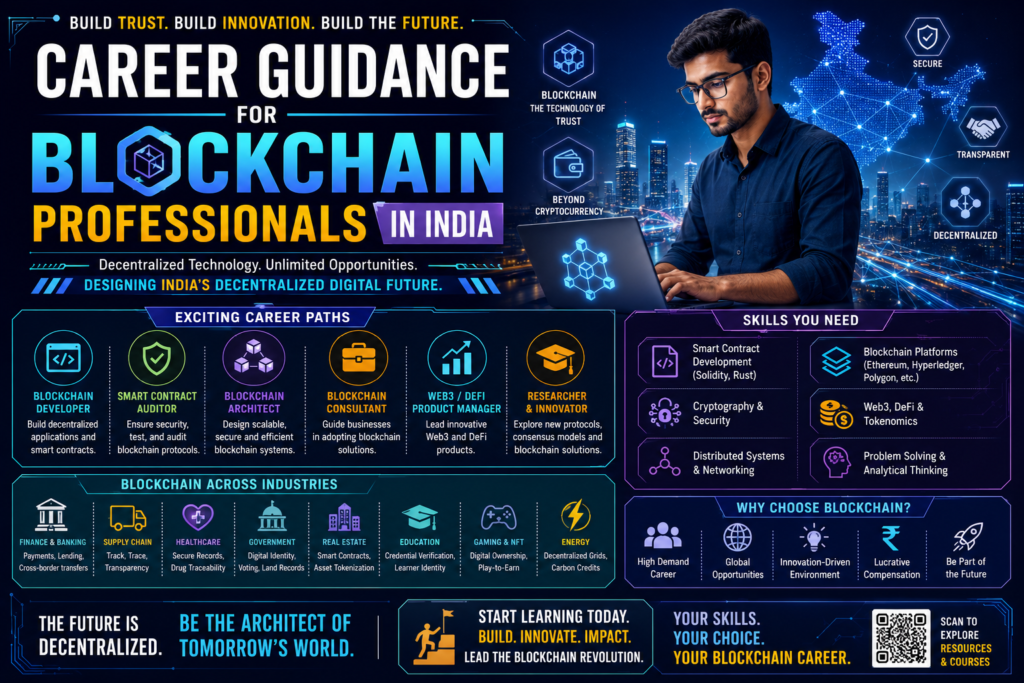
Understanding Blockchain Technology: Beyond Cryptocurrency
To build a meaningful career in blockchain technologies, professionals must first understand the fundamental philosophy underlying blockchain systems.
Blockchain is essentially a decentralized digital ledger technology that records transactions or information across multiple distributed computers in a secure, transparent, immutable, and tamper-resistant manner. Unlike traditional centralized databases controlled by a single authority, blockchain systems distribute data validation across network participants.
This decentralization creates several transformative advantages:
- Transparency
- Security
- Immutability
- Reduced fraud
- Elimination of intermediaries
- Trustless verification
- Enhanced data integrity
The true revolutionary aspect of blockchain lies not merely in digital currencies but in the concept of decentralized trust.
Historically, human societies depended upon centralized institutions such as banks, governments, corporations, and intermediaries to verify transactions and maintain records. Blockchain introduces the possibility of trust through mathematical consensus rather than centralized authority.
This shift may profoundly transform industries globally.
The Evolution of Blockchain Technology
Blockchain technology has evolved through multiple developmental stages.
Blockchain 1.0: Cryptocurrency Era
The first major blockchain revolution began with the emergence of Bitcoin in 2009. Bitcoin demonstrated the possibility of decentralized digital currency systems operating independently of central banks.
This phase primarily focused upon:
- Digital payments
- Peer-to-peer transactions
- Decentralized monetary systems
Blockchain 2.0: Smart Contracts and Decentralized Applications
The introduction of Ethereum expanded blockchain capabilities through smart contracts — programmable agreements capable of executing automatically when predefined conditions are met.
This phase enabled:
- Decentralized applications (DApps)
- Token ecosystems
- DeFi platforms
- NFT marketplaces
- Automated financial protocols
Blockchain evolved from digital currency infrastructure into programmable digital ecosystems.
Blockchain 3.0: Enterprise and Industrial Integration
The latest phase focuses upon enterprise adoption and integration into real-world industries such as:
- Supply chain management
- Healthcare systems
- Digital identity
- Pharmaceutical traceability
- Banking infrastructure
- Government records
- Logistics management
This phase represents the most significant opportunity for blockchain professionals in India.
Why Blockchain Matters for India
India represents one of the world’s most promising environments for blockchain innovation due to several strategic advantages.
Massive Digital Economy
India’s digital transformation accelerated dramatically through:
- UPI infrastructure
- Digital banking
- E-governance
- Aadhaar systems
- Fintech expansion
- Startup growth
Blockchain integration can further enhance transparency, security, and efficiency across these systems.
Growing Startup Ecosystem
India possesses one of the world’s largest startup ecosystems. Blockchain startups are emerging across:
- Fintech
- Healthcare
- Agritech
- Logistics
- Education
- Supply chain systems
- Web3 applications
This creates expanding career opportunities for blockchain developers and strategists.
IT Workforce Strength
India’s global reputation in software development provides a strong foundation for blockchain adoption. Engineers with programming expertise can transition into blockchain development relatively effectively.
Government and Enterprise Interest
Indian enterprises and government agencies are increasingly exploring blockchain applications in:
- Land records
- Identity verification
- Financial systems
- Healthcare databases
- Academic credential verification
As institutional adoption increases, demand for blockchain professionals is expected to rise substantially.
Educational Pathways for Blockchain Careers
One of the unique aspects of blockchain careers is that there is no single mandatory educational pathway.
Professionals from multiple backgrounds can enter blockchain ecosystems, including:
- Computer science
- Information technology
- Electronics engineering
- Mathematics
- Finance
- Economics
- Cybersecurity
- Law
However, strong technical foundations significantly improve career prospects.
Students interested in blockchain should ideally develop expertise in:
- Programming
- Data structures
- Algorithms
- Cryptography
- Networking
- Distributed systems
- Database management
Programming languages commonly used in blockchain development include:
- Solidity
- Rust
- JavaScript
- Python
- Go
- C++
Essential Technical Skills for Blockchain Professionals
Blockchain careers require multidisciplinary technical capabilities.
Cryptography
Cryptography forms the backbone of blockchain security. Professionals must understand:
- Hash functions
- Public-private key encryption
- Digital signatures
- Consensus algorithms
Without cryptographic understanding, blockchain architecture cannot be fully comprehended.
Smart Contract Development
Smart contracts automate decentralized transactions and applications.
Professionals should learn:
- Solidity programming
- Ethereum Virtual Machine architecture
- Gas optimization
- Smart contract auditing
- Security testing
Smart contract vulnerabilities can lead to catastrophic financial losses, making secure coding essential.
Distributed Systems
Blockchain networks are distributed computing systems.
Professionals should understand:
- Peer-to-peer networks
- Consensus mechanisms
- Node architecture
- Scalability challenges
- Fault tolerance
Cybersecurity
Blockchain systems remain vulnerable to:
- Smart contract exploits
- Phishing attacks
- Protocol vulnerabilities
- Wallet security breaches
Blockchain professionals with cybersecurity expertise are expected to witness increasing demand.
Major Career Roles in Blockchain Technology
Blockchain careers are rapidly diversifying.
Blockchain Developer
Blockchain developers design decentralized systems and smart contracts.
Responsibilities include:
- Smart contract programming
- DApp development
- Protocol integration
- Blockchain architecture
This remains one of the most in-demand blockchain roles globally.
Smart Contract Auditor
Security auditing has become critically important due to rising cyberattacks within blockchain ecosystems.
Auditors identify:
- Coding vulnerabilities
- Exploitable loopholes
- Consensus weaknesses
- Security flaws
Blockchain security experts command substantial professional value.
Blockchain Architect
Architects design large-scale decentralized systems.
Responsibilities include:
- Infrastructure planning
- Scalability optimization
- Consensus selection
- Enterprise integration
This role combines technical depth with strategic thinking.
Blockchain Consultant
Consultants advise enterprises regarding blockchain implementation strategies.
Responsibilities involve:
- Feasibility analysis
- Digital transformation planning
- Blockchain integration models
- Regulatory considerations
Consulting opportunities are expected to expand significantly as enterprises adopt blockchain systems.
Web3 Product Manager
Web3 ecosystems require professionals capable of bridging technology, business strategy, and user experience.
Product managers oversee:
- Platform development
- Ecosystem growth
- User adoption strategies
- Community coordination
Blockchain Researcher
Research professionals contribute to:
- Scalability innovations
- Cryptographic systems
- Consensus algorithms
- Interoperability solutions
India requires stronger blockchain research ecosystems to achieve technological sovereignty.
Decentralized Finance (DeFi): The Financial Revolution
One of blockchain’s most disruptive applications is decentralized finance.
DeFi platforms attempt to recreate financial services such as:
- Lending
- Borrowing
- Trading
- Insurance
- Asset management
without traditional intermediaries.
This ecosystem creates opportunities for:
- Blockchain developers
- Financial analysts
- Token economists
- Security experts
- Compliance professionals
India’s fintech ecosystem may increasingly intersect with decentralized financial technologies.
NFTs and the Creator Economy
Non-fungible tokens (NFTs) introduced blockchain into:
- Digital art
- Intellectual property
- Gaming
- Entertainment
- Digital ownership systems
While speculative hype surrounding NFTs fluctuates, the underlying concept of verifiable digital ownership remains strategically important.
Future blockchain professionals may work in:
- Digital rights management
- Gaming ecosystems
- Metaverse platforms
- Intellectual property systems
Blockchain in Healthcare and Pharmaceuticals
Blockchain possesses transformative potential within healthcare and pharmaceutical industries.
Potential applications include:
- Drug supply chain traceability
- Electronic health records
- Clinical trial transparency
- Anti-counterfeit systems
- Prescription authentication
India’s pharmaceutical industry may increasingly adopt blockchain to strengthen regulatory compliance and supply chain integrity.
Blockchain and Cybersecurity
Cybersecurity is becoming one of the most important blockchain career domains.
As decentralized systems expand, cybersecurity threats involving:
- Wallet theft
- Smart contract hacks
- Identity fraud
- Protocol attacks
are increasing.
Blockchain cybersecurity experts capable of securing decentralized ecosystems will become strategically vital professionals.
Legal and Regulatory Careers in Blockchain
Blockchain technology creates complex legal and regulatory questions involving:
- Digital assets
- Smart contracts
- Taxation
- Data privacy
- Financial compliance
- Cross-border regulation
Lawyers and compliance professionals specializing in blockchain regulation are expected to witness substantial future demand.
India’s evolving regulatory landscape regarding digital assets will significantly influence blockchain industry growth.
Entrepreneurship Opportunities in Blockchain
Blockchain technology offers immense entrepreneurial potential.
Indian blockchain startups are emerging in:
- Fintech
- Supply chains
- Healthcare
- Identity management
- Gaming
- Education
- Digital governance
Blockchain entrepreneurs must combine:
- Technical expertise
- Business strategy
- Regulatory understanding
- Community building capability
The decentralized economy may create entirely new business models over the coming decades.
The Importance of Community Building in Blockchain Ecosystems
Unlike traditional industries, blockchain ecosystems are highly community-driven.
Professional success often depends upon:
- Open-source contributions
- Developer communities
- Governance participation
- Ecosystem networking
Blockchain professionals should actively participate in:
- Hackathons
- Developer forums
- Web3 conferences
- Open-source collaborations
Visibility within blockchain communities significantly enhances opportunities.
Global Career Opportunities for Indian Blockchain Professionals
Blockchain remains a global industry with remote work flexibility.
Indian professionals can work with:
- International startups
- Global DeFi protocols
- Web3 platforms
- Security firms
- Research organizations
The decentralized nature of blockchain ecosystems enables borderless collaboration.
Remote blockchain careers may therefore become highly attractive for Indian professionals.
Financial Prospects and Compensation
Blockchain careers often offer strong compensation due to talent scarcity and technical complexity.
High-demand roles include:
- Smart contract engineers
- Blockchain architects
- Security auditors
- Protocol developers
- Web3 strategists
However, professionals must distinguish sustainable blockchain innovation from speculative hype.
Long-term success depends upon technical expertise and strategic adaptability rather than short-term cryptocurrency speculation.
The Risks and Challenges of Blockchain Careers
Despite enormous opportunities, blockchain careers involve substantial challenges.
Regulatory Uncertainty
Governments globally continue debating cryptocurrency and digital asset regulations.
Regulatory uncertainty may influence:
- Investment patterns
- Startup viability
- Market growth
Professionals must therefore remain adaptable.
Rapid Technological Evolution
Blockchain ecosystems evolve extremely rapidly.
Protocols, frameworks, and technologies frequently change, requiring continuous learning.
Security Risks
Blockchain systems remain vulnerable to sophisticated cyberattacks.
Professionals must maintain rigorous security awareness.
Market Volatility
Cryptocurrency markets experience extreme volatility.
Blockchain professionals should focus upon technological innovation rather than speculative financial behavior.
Artificial Intelligence and Blockchain Integration
The convergence of artificial intelligence and blockchain may define the next technological revolution.
Potential applications include:
- Decentralized AI marketplaces
- AI data integrity systems
- Autonomous smart contracts
- AI-powered cybersecurity
Professionals who understand both AI and blockchain may become exceptionally valuable in future technological ecosystems.
Blockchain and National Digital Sovereignty
Blockchain technologies may significantly influence geopolitical and economic sovereignty.
Nations increasingly recognize the strategic importance of:
- Digital identity systems
- Central bank digital currencies
- Secure digital infrastructure
- Decentralized data protection
India’s future digital sovereignty may partially depend upon domestic blockchain innovation capabilities.
Ethical Considerations in Blockchain Technologies
Blockchain professionals must recognize ethical responsibilities involving:
- Privacy protection
- Financial inclusion
- Cybersecurity
- Energy sustainability
- Digital governance
Technology without ethics can produce social instability.
Future blockchain ecosystems must prioritize responsible innovation and human welfare.
Women in Blockchain Technology
Women remain underrepresented in blockchain ecosystems globally.
India’s blockchain future must encourage:
- Inclusive participation
- Women-led innovation
- Leadership diversity
- Equal opportunities
Diverse technological ecosystems produce stronger innovation outcomes.
The Future of Web3 and Decentralized Civilization
Web3 represents the vision of a decentralized internet where users possess greater control over:
- Data ownership
- Digital identity
- Financial systems
- Online communities
Blockchain technologies may fundamentally reshape:
- Social media
- Commerce
- Governance
- Finance
- Digital interaction
Professionals entering blockchain today are participating in the early construction of future digital civilization.
Conclusion: Building the Architects of India’s Decentralized Future
Career guidance for blockchain professionals in India must move beyond superficial conversations surrounding cryptocurrency speculation. Blockchain represents far more than digital assets. It is a foundational technological revolution capable of transforming trust systems across industries and societies.
The blockchain professional of the future will not merely develop code.
The future blockchain expert must become:
- Technologist
- Cybersecurity strategist
- Digital architect
- Innovator
- Entrepreneur
- Governance thinker
- Researcher
- Decentralized systems designer
India possesses extraordinary potential to become a global blockchain powerhouse due to its technological workforce, digital infrastructure, startup ecosystem, and innovation capabilities.
However, success in blockchain careers will require:
- Continuous learning
- Technical excellence
- Ethical integrity
- Strategic adaptability
- Interdisciplinary thinking
The future digital economy will increasingly depend upon decentralized systems, secure digital trust, transparent governance, and intelligent technological infrastructure.
Blockchain professionals will stand at the center of this transformation.
The blockchain engineer of the future will not merely build applications.
The blockchain engineer of the future will build the architecture of digital civilization itself.