

The Impact of Artificial Intelligence on India’s Healthcare Infrastructure in the Coming Decades
By Devanssh Mehta
Abstract
Artificial Intelligence (AI) is poised to become one of the defining technologies of India’s healthcare transformation over the coming decades. As the nation strives to provide equitable, affordable, and high-quality healthcare to more than 1.4 billion citizens, AI offers unprecedented opportunities to strengthen healthcare infrastructure, improve clinical outcomes, optimize hospital operations, and accelerate pharmaceutical innovation. From intelligent diagnostics and precision medicine to robotic surgery, predictive analytics, and digital public health surveillance, AI has the potential to reshape every layer of the healthcare ecosystem. However, realizing this potential will require robust digital infrastructure, ethical governance, regulatory preparedness, workforce development, and interdisciplinary collaboration. This article explores the transformative role of AI in India’s healthcare infrastructure, its emerging applications, future opportunities, and the strategic roadmap required to build an intelligent, resilient, and patient-centric healthcare system.
Introduction
Healthcare is undergoing one of the most significant technological transformations in modern history. Artificial Intelligence has moved beyond theoretical research and is now being integrated into clinical practice, pharmaceutical research, hospital management, medical education, and public health policy. Globally, AI is redefining how healthcare is delivered by enabling faster diagnoses, data-driven clinical decision-making, automation of repetitive tasks, and personalized patient care.
For India, the significance of AI is particularly profound. Despite remarkable achievements in medical science, pharmaceutical manufacturing, and digital innovation, the country’s healthcare infrastructure continues to face persistent challenges. Rapid population growth, an increasing burden of chronic diseases, shortages of healthcare professionals, disparities between urban and rural healthcare facilities, and rising healthcare expenditure continue to place enormous pressure on the system.
Artificial Intelligence presents a unique opportunity to address these structural challenges while supporting the Government of India’s vision of digitally enabled, accessible, and affordable healthcare. Rather than replacing healthcare professionals, AI will increasingly serve as an intelligent partner, augmenting clinical expertise and improving healthcare delivery across the country.
India’s Healthcare Infrastructure: Current Challenges
India has made considerable progress through initiatives such as Ayushman Bharat, the Ayushman Bharat Digital Mission (ABDM), expansion of medical colleges, telemedicine services, and digital health records. Nevertheless, major infrastructure gaps remain.
Many districts continue to experience shortages of specialists, diagnostic facilities, intensive care units, and advanced laboratory services. Rural populations often travel long distances to access tertiary healthcare, while metropolitan hospitals struggle with overcrowding and resource constraints. Simultaneously, lifestyle-related diseases—including diabetes, cardiovascular disorders, obesity, chronic respiratory illnesses, and cancer—are increasing at an alarming rate.
The coming decades will therefore require healthcare systems that are not merely larger, but significantly smarter. Artificial Intelligence is expected to play a central role in this evolution.
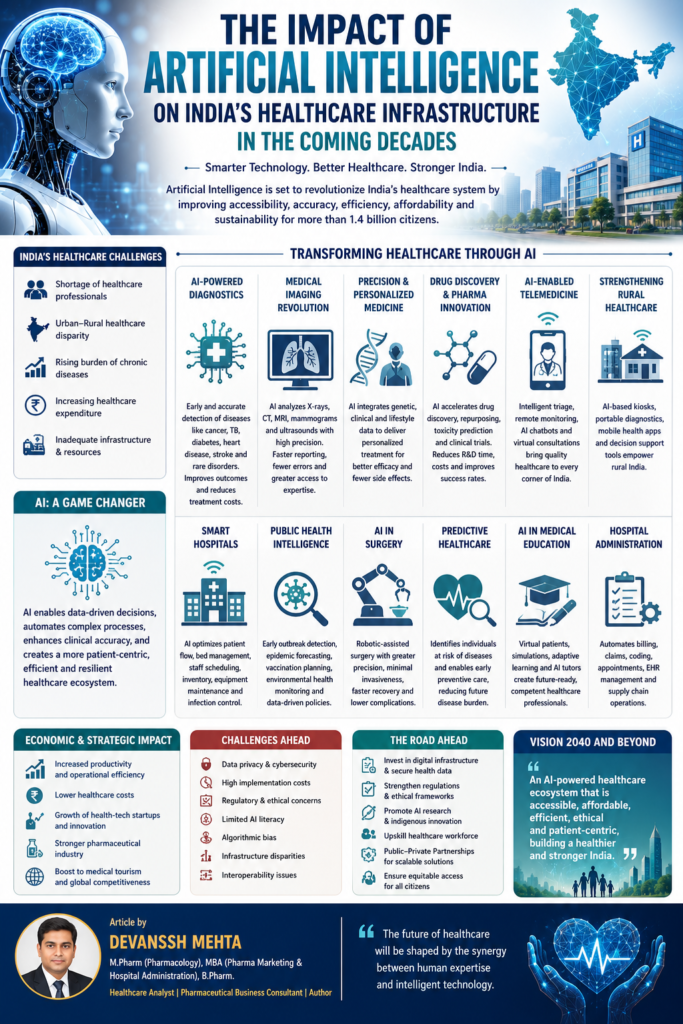
AI-Driven Clinical Diagnostics
One of the most transformative applications of AI lies in clinical diagnostics. Advanced machine learning algorithms can analyse millions of clinical records, laboratory investigations, imaging studies, and patient histories within seconds, enabling faster and more accurate decision-making.
AI-assisted diagnostic systems are expected to improve early detection of conditions such as cancer, tuberculosis, diabetic retinopathy, stroke, cardiovascular diseases, neurological disorders, and rare genetic conditions. Early diagnosis allows timely intervention, reduces complications, lowers treatment costs, and improves long-term patient outcomes.
Rather than replacing physicians, AI functions as a sophisticated clinical decision-support system that enhances diagnostic confidence and minimizes human error.
Revolutionizing Medical Imaging
Radiology represents one of the fastest-growing areas of AI adoption. Deep learning algorithms can identify subtle abnormalities in X-rays, CT scans, MRI scans, mammograms, and ultrasound images with remarkable precision.
In India’s resource-constrained settings, AI-assisted imaging has the potential to reduce reporting delays, standardize diagnostic quality, support radiologists managing large caseloads, and extend specialist expertise to remote healthcare facilities through cloud-based platforms.
Future radiology departments are likely to operate as integrated human-AI collaborations where intelligent software accelerates image interpretation while radiologists retain ultimate clinical responsibility.
Precision Medicine and Personalized Healthcare
Healthcare is gradually shifting from standardized treatment approaches toward individualized medicine. AI enables precision healthcare by integrating genomic information, laboratory findings, imaging data, electronic health records, environmental exposures, and lifestyle factors to generate personalized therapeutic recommendations.
Such approaches may significantly improve treatment effectiveness in oncology, cardiology, neurology, endocrinology, infectious diseases, and pharmacogenomics while reducing adverse drug reactions and unnecessary healthcare expenditure.
Transforming India’s Pharmaceutical Industry
India is widely recognized as the “Pharmacy of the World.” Artificial Intelligence is expected to further strengthen this position by accelerating pharmaceutical research and development.
AI applications include target identification, molecular modelling, drug repurposing, toxicity prediction, clinical trial optimization, pharmacovigilance, and biomarker discovery. By reducing the cost and duration of drug development, AI can enhance innovation while making novel therapies more accessible.
Integration of AI with computational biology, bioinformatics, and precision pharmacology will define the future of pharmaceutical research.
AI-Enabled Telemedicine and Rural Healthcare
Telemedicine has already transformed healthcare accessibility in India, particularly following the COVID-19 pandemic. AI will further strengthen digital healthcare by enabling intelligent symptom assessment, automated triage, remote patient monitoring, predictive risk analysis, multilingual virtual assistants, and personalized follow-up care.
For rural India, AI-powered diagnostic kiosks, portable imaging devices, wearable sensors, and decision-support tools for community health workers can substantially reduce healthcare disparities. Intelligent healthcare platforms will help extend specialist services to underserved populations while minimizing travel and associated costs.
Smart Hospitals and Intelligent Healthcare Infrastructure
The hospitals of the future will increasingly rely on AI-powered infrastructure to optimize operational efficiency. Intelligent hospital management systems will automate appointment scheduling, patient flow management, resource allocation, inventory control, predictive equipment maintenance, infection surveillance, and emergency response coordination.
Such digital transformation can reduce administrative burden, improve patient satisfaction, optimize workforce utilization, and lower operational costs without compromising quality of care.
Public Health Intelligence
Artificial Intelligence is expected to become an indispensable tool for national public health surveillance. By analysing large-scale epidemiological datasets, AI can detect disease outbreaks earlier, forecast epidemic trends, optimize vaccination campaigns, monitor antimicrobial resistance, and identify environmental health risks.
During future pandemics and public health emergencies, AI-supported predictive modelling could significantly improve preparedness, resource allocation, and evidence-based policymaking.
Robotic Surgery and Advanced Clinical Care
AI-integrated robotic surgery is gradually expanding across tertiary healthcare centres. These systems provide enhanced surgical precision, greater dexterity, improved visualization, reduced blood loss, smaller incisions, and faster postoperative recovery.
Although robotic surgery remains resource-intensive, technological advancements and declining costs are expected to improve accessibility across India’s healthcare infrastructure in the coming decades.
Medical Education in the AI Era
Artificial Intelligence will also reshape medical education by enabling adaptive learning platforms, virtual patients, immersive simulation laboratories, AI tutors, automated assessments, and competency-based training. Future healthcare professionals will require not only clinical expertise but also digital literacy, data interpretation skills, and an understanding of AI-assisted clinical decision-making.
Medical curricula will increasingly integrate data science, digital health, bioinformatics, and ethical AI governance.
Economic and Strategic Implications
Beyond improving healthcare delivery, AI has significant economic implications for India. Increased productivity, reduced healthcare expenditure, accelerated pharmaceutical innovation, expansion of health technology startups, and growth in medical tourism could collectively strengthen India’s position as a global healthcare innovation hub.
The convergence of AI, biotechnology, digital health, genomics, and pharmaceutical manufacturing may create entirely new sectors within the healthcare economy.
Challenges and Ethical Considerations
Despite its transformative potential, AI adoption presents important challenges. Data privacy, cybersecurity, algorithmic bias, transparency, interoperability, regulatory uncertainty, infrastructure disparities, and workforce readiness remain critical concerns.
Ethical governance will be essential to ensure that AI complements clinical judgment rather than replacing human empathy and professional accountability. Policymakers must establish robust regulatory frameworks that promote innovation while safeguarding patient rights, data security, and equitable healthcare access.
Strategic Roadmap for India
To fully harness AI’s potential, India should prioritize investments in digital health infrastructure, secure electronic health records, high-quality clinical datasets, AI research centres, healthcare workforce training, and interdisciplinary collaboration among government agencies, academia, healthcare institutions, and industry.
Strengthening regulatory frameworks, encouraging indigenous AI innovation, promoting public-private partnerships, and expanding digital connectivity in rural regions will be equally important in ensuring sustainable and inclusive healthcare transformation.
Conclusion
Artificial Intelligence is not merely another technological advancement; it represents a paradigm shift in the future of healthcare. Over the coming decades, AI is expected to become deeply embedded within every component of India’s healthcare infrastructure—from diagnostics and treatment planning to hospital administration, pharmaceutical research, medical education, and national public health management.
India possesses unique advantages, including a rapidly growing digital ecosystem, a globally respected pharmaceutical industry, an expanding healthcare workforce, and strong government support for digital health initiatives. If implemented responsibly through evidence-based policymaking, ethical governance, and continuous investment in innovation, Artificial Intelligence can help build a healthcare system that is more efficient, equitable, resilient, and patient-centred.
The future of Indian healthcare will not be defined by Artificial Intelligence alone, but by the successful collaboration between intelligent technologies and skilled healthcare professionals. Such a partnership has the potential to position India as a global leader in next-generation healthcare while significantly improving the health and well-being of its population.
Author
Devanssh Mehta
M.Pharm. (Pharmacology), MBA (Pharmaceutical Marketing & Hospital Administration), B.Pharm.
Researcher, Healthcare Analyst, Pharmaceutical Business Consultant, and Author.