

Twenty Ways of Effective Financial Management
Abstract
Financial management is one of the most essential life skills in today’s rapidly changing economic environment. Whether an individual is a student, employee, entrepreneur, or retiree, managing money wisely determines long-term financial stability and peace of mind. Effective financial management is not merely about earning more income; it is about making informed decisions regarding spending, saving, investing, and protecting wealth. It requires discipline, planning, continuous learning, and adaptability to changing financial circumstances. This article presents twenty practical and evidence-based strategies that can help individuals build a secure financial future while minimizing unnecessary risks and maximizing opportunities for growth.
Keywords: Financial management, budgeting, saving, investing, wealth creation, personal finance, financial planning, emergency fund, debt management, financial literacy.
Introduction
Money influences almost every aspect of modern life. It determines access to education, healthcare, housing, travel, and retirement security. However, despite its importance, financial management remains one of the least formally taught life skills. Many individuals earn good incomes but struggle financially because of poor spending habits, lack of planning, excessive debt, or inadequate investments.
Effective financial management is not reserved for accountants or financial experts. It is a practical discipline that anyone can develop through consistent habits and informed decision-making. The following twenty principles provide a comprehensive framework for achieving financial stability and long-term prosperity.
1. Create a Realistic Budget
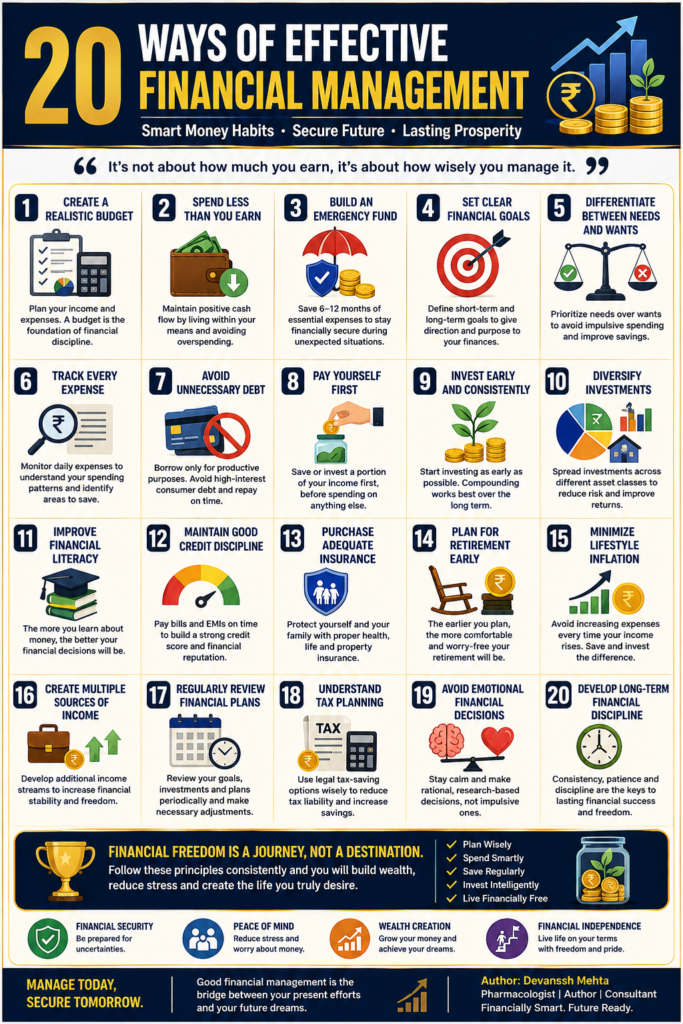
A budget serves as the foundation of financial management. It allows individuals to track income and expenditures while ensuring that expenses remain within available resources. Monthly budgeting helps identify unnecessary spending and improves financial discipline.
2. Spend Less Than You Earn
One of the simplest yet most powerful financial principles is maintaining a positive cash flow. Consistently spending less than one’s income creates opportunities for savings, investments, and future wealth accumulation.
3. Build an Emergency Fund
Unexpected medical emergencies, job losses, or economic downturns can significantly affect financial stability. Maintaining an emergency fund equivalent to six to twelve months of essential living expenses provides financial security during unforeseen circumstances.
4. Set Clear Financial Goals
Financial goals provide direction and motivation. Goals may include purchasing a home, funding higher education, establishing a business, or planning retirement. Clearly defined objectives improve financial decision-making and encourage disciplined saving.
5. Differentiate Between Needs and Wants
Successful financial management requires distinguishing essential expenses from discretionary spending. Prioritizing necessities over luxuries prevents impulsive purchases and improves long-term financial health.
6. Track Every Expense
Monitoring daily expenditures increases awareness of spending patterns. Even small recurring expenses can accumulate into significant amounts over time. Expense tracking allows timely corrective action.
7. Avoid Unnecessary Debt
While certain loans such as education or home loans may be productive investments, excessive consumer debt often becomes a financial burden. Responsible borrowing and timely repayment protect financial stability.
8. Pay Yourself First
Savings should be treated as a fixed monthly expense rather than whatever remains after spending. Automatically transferring a portion of income into savings or investment accounts promotes consistent wealth creation.
9. Invest Early and Consistently
The power of compound growth makes early investing one of the most effective wealth-building strategies. Regular investments over long periods often outperform sporadic large investments.
10. Diversify Investments
Diversification reduces financial risk by spreading investments across different asset classes such as equities, bonds, mutual funds, fixed deposits, gold, and real estate. A diversified portfolio enhances long-term stability.
11. Improve Financial Literacy
Financial knowledge enables better decisions regarding investments, taxes, insurance, and retirement planning. Reading financial books, attending seminars, and following credible financial resources improve money management skills.
12. Maintain Good Credit Discipline
A strong credit history facilitates easier access to loans at favorable interest rates. Paying bills and loan installments on time strengthens creditworthiness and financial reputation.
13. Purchase Adequate Insurance
Insurance protects against financial losses arising from illness, accidents, disability, property damage, or death. Appropriate health, life, and property insurance reduce long-term financial risks.
14. Plan for Retirement Early
Retirement planning should begin during the early years of one’s career. Long investment horizons provide greater opportunities for wealth accumulation through compounding returns.
15. Minimize Lifestyle Inflation
As income increases, many individuals proportionally increase their spending. Maintaining modest lifestyle growth while increasing savings and investments accelerates wealth accumulation.
16. Create Multiple Sources of Income
Financial resilience improves when income originates from multiple sources. Investments, rental properties, consulting, freelancing, royalties, dividends, or businesses reduce dependence on a single salary.
17. Regularly Review Financial Plans
Financial goals evolve with age, family responsibilities, career progression, and economic conditions. Annual financial reviews ensure that investment strategies remain aligned with changing objectives.
18. Understand Tax Planning
Legal tax planning helps maximize after-tax income through appropriate deductions, exemptions, retirement contributions, and investment incentives available under applicable tax laws.
19. Avoid Emotional Financial Decisions
Fear, greed, social pressure, and impulsive behavior often lead to poor financial choices. Objective, research-based decision-making generally produces better long-term financial outcomes.
20. Develop Long-Term Financial Discipline
Financial success rarely results from isolated decisions. It is built through years of disciplined budgeting, saving, investing, continuous learning, and responsible spending. Consistency remains the greatest predictor of long-term financial prosperity.
Conclusion
Effective financial management is a lifelong process rather than a one-time activity. Sound financial habits developed today create opportunities for future independence, security, and prosperity. Budgeting wisely, controlling expenses, investing consistently, managing debt responsibly, maintaining adequate insurance, and continuously improving financial literacy collectively establish a strong financial foundation. Individuals who adopt these twenty principles are better equipped to navigate economic uncertainties while steadily progressing toward their personal and professional aspirations. Ultimately, financial success is determined less by the amount of money earned and more by the wisdom with which it is managed.
Suggested References
- Bogle, J. C. The Little Book of Common Sense Investing. Wiley.
- Covey, S. R. The 7 Habits of Highly Effective People. Simon & Schuster.
- Kahneman, D. Thinking, Fast and Slow. Farrar, Straus and Giroux.
- Kiyosaki, R. T. Rich Dad Poor Dad. Plata Publishing.
- Ramsey, D. The Total Money Makeover. Thomas Nelson.
- Sethi, R. I Will Teach You to Be Rich. Workman Publishing.
- Collins, J. L. The Simple Path to Wealth. JL Collins LLC.
- Reserve Bank of India. Financial Education and Consumer Awareness Publications.
- Securities and Exchange Board of India (SEBI). Investor Education Resources.
- National Centre for Financial Education (NCFE). Financial Literacy Publications.