

How to Effectively Follow the Constitution of India: A Guide to Responsible Citizenship
Abstract
The Constitution of India is more than a legal document; it is the foundation of the nation’s democratic values, governance, justice, and social harmony. It establishes the rights and responsibilities of every citizen while defining the framework within which governments function. Effectively following the Constitution does not require legal expertise. Instead, it requires an understanding of its principles and a commitment to practicing them in everyday life. This article explores practical ways through which citizens can uphold constitutional values, strengthen democracy, and contribute to the development of an inclusive, peaceful, and progressive India.
Introduction
Adopted on 26 November 1949 and coming into force on 26 January 1950, the Constitution of India is the supreme law of the land. It guarantees justice, liberty, equality, and fraternity to all citizens irrespective of religion, caste, gender, language, or region.
The Constitution is not merely a document for judges, lawyers, and politicians. It serves as a moral and legal guide for every citizen. A constitutional society is one where individuals respect the rule of law, uphold democratic values, and fulfill both their rights and responsibilities.
Following the Constitution effectively begins with awareness and continues through responsible conduct in personal, professional, and public life.
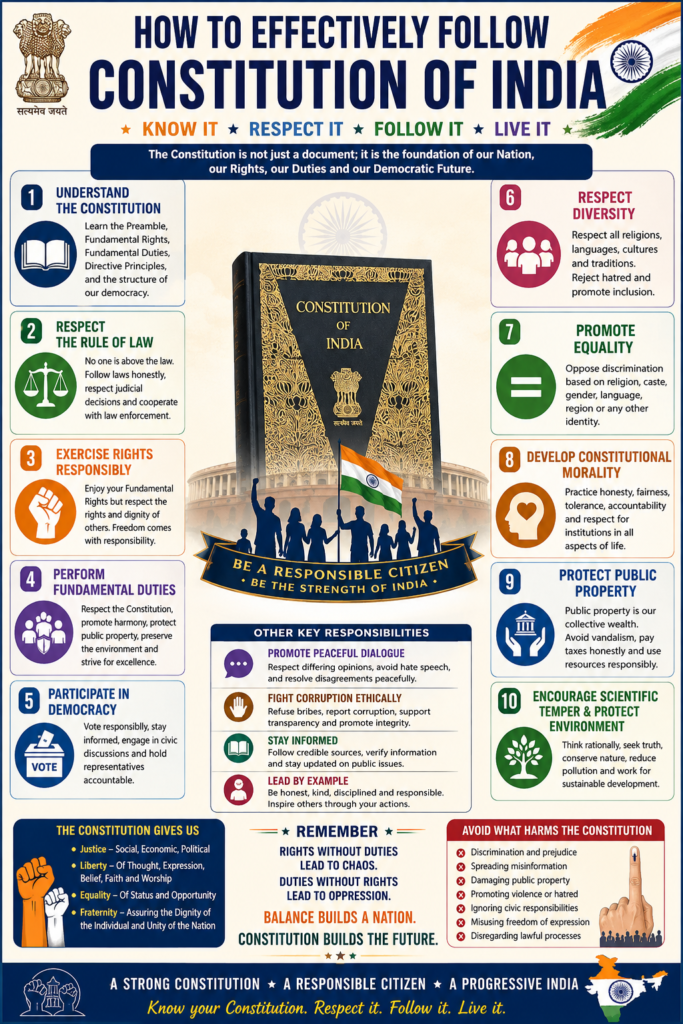
1. Understand the Constitution
The first step is to gain a basic understanding of the Constitution.
Citizens should familiarize themselves with:
- The Preamble
- Fundamental Rights
- Fundamental Duties
- Directive Principles of State Policy
- Structure of the Union and State Governments
- Independent Judiciary
- Election system
- Constitutional institutions
Even a basic knowledge enables citizens to make informed decisions and actively participate in democracy.
2. Respect the Rule of Law
No individual is above the law.
Responsible citizens should:
- Follow laws honestly.
- Respect judicial decisions.
- Avoid illegal shortcuts.
- Cooperate with law enforcement agencies.
- Resolve disputes through lawful means.
Respect for the rule of law builds trust and stability in society.
3. Exercise Fundamental Rights Responsibly
The Constitution guarantees several Fundamental Rights, including:
- Right to Equality
- Right to Freedom
- Right against Exploitation
- Freedom of Religion
- Cultural and Educational Rights
- Right to Constitutional Remedies
Citizens should enjoy these rights while respecting the rights of others. Freedom should always be exercised with responsibility.
4. Perform Fundamental Duties
Part IVA of the Constitution outlines the Fundamental Duties of citizens. These include:
- Respect the Constitution and national symbols.
- Promote harmony and brotherhood.
- Protect public property.
- Preserve the environment.
- Develop scientific temper and humanism.
- Safeguard India’s heritage.
- Strive for excellence.
- Value the nation’s sovereignty and integrity.
Responsible citizenship requires balancing rights with duties.
5. Participate in Democratic Processes
Democracy succeeds when citizens actively participate.
Effective participation includes:
- Voting responsibly.
- Staying informed about public issues.
- Engaging peacefully in civic discussions.
- Holding elected representatives accountable.
- Encouraging ethical governance.
An informed voter strengthens democratic institutions.
6. Respect Diversity
India is home to extraordinary linguistic, cultural, religious, and regional diversity.
Constitutional values encourage citizens to:
- Respect different beliefs.
- Avoid discrimination.
- Promote social inclusion.
- Celebrate cultural diversity.
- Reject hatred and prejudice.
Unity in diversity remains one of India’s greatest strengths.
7. Promote Equality
Equality is a cornerstone of constitutional democracy.
Citizens should oppose discrimination based on:
- Religion
- Caste
- Gender
- Language
- Region
- Disability
- Economic status
Equal treatment fosters social justice and national unity.
8. Develop Constitutional Morality
Constitutional morality means acting according to the values and principles embedded in the Constitution, even when doing so is difficult.
It involves:
- Honesty
- Fairness
- Respect for institutions
- Tolerance
- Accountability
- Ethical decision-making
A society guided by constitutional morality becomes more resilient and democratic.
9. Protect Public Property
Public infrastructure belongs to every citizen.
Responsible behavior includes:
- Avoiding vandalism.
- Protecting public facilities.
- Paying taxes honestly.
- Using public resources responsibly.
- Reporting corruption or misuse where appropriate.
Respect for public assets reflects respect for the Constitution.
10. Encourage Scientific Temper
The Constitution encourages citizens to develop scientific temper, humanism, and the spirit of inquiry.
This can be achieved through:
- Critical thinking
- Evidence-based decision-making
- Continuous learning
- Respect for research
- Rejecting misinformation
Scientific thinking supports informed citizenship and national development.
11. Protect the Environment
Environmental conservation is a constitutional responsibility.
Citizens can contribute by:
- Conserving water.
- Planting trees.
- Reducing pollution.
- Managing waste responsibly.
- Conserving biodiversity.
- Supporting sustainable development.
Environmental stewardship benefits both present and future generations.
12. Promote Peaceful Dialogue
Differences of opinion are natural in a democracy.
Citizens should:
- Respect opposing viewpoints.
- Avoid hate speech.
- Resolve disagreements peacefully.
- Encourage constructive discussions.
- Reject violence as a means of resolving disputes.
Civil dialogue strengthens democratic culture.
13. Fight Corruption Ethically
Corruption weakens constitutional governance.
Citizens should:
- Refuse to offer or accept bribes.
- Report corruption through appropriate legal channels.
- Maintain integrity in professional life.
- Support transparent governance.
- Encourage accountability in institutions.
Integrity is essential for the effective functioning of constitutional democracy.
14. Stay Informed
Responsible citizens remain informed through credible and diverse sources of information.
This includes:
- Understanding public policies.
- Following legislative developments.
- Learning about civic rights and responsibilities.
- Verifying information before sharing it.
An informed public is essential to a healthy democracy.
15. Lead by Example
Constitutional values become meaningful when practiced consistently.
Every individual can contribute by:
- Being honest.
- Respecting others.
- Helping those in need.
- Acting responsibly in public spaces.
- Encouraging ethical behavior within family, workplace, and community.
Positive conduct inspires others and reinforces constitutional ideals.
Common Mistakes to Avoid
Citizens should avoid practices that undermine constitutional values, such as:
- Discrimination or prejudice.
- Spreading misinformation.
- Damaging public property.
- Ignoring civic responsibilities.
- Promoting violence or hatred.
- Disregarding lawful processes.
- Misusing freedom of expression to infringe on others’ rights.
Benefits of Following the Constitution
When citizens uphold constitutional principles:
- Democracy becomes stronger.
- Social harmony improves.
- Justice is more accessible.
- Human rights are better protected.
- Public institutions gain trust.
- Economic and social development become more sustainable.
- National unity is reinforced.
Conclusion
The Constitution of India is not merely a legal framework but a shared commitment to democratic values, justice, liberty, equality, and fraternity. Following it effectively requires more than legal compliance—it calls for ethical conduct, civic responsibility, respect for diversity, and active participation in democratic life. Every citizen, regardless of profession or background, has a role in preserving constitutional ideals. By understanding our rights, fulfilling our duties, respecting the rule of law, protecting public resources, and promoting harmony, we contribute to a stronger and more inclusive nation. A Constitution is only as effective as the willingness of its people to uphold its principles, making responsible citizenship the true foundation of India’s democratic future.