

Top Twenty Qualities of the Best Police Officers
Introduction
Police officers play a vital role in maintaining law and order, protecting citizens, preventing crime, and ensuring justice in society. Their profession demands far more than physical strength or legal knowledge. The best police officers combine integrity, compassion, professionalism, courage, and intelligence to serve their communities effectively. They inspire confidence, earn public trust, and uphold the rule of law without fear or favor. In an increasingly complex world, modern policing requires continuous learning, emotional resilience, ethical conduct, and strong leadership.
This article discusses the twenty most important qualities that distinguish outstanding police officers from ordinary ones.
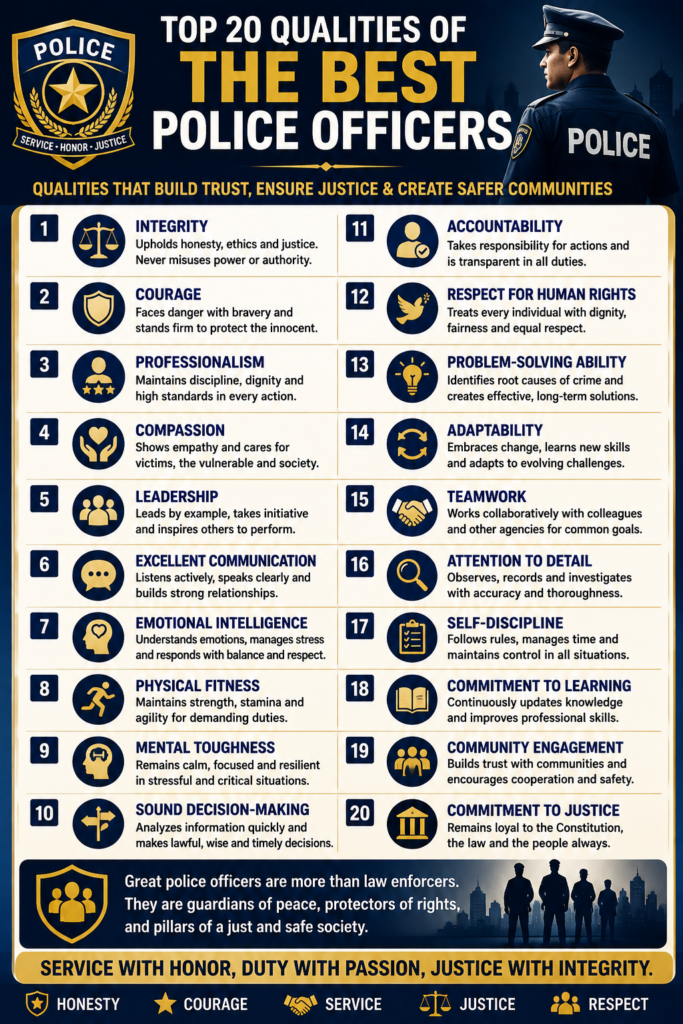
1. Integrity
Integrity is the cornerstone of professional policing. Honest officers refuse corruption, bribery, favoritism, and misuse of authority. They uphold ethical standards even when no one is watching.
2. Courage
Police officers routinely encounter dangerous situations involving criminals, accidents, disasters, and emergencies. Courage enables them to protect lives while remaining calm under pressure.
3. Professionalism
Professional officers conduct themselves with dignity, discipline, and respect. They maintain proper behavior both in uniform and outside official duties.
4. Compassion
The best officers understand that many people they encounter are victims of trauma, abuse, poverty, or crisis. Showing empathy helps build public trust and encourages cooperation.
5. Leadership
Leadership is not limited to senior officers. Every police officer should demonstrate initiative, responsibility, and the ability to guide others during emergencies.
6. Excellent Communication Skills
Effective communication reduces conflict, improves investigations, and strengthens relationships with the community. Officers must listen carefully and explain situations clearly.
7. Emotional Intelligence
Understanding emotions—both their own and others’—helps officers manage stressful situations without unnecessary aggression or poor judgment.
8. Physical Fitness
Policing demands stamina, strength, agility, and endurance. Regular physical training improves operational effectiveness and reduces injury risk.
9. Mental Toughness
Police work involves exposure to violence, stress, criticism, and uncertainty. Mentally resilient officers recover quickly from difficult experiences while maintaining professional standards.
10. Sound Decision-Making
Many policing decisions must be made within seconds. Good officers analyze available information, assess risks, and choose lawful and appropriate actions.
11. Accountability
Outstanding officers accept responsibility for their decisions and actions. They welcome transparency and remain accountable to the law and the public.
12. Respect for Human Rights
Every individual deserves dignity regardless of background, religion, gender, ethnicity, or social status. Respecting human rights strengthens public confidence in policing.
13. Problem-Solving Ability
Modern policing involves identifying the root causes of crime rather than merely responding to incidents. Creative problem-solving helps prevent future offenses.
14. Adaptability
Technology, cybercrime, terrorism, and evolving criminal tactics require officers to adapt continuously to new challenges and investigative methods.
15. Teamwork
Effective policing depends on collaboration among officers, emergency services, intelligence agencies, healthcare professionals, and community organizations.
16. Attention to Detail
Accurate observation is essential for collecting evidence, preparing reports, interviewing witnesses, and solving complex criminal investigations.
17. Self-Discipline
Discipline ensures punctuality, adherence to procedures, responsible use of authority, and continuous professional development.
18. Commitment to Continuous Learning
Laws, technology, forensic science, cybersecurity, and investigative methods evolve rapidly. Lifelong learning helps officers remain competent and effective.
19. Community Engagement
Successful policing relies on strong relationships with local communities. Officers who engage positively with citizens improve cooperation, crime prevention, and public safety.
20. Commitment to Justice
Above all, exceptional police officers are committed to justice rather than personal gain, political influence, or prejudice. Their loyalty remains with the Constitution, the law, and the people they serve.
Conclusion
The finest police officers are not defined solely by their rank, authority, or years of service. They are recognized by their unwavering integrity, professionalism, courage, compassion, and dedication to justice. These twenty qualities enable officers to protect citizens, maintain public confidence, resolve conflicts peacefully, and uphold democratic values. As policing continues to evolve with technological advances and emerging security challenges, officers who cultivate these qualities will remain the foundation of safe, secure, and resilient communities.
By embracing ethical leadership, continuous learning, emotional intelligence, and community-oriented policing, today’s police professionals can become trusted guardians of society and exemplary public servants for future generations.