

Introduction: Leadership Beyond Rank and Authority
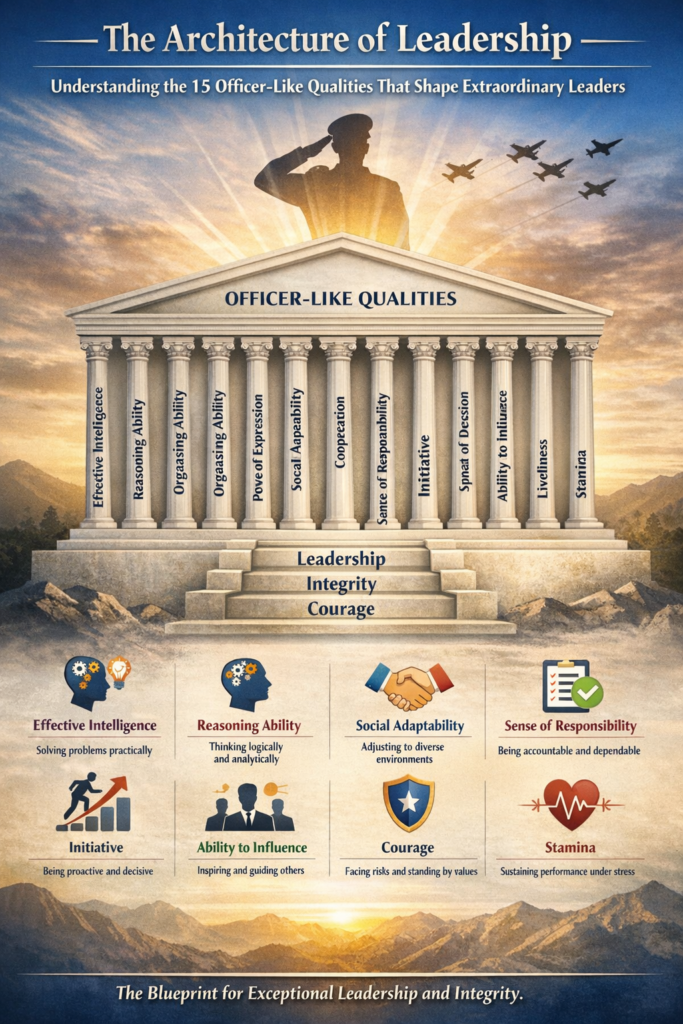
In the study of leadership, there exists a profound difference between holding authority and embodying leadership. True leadership is not conferred merely by designation, uniform, or position; rather, it emerges from a complex set of personal attributes that guide an individual’s thinking, decision-making, and behavior under pressure. In the Indian context, the concept of Officer-Like Qualities (OLQs) has long been recognized as the gold standard for evaluating leadership potential, particularly within the framework of the Services Selection Board (SSB) of the Indian Armed Forces. These qualities are not merely criteria for military officers; they represent a universal blueprint for character, competence, and responsibility.
The fifteen Officer-Like Qualities form an integrated psychological and behavioral architecture that defines how an individual thinks, interacts with others, solves problems, and confronts challenges. They combine intellectual ability, emotional stability, social intelligence, courage, discipline, and moral integrity. Together, these attributes create individuals capable of leading organizations, nations, and communities through uncertainty and adversity.
In a rapidly evolving world characterized by technological transformation, geopolitical uncertainty, and organizational complexity, the relevance of these qualities extends far beyond military institutions. Corporations, governments, academic institutions, and entrepreneurial ventures increasingly seek leaders who possess the resilience, clarity, and ethical foundation embodied in these qualities.
Understanding the fifteen OLQs therefore becomes more than an exercise in military assessment—it becomes a study of human leadership at its most refined form.
Effective Intelligence: The Ability to Solve Real Problems
The first officer-like quality is Effective Intelligence, which refers to the practical application of knowledge and reasoning to solve real-world problems. It is not synonymous with academic intelligence or theoretical brilliance; rather, it represents the ability to assess situations quickly, identify workable solutions, and implement them under constraints.
In military and organizational environments, situations rarely present themselves in perfect conditions. Resources may be limited, time may be scarce, and information may be incomplete. Under such circumstances, leaders must rely on effective intelligence to evaluate possibilities and act decisively.
Effective intelligence reflects a balance between analytical thinking and practical judgment. Individuals possessing this quality demonstrate the capacity to break complex problems into manageable components and arrive at logical solutions. More importantly, they possess the confidence to execute those solutions.
In contemporary leadership environments—whether in corporate management or public policy—this quality is indispensable. Decision-makers must often navigate ambiguity while maintaining clarity of purpose. Effective intelligence ensures that leaders do not remain trapped in theoretical debates but move forward with pragmatic action.
Reasoning Ability: The Foundation of Rational Decision-Making
Closely related to effective intelligence is Reasoning Ability, which reflects the capacity for logical analysis and structured thinking. Reasoning ability allows leaders to evaluate evidence, detect inconsistencies, and draw accurate conclusions.
In leadership roles, reasoning ability plays a crucial role in strategic planning and policy formulation. Leaders constantly encounter competing viewpoints, incomplete information, and complex scenarios. Without the ability to reason logically, decision-making can easily become impulsive or emotionally driven.
Reasoning ability strengthens judgment and enhances clarity. Leaders who possess this attribute can anticipate consequences, evaluate risks, and formulate balanced strategies. In high-stakes environments such as military operations or corporate negotiations, this intellectual discipline becomes essential.
Furthermore, reasoning ability contributes to credibility. Subordinates and colleagues tend to trust leaders whose decisions are grounded in logic rather than arbitrary authority. In this sense, reasoning ability reinforces the legitimacy of leadership.
Organizing Ability: Turning Vision into Structured Action
Leadership often begins with vision, but vision alone cannot transform reality. It must be supported by Organizing Ability, the capacity to structure resources, people, and time in order to achieve defined objectives.
Organizing ability reflects systematic thinking and operational discipline. Leaders possessing this quality can translate abstract goals into actionable plans. They allocate responsibilities effectively, coordinate activities, and ensure that tasks are executed efficiently.
In organizational settings, poor organizing ability frequently leads to confusion, duplication of effort, and inefficiency. Conversely, effective organization creates clarity and momentum. Teams understand their roles, timelines become realistic, and progress becomes measurable.
This quality also requires foresight. Leaders must anticipate potential obstacles and prepare contingency plans. In complex operations—whether military missions or corporate projects—the ability to organize effectively determines success or failure.
Power of Expression: Communicating Ideas with Clarity
No leader operates in isolation. Leadership is inherently relational, requiring the ability to communicate ideas, instructions, and visions effectively. Power of Expression refers to the capacity to articulate thoughts clearly, confidently, and persuasively.
Communication is not merely about speaking; it encompasses listening, understanding, and responding appropriately. Leaders with strong power of expression convey information in a manner that motivates, guides, and inspires their teams.
In high-pressure environments, clarity of communication becomes critical. Miscommunication can lead to operational errors, strategic misunderstandings, or breakdowns in coordination. Leaders who communicate with precision ensure that everyone understands objectives and expectations.
Moreover, effective communication fosters trust. When leaders express themselves with transparency and authenticity, they create an atmosphere of openness and mutual respect.
Social Adaptability: Navigating Human Diversity
Modern organizations are characterized by diversity—diversity of backgrounds, perspectives, cultures, and personalities. Social Adaptability refers to the ability to adjust effectively within different social environments and build harmonious relationships with others.
This quality reflects emotional intelligence and interpersonal awareness. Leaders must interact with individuals from varied social contexts while maintaining respect and understanding.
Social adaptability enables leaders to function effectively within teams and larger organizational structures. It allows them to recognize the strengths of individuals, manage interpersonal conflicts, and foster collaboration.
In an increasingly globalized world, social adaptability has become a critical leadership trait. Leaders who lack this quality often struggle to build cohesive teams, whereas socially adaptable leaders create inclusive environments where individuals feel valued and motivated.
Cooperation: The Spirit of Collective Achievement
Closely related to social adaptability is the quality of Cooperation, which reflects the willingness to work with others toward shared goals. Leadership is often misunderstood as dominance or command; in reality, it involves facilitating collaboration.
Cooperative leaders understand that complex challenges cannot be solved individually. They encourage participation, respect diverse viewpoints, and integrate collective effort.
In military operations, cooperation ensures coordinated action across units and departments. In corporate environments, it enhances teamwork and organizational cohesion.
The presence of cooperation transforms leadership from authority into partnership. Leaders who embody this quality create cultures of mutual support and collective responsibility.
Sense of Responsibility: Accountability in Action
Leadership carries profound responsibility. Decisions made by leaders influence the well-being, safety, and success of others. Sense of Responsibility refers to the willingness to accept accountability for actions, decisions, and outcomes.
Responsible leaders do not shift blame when difficulties arise. Instead, they confront challenges with honesty and integrity. They recognize that leadership is a commitment to serve others rather than merely exercising authority.
This quality also involves reliability. Leaders with a strong sense of responsibility fulfill their commitments and maintain consistency in their actions.
In institutions where responsibility is neglected, trust deteriorates rapidly. Conversely, responsible leadership strengthens institutional credibility and stability.
Initiative: Acting Without Waiting
Another essential officer-like quality is Initiative, the willingness to act proactively rather than waiting for instructions. Leaders with initiative recognize opportunities and respond to challenges without hesitation.
In dynamic environments, delays can lead to missed opportunities or strategic disadvantages. Initiative allows leaders to remain ahead of circumstances rather than reacting passively.
However, initiative must be balanced with judgment. Acting impulsively without considering consequences can create problems. True initiative involves thoughtful action driven by purpose.
Leaders who demonstrate initiative inspire confidence among their teams. Their proactive approach creates momentum and encourages others to take responsibility for their roles.
Self-Confidence: Trusting One’s Own Judgment
Leadership often requires making decisions under uncertainty. Self-Confidence provides the psychological foundation that enables leaders to trust their judgment and act decisively.
Self-confidence should not be confused with arrogance. Genuine confidence arises from preparation, knowledge, and experience. It reflects inner stability rather than external display.
Leaders lacking self-confidence may hesitate excessively, undermining team morale. In contrast, confident leaders project assurance and clarity.
In challenging situations, the confidence of the leader often determines the confidence of the entire team. When leaders demonstrate composure and belief in their decisions, others follow with trust and commitment.
Speed of Decision: Acting When Time Matters
In many situations, delayed decisions can be more harmful than imperfect ones. Speed of Decision refers to the ability to analyze situations quickly and arrive at timely conclusions.
This quality is particularly critical in crisis situations where time constraints demand immediate action. Leaders must balance thorough analysis with decisive execution.
The ability to decide quickly reflects mental agility and situational awareness. Leaders who possess this quality remain alert to changing circumstances and adapt their decisions accordingly.
Speed of decision ensures that organizations remain responsive and proactive rather than stagnant.
Ability to Influence the Group: Guiding Collective Direction
Leadership is ultimately measured by the ability to influence others toward a shared objective. Ability to Influence the Group reflects the capacity to inspire trust, motivate participation, and guide collective action.
This influence arises from credibility, communication, and personal example rather than coercion. Leaders who influence effectively create alignment within teams.
Influential leaders encourage participation and foster a sense of ownership among their members. As a result, teams become more engaged and committed to achieving goals.
In organizational environments, influence often determines whether strategies succeed or fail.
Liveliness: The Energy of Leadership
Leadership requires vitality. Liveliness refers to the presence of enthusiasm, optimism, and positive energy in a leader’s personality.
A lively leader creates an atmosphere of motivation and encouragement. This quality helps maintain morale during challenging circumstances.
Energy and optimism are contagious. Teams tend to mirror the emotional state of their leaders. When leaders remain energetic and positive, teams develop resilience and determination.
Liveliness therefore contributes significantly to organizational morale and productivity.
Determination: Persevering Through Adversity
Every leadership journey encounters obstacles. Determination reflects the persistence and resilience required to overcome difficulties.
Determined leaders do not abandon their goals when confronted with challenges. Instead, they adapt their strategies and continue moving forward.
This quality embodies courage and mental strength. It ensures that leaders remain committed to their responsibilities even during adversity.
Determination often distinguishes exceptional leaders from ordinary ones.
Courage: Facing Risks with Integrity
Courage represents one of the most respected qualities in leadership. It involves both physical courage and moral courage.
Physical courage reflects the willingness to confront danger when necessary. Moral courage, however, is equally important. It involves standing for ethical principles even when such positions are unpopular or difficult.
Courageous leaders defend truth, justice, and integrity. They do not compromise their values for convenience.
In times of crisis or ethical dilemmas, courage becomes the defining characteristic of leadership.
Stamina: Sustaining Performance Over Time
Finally, Stamina represents the endurance required to sustain performance under prolonged stress and effort. Leadership demands physical, mental, and emotional resilience.
Leaders frequently face demanding schedules, high expectations, and constant challenges. Without stamina, maintaining effectiveness becomes difficult.
Stamina ensures that leaders remain capable of fulfilling their responsibilities consistently. It reflects discipline, health, and inner resilience.
In demanding professions such as the armed forces, stamina is indispensable. However, even in corporate or academic environments, sustained endurance determines long-term success.
Conclusion: The Enduring Relevance of Officer-Like Qualities
The fifteen Officer-Like Qualities collectively represent a comprehensive framework for understanding leadership potential. They integrate intellectual capability, emotional maturity, ethical strength, and physical resilience.
Although originally conceptualized for military leadership, these qualities possess universal relevance. In a world increasingly shaped by uncertainty and complexity, societies require leaders who combine competence with character.
Organizations that cultivate these qualities create environments where integrity, collaboration, and excellence flourish. Individuals who develop these attributes become capable of guiding others with wisdom and responsibility.
Ultimately, leadership is not merely about commanding authority—it is about inspiring trust, shaping vision, and serving a greater purpose. The fifteen Officer-Like Qualities provide a timeless blueprint for achieving that ideal.