

Introduction: A World in Systemic Transition
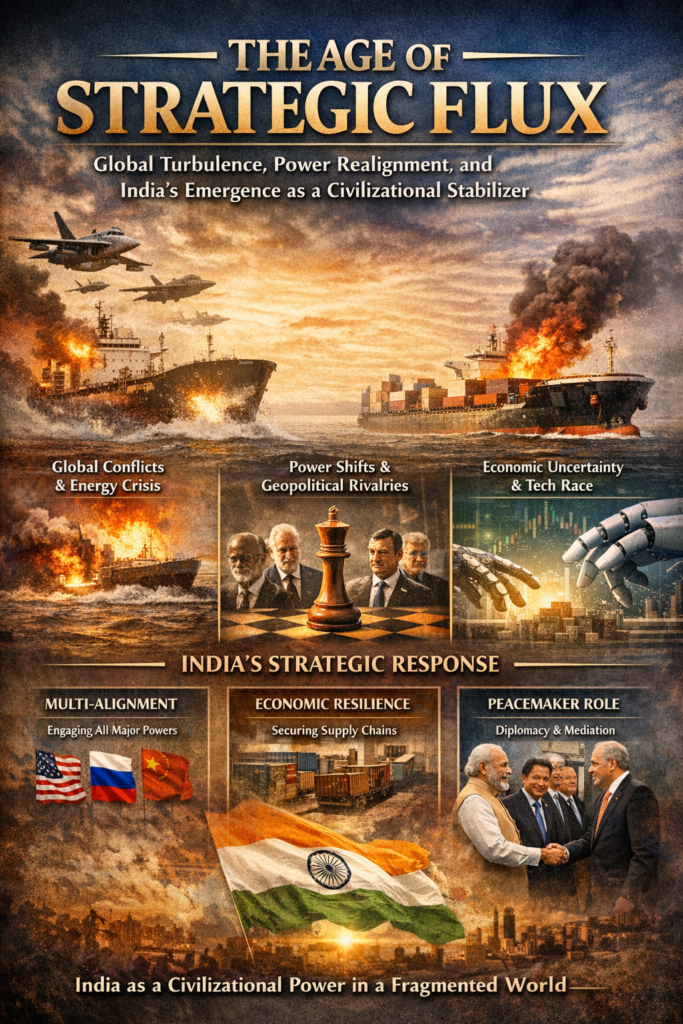
The contemporary global order is no longer defined by stability, predictability, or institutional coherence; rather, it is characterized by fragmentation, conflictual multipolarity, and the erosion of post–World War II consensus frameworks. The year 2026 represents not merely a continuation of geopolitical tensions but a decisive acceleration toward what can be termed a polycrisis world—a condition where economic instability, military conflict, technological rivalry, and energy insecurity intersect simultaneously.
The escalation of the Middle East conflict involving Iran, Israel, and the United States—triggering disruptions in global energy flows and maritime security—has exposed the fragility of global supply chains and the limitations of existing diplomatic institutions. (AP News) Simultaneously, shifts in trade regimes, climate politics, and technological competition have deepened divisions among major powers, leading to a reconfiguration of alliances and strategic priorities.
Within this evolving landscape, India is not merely a passive observer but an active, shaping force. Its foreign policy, rooted in strategic autonomy yet increasingly assertive in execution, reflects a calibrated attempt to navigate chaos while advancing national interests and global responsibilities.
Background: From Globalization to Fragmentation
The early 21st century was marked by optimism surrounding globalization, multilateralism, and economic interdependence. However, the events of the past decade—ranging from the COVID-19 pandemic to the Russia-Ukraine war and now the intensifying Middle East crisis—have fundamentally altered this trajectory.
The current global system is transitioning from rules-based multilateralism to power-driven transactional geopolitics. (Next IAS) Institutions like the United Nations and WTO have lost efficacy, while smaller, issue-based coalitions are increasingly replacing broad multilateral frameworks. (VISION IAS) This shift signifies not merely institutional fatigue but a deeper structural transformation in how power is exercised and negotiated.
Simultaneously, economic interdependence—once viewed as a stabilizing force—is now perceived as a vulnerability. Supply chain disruptions, sanctions regimes, and energy dependencies have made nations increasingly cautious, leading to economic nationalism and strategic decoupling.
India, having experienced significant foreign policy shocks in 2025—including trade tensions with the United States and regional instability—entered 2026 with a recalibrated strategic outlook focused on resilience, diversification, and autonomy. (GKToday)
Global Power Dynamics: Conflict, Energy, and Strategic Competition
At the heart of current global happenings lies the intensification of military and strategic conflicts. The Middle East crisis, in particular, has emerged as a defining event of 2026. Iranian strikes on energy infrastructure in Gulf nations and disruptions in the Strait of Hormuz—through which nearly one-fifth of global oil supply passes—have triggered a surge in global oil prices and heightened economic uncertainty. (The Guardian)
This conflict is not isolated; it is deeply interconnected with broader geopolitical rivalries. The United States’ military escalation, including extensive strikes on Iranian targets, reflects the persistence of great-power interventionism. (AP News) Meanwhile, regional actors such as Saudi Arabia, Turkey, and European nations are navigating complex strategic choices between escalation and restraint.
Energy security has re-emerged as a central axis of global geopolitics. The weaponization of energy—through disruptions, sanctions, and strategic control of supply routes—has transformed oil and gas from mere economic commodities into instruments of geopolitical leverage.
In parallel, the rise of China as a dominant economic and technological power continues to challenge the existing global order. Its influence in critical minerals, supply chains, and regional infrastructure projects has compelled other nations, including India, to adopt counter-strategies to safeguard their interests.
India’s Strategic Posture: From Non-Alignment to Multi-Alignment
India’s response to this turbulent global environment is rooted in the principle of strategic autonomy, but its operationalization has evolved significantly. No longer confined to traditional non-alignment, India now practices what can be termed multi-alignment—engaging simultaneously with multiple power centers while avoiding exclusive commitments.
This approach is evident in India’s balanced relations with the United States, Russia, and emerging global coalitions such as BRICS and QUAD. India has strengthened defense and technological cooperation with Russia while maintaining strategic partnerships with Western nations, reflecting a pragmatic, interest-based foreign policy. (Vivekananda International Foundation)
Moreover, India’s diplomatic engagement with Iran to ensure the reopening of the Strait of Hormuz underscores its capacity for independent negotiation and conflict mediation. (Reuters) This approach highlights India’s willingness to act as a bridge between conflicting actors, reinforcing its role as a stabilizing force in global geopolitics.
India as a Mediator: The Emerging Peacemaker Role
One of the most significant aspects of India’s current global stance is its increasing emphasis on diplomacy and conflict resolution. In the context of the Middle East crisis, India has consistently advocated for de-escalation and dialogue, as reflected in high-level engagements with global leaders such as France. (Reuters)
This positioning aligns with a broader strategic vision of India as a neutral yet influential actor—a nation capable of engaging with diverse stakeholders without being perceived as partisan. Such a role is particularly valuable in a fragmented world where trust deficits and ideological divisions hinder effective diplomacy.
India’s participation in global forums such as the Raisina Dialogue further reinforces its status as a convenor of international discourse, shaping narratives and facilitating strategic conversations on critical global issues. (Sanskriti IAS)
Economic Security and Trade Realignment
The ongoing global crises have underscored the inseparability of economic policy and foreign policy. India’s decision to establish a war-risk insurance fund to support maritime trade amid disruptions in the Strait of Hormuz reflects a proactive approach to safeguarding economic interests. (The Economic Times)
This move illustrates a broader shift toward economic resilience, including diversification of trade partners, strengthening domestic manufacturing, and securing critical supply chains. The emphasis on critical minerals, for instance, highlights the recognition that future economic competitiveness will depend on access to essential resources for technologies such as electric vehicles and renewable energy systems. (India’s World)
Additionally, India’s foreign aid and investment strategies are increasingly aligned with geopolitical objectives, targeting regions where influence can be maximized through economic engagement. (The Diplomat)
Defence and Strategic Modernization
In an era of heightened security threats, India has prioritized defense modernization as a cornerstone of its strategic policy. The “Defence Vision 2047” represents a comprehensive framework linking military strength with economic development and technological advancement. (The Economic Times)
This approach reflects a holistic understanding of national power, where defense capability is not merely a deterrent but a driver of innovation, industrial growth, and geopolitical influence. The integration of defense policy with broader developmental goals underscores India’s long-term vision of becoming a leading global power.
Furthermore, initiatives such as enhanced maritime cooperation in the Indian Ocean region highlight India’s focus on securing its strategic neighborhood and maintaining regional stability. (The Times of India)
Technological and Climate Diplomacy
Beyond traditional domains of power, technology and climate policy have emerged as critical arenas of global competition and cooperation. India’s stance on climate negotiations emphasizes equity and the principle of common but differentiated responsibilities, resisting external pressures that may hinder its developmental trajectory. (Council on Foreign Relations)
Simultaneously, India is investing in emerging technologies such as artificial intelligence, space exploration, and digital infrastructure, recognizing their strategic significance in shaping future global hierarchies.
The interplay between technological sovereignty and global interdependence presents both opportunities and challenges. India’s approach seeks to balance openness with self-reliance, ensuring that technological advancement does not come at the cost of strategic vulnerability.
Challenges and Constraints
Despite its strategic advancements, India faces several constraints in its global positioning. Economic vulnerabilities, particularly dependence on energy imports and external supply chains, remain significant challenges. Research indicates that India’s economy is particularly sensitive to disruptions in energy supply from key regions such as the Middle East. (arXiv)
Additionally, managing relations with neighboring countries, particularly in the context of China’s expanding influence, requires continuous diplomatic and strategic effort. The complexity of balancing multiple global partnerships without compromising autonomy further adds to the challenges.
Domestic factors, including economic disparities and political debates, also influence foreign policy decisions, highlighting the interconnectedness of internal and external dynamics.
Strategic Implications: India in a Multipolar World
The ongoing transformation of the global order presents both risks and opportunities for India. The decline of traditional power structures and the emergence of a multipolar system create space for India to assert itself as an independent pole of influence.
India’s emphasis on multi-alignment, economic resilience, and diplomatic engagement positions it uniquely to navigate this transition. By leveraging its demographic advantage, technological capabilities, and geopolitical location, India can play a central role in shaping the future global order.
However, this requires sustained strategic clarity, institutional capacity, and policy coherence. The ability to integrate economic, military, and diplomatic strategies will be critical in ensuring that India’s rise is both stable and sustainable.
Conclusion: India as a Civilizational Power in a Fragmented World
The current global landscape is defined by uncertainty, competition, and transformation. In this environment, India’s approach—characterized by strategic autonomy, pragmatic engagement, and a commitment to stability—offers a distinct model of global leadership.
India is not merely responding to global changes; it is actively shaping them. Its role as a mediator, economic actor, and strategic power reflects a broader civilizational vision that transcends immediate geopolitical considerations.
As the world moves further into an era of fragmentation and flux, India’s ability to balance power with principle, autonomy with cooperation, and ambition with responsibility will determine not only its own future but also the trajectory of the global order.
In essence, India stands at a historic juncture—not as a peripheral participant, but as a central architect of a new world order defined not by domination, but by equilibrium, resilience, and shared progress.