

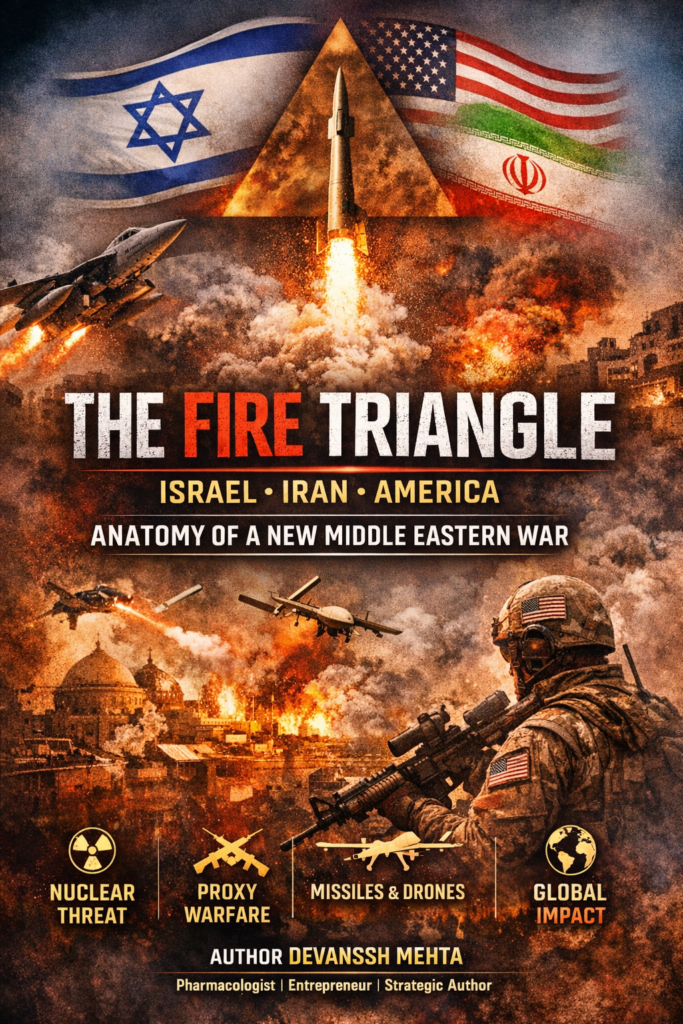
Introduction: A War That Could Reshape the World
The geopolitical architecture of the Middle East has always been fragile, shaped by historical grievances, ideological rivalries, and strategic competition for regional dominance. In the twenty-first century, however, the relationship between Israel, Iran, and the United States has become the central axis around which regional stability or instability revolves. The recent escalation into open warfare between these actors has raised profound questions about the future of global security, the balance of power in West Asia, and the risk of a wider global conflict.
The ongoing confrontation is not merely a bilateral dispute between nations. Rather, it represents a complex strategic triangle involving ideological hostility, nuclear anxieties, proxy warfare, and great-power politics. What began as covert operations, sanctions, and proxy confrontations has gradually evolved into direct military engagement involving airstrikes, missile attacks, and drone warfare.
The conflict escalated dramatically when the United States and Israel launched coordinated military strikes on Iranian military infrastructure in February 2026, triggering a retaliatory campaign from Iran targeting Israeli cities, American military bases, and allied states across the Middle East.
To understand the deeper implications of this war, it is essential to analyze its historical roots, strategic motivations, military dynamics, and potential consequences for the global order.
Historical Roots of the Israel–Iran Rivalry
The hostility between Israel and Iran is relatively recent in historical terms. Before the Islamic Revolution of 1979, Iran under Shah Mohammad Reza Pahlavi maintained relatively cordial relations with Israel. Both nations were allied with the United States and shared strategic concerns regarding Arab nationalism and Soviet influence in the region.
However, the Islamic Revolution transformed Iran’s geopolitical orientation. The revolutionary leadership established a theocratic regime based on Shiite Islamic ideology and adopted an openly hostile stance toward Israel, which it described as an illegitimate state occupying Muslim land.
Since then, Iran has consistently supported anti-Israel militant groups such as Hezbollah in Lebanon and Hamas in Gaza. These organizations became key components of Iran’s strategy of “asymmetric warfare” against Israel.
Over the decades, Israel perceived Iran’s growing military capabilities—particularly its nuclear ambitions—as an existential threat. Israeli leaders repeatedly warned that a nuclear-armed Iran could fundamentally alter the security balance in the Middle East.
Thus, the rivalry gradually transformed into a shadow war involving cyberattacks, targeted assassinations, covert operations, and proxy conflicts.
The Strategic Role of the United States
The United States has historically been Israel’s most important strategic ally. Since the Cold War era, Washington has provided Israel with military aid, intelligence support, and diplomatic backing.
At the same time, relations between the United States and Iran deteriorated sharply after the 1979 hostage crisis, when Iranian revolutionaries seized the American embassy in Tehran and held diplomats hostage for 444 days.
Over the decades, Washington imposed extensive economic sanctions on Iran, particularly in response to its nuclear program and support for militant groups across the Middle East.
The United States has long viewed Iran as a destabilizing force in the region. From Washington’s perspective, Iran’s ballistic missile program, nuclear ambitions, and influence across Iraq, Syria, Lebanon, and Yemen pose a major threat to regional security.
Consequently, American strategy in the Middle East has often focused on containing Iranian power while maintaining Israel’s military superiority.
The Nuclear Question: The Core Strategic Anxiety
At the heart of the Israel–Iran confrontation lies the question of nuclear weapons.
Iran has consistently maintained that its nuclear program is intended for peaceful purposes such as energy generation and scientific research. However, Western intelligence agencies and Israeli officials have long suspected that Iran seeks to develop nuclear weapons capability.
Israel, which is widely believed to possess nuclear weapons though it maintains a policy of ambiguity, considers the prospect of a nuclear-armed Iran unacceptable.
From Israel’s perspective, Iran’s leadership has repeatedly called for the elimination of the Israeli state, making nuclear proliferation an existential threat.
Therefore, Israeli strategy has historically involved preventing Iran from acquiring nuclear weapons through diplomatic pressure, economic sanctions, and covert operations.
The Escalation Toward War
The path toward the current war was gradual but relentless.
Over the past decade, tensions increased through several key developments:
- Cyberattacks targeting Iranian nuclear facilities.
- Israeli strikes on Iranian military positions in Syria.
- Iranian missile and drone attacks against Israeli and American interests.
- Intensifying sanctions and diplomatic breakdown.
The situation reached a breaking point when large-scale U.S. and Israeli airstrikes targeted Iranian military infrastructure in February 2026. These strikes reportedly killed several senior Iranian leaders and severely damaged missile facilities.
Iran responded with massive retaliatory attacks using ballistic missiles and drones against Israeli cities and U.S. military installations across the Middle East.
The conflict quickly spread across multiple fronts including Lebanon, Syria, Iraq, and the Persian Gulf.
The Role of Proxy Warfare
One of the defining characteristics of this conflict is the role of proxy actors.
Iran has cultivated a network of allied militias and organizations across the Middle East, often referred to as the “Axis of Resistance.” These include:
- Hezbollah in Lebanon
- Various Shiite militias in Iraq
- Pro-Iranian groups in Syria
- The Houthi movement in Yemen
These groups serve as strategic instruments allowing Iran to project power without engaging in direct confrontation.
For example, Hezbollah possesses tens of thousands of rockets capable of striking Israeli cities. During the current conflict, Hezbollah has launched attacks from southern Lebanon in support of Iran, prompting Israeli military operations along the Lebanese border.
Thus, the war has evolved into a multi-front regional conflict.
Military Dynamics of the War
The Israel–Iran–U.S. conflict has introduced a new model of warfare characterized by advanced technology and asymmetric strategies.
Several key features define the military dynamics of this war.
Drone Warfare
Iran has deployed large numbers of inexpensive but effective drones capable of overwhelming advanced defense systems.
These drones have targeted American radar sites and military installations across the Middle East, demonstrating how low-cost technology can challenge sophisticated Western military systems.
Missile Strikes
Ballistic missiles remain a central component of Iran’s strategy. Iranian missile barrages have targeted Israeli cities and U.S. bases in the Gulf region.
Israel’s Iron Dome and Arrow defense systems have intercepted many of these missiles, but the sheer volume of attacks continues to test the limits of these systems.
Air Superiority
Israel and the United States possess overwhelming airpower. Fighter jets and long-range missiles have targeted Iranian military bases, missile facilities, and intelligence centers.
Recent Israeli airstrikes reportedly struck key military infrastructure in Tehran itself.
Economic and Energy Implications
Beyond the battlefield, the war carries enormous economic implications.
The Middle East remains one of the most critical regions for global energy supply. The Strait of Hormuz, located between Iran and the Arabian Peninsula, is one of the most important oil transit routes in the world.
Any disruption in this region can trigger global energy crises.
The conflict has already caused volatility in global oil markets and forced international agencies to release emergency oil reserves to stabilize prices.
Higher energy prices have cascading effects on inflation, economic growth, and global trade.
The Risk of Regional Escalation
One of the most dangerous aspects of this conflict is the risk of regional escalation.
Several countries in the Middle East could be drawn into the war.
Potential actors include:
- Saudi Arabia
- The United Arab Emirates
- Turkey
- Qatar
Many of these states host American military bases, making them potential targets for Iranian retaliation.
Additionally, Hezbollah’s involvement increases the likelihood of a broader Israel–Lebanon war.
If these conflicts merge into a single regional war, the consequences could be catastrophic.
Global Geopolitical Implications
The war also has major implications for global geopolitics.
Several major powers are closely watching the conflict.
Russia
Russia maintains strategic relations with Iran and has cooperated with Tehran in Syria. Moscow may view the conflict as an opportunity to challenge American influence in the region.
China
China depends heavily on Middle Eastern energy supplies and has developed economic partnerships with Iran through the Belt and Road Initiative.
Beijing may attempt to position itself as a mediator while protecting its economic interests.
Europe
European nations fear the destabilizing effects of the war, particularly the potential for refugee crises and energy shortages.
Thus, the conflict has become a global geopolitical issue rather than merely a regional war.
Humanitarian Consequences
Wars inevitably produce immense human suffering.
Reports indicate significant civilian casualties in Iran following large-scale airstrikes, with thousands of deaths reported and many among them children.
Displacement, infrastructure destruction, and economic disruption are creating humanitarian crises across the region.
Moreover, psychological trauma and long-term social consequences may persist for generations.
The Strategic Calculus of Each Actor
Understanding the motivations of the three major actors helps clarify the dynamics of the war.
Israel
Israel’s primary objective is preventing Iran from developing nuclear weapons and weakening Iran’s regional military capabilities.
Iran
Iran seeks to resist Western influence, maintain regional power, and demonstrate its ability to challenge Israel and the United States.
United States
The United States aims to neutralize Iran’s missile capabilities, protect allies, and maintain strategic dominance in the Middle East.
Interestingly, American and Israeli war objectives are not identical. While Israel prioritizes eliminating Iranian leadership, the United States focuses more on degrading Iran’s military capabilities.
Could This Become World War III?
The question frequently raised by analysts is whether the conflict could expand into a wider global war.
Although a direct confrontation between great powers remains unlikely, several factors could escalate the situation:
- Miscalculation during military operations
- Expansion of the war into the Persian Gulf
- Direct involvement of major powers
- Nuclear escalation
Thus, the war remains one of the most dangerous geopolitical crises of the decade.
Implications for India
For India, the conflict carries significant strategic consequences.
India depends heavily on Middle Eastern oil imports, and disruptions in the region could affect energy security and economic stability.
Additionally, millions of Indian citizens work in Gulf countries, making their safety a major concern.
Therefore, India must adopt a careful diplomatic approach that balances relations with Israel, Iran, and the United States.
Strategic autonomy remains essential for safeguarding India’s national interests.
Conclusion: The Uncertain Future of the Middle East
The war between Israel, Iran, and the United States represents a defining geopolitical crisis of our time. It reflects deeper structural tensions within the international system: ideological conflicts, nuclear anxieties, regional rivalries, and the shifting balance of global power.
While military operations continue, the ultimate outcome remains uncertain. Wars rarely produce clear winners. Instead, they reshape political landscapes, redefine alliances, and create new security dilemmas.
The future of the Middle East will depend not only on military outcomes but also on diplomatic wisdom, international cooperation, and the ability of global leaders to prevent escalation.
History reminds us that wars often begin with strategic calculations but end with unforeseen consequences.
The Israel–Iran–America conflict is therefore not merely a regional confrontation. It is a geopolitical drama whose outcome may shape the global order for decades to come.