

Prologue: When Death Becomes a Profession
Assassination is not merely the act of killing; it is a philosophical rupture in the architecture of civilization. Wars may be declared with speeches and fought with armies, but assassinations are born in whispers. They exist in the narrow corridors between loyalty and betrayal, ideology and ambition, patriotism and personal survival. Throughout human history, assassination has altered the trajectory of nations, destroyed empires, and elevated unknown individuals into the pages of history.
In the quiet city of Ravenport, where the ocean met the granite cliffs of the northern coast, the citizens believed they lived in a peaceful place. The cafés were filled with philosophers, fishermen, and artists. The harbor lights shimmered on the water like scattered constellations. Yet beneath this calm surface, Ravenport harbored secrets darker than the deepest waters of its harbor. It was a city where intelligence agencies operated under academic cover, where politicians negotiated deals that could topple governments, and where occasionally, a single bullet decided the fate of history.
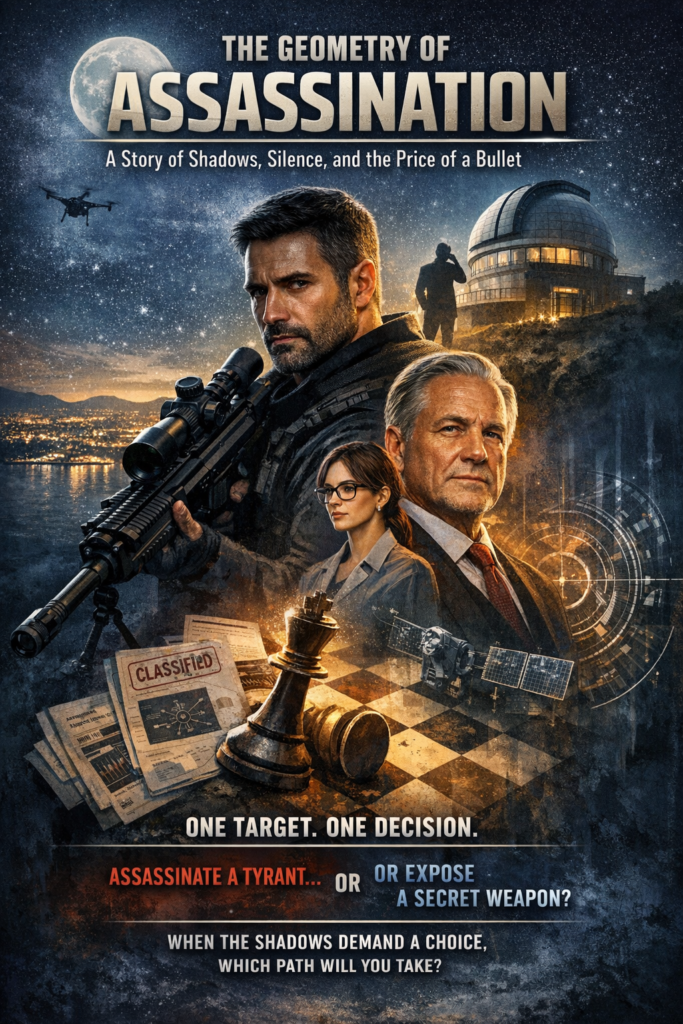
In this city lived a man whose profession existed outside law, morality, and recognition. His name was Adrian Kade, and he was an assassin.
But Adrian Kade was not the type of assassin that films often glorify. He was not driven by thrill or greed. His profession was shaped by circumstances, by training, and by a peculiar philosophical conviction that the world sometimes required surgical violence to prevent greater catastrophes. To him, assassination was not chaos—it was geometry: precise, calculated, and devoid of unnecessary cruelty.
Yet even the most disciplined geometry of violence eventually collides with the unpredictable mathematics of the human soul.
The Making of an Invisible Man
Adrian Kade had once been a soldier.
Born in a quiet farming town, he grew up surrounded by fields and silence. His father was a schoolteacher who believed in discipline, while his mother was a nurse who taught him compassion. Adrian excelled in academics, but he possessed a peculiar calm under pressure that attracted the attention of military recruiters.
At the age of twenty-two, he joined the Strategic Reconnaissance Division, an elite unit responsible for covert operations across unstable regions of the world. There he learned the art of invisibility: how to move without sound, how to observe without being observed, how to transform patience into a weapon.
But the training went beyond physical skills. Adrian studied psychology, political science, and behavioral analysis. His instructors taught him that assassination was not merely a mechanical act. It was a study of human vulnerability.
“Every powerful man,” his instructor once told him, “has a weakness. Find that weakness, and you control history.”
For years Adrian served his country in missions that were never publicly acknowledged. Governments changed, wars erupted and subsided, but his name never appeared in official records. In intelligence circles he became known only by a codename:
“Specter.”
Yet after a decade of covert operations, Adrian realized a disturbing truth. The governments that authorized these missions often operated under political agendas rather than ethical principles. Assassinations that were justified as national security sometimes concealed corporate interests or geopolitical manipulation.
Disillusioned, Adrian left the intelligence service and disappeared into the civilian world.
But men trained to operate in shadows rarely escape them.
The Contract That Should Not Exist
One rainy evening in Ravenport, Adrian received a message.
It arrived through a secure channel that only a handful of individuals in the world knew how to access. The message contained only two lines.
“We require your expertise.
The target threatens global stability.”
Attached to the message was a photograph.
The face in the photograph belonged to Victor Halberg, one of the most powerful industrial magnates in the world. Halberg controlled a vast technological empire that dominated defense manufacturing, artificial intelligence systems, and private military contractors.
Officially, Victor Halberg was celebrated as a visionary entrepreneur. Governments praised his innovations. Universities awarded him honorary doctorates.
But Adrian knew that such individuals rarely accumulated power without darker mechanisms.
He began investigating.
What Adrian discovered disturbed him deeply.
Halberg was secretly developing an autonomous weapons network powered by advanced artificial intelligence—an infrastructure capable of launching military strikes without human authorization. The project, code-named “Aegis Dominion,” was being marketed to governments as a defensive shield against terrorism.
But the internal documents revealed a different purpose.
The system could easily be manipulated to destabilize governments, trigger conflicts, or eliminate political opponents under the guise of automated warfare. Whoever controlled Aegis Dominion would possess unprecedented influence over global security.
In essence, Victor Halberg was attempting to privatize war.
The intelligence agencies that contacted Adrian feared that Halberg had grown too powerful to be restrained through legal mechanisms. Political leaders were already entangled in financial relationships with his corporation.
There was only one solution they believed remained.
Assassination.
Adrian stared at the photograph for a long time.
This mission was not merely about eliminating a man. It was about deciding whether one individual had the moral authority to terminate another human life for the supposed benefit of millions.
The Chessboard of Power
Victor Halberg rarely appeared in public without heavy security. His corporate headquarters resembled a fortress disguised as a modern architectural masterpiece. Surveillance cameras covered every corridor. Private security personnel operated with military precision.
But Adrian understood that no system was perfect.
He spent weeks studying Halberg’s routines. The billionaire maintained an unpredictable schedule to avoid patterns. Yet Adrian eventually discovered a subtle habit.
Every Friday evening Halberg visited the Helios Observatory, a private research facility located on a remote hill overlooking Ravenport. The observatory housed an experimental telescope designed to track orbital satellites.
To the public, Halberg’s visits were presented as philanthropic interest in space science. But Adrian suspected the observatory also served as a discreet location for confidential meetings.
One night Adrian infiltrated the surrounding forest to observe the facility.
From his concealed vantage point he noticed something unexpected.
Halberg was not alone.
Standing beside him on the observatory balcony was a young woman. She appeared to be a scientist, perhaps a research director. Their conversation seemed calm and reflective, far removed from the ruthless corporate image that Halberg projected publicly.
Adrian activated his directional microphone and listened.
What he heard complicated everything.
The woman, whose name was Dr. Elina Voss, was warning Halberg about the ethical consequences of the Aegis Dominion project. She argued that autonomous weapons would remove human accountability from warfare.
Halberg responded with a quiet tone.
“History,” he said, “is written by those who control technology. If we do not build this system, someone else will.”
Adrian felt a strange conflict forming within him.
Halberg was not the caricature of evil he had expected. He was a man driven by ambition and belief in technological inevitability. Dangerous, perhaps, but not irrational.
The line between villain and visionary suddenly became blurred.
The Philosophy of the Trigger
For several nights Adrian wrestled with his conscience.
Assassins are often portrayed as emotionless instruments. In reality, the act of taking a life imposes psychological consequences that even the most disciplined mind cannot fully escape.
Adrian reviewed the evidence repeatedly.
If Halberg completed the Aegis Dominion system, global warfare might indeed become automated and uncontrollable. Governments could lose the ability to restrain military escalation.
But if Adrian killed Halberg, he would also eliminate a human being whose intentions—however misguided—were not purely malicious.
Was assassination a justified preventive measure, or merely a convenient solution for political institutions unwilling to confront power through transparency?
These questions haunted him.
Yet the deadline approached.
Halberg was scheduled to announce the operational deployment of Aegis Dominion at an international defense summit in two weeks.
If the project moved beyond prototype stage, dismantling it would become nearly impossible.
Adrian realized that history often forces individuals into decisions where moral clarity does not exist.
He prepared for the mission.
Night of Convergence
The operation would take place at the Helios Observatory.
Adrian planned every detail with mathematical precision. Entry through the northern ridge, neutralization of external surveillance, infiltration through the ventilation shaft above the observatory chamber, and a single suppressed shot from a concealed position.
No witnesses. No chaos.
Just one silent moment that would erase Victor Halberg from history.
The night of the mission arrived beneath a sky filled with stars.
Adrian moved through the forest like a shadow.
Inside the observatory, Halberg stood alone beside the massive telescope, gazing at the night sky. His security team remained outside the main chamber, maintaining perimeter control.
Adrian positioned himself in the darkness above the chamber.
Through his rifle scope he observed Halberg carefully.
The billionaire appeared contemplative, almost melancholic.
Adrian steadied his breathing.
The crosshair aligned with Halberg’s chest.
But at that moment the chamber door opened.
Dr. Elina Voss entered.
She approached Halberg urgently.
“I’ve analyzed the final simulations,” she said. “The system cannot guarantee fail-safe control. If multiple governments deploy it simultaneously, it could trigger autonomous retaliation loops.”
Halberg remained silent.
Then he sighed.
“Perhaps,” he replied slowly, “humanity is already too dangerous to trust with restraint.”
Adrian felt the weight of the rifle grow heavier in his hands.
This was not a monster.
This was a man confronting the same ethical paradox that Adrian himself faced.
The Decision
For several seconds Adrian hesitated.
Assassination requires certainty. Doubt can be fatal.
Yet in that suspended moment he realized something profound.
Killing Halberg would not eliminate the idea of autonomous warfare. The technology already existed in fragments across laboratories worldwide. Another corporation or government would continue the research.
Violence might delay the future—but it rarely prevents it.
Adrian lowered the rifle.
Instead of pulling the trigger, he made a different choice.
He activated a hidden transmitter that released the classified documents he had gathered about Aegis Dominion to international journalists and cybersecurity watchdogs.
Within minutes the information began spreading across global networks.
The project that Halberg had hoped to unveil secretly would now be exposed to public scrutiny.
Power thrives in secrecy.
Transparency is often the most effective weapon against it.
Aftermath
Within days the world erupted in debate.
Governments demanded investigations into autonomous weapons development. Ethical committees and international organizations began drafting regulations to prevent fully automated warfare.
Victor Halberg’s reputation suffered enormous damage, but he remained alive.
Adrian Kade vanished from Ravenport.
Some intelligence agencies considered him unreliable for refusing to complete the contract. Others quietly acknowledged that his decision had prevented a potential geopolitical crisis without bloodshed.
Months later Adrian received another message through the secure channel.
It contained only a single sentence.
“You chose wisdom over efficiency.”
He smiled faintly.
Perhaps assassination was not always about pulling a trigger.
Sometimes it meant assassinating dangerous ideas instead.
Epilogue: The Silent Geometry of History
History rarely remembers the individuals who prevent catastrophes quietly.
It celebrates heroes of war and revolution but forgets those who choose restraint in moments where violence appears justified.
Adrian Kade continued living in obscurity, traveling from city to city under different identities. He remained vigilant, aware that the world would always produce individuals whose ambitions threatened global stability.
Yet he also carried a deeper understanding.
Assassination is not merely the elimination of a person. It is a profound intervention in the delicate architecture of human history. Each bullet fired in secrecy reshapes the moral landscape of civilization.
And sometimes the greatest act of courage is not pulling the trigger.
Sometimes it is choosing not to.