

Introduction: The Economic and Cultural Importance of Toys
Toys represent far more than simple objects of entertainment for children. They are instruments of learning, cognitive development, imagination, and cultural expression. Across civilizations, toys have reflected the technological capabilities, artistic traditions, and social values of societies. In India, the toy industry has historically been rooted in rich craft traditions—ranging from clay dolls of rural villages to intricately carved wooden toys of Karnataka and Rajasthan.
In the twenty-first century, however, the toy industry has evolved into a complex global business involving design innovation, advanced manufacturing, supply chain management, digital marketing, and international trade. Countries such as China, the United States, Japan, and Germany have dominated the global toy ecosystem for decades.
India, despite its ancient heritage of toy-making and its enormous child population, remained a relatively small player in the global toy market for many years. Yet the situation is rapidly changing. With the convergence of government initiatives, rising domestic consumption, technological innovation, and growing entrepreneurial activity, India’s toy industry is experiencing a transformation that may position it as a future global hub of toy manufacturing.
This article explores the structure, growth trajectory, market dynamics, government policies, manufacturing ecosystem, export potential, challenges, and future prospects of the toy industry in India, supported by relevant data and analytical insights.
Historical Evolution of Toys in India
Traditional Toy-Making Heritage
India’s relationship with toys dates back thousands of years. Archaeological discoveries from the Indus Valley Civilization (2600–1900 BCE) reveal clay figurines, miniature carts, animal models, and spinning toys used by children of ancient cities such as Harappa and Mohenjo-Daro.
Over centuries, various regions developed distinctive toy-making traditions:
• Channapatna wooden toys (Karnataka)
• Kondapalli toys (Andhra Pradesh)
• Etikoppaka lacquer toys (Andhra Pradesh)
• Varanasi wooden toys (Uttar Pradesh)
• Bankura clay horses (West Bengal)
These toys were handcrafted using natural materials such as wood, clay, bamboo, textiles, and lacquer. Beyond entertainment, they reflected mythology, local festivals, folk culture, and social life.
Traditional toy manufacturing served as a livelihood for thousands of artisans. However, the industrialization of toy manufacturing in the twentieth century gradually shifted global production toward large-scale factories, particularly in China.
Global Toy Industry Overview
The global toy industry is a massive market driven by entertainment franchises, educational trends, and technological innovation.
Key characteristics of the global toy industry include:
• Integration with film, television, and digital media
• Rapid product life cycles
• Strong brand-driven consumer demand
• High levels of innovation in design and technology
Global toy companies such as:
- Mattel
- Hasbro
- Lego
- Bandai Namco
dominate international markets through strong intellectual property and marketing networks.
The global toy market has been expanding steadily, supported by rising incomes, urbanization, and increased spending on child development.
Structure of the Toy Industry in India
India’s toy industry consists of three major segments:
1. Traditional and Handmade Toys
These toys are produced by artisans using natural materials and traditional craftsmanship. Examples include wooden toys, clay figurines, and handmade dolls.
2. Electronic and Plastic Toys
Mass-produced toys made using injection-moulding plastic technology, electronics, and mechanical components.
3. Educational and STEM Toys
Modern toys designed to enhance learning in science, mathematics, engineering, and cognitive development.
Market Size and Growth of the Indian Toy Industry
India’s toy market has witnessed significant growth over the last decade.
Several market research studies estimate the following:
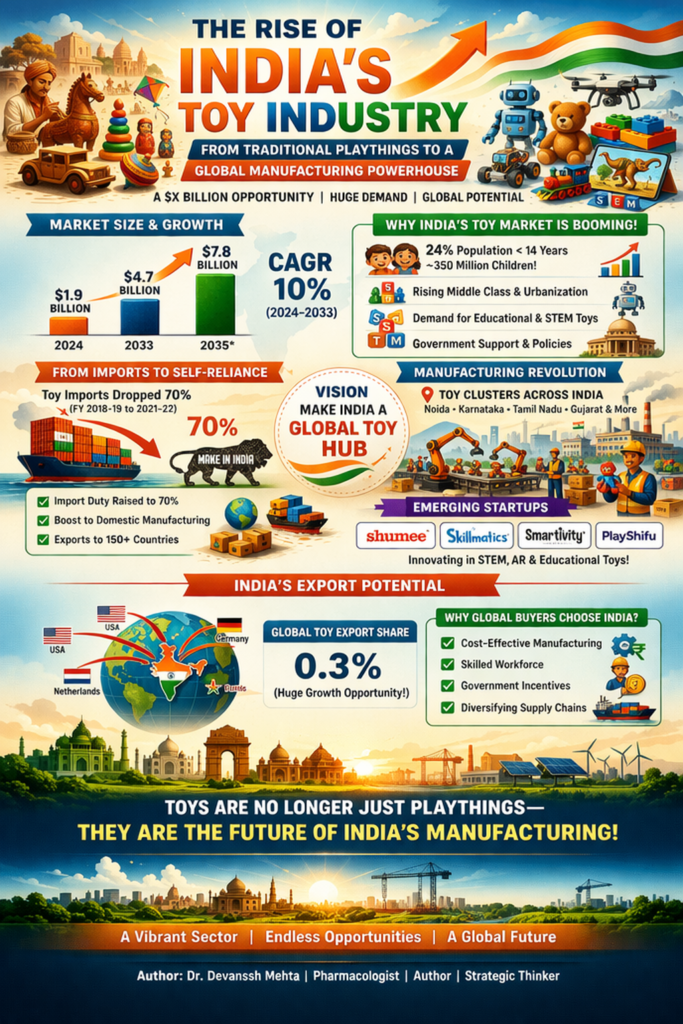
• The Indian toy market was valued at approximately USD 1.9 billion in 2024.
• It is expected to reach around USD 4.7 billion by 2033, growing at about 10% compound annual growth rate (CAGR).
• Some projections estimate the industry could expand further to USD 7.8 billion by 2035, indicating strong long-term growth potential.
Another estimate places the market size at USD 2.09 billion in 2025, with expectations of reaching USD 4.74 billion by 2034 at nearly 9.5% CAGR.
This expansion reflects rising consumer demand, demographic advantages, and supportive policy frameworks.
Demographic Advantage: India’s Largest Consumer Base
One of the biggest drivers of the toy industry in India is the country’s demographic structure.
India has one of the youngest populations in the world:
• Approximately 24% of India’s population is under the age of 14.
With a population exceeding 1.4 billion people, this demographic represents an enormous consumer base for toys, games, and educational products.
Additionally, urban middle-class families are increasingly investing in:
• Early childhood learning
• Educational toys
• Cognitive development tools
This shift in parental attitudes toward learning through play is reshaping demand patterns in the toy market.
Changing Consumer Preferences in India
Consumer behaviour in the Indian toy market has undergone significant transformation.
Key Emerging Trends
1. Educational Toys
Parents increasingly prefer toys that enhance cognitive development.
Popular categories include:
• STEM toys
• Puzzle games
• Robotics kits
• Coding toys
2. Licensed Character Toys
Toys based on popular films, cartoons, and superhero franchises have gained strong popularity.
Examples include toys linked to:
• Marvel characters
• Disney films
• Anime franchises
3. Digital and Electronic Toys
Technology-enabled toys incorporating artificial intelligence, augmented reality, and mobile connectivity are gaining traction.
4. Eco-Friendly Toys
Rising environmental awareness is boosting demand for toys made from:
• Wood
• Bamboo
• Organic materials
Import Dependency and Structural Challenges
Historically, India’s toy market was heavily dependent on imports, especially from China.
China dominated the global toy supply chain due to:
• Large-scale manufacturing capacity
• Low production costs
• Advanced supply chains
For many years, imported toys accounted for nearly 80–90% of the Indian market.
However, recent policy measures have significantly reduced import dependence.
Toy imports declined dramatically from USD 371 million in FY 2018-19 to about USD 110 million in FY 2021-22, representing a decline of nearly 70%.
Meanwhile, toy exports increased by over 61% during the same period, indicating strengthening domestic production capabilities.
By 2023, imports had declined further while exports rose sharply, reflecting a structural shift toward domestic manufacturing.
Government Initiatives Supporting the Toy Industry
Recognizing the strategic importance of the toy sector, the Government of India has introduced several initiatives to promote domestic manufacturing.
Atmanirbhar Bharat Initiative
The Atmanirbhar Bharat (Self-Reliant India) campaign aims to strengthen local manufacturing across multiple industries, including toys.
Policy measures include:
• Higher import duties on toys
• Mandatory quality standards
• Support for local manufacturing clusters
Basic customs duty on imported toys was increased from 20% to 60% in 2020, later rising to 70% in 2023 to discourage imports and encourage domestic production.
National Action Plan for Toys (NAPT)
The government introduced the National Action Plan for Toys to promote:
• Innovation
• Design capabilities
• Skill development
• Toy clusters
This initiative encourages collaboration between:
• Toy manufacturers
• Designers
• Educational institutions
Toy Manufacturing Clusters
Several toy manufacturing clusters have been established across India, including:
• Karnataka (Channapatna)
• Uttar Pradesh (Noida)
• Tamil Nadu
• Gujarat
These clusters aim to provide infrastructure, training, and logistics support to toy manufacturers.
Proposed Incentive Programs
India is also planning major incentive schemes to transform the country into a global toy manufacturing hub.
One proposal includes a ₹13,000-crore incentive scheme aimed at boosting large-scale toy production.
Growth of Toy Manufacturing in India
Domestic toy manufacturing has expanded significantly in recent years.
India’s toy industry now exports products to over 150 countries worldwide, indicating rising global competitiveness.
Key manufacturing hubs include:
• Noida (Uttar Pradesh)
• Bengaluru (Karnataka)
• Mumbai (Maharashtra)
• Chennai (Tamil Nadu)
Manufacturers produce a wide range of products such as:
• Plastic toys
• Battery-operated toys
• Educational kits
• Dolls and figurines
• Board games
Role of E-Commerce in the Toy Industry
The rise of digital retail platforms has significantly transformed toy distribution in India.
Major e-commerce platforms include:
• Amazon
• Flipkart
• FirstCry
• Hamleys India
Online retail allows manufacturers to reach customers across:
• Tier-2 cities
• Tier-3 towns
• Rural areas
Digital marketing, influencer promotion, and online reviews have become critical tools for toy brands.
Emerging Toy Startups in India
The new generation of Indian entrepreneurs is redefining the toy ecosystem.
Prominent toy startups include:
• Shumee
• Skillmatics
• Smartivity
• PlayShifu
These companies focus on:
• STEM education
• Interactive learning
• Augmented reality toys
• Cognitive development tools
Many of these startups have successfully entered international markets.
Segment Analysis of the Toy Market
Plush and Soft Toys
The stuffed toy segment is one of the largest categories in India.
This segment generated about USD 752 million in revenue in 2025 and is projected to reach USD 1.66 billion by 2033, growing at more than 10% CAGR.
Educational and STEM Toys
This category is experiencing the fastest growth due to increasing focus on:
• Early childhood learning
• STEM education
• Skill development
Parents increasingly prefer toys that combine entertainment with learning.
Outdoor and Sports Toys
Outdoor toys include:
• bicycles
• sports kits
• ride-on toys
Rising interest in physical activity among children supports this segment.
International Companies in the Indian Market
Many global toy companies are expanding their presence in India.
Major international brands include:
• Lego
• Mattel
• Hasbro
For instance, Lego plans to expand aggressively in India and aims to establish 50 retail stores by 2030, reflecting strong confidence in the market’s growth potential.
Export Potential of the Indian Toy Industry
India currently holds a small share in the global toy trade.
India’s share in global toy exports is estimated at around 0.3%, placing the country among emerging exporters rather than dominant players.
However, several factors could strengthen India’s export potential:
• Rising global demand for diversified supply chains
• Growing costs in China
• Government incentives for manufacturing
Countries importing Indian toys include:
• United States
• United Kingdom
• Germany
• Netherlands
Challenges Facing the Indian Toy Industry
Despite strong growth potential, several structural challenges remain.
1. Limited Scale of Manufacturing
Many Indian toy manufacturers operate on a small scale and lack advanced manufacturing technologies.
2. Design and Innovation Gap
Global toy companies invest heavily in product design and intellectual property development.
Indian manufacturers must strengthen their capabilities in:
• product design
• branding
• innovation
3. Supply Chain Limitations
Efficient supply chains are essential for toy production.
Challenges include:
• logistics infrastructure
• component sourcing
• packaging standards
4. Competition from China
China continues to dominate global toy manufacturing with massive production capacity.
Technological Transformation of the Toy Industry
Technology is reshaping toy manufacturing and product innovation.
Emerging technologies include:
• Artificial intelligence toys
• Robotics kits
• Augmented reality learning tools
• App-connected educational toys
These innovations are transforming toys into interactive learning systems.
Sustainability and Eco-Friendly Toys
Environmental sustainability is becoming an important factor in toy manufacturing.
Consumers increasingly demand:
• non-toxic materials
• biodegradable toys
• eco-friendly packaging
Traditional Indian toy-making methods using natural materials may offer a competitive advantage in this segment.
Future Outlook of India’s Toy Industry
India’s toy industry stands at the threshold of major expansion.
Several structural factors support long-term growth:
1. Demographic Advantage
India’s large child population ensures sustained demand.
2. Rising Middle-Class Income
Increasing disposable income allows parents to spend more on child development.
3. Government Support
Policies promoting domestic manufacturing are strengthening the ecosystem.
4. Entrepreneurial Innovation
Toy startups are introducing new educational and digital products.
5. Export Opportunities
India has the potential to become an alternative manufacturing hub in the global toy supply chain.
Conclusion: India’s Toy Industry at a Strategic Turning Point
The toy industry in India is undergoing a remarkable transformation. From traditional handcrafted playthings to advanced STEM learning systems, the sector reflects the dynamic intersection of culture, technology, and economic development.
Supported by favorable demographics, rising consumer demand, strong policy initiatives, and increasing entrepreneurial innovation, the Indian toy industry is poised for substantial growth in the coming decades.
Although challenges remain in terms of scale, design capabilities, and global competitiveness, the trajectory of the industry indicates a shift from import dependency toward domestic manufacturing and export orientation.
If India successfully integrates innovation, manufacturing excellence, design capabilities, and global branding, the country could emerge as one of the world’s leading toy manufacturing hubs.
In this sense, toys are no longer merely instruments of play—they represent a vibrant sector of economic opportunity, cultural creativity, and technological innovation shaping the future of India’s manufacturing economy.