
Executive Summary
The pharmaceutical industry in 2026 is undergoing one of the most significant transformations in its history. Advances in artificial intelligence, biotechnology, genomics, precision medicine, digital health, and personalized therapeutics have accelerated drug discovery and improved patient outcomes. Simultaneously, increasing healthcare expenditure, aging populations, and the growing burden of chronic diseases continue to drive demand for innovative pharmaceutical products.
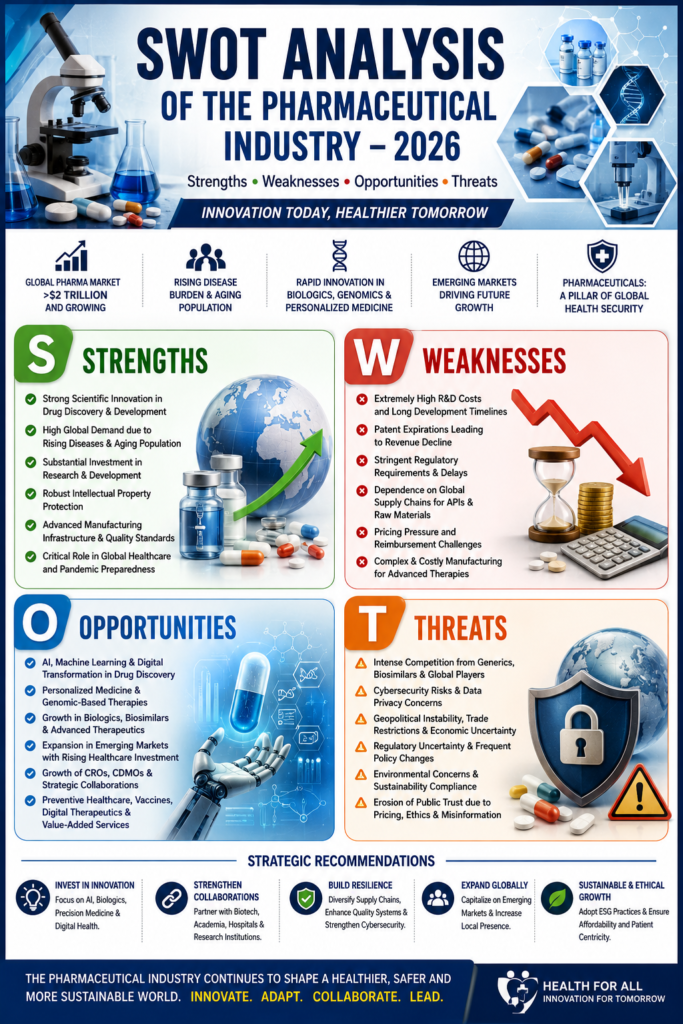
Despite remarkable scientific progress, the industry faces numerous challenges, including escalating research and development costs, stringent regulatory requirements, patent expirations, pricing pressures, geopolitical instability, supply-chain disruptions, and cybersecurity risks. A comprehensive SWOT (Strengths, Weaknesses, Opportunities, and Threats) analysis provides strategic insights into the industry’s current position and future prospects.
Introduction
The pharmaceutical industry encompasses research, development, manufacturing, quality assurance, marketing, distribution, and post-marketing surveillance of medicines, vaccines, biologics, and advanced therapeutic products. It is among the most research-intensive sectors globally, investing billions of dollars annually in scientific innovation.
The industry’s strategic importance extends beyond economic growth. It contributes directly to public health, life expectancy, disease prevention, and national healthcare security. The COVID-19 pandemic reinforced the critical role of pharmaceutical companies in ensuring global health preparedness and accelerated investment in vaccine technologies, biologics, and digital healthcare platforms.
Strengths
1. Strong Scientific Innovation
The pharmaceutical industry possesses exceptional research capabilities supported by biotechnology, molecular biology, genomics, artificial intelligence, and computational chemistry. Continuous innovation has accelerated the development of biologics, biosimilars, RNA therapeutics, monoclonal antibodies, gene therapies, and precision medicines.
2. High Global Demand
Population growth, increased life expectancy, rising prevalence of chronic diseases, expanding healthcare access, and growing awareness regarding preventive medicine ensure long-term demand for pharmaceutical products. Diseases such as diabetes, cardiovascular disorders, cancer, neurological diseases, autoimmune disorders, and infectious diseases require continuous therapeutic intervention.
3. Large Investment in Research and Development
Major pharmaceutical companies invest substantial financial resources in research and development. Strong collaborations among universities, biotechnology companies, hospitals, contract research organizations, and government institutions enhance innovation while reducing development timelines.
4. Robust Intellectual Property Protection
Patent protection provides innovators with market exclusivity, enabling recovery of extensive research investments. Strong intellectual property rights encourage scientific discovery, technology licensing, strategic partnerships, and global commercialization of innovative medicines.
5. Advanced Manufacturing Infrastructure
Modern pharmaceutical manufacturing incorporates automation, robotics, digital quality systems, process analytical technologies, and continuous manufacturing. Compliance with Good Manufacturing Practices (GMP) ensures product quality, safety, and consistency.
6. Global Healthcare Importance
Pharmaceutical companies play an indispensable role in healthcare systems worldwide by improving disease management, reducing mortality, increasing life expectancy, and supporting pandemic preparedness. Governments continue to prioritize pharmaceutical manufacturing as a strategic national asset.
Weaknesses
1. Extremely High Research Costs
Drug discovery remains expensive and time-consuming. Developing a single innovative medicine often requires more than a decade of research, extensive clinical trials, and substantial financial investment. High failure rates during clinical development increase overall project risk.
2. Patent Expirations
The expiration of patents significantly reduces revenues as generic and biosimilar manufacturers introduce lower-cost alternatives. Many blockbuster medicines are expected to face patent cliffs during the coming decade.
3. Stringent Regulatory Environment
Regulatory agencies require extensive evidence regarding safety, efficacy, manufacturing quality, pharmacovigilance, and post-marketing surveillance. Regulatory delays often postpone product launches and increase development costs.
4. Supply Chain Dependence
Global pharmaceutical supply chains depend heavily on international suppliers for active pharmaceutical ingredients (APIs), intermediates, raw materials, packaging components, and logistics. Geopolitical conflicts and transportation disruptions expose manufacturers to significant operational risks.
5. Pricing Pressure
Governments, insurance providers, healthcare systems, and patient advocacy groups increasingly demand affordable medicines. Price negotiations, reimbursement limitations, and reference pricing reduce profit margins, particularly for innovative therapies.
6. Complex Manufacturing
Biologics, cell therapies, gene therapies, vaccines, and sterile injectable products require sophisticated manufacturing facilities, highly skilled personnel, and rigorous quality management systems, resulting in elevated production costs.
Opportunities
1. Artificial Intelligence and Digital Transformation
Artificial intelligence is revolutionizing pharmaceutical research through predictive analytics, molecular modeling, drug repurposing, virtual screening, digital clinical trials, and pharmacovigilance. AI-driven research significantly reduces development timelines while improving productivity.
2. Personalized Medicine
Advances in genomics, biomarker research, and companion diagnostics enable personalized treatment strategies based on individual genetic characteristics, improving therapeutic effectiveness and reducing adverse drug reactions.
3. Expansion of Biologics and Biosimilars
The increasing prevalence of chronic diseases has accelerated demand for biologics. Simultaneously, biosimilars provide affordable alternatives following patent expirations, creating substantial commercial opportunities for manufacturers.
4. Emerging Markets
Countries including India, China, Brazil, Indonesia, Vietnam, and several African nations represent rapidly expanding pharmaceutical markets due to improving healthcare infrastructure, economic growth, rising healthcare expenditure, and increasing insurance coverage.
5. Contract Development and Manufacturing
Pharmaceutical outsourcing continues to grow rapidly. Contract Research Organizations (CROs) and Contract Development and Manufacturing Organizations (CDMOs) provide specialized research, manufacturing, analytical testing, and regulatory support, enabling companies to improve operational efficiency.
6. Preventive Healthcare
Vaccination programs, nutraceuticals, preventive medicine, digital monitoring devices, wearable healthcare technologies, and early disease detection represent rapidly expanding market segments with significant growth potential.
Threats
1. Increasing Competition
Competition from generic manufacturers, biosimilar producers, biotechnology startups, and multinational pharmaceutical companies continues to intensify. Price competition and product differentiation remain major strategic challenges.
2. Cybersecurity Risks
Digital transformation increases vulnerability to cyberattacks targeting clinical trial data, manufacturing systems, patient information, intellectual property, and supply chain networks. Data breaches can result in substantial financial and reputational damage.
3. Geopolitical Instability
Trade restrictions, geopolitical conflicts, economic sanctions, currency fluctuations, and changing international trade policies can disrupt pharmaceutical manufacturing and global medicine distribution.
4. Regulatory Uncertainty
Frequent revisions of pharmaceutical regulations, environmental standards, pricing policies, intellectual property frameworks, and approval pathways create uncertainty for long-term strategic planning.
5. Environmental Sustainability
Governments increasingly expect pharmaceutical manufacturers to reduce carbon emissions, minimize hazardous waste, improve water management, and adopt environmentally sustainable manufacturing practices. Compliance requires significant capital investment.
6. Public Trust and Ethical Issues
Clinical trial transparency, drug pricing controversies, misinformation, counterfeit medicines, data privacy concerns, and ethical challenges surrounding artificial intelligence may affect public confidence in pharmaceutical companies.
Strategic Recommendations
To maintain long-term competitiveness, pharmaceutical companies should prioritize investment in artificial intelligence, digital health technologies, biologics, precision medicine, and sustainable manufacturing practices. Diversification of supply chains, strengthening cybersecurity infrastructure, expanding collaborations with biotechnology firms and academic institutions, and enhancing regulatory compliance will improve organizational resilience. Companies should also focus on emerging markets, patient-centric innovation, affordable healthcare solutions, and environmental, social, and governance (ESG) initiatives to achieve sustainable growth.
Conclusion
The global pharmaceutical industry in 2026 remains one of the most innovative and strategically important sectors of the global economy. Its strengths in scientific research, technological advancement, global healthcare contribution, and manufacturing excellence provide a strong foundation for future growth. However, escalating development costs, regulatory complexity, pricing pressures, and geopolitical uncertainties necessitate adaptive and forward-looking strategies.
The future of the pharmaceutical industry will be shaped by artificial intelligence, precision medicine, biotechnology, digital therapeutics, and sustainable healthcare systems. Organizations capable of integrating innovation with affordability, regulatory excellence, operational resilience, and patient-centric approaches will be best positioned to lead the next generation of global healthcare. A comprehensive SWOT analysis serves as an essential strategic framework for guiding investment decisions, risk management, competitive positioning, and long-term organizational success in an increasingly dynamic pharmaceutical landscape.