

Introduction
Small-scale industries (SSIs), presently encompassed under the Micro, Small and Medium Enterprises (MSME) framework, represent the backbone of India’s industrial ecosystem. They contribute significantly to employment generation, industrial output, exports, innovation, entrepreneurship, and balanced regional development. India’s industrial growth has historically been supported by a vibrant network of small enterprises engaged in manufacturing, services, handicrafts, food processing, engineering, pharmaceuticals, textiles, leather products, information technology, and numerous other sectors. In an economy characterized by demographic diversity, varying regional capacities, and a growing entrepreneurial ecosystem, small-scale industries play a transformative role in promoting inclusive and sustainable economic development.
The Government of India has consistently recognized the strategic importance of small enterprises by implementing supportive policies, financial incentives, infrastructure development programs, digital transformation initiatives, and market facilitation measures. Programs such as Make in India, Startup India, Digital India, Skill India, Production Linked Incentive (PLI) schemes, and the Udyam Registration Portal have strengthened the MSME ecosystem. Despite these developments, the sector continues to encounter numerous challenges including limited access to finance, technological obsolescence, inadequate infrastructure, regulatory complexities, global competition, and supply chain disruptions.
Evolution of Small-Scale Industries in India
The evolution of India’s small-scale industrial sector dates back to the pre-independence period when traditional cottage industries formed the backbone of rural livelihoods. Following independence, industrial policy emphasized the development of small enterprises to generate employment, reduce regional disparities, and promote equitable economic growth.
Over successive Five-Year Plans, numerous institutional mechanisms were established to promote entrepreneurship, facilitate industrial financing, encourage technological modernization, and provide marketing support. The MSME Development Act, 2006 marked a significant milestone by integrating manufacturing and service enterprises under a unified framework. Subsequently, revised investment and turnover-based classification criteria enhanced the competitiveness and scalability of Indian MSMEs.
Today, the sector has evolved into an integrated component of India’s manufacturing and service economy, contributing substantially to national GDP and global trade.
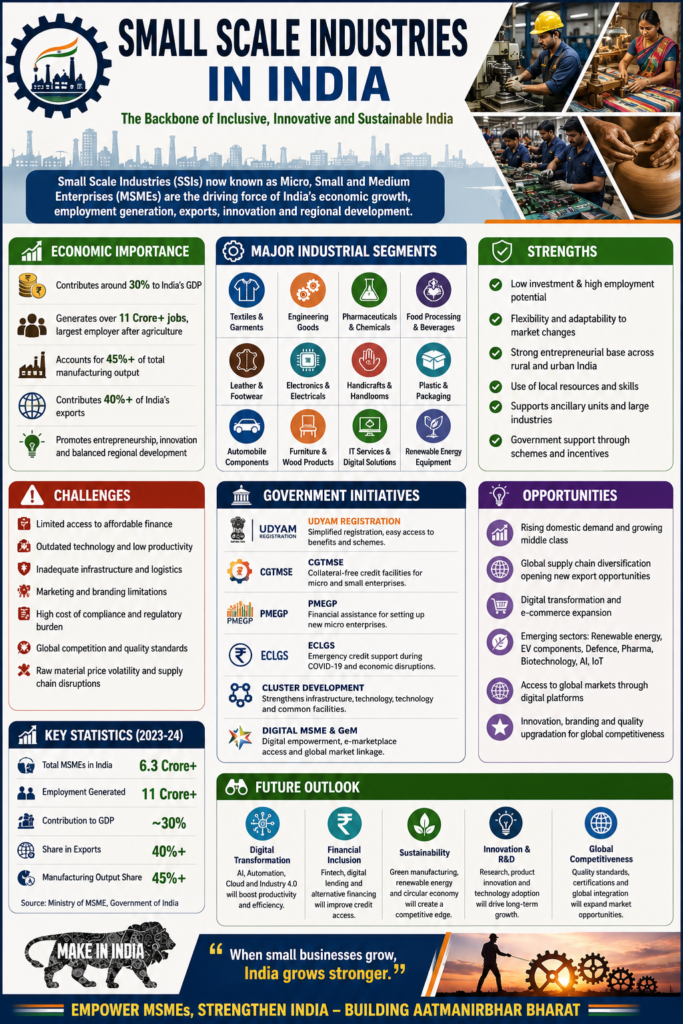
Economic Importance
Small-scale industries contribute to economic development through multiple channels.
Employment generation remains the most significant contribution of the sector. Due to relatively lower capital requirements, MSMEs create significantly more employment opportunities per unit of investment compared to large industries. Millions of skilled, semi-skilled, and unskilled workers derive their livelihoods from this sector.
The sector also contributes substantially to India’s Gross Domestic Product by supporting manufacturing, services, exports, and value addition across industries. Numerous large corporations rely on MSMEs as suppliers, component manufacturers, logistics providers, and service partners.
Regional development represents another major contribution. Small industries encourage industrialization in rural, semi-urban, and backward regions, reducing migration pressures and promoting balanced economic growth.
Export promotion is another important function. Indian MSMEs manufacture engineering goods, pharmaceuticals, garments, handicrafts, leather products, processed foods, chemicals, electronics, and software services that are exported to international markets.
Innovation and entrepreneurship flourish within the sector because smaller firms demonstrate greater flexibility in adopting new technologies, responding to changing consumer preferences, and developing niche products.
Major Industrial Segments
The diversity of India’s small-scale industrial landscape includes food processing, textiles, pharmaceuticals, chemicals, automobile components, engineering goods, leather products, handicrafts, renewable energy equipment, electronics manufacturing, information technology services, healthcare products, packaging industries, agricultural machinery, educational services, tourism, hospitality, digital consulting, and creative industries.
The rapid expansion of digital commerce has further enabled small enterprises to access domestic and international customers through online platforms.
Strengths of Small-Scale Industries
One of the principal strengths lies in their flexibility. Small enterprises can rapidly modify production processes according to changing market demand.
Entrepreneurship development is another significant advantage. The sector provides opportunities for first-generation entrepreneurs, women entrepreneurs, youth innovators, and rural businesses.
Lower capital requirements encourage widespread participation from individuals with limited financial resources.
Labour-intensive production supports employment generation and contributes to social inclusion.
The integration of traditional craftsmanship with modern technology has enabled Indian products to compete successfully in global markets.
Government support through subsidized financing, technology centers, incubation facilities, export promotion schemes, and digital platforms further enhances sectoral competitiveness.
Challenges
Despite impressive achievements, the sector faces persistent structural constraints.
Limited access to affordable finance remains one of the most serious obstacles. Many enterprises rely on informal financing because of collateral requirements and limited credit history.
Technological backwardness reduces productivity and product quality. Many firms continue operating with outdated machinery.
Infrastructure deficiencies, including unreliable power supply, logistics bottlenecks, inadequate warehousing, and poor transportation connectivity, increase operational costs.
Marketing limitations restrict market access, particularly for rural enterprises lacking digital capabilities and branding expertise.
Global competition from technologically advanced manufacturers exerts significant pressure on pricing and quality standards.
Compliance with taxation, labour laws, environmental regulations, and quality certifications often imposes disproportionate administrative burdens on smaller firms.
Supply chain disruptions, raw material price volatility, and geopolitical uncertainties further increase operational risks.
Government Initiatives
The Government of India has introduced several initiatives to strengthen MSMEs.
The Udyam Registration Portal simplifies enterprise registration and improves access to government benefits.
The Credit Guarantee Fund Trust for Micro and Small Enterprises (CGTMSE) facilitates collateral-free loans.
The Prime Minister’s Employment Generation Programme (PMEGP) promotes entrepreneurship through financial assistance.
The Emergency Credit Line Guarantee Scheme (ECLGS) provided critical financial support during economic disruptions.
Technology Centres, Cluster Development Programmes, Digital MSME initiatives, GeM procurement, export promotion councils, Startup India, Skill India, and Make in India collectively enhance industrial competitiveness.
Opportunities
India’s expanding middle class, increasing digital adoption, rapid urbanization, infrastructure development, renewable energy transition, pharmaceutical expansion, defence manufacturing, electronics production, healthcare services, biotechnology, artificial intelligence, precision manufacturing, and export diversification present enormous growth opportunities.
The global strategy of supply chain diversification also creates opportunities for Indian MSMEs to integrate into international value chains.
Digital platforms enable even the smallest enterprises to access global customers with relatively low marketing costs.
Green manufacturing and sustainable production practices are emerging as competitive differentiators.
Future Outlook
The future of India’s small-scale industrial sector appears highly promising.
Digital transformation will reshape production, marketing, logistics, finance, customer engagement, and quality management.
Artificial intelligence, automation, cloud computing, Industry 4.0 technologies, blockchain-enabled supply chains, additive manufacturing, and advanced analytics are expected to improve productivity and competitiveness.
Financial inclusion through fintech platforms, digital lending, and alternative financing mechanisms will enhance access to capital.
Increasing emphasis on environmental sustainability, circular economy principles, renewable energy adoption, and responsible manufacturing will further strengthen global competitiveness.
Public-private partnerships, academic collaborations, research commercialization, startup ecosystems, and innovation clusters will accelerate industrial modernization.
Recommendations
To maximize the sector’s contribution, India should prioritize easier credit access, technological modernization, digital literacy, infrastructure development, export facilitation, entrepreneurship training, research-industry collaboration, simplified regulatory compliance, stronger intellectual property protection, quality certification support, and sustainable manufacturing practices.
Greater integration of MSMEs into global value chains, coupled with stronger branding and innovation capabilities, will enable Indian enterprises to compete more effectively in international markets.
Conclusion
Small-scale industries remain indispensable to India’s long-term economic transformation. Their contribution extends beyond production and employment to encompass innovation, regional development, social inclusion, and entrepreneurial dynamism. Although challenges relating to finance, technology, infrastructure, and competitiveness persist, ongoing policy reforms and digital transformation provide unprecedented opportunities for sustained growth.
As India advances toward becoming a global manufacturing and innovation hub, strengthening the MSME ecosystem will be essential for achieving inclusive economic growth, employment generation, export expansion, technological advancement, and sustainable national development. A resilient, technologically empowered, and globally competitive small-scale industrial sector will continue to serve as one of the strongest engines of India’s economic progress in the coming decades.