

Abstract
Orthodontics has undergone a revolutionary transformation during the twenty-first century due to rapid advancements in digital dentistry, artificial intelligence, biomaterials, three-dimensional imaging, computer-assisted treatment planning, and esthetic orthodontic systems. Traditional fixed mechanotherapy has increasingly evolved into a sophisticated interdisciplinary specialty integrating biomechanics, software engineering, regenerative biology, craniofacial imaging, and minimally invasive therapeutic strategies. Across the world, the orthodontic industry has witnessed accelerated adoption of clear aligners, temporary anchorage devices (TADs), self-ligating brackets, CAD/CAM systems, teleorthodontics, and AI-assisted predictive treatment planning. India, one of the fastest-growing dental healthcare markets globally, is simultaneously experiencing substantial expansion in orthodontic awareness, digital dental infrastructure, aligner manufacturing, and cosmetic dentistry demand. However, disparities remain in affordability, technological accessibility, training standards, and rural orthodontic care. This cross-sectional comparative review critically evaluates the latest developments in orthodontics in India and globally, focusing on technological innovation, treatment efficiency, clinical outcomes, patient-centered care, digital transformation, and future trends. Particular emphasis is placed upon artificial intelligence, 3D printing, smart materials, clear aligner therapy, skeletal anchorage systems, accelerated orthodontics, robotic systems, teledentistry, and personalized orthodontic biomechanics. Comparative analysis demonstrates that developed nations such as the United States, Germany, Japan, South Korea, and Scandinavian countries have integrated advanced digital orthodontics into mainstream practice, whereas emerging economies including India are rapidly adapting these technologies through cost-effective innovation and domestic aligner ecosystems. The review further explores ethical considerations, economic barriers, educational reforms, and public health implications associated with modern orthodontic practice. The study concludes that orthodontics is transitioning from mechanically driven tooth movement toward biologically optimized, digitally controlled, precision craniofacial therapy, thereby redefining the future of dentofacial healthcare worldwide. (Lippincott Journals)
Keywords: Orthodontics; Clear aligners; Artificial intelligence; Digital dentistry; India; Skeletal anchorage
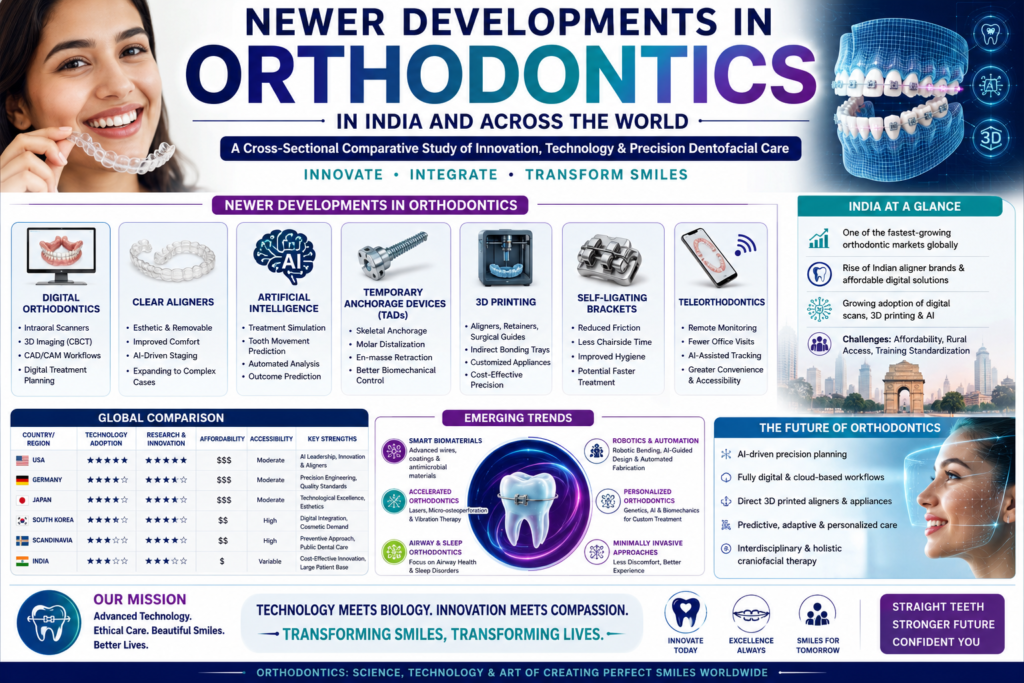
Introduction
Orthodontics has historically represented one of the most technically demanding and scientifically dynamic branches of dentistry. Traditionally centered upon fixed appliances, arch wires, brackets, and biomechanical tooth movement, the discipline has progressively evolved into a technologically integrated specialty combining engineering, computer science, craniofacial biology, imaging sciences, biomaterials, and precision digital healthcare.
The global orthodontic landscape has changed dramatically over the past two decades because of increasing esthetic awareness, patient demand for minimally visible appliances, advances in biomedical imaging, and the emergence of digital dentistry ecosystems. Contemporary orthodontics now incorporates intraoral scanners, computer-assisted treatment planning, artificial intelligence-based movement prediction, 3D printed appliances, robotic aligner fabrication, remote treatment monitoring, and skeletal anchorage systems. (Lippincott Journals)
India has emerged as a rapidly growing orthodontic market because of increasing urbanization, rising disposable income, cosmetic dental awareness, expansion of private dental chains, and social media-driven esthetic consciousness. The country now possesses one of the world’s largest populations requiring orthodontic intervention, especially among adolescents and young adults. However, substantial challenges remain regarding affordability, rural accessibility, training heterogeneity, regulatory standardization, and unequal access to advanced digital technologies.
Globally, orthodontic innovation is increasingly directed toward:
- Minimally invasive therapy
- Enhanced treatment predictability
- Reduction in treatment duration
- Improved patient comfort
- Personalized biomechanics
- Reduced clinical visits
- AI-driven precision planning
- Esthetic appliance systems
Clear aligner therapy has particularly transformed modern orthodontics. Once limited to mild malocclusions, clear aligners are now increasingly used for complex cases because of integration with temporary anchorage devices (TADs), digital simulation systems, and AI-assisted staging algorithms. (PMC)
This article presents a detailed cross-sectional comparative study evaluating newer developments in orthodontics in India and across the world. The study critically examines technological innovations, comparative treatment approaches, economic and educational implications, digital transformation, and future prospects of orthodontic science.
Evolution of Orthodontics: From Mechanical Dentistry to Digital Precision Therapy
Orthodontics originated primarily as a mechanical specialty focused upon alignment correction using metallic appliances and force systems. Early orthodontic treatment relied heavily on clinician experience, manual measurements, plaster casts, cephalometric tracing, and empirical biomechanical principles.
The twentieth century witnessed major milestones including:
- Edgewise appliances
- Functional appliances
- Straight-wire systems
- Cephalometric analysis
- Orthognathic surgical integration
- Elastomeric systems
- Nickel-titanium arch wires
However, the twenty-first century introduced a paradigm shift from analog orthodontics toward digital orthodontics.
Modern orthodontic practice increasingly incorporates:
- Cone-beam computed tomography (CBCT)
- Intraoral digital scanning
- AI-assisted treatment simulation
- CAD/CAM appliance design
- 3D printing
- Biomechanical software modeling
- Digital workflow integration
These innovations have dramatically improved diagnostic precision, treatment customization, patient comfort, and interdisciplinary collaboration.
Digital Orthodontics
Digital orthodontics represents one of the most transformative developments in contemporary dental science.
Intraoral Scanners
Traditional alginate impressions are increasingly being replaced by intraoral digital scanners. These systems generate high-resolution three-dimensional representations of dental arches, enabling:
- Improved diagnostic accuracy
- Reduced patient discomfort
- Faster treatment workflows
- Digital storage and communication
- CAD/CAM integration
Countries such as the United States, Germany, Japan, and South Korea have integrated intraoral scanning into mainstream orthodontic practice. India is rapidly adopting these technologies in urban dental centers and premium orthodontic clinics.
CAD/CAM Technology
Computer-aided design and computer-aided manufacturing systems facilitate:
- Precision appliance fabrication
- Customized aligners
- Indirect bonding trays
- Lingual appliances
- Surgical splints
Digital workflows reduce human error and improve treatment standardization.
Three-Dimensional Imaging
CBCT imaging has significantly enhanced craniofacial diagnosis, airway evaluation, impacted tooth localization, temporomandibular joint assessment, and orthognathic surgical planning.
Three-dimensional visualization improves:
- Root positioning analysis
- Skeletal asymmetry assessment
- Bone density evaluation
- Implant anchorage planning
Artificial Intelligence in Orthodontics
Artificial intelligence represents one of the most disruptive innovations in modern orthodontics.
AI systems increasingly assist clinicians in:
- Treatment planning
- Tooth movement prediction
- Automated landmark identification
- Cephalometric tracing
- Occlusal analysis
- Patient monitoring
- Outcome prediction
Recent reviews indicate that AI-driven orthodontic systems improve efficiency, diagnostic accuracy, and treatment predictability. (PMC)
AI-Assisted Clear Aligner Planning
Artificial intelligence algorithms now analyze:
- Tooth morphology
- Arch relationships
- Movement sequencing
- Biomechanical feasibility
- Root torque prediction
These systems create optimized aligner staging with greater precision.
Advanced AI orthodontic systems are evolving toward neurosymbolic treatment reasoning and automated biomechanical modeling. (arXiv)
AI in India
India is witnessing rapid expansion of AI-driven orthodontic startups and aligner companies. Domestic companies increasingly integrate:
- Cloud-based treatment simulation
- AI-assisted planning
- Smartphone-based remote monitoring
- Automated aligner production
However, significant disparities remain between metropolitan centers and rural healthcare infrastructure.
Clear Aligners: Revolutionizing Orthodontic Treatment
Clear aligners represent one of the most commercially and clinically transformative innovations in orthodontics.
Align Technology popularized the global clear aligner revolution through Invisalign systems. Modern clear aligners utilize transparent thermoplastic appliances fabricated through digital treatment planning and sequential tooth movement staging. (Wikipedia)
Advantages of Clear Aligners
- Superior esthetics
- Enhanced patient comfort
- Improved oral hygiene
- Reduced mucosal trauma
- Digital treatment visualization
- Reduced chairside time
Expanding Clinical Applications
Initially, clear aligners were mainly used for mild crowding and spacing. However, recent advancements have expanded their applicability to:
- Extraction cases
- Open bites
- Deep bites
- Class II correction
- Posterior distalization
- Complex rotational movements
This progress has been facilitated by:
- AI-driven planning
- Smart attachments
- Optimized force systems
- TAD integration
(PMC)
Indian Clear Aligner Ecosystem
India has emerged as a major growth center for affordable aligner therapy. Several Indian companies now manufacture domestically produced aligners at substantially lower costs compared with imported systems.
This has increased orthodontic accessibility among middle-class populations and young professionals.
Temporary Anchorage Devices (TADs)
Temporary anchorage devices, also known as miniscrews or skeletal anchorage systems, have fundamentally transformed orthodontic biomechanics.
TADs provide stable skeletal anchorage without relying on patient compliance.
Clinical Applications
TADs enable:
- Molar intrusion
- En-masse retraction
- Distalization
- Vertical control
- Midline correction
- Asymmetric tooth movement
Integration of TADs with clear aligners has significantly expanded treatment capabilities for complex malocclusions. (PMC)
Global Trends
Developed countries demonstrate extensive use of TADs in advanced orthodontic cases. India is increasingly adopting miniscrew-supported biomechanics in tertiary orthodontic centers and academic institutions.
Self-Ligating Brackets
Self-ligating bracket systems represent another major innovation in orthodontic appliance technology.
These systems eliminate elastic ligatures and reduce friction between bracket and wire.
Advantages include:
- Faster arch wire engagement
- Reduced chairside time
- Improved hygiene
- Potential reduction in treatment duration
Modern self-ligating systems have evolved with improved bracket designs and biomechanical efficiency. (Sabka Dentist)
Accelerated Orthodontics
One of the major concerns in orthodontic treatment remains prolonged treatment duration.
Newer accelerated orthodontic methods include:
- Micro-osteoperforation
- Low-level laser therapy
- Vibration devices
- Photobiomodulation
- Corticotomy-assisted orthodontics
These approaches aim to enhance bone remodeling and accelerate tooth movement.
Research remains ongoing regarding long-term efficacy and biological safety.
3D Printing in Orthodontics
Three-dimensional printing has revolutionized appliance fabrication.
Applications include:
- Aligner model fabrication
- Retainers
- Surgical guides
- Custom brackets
- Occlusal splints
- Orthognathic surgical planning
Recent industrial developments suggest direct 3D printing of aligners may become mainstream, potentially reducing costs and manufacturing complexity.
Indian Perspective
India is increasingly integrating 3D printing technologies into dental laboratories and orthodontic centers, especially in metropolitan cities.
Cost reduction in domestic 3D printing may substantially democratize digital orthodontics in India.
Teleorthodontics and Remote Monitoring
Teleorthodontics gained major momentum following the COVID-19 pandemic.
Remote monitoring systems now allow:
- Smartphone-based scan submission
- AI-assisted progress tracking
- Virtual consultations
- Reduced in-office visits
These technologies are particularly beneficial for:
- Rural populations
- Working professionals
- International patients
- Long-distance treatment monitoring
India’s rapid smartphone penetration creates significant potential for teleorthodontic expansion.
Smart Biomaterials in Orthodontics
Modern orthodontics increasingly utilizes advanced biomaterials with enhanced mechanical and biological properties.
Nickel-Titanium Alloys
Shape-memory nickel-titanium wires provide:
- Superelasticity
- Continuous low-force application
- Improved patient comfort
Esthetic Materials
Ceramic brackets, fiber-reinforced composites, and translucent polymers improve esthetics.
Antimicrobial Materials
New biomaterials increasingly incorporate antimicrobial coatings to reduce:
- Plaque accumulation
- White spot lesions
- Gingival inflammation
Lingual Orthodontics
Lingual orthodontics involves placement of appliances on the lingual surfaces of teeth, rendering them nearly invisible.
Although technically demanding, advancements in digital customization and CAD/CAM fabrication have improved treatment precision and patient comfort.
Lingual orthodontics remains more prevalent in developed countries because of higher treatment costs and technical expertise requirements.
Orthognathic Surgery and Interdisciplinary Orthodontics
Orthodontics increasingly integrates with:
- Maxillofacial surgery
- Prosthodontics
- Periodontics
- Sleep medicine
- Speech therapy
Digital surgical planning now enables:
- Virtual surgical simulation
- Precise skeletal prediction
- Customized osteotomy guides
- Enhanced facial esthetics
Pediatric Orthodontics and Growth Modification
Modern pediatric orthodontics increasingly emphasizes:
- Early interception
- Airway assessment
- Growth guidance
- Functional orthopedic appliances
Research increasingly links craniofacial development with airway health and pediatric sleep disorders.
Functional appliances continue evolving with improved biomechanical efficiency and patient compliance.
Orthodontics and Airway Science
Airway-focused orthodontics has gained major international attention.
Orthodontists increasingly evaluate:
- Nasal airway dimensions
- Sleep-disordered breathing
- Mouth breathing
- Craniofacial airway morphology
CBCT-based airway analysis has become increasingly integrated into comprehensive orthodontic diagnosis.
Robotics and Automation in Orthodontics
Robotics represents an emerging frontier in orthodontic innovation.
Potential applications include:
- Robotic wire bending
- Automated aligner fabrication
- AI-guided appliance customization
- Precision biomechanical simulation
Future orthodontic systems may integrate robotics with real-time AI-driven adaptive treatment planning.
Comparative Orthodontic Trends Across the World
United States
The United States leads in:
- Clear aligner innovation
- AI integration
- Digital workflows
- Corporate orthodontic systems
- Research and commercialization
The country possesses highly advanced orthodontic infrastructure but also faces rising treatment costs.
Germany
Germany emphasizes precision engineering, digital dentistry, and biomaterial innovation.
German orthodontic systems are renowned for:
- High manufacturing standards
- CAD/CAM integration
- Advanced bracket systems
Japan
Japan combines technological sophistication with esthetic orthodontics and minimally invasive approaches.
South Korea
South Korea has emerged as a global leader in cosmetic dentistry and digitally integrated orthodontics.
Scandinavian Countries
Nordic nations emphasize:
- Preventive orthodontics
- Public dental healthcare
- Early intervention
- Evidence-based protocols
Orthodontics in India: Current Scenario
India possesses one of the world’s largest pools of dental graduates and orthodontic specialists.
Major Trends in India
- Rapid growth of clear aligner therapy
- Increasing cosmetic dentistry demand
- Expansion of dental chains
- Growth of digital dentistry
- Increased social media influence
- Rising adult orthodontics
Challenges
Despite growth, India faces:
- Rural healthcare disparity
- High treatment costs
- Unequal technological distribution
- Variable training standards
- Lack of universal insurance coverage
Educational Infrastructure
India has numerous orthodontic postgraduate programs. However, integration of AI, digital workflows, and advanced biomechanics into training curricula remains inconsistent.
Economic Impact of Orthodontic Innovation
The global orthodontics market is expanding rapidly.
Recent market analyses estimate substantial future growth in clear aligner systems and digital orthodontics. (iData Research)
Key growth drivers include:
- Cosmetic awareness
- Digital dentistry
- Adult orthodontics
- Social media influence
- Technological accessibility
India represents one of the fastest-growing emerging markets.
Ethical and Regulatory Concerns
Modern orthodontics faces several ethical challenges:
- Overcommercialization
- Direct-to-consumer aligners
- Inadequate clinical supervision
- AI decision transparency
- Data privacy
- Aggressive cosmetic marketing
Professional regulation remains essential to maintain treatment quality and patient safety.
Future of Orthodontics
The future of orthodontics will likely involve:
- AI-assisted autonomous planning
- Precision craniofacial therapy
- Genomics-based orthodontics
- Smart biomaterials
- Fully digital workflows
- Direct 3D printed appliances
- Remote AI monitoring
Orthodontics may increasingly evolve toward biologically adaptive and personalized treatment systems.
Cross-Sectional Comparative Analysis
Cross-sectional evaluation demonstrates substantial global variation in orthodontic accessibility, technology adoption, and treatment economics.
Developed Nations
Advantages include:
- Advanced digital infrastructure
- AI integration
- Insurance support
- Standardized education
- Research funding
Developing Nations
Challenges include:
- Limited affordability
- Technological gaps
- Urban-rural disparities
- Lower specialist density
India demonstrates rapid adaptation despite infrastructural inequalities.
Strategic Recommendations
For India
- Expansion of rural orthodontic care
- Integration of AI training in dental education
- Affordable indigenous aligner systems
- Public oral health awareness
- Insurance inclusion for orthodontics
For Global Orthodontics
- Ethical AI regulation
- Standardized digital protocols
- Sustainable biomaterials
- Accessibility-focused innovation
- Evidence-based commercialization
Conclusion
Orthodontics has entered an era of unprecedented technological transformation. The specialty is rapidly evolving from traditional mechanical tooth movement toward digitally integrated, biologically optimized, patient-centered craniofacial healthcare. Innovations including artificial intelligence, clear aligners, temporary anchorage devices, CAD/CAM systems, 3D printing, teleorthodontics, and smart biomaterials are fundamentally redefining orthodontic science and clinical practice.
India represents one of the most promising emerging orthodontic markets globally. Rising esthetic awareness, expanding digital infrastructure, domestic aligner manufacturing, and increasing specialist expertise are accelerating orthodontic modernization. However, disparities in affordability, rural access, technological penetration, and educational standardization remain major challenges.
Comparative analysis reveals that developed nations possess stronger digital integration and research ecosystems, whereas India demonstrates remarkable potential through cost-effective innovation and large-scale patient demand. The future trajectory of orthodontics will likely depend upon the successful integration of precision biomechanics, artificial intelligence, biological modulation, and ethical patient-centered care.
Orthodontics is no longer merely a discipline of dental alignment; it is increasingly becoming a sophisticated convergence of biomedical engineering, computational science, craniofacial biology, esthetic medicine, and digital healthcare innovation. The coming decades may witness the emergence of fully personalized orthodontic ecosystems capable of transforming dentofacial therapy into a predictive, minimally invasive, AI-guided branch of precision medicine.
References
- Gupta M. Recent Advances in Orthodontics: A Narrative Review. 2025. (Lippincott Journals)
- Marinelli G et al. Temporary Anchorage Devices in Clear Aligner Therapy. 2025. (PMC)
- Al Husini M et al. Optimizing Complex Tooth Movements with Clear Aligners. 2025. (ScienceDirect)
- Olawade DB et al. AI-Driven Advancements in Orthodontics for Precision Therapy. 2025. (PMC)
- Chen Z et al. Trends and Challenges in Temporary Anchorage Devices. 2025. (PMC)
- Tucci I et al. Present and Future of Artificial Intelligence in Orthodontics. 2026. (MDPI)
- iData Research. Global Clear Aligner Market Report 2025–2031. (iData Research)
- Orthodontic Products Online. What’s New in Aligners in 2025. (Orthodontic Products)
- Sabka Dentist. Orthodontic Innovations 2025. (Sabka Dentist)
- ODONTO Aligners. Future of Clear Aligners 2025. (Odonto Aligners)
- Keim RG. Orthodontics for the 21st Century: Game Changers. (JCO Online)
- Align Technology Annual Report 2024. (Wikipedia)
- Wired Magazine. Invisalign and 3D Printing Revolution. 2026.
- Lansiaux E et al. OrthoAI Framework for Biomechanical Reasoning. 2026. (arXiv)
- Lansiaux E et al. OrthoAI v2 Treatment Planning System. 2026. (arXiv)
- Zhang B et al. ArchMap for Structured Dental Understanding. 2025. (arXiv)
- Wikipedia Contributors. Clear Aligners Overview. (Wikipedia)
- ResearchGate. Artificial Intelligence Innovations in Orthodontics. (ResearchGate)
- Eon Aligner. Role of TADs with Clear Aligners. (Eon Aligner)
- Gentle Dentistry. Breakthrough Innovations in Orthodontics for 2026. (gentledentistrysi.com)