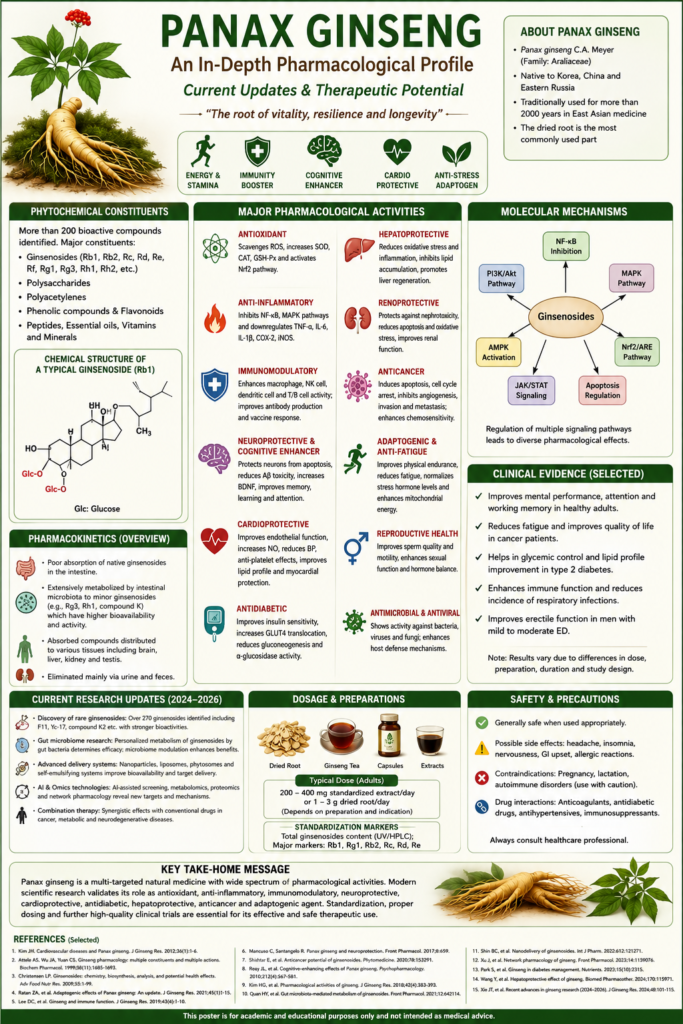

An In-Depth Pharmacological Profile of Panax ginseng: Current Perspectives and Therapeutic Potential
Author: Devanssh Mehta, M.Pharm., MBA
Abstract
Panax ginseng, commonly known as Korean or Asian ginseng, is one of the most widely studied medicinal plants in the world. It has been used for thousands of years in traditional Chinese, Korean, and Japanese medicine for improving vitality, enhancing immunity, reducing fatigue, and promoting longevity. The major bioactive constituents of Panax ginseng are ginsenosides, which exhibit diverse pharmacological properties including antioxidant, anti-inflammatory, immunomodulatory, neuroprotective, cardioprotective, antidiabetic, anticancer, and hepatoprotective effects. Recent advances in molecular pharmacology have revealed that ginseng regulates multiple cellular signaling pathways, making it a promising natural therapeutic agent for chronic diseases. This review summarizes the botanical characteristics, phytochemistry, pharmacological activities, molecular mechanisms, clinical applications, safety profile, and recent scientific developments related to Panax ginseng.
Keywords: Panax ginseng, Ginsenosides, Pharmacology, Herbal medicine, Antioxidant, Neuroprotection, Adaptogen.
Introduction
Medicinal plants continue to play a significant role in modern healthcare because of their therapeutic potential and relatively favorable safety profiles. Among these, Panax ginseng C.A. Meyer has attracted considerable scientific attention owing to its extensive medicinal properties. The term “Panax” originates from the Greek word meaning “all-healing,” reflecting the historical belief that the plant possesses broad therapeutic benefits.
The root of Panax ginseng has been traditionally used to improve physical strength, mental performance, immune function, and resistance to stress. Modern pharmacological research has confirmed many of these traditional claims through laboratory, animal, and human studies. The biological activity of ginseng is mainly attributed to a unique class of triterpene saponins known as ginsenosides.
Botanical Profile
Panax ginseng belongs to the family Araliaceae. It is a slow-growing perennial herb native to Korea, northeastern China, and eastern Russia. The plant generally requires four to six years of cultivation before harvesting. The medicinally important part is the root, although leaves, berries, and flowers also contain pharmacologically active compounds.
Phytochemical Constituents
More than 200 bioactive compounds have been identified in Panax ginseng. The most important constituents include:
- Ginsenosides (Rb1, Rb2, Rc, Rd, Re, Rf, Rg1, Rg3, Rh1, Rh2)
- Polysaccharides
- Polyacetylenes
- Phenolic compounds
- Flavonoids
- Peptides
- Essential oils
- Vitamins and minerals
Among these compounds, ginsenosides are considered the primary therapeutic molecules responsible for the majority of pharmacological actions.
Pharmacological Activities
Antioxidant Activity
Oxidative stress contributes significantly to aging and chronic diseases. Ginsenosides effectively neutralize reactive oxygen species (ROS) and enhance endogenous antioxidant enzymes such as superoxide dismutase, catalase, and glutathione peroxidase. These actions help protect cellular components from oxidative damage.
Anti-inflammatory Activity
Inflammation is involved in numerous chronic diseases including arthritis, diabetes, and cardiovascular disorders. Ginseng suppresses inflammatory mediators such as tumor necrosis factor-alpha (TNF-α), interleukin-6 (IL-6), prostaglandin E2, and nitric oxide by inhibiting NF-κB and MAPK signaling pathways.
Immunomodulatory Effects
Panax ginseng enhances both innate and adaptive immunity. It stimulates macrophages, natural killer cells, dendritic cells, and T lymphocytes while improving antibody production. Clinical studies have suggested that ginseng supplementation may reduce susceptibility to respiratory infections and improve vaccine responses.
Neuroprotective Activity
Neurodegenerative disorders such as Alzheimer’s disease and Parkinson’s disease are associated with oxidative stress, inflammation, and neuronal degeneration. Ginsenosides improve cognitive function by reducing neuronal apoptosis, enhancing synaptic plasticity, regulating neurotransmitter release, and increasing brain-derived neurotrophic factor (BDNF).
Cardioprotective Activity
Cardiovascular diseases remain the leading cause of mortality worldwide. Ginseng improves endothelial function, promotes nitric oxide production, reduces oxidative stress, lowers blood pressure, and improves myocardial function. It may also reduce platelet aggregation and improve lipid metabolism.
Antidiabetic Activity
Numerous experimental studies have demonstrated that Panax ginseng improves glucose metabolism by increasing insulin sensitivity, stimulating glucose uptake through GLUT4 transporters, reducing insulin resistance, and protecting pancreatic beta cells. These effects may contribute to better glycemic control in individuals with type 2 diabetes.
Hepatoprotective Activity
The liver is susceptible to injury from toxins, alcohol, and metabolic disorders. Ginseng exhibits hepatoprotective activity by reducing oxidative stress, inhibiting inflammatory cytokines, decreasing lipid accumulation, and promoting liver regeneration. Experimental studies suggest beneficial effects in non-alcoholic fatty liver disease.
Renoprotective Activity
Kidney diseases involve oxidative damage and inflammation. Ginseng has shown protective effects against nephrotoxicity induced by drugs, heavy metals, and diabetes. It preserves renal function by reducing apoptosis and improving antioxidant defense systems.
Anticancer Activity
Extensive laboratory research has demonstrated that ginsenosides possess anticancer properties against multiple cancer types including breast, lung, colorectal, liver, gastric, prostate, and pancreatic cancers. The mechanisms include inhibition of tumor cell proliferation, induction of apoptosis, suppression of angiogenesis, inhibition of metastasis, and enhancement of immune surveillance.
Although preclinical evidence is promising, additional large-scale clinical trials are required before ginseng can be routinely recommended as an anticancer therapy.
Adaptogenic and Anti-fatigue Effects
One of the most recognized properties of Panax ginseng is its adaptogenic activity. Adaptogens help the body resist physical, emotional, and environmental stress. Ginseng improves physical endurance, reduces fatigue, enhances mitochondrial energy production, and increases exercise performance.
Cognitive Enhancement
Several randomized clinical studies indicate that Panax ginseng may improve memory, concentration, attention, learning ability, and mental performance. These effects are believed to result from enhanced cerebral blood flow, neurotransmitter regulation, and antioxidant protection.
Antimicrobial and Antiviral Activities
Recent investigations have shown that ginseng possesses antibacterial, antiviral, and antifungal properties. It enhances host immune defense against influenza viruses, respiratory pathogens, and several bacterial infections. Ongoing research continues to evaluate its role as an adjunct to conventional antimicrobial therapy.
Molecular Mechanisms
Modern pharmacological studies have demonstrated that Panax ginseng regulates numerous intracellular signaling pathways including:
- NF-κB signaling
- PI3K/Akt pathway
- MAPK pathway
- AMPK signaling
- Nrf2 antioxidant pathway
- JAK/STAT signaling
- Apoptotic pathways involving caspases
- Mitochondrial function
These molecular actions explain the wide spectrum of pharmacological activities exhibited by ginseng.
Clinical Applications
Clinical studies have investigated Panax ginseng in various conditions including fatigue, cognitive impairment, diabetes, metabolic syndrome, erectile dysfunction, immune dysfunction, respiratory infections, and cardiovascular diseases. While many studies report beneficial outcomes, differences in dosage, preparation methods, treatment duration, and study design have resulted in variable findings. Standardization of ginseng preparations remains an important consideration for future clinical research.
Safety Profile
Panax ginseng is generally considered safe when consumed in recommended doses. Reported adverse effects are usually mild and include headache, insomnia, gastrointestinal discomfort, nervousness, and allergic reactions.
Patients taking anticoagulants, antidiabetic drugs, antihypertensive medications, or immunosuppressive agents should consult healthcare professionals before using ginseng because potential drug interactions have been reported.
Pregnant and breastfeeding women should avoid excessive use until sufficient safety data become available.
Current Research Updates
Recent research has focused on advanced extraction technologies, nanotechnology-based drug delivery systems, gut microbiota-mediated metabolism of ginsenosides, artificial intelligence-assisted phytochemical discovery, metabolomics, and precision herbal medicine. Scientists are also investigating rare ginsenosides with improved bioavailability and stronger pharmacological activity.
Several studies have highlighted the potential of combining Panax ginseng with conventional therapies to improve treatment outcomes while minimizing adverse effects. Future clinical trials are expected to establish standardized therapeutic guidelines for its broader clinical application.
Future Perspectives
Future research should emphasize well-designed multicenter clinical trials, standardization of ginseng preparations, pharmacokinetic investigations, personalized medicine approaches, and long-term safety assessments. Integration of molecular biology, biotechnology, metabolomics, and systems pharmacology will further enhance understanding of this important medicinal plant.
Conclusion
Panax ginseng represents one of the most valuable medicinal plants in traditional and modern medicine. Its rich content of ginsenosides and other phytochemicals contributes to a wide range of pharmacological effects including antioxidant, anti-inflammatory, neuroprotective, cardioprotective, antidiabetic, hepatoprotective, immunomodulatory, and anticancer activities. Although extensive experimental evidence supports its therapeutic potential, additional high-quality clinical studies are required to establish standardized treatment protocols. Continued scientific investigation will likely expand the role of Panax ginseng as a complementary therapeutic agent in the management of chronic diseases and the promotion of human health.
References
- Attele AS, Wu JA, Yuan CS. Ginseng pharmacology: multiple constituents and multiple actions. Biochemical Pharmacology. 1999.
- Christensen LP. Ginsenosides: chemistry, biosynthesis, analysis, and potential health effects. Advances in Food and Nutrition Research. 2009.
- Kim JH. Cardiovascular diseases and Panax ginseng. Journal of Ginseng Research. 2012.
- Ratan ZA, et al. Adaptogenic effects of Panax ginseng. Journal of Ginseng Research. 2021.
- Lee DC, et al. Ginseng and immune function. Journal of Ginseng Research. 2019.
- Mancuso C, Santangelo R. Panax ginseng and neuroprotection. Frontiers in Pharmacology. 2017.
- Helms S. Cancer prevention and Panax ginseng. Alternative Medicine Review. 2004.
- Reay JL, et al. Cognitive effects of Panax ginseng. Psychopharmacology. 2010.
- Kim HG, et al. Pharmacological activities of ginseng. Journal of Ginseng Research. 2018.
- Recent reviews in Frontiers in Pharmacology, Phytomedicine, Nutrients, and Biomedicine & Pharmacotherapy (2022–2025).