

Enhancing the Counter-Terrorism Capabilities of India’s Security Forces: Building a Future-Ready National Security Architecture
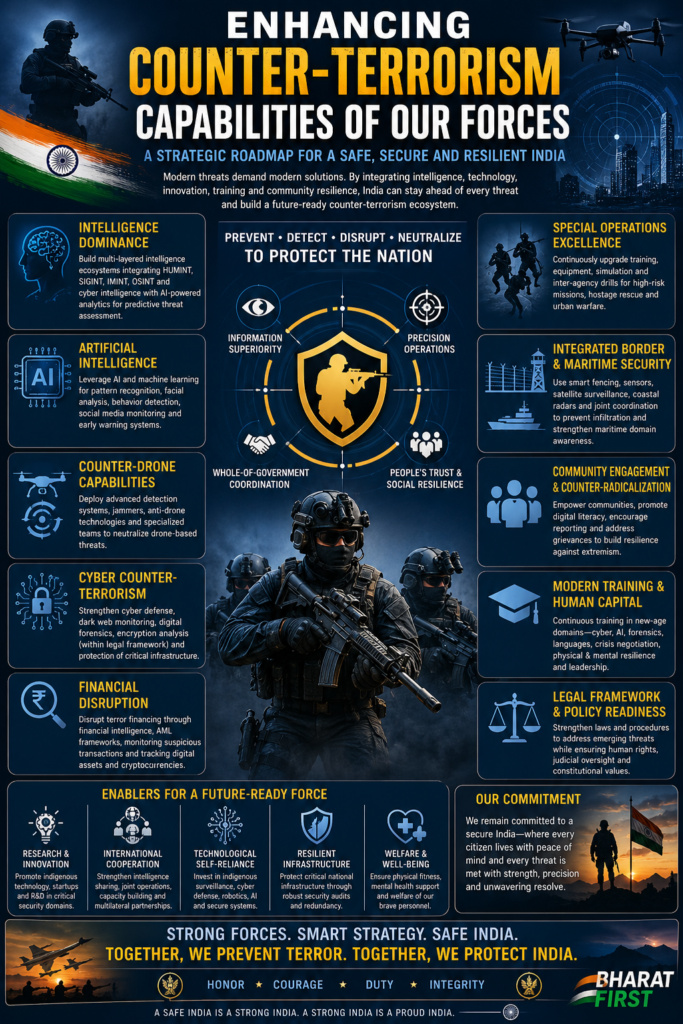
Introduction
Counter-terrorism has become one of the defining national security challenges of the twenty-first century. Unlike conventional warfare, terrorism is adaptive, decentralized, technologically sophisticated, and psychologically driven. Terrorist organizations increasingly exploit encrypted communications, cyber networks, artificial intelligence, drones, cryptocurrencies, social media platforms, and transnational criminal ecosystems to expand their operational reach. Their ability to rapidly evolve demands that security forces continuously modernize their doctrines, capabilities, technologies, and operational frameworks.
India, owing to its geopolitical location, extensive borders, diverse demographics, strategic significance, and regional security dynamics, continues to face multifaceted terrorist threats. Cross-border terrorism, homegrown radicalization, urban terrorism, cyber-enabled extremism, maritime infiltration, and drone-assisted smuggling have collectively transformed the country’s security environment. While India’s armed forces, central armed police forces, intelligence agencies, state police organizations, and specialized counter-terrorism units have demonstrated remarkable professionalism and resilience, future threats require a new generation of integrated counter-terrorism capabilities that combine technological superiority with strategic intelligence, rapid response, legal preparedness, and societal resilience.
The future of counter-terrorism is no longer determined solely by firepower. Instead, success increasingly depends upon information dominance, predictive intelligence, precision operations, inter-agency coordination, cyber resilience, public trust, and international cooperation. A comprehensive modernization strategy is therefore essential to ensure that India’s security forces remain capable of preventing, detecting, disrupting, and neutralizing evolving terrorist threats.
Understanding the Changing Nature of Terrorism
Modern terrorism has undergone a profound transformation. Traditional hierarchical organizations have increasingly given way to decentralized networks capable of operating autonomously while remaining ideologically connected. Terrorist groups now leverage advanced communication technologies, encrypted messaging applications, dark web marketplaces, unmanned aerial systems, and sophisticated propaganda campaigns to recruit, finance, train, and coordinate operations across international borders.
The emergence of lone-wolf attacks, cyber-terrorism, critical infrastructure targeting, misinformation campaigns, and technologically enabled extremist networks has further complicated counter-terrorism operations. Artificial intelligence has enabled malicious actors to automate propaganda dissemination, manipulate digital content, generate fake identities, and enhance operational security.
Consequently, counter-terrorism can no longer rely exclusively upon traditional policing or military responses. Instead, it requires a multidisciplinary ecosystem integrating intelligence analysis, cyber capabilities, forensic sciences, behavioral analytics, financial monitoring, technological innovation, and community engagement.
Intelligence-Centric Counter-Terrorism
Intelligence remains the cornerstone of every successful counter-terrorism operation. Preventing attacks before execution is significantly more effective than responding after casualties occur. Modern intelligence capabilities should therefore prioritize predictive analysis rather than reactive investigation.
Advanced intelligence systems should integrate human intelligence (HUMINT), signals intelligence (SIGINT), electronic intelligence (ELINT), imagery intelligence (IMINT), open-source intelligence (OSINT), cyber intelligence, geospatial intelligence, and financial intelligence into unified operational platforms. Artificial intelligence-assisted data analytics can rapidly identify suspicious behavioral patterns, unusual financial transactions, abnormal travel patterns, communication anomalies, and emerging terrorist networks.
Real-time intelligence fusion centers connecting military agencies, intelligence organizations, law enforcement authorities, border security agencies, and cyber specialists can significantly reduce information silos while improving coordinated operational responses.
Artificial Intelligence as a Force Multiplier
Artificial intelligence represents one of the most transformative technologies in modern counter-terrorism. Rather than replacing human judgment, AI enhances situational awareness, accelerates data processing, and supports informed decision-making.
Potential applications include predictive threat assessment, facial recognition, multilingual translation, behavioral anomaly detection, satellite image analysis, automated surveillance monitoring, drone detection, cyber threat intelligence, social media monitoring, and resource allocation optimization.
Machine learning algorithms can process millions of data points within seconds, identifying patterns that would otherwise remain undetected. AI-assisted intelligence platforms may also support early warning systems by correlating information from diverse databases.
However, AI deployment must remain consistent with constitutional safeguards, transparency, accountability, human oversight, and applicable legal frameworks to maintain public trust and protect civil liberties.
Countering Drone-Based Threats
The increasing use of unmanned aerial systems by terrorist organizations presents new operational challenges. Drones may potentially be exploited for surveillance, contraband delivery, reconnaissance, or attacks against critical infrastructure. Consequently, counter-drone capabilities have become an essential component of national security planning.
A comprehensive counter-drone architecture should incorporate radar systems, radio-frequency sensors, electro-optical surveillance, acoustic detection technologies, electronic countermeasures, jamming systems where legally authorized, and layered airspace monitoring around sensitive installations.
Specialized rapid-response teams trained in drone identification, electronic warfare, forensic examination, and incident response can further strengthen defensive preparedness.
Cyber Counter-Terrorism
Digital platforms have become central operational spaces for terrorist recruitment, financing, propaganda, communication, and operational planning. Cybersecurity therefore forms an indispensable pillar of modern counter-terrorism.
Dedicated cyber counter-terrorism units should strengthen capabilities in malware analysis, digital forensics, blockchain intelligence, cryptocurrency investigations, encrypted communication analysis (within lawful authority), cyber threat hunting, and dark web intelligence collection.
Protection of critical infrastructure—including power grids, transportation systems, telecommunications networks, healthcare institutions, financial systems, and government services—must remain a national priority. Regular cyber resilience exercises, vulnerability assessments, and incident response planning are essential to strengthen preparedness.
Special Operations Modernization
Special operations forces remain indispensable for high-risk counter-terrorism missions involving hostage rescue, precision interdiction, urban operations, and critical infrastructure protection. Continuous modernization should emphasize advanced tactical training, realistic simulation environments, interoperable communications, enhanced situational awareness, and rapid mobility.
Scenario-based exercises that integrate military, police, intelligence, emergency medical services, and disaster response agencies can improve coordination during complex incidents while reducing operational uncertainty.
Border Security and Integrated Surveillance
Secure borders play a crucial role in preventing infiltration, illegal trafficking, and movement of terrorist operatives. Modern border management increasingly relies on integrated surveillance technologies rather than physical barriers alone.
Smart border systems may include ground sensors, thermal imaging, satellite monitoring, long-range observation systems, secure communications, geographic information systems, and coordinated patrol mechanisms. Data integration between border management agencies and intelligence organizations enhances situational awareness and supports timely decision-making.
Maritime security should similarly incorporate coastal surveillance, vessel tracking, port security, maritime domain awareness, and coordinated information sharing among relevant authorities.
Financial Counter-Terrorism
Terrorist organizations require financial resources to recruit personnel, acquire equipment, sustain logistics, and conduct operations. Disrupting these financial networks can significantly reduce operational capability.
Strengthening anti-money laundering frameworks, improving financial intelligence analysis, enhancing international cooperation, monitoring suspicious financial transactions consistent with legal standards, and expanding expertise in digital asset investigations contribute to more effective counter-terrorism financing efforts.
Interdisciplinary collaboration among financial regulators, law enforcement agencies, intelligence organizations, and international partners remains essential.
Community Engagement and Counter-Radicalization
Long-term counter-terrorism success depends not only upon operational capability but also upon societal resilience. Community engagement can help reduce vulnerabilities to extremist recruitment by promoting trust, encouraging reporting of genuine security concerns, and supporting preventive interventions.
Educational initiatives, digital literacy programs, responsible online engagement, youth development opportunities, and partnerships with civil society can contribute to reducing susceptibility to extremist narratives while respecting diversity, constitutional values, and human rights.
Efforts should focus on preventing violence rather than stigmatizing any community, recognizing that terrorism is driven by extremist ideologies rather than any religion or ethnicity.
Modern Training and Professional Development
Counter-terrorism professionals require continuous education to keep pace with evolving threats. Training should increasingly incorporate multidisciplinary competencies including cyber operations, intelligence analysis, digital forensics, crisis negotiation, language skills, psychological resilience, legal procedures, and technological proficiency.
Simulation-based learning, virtual reality training environments, artificial intelligence-assisted decision exercises, tabletop scenarios, and joint inter-agency drills can significantly improve preparedness for complex operational environments.
Leadership development should also emphasize adaptive decision-making, ethical leadership, operational accountability, and evidence-based planning.
Legal and Policy Preparedness
Effective counter-terrorism requires robust legal frameworks that enable timely investigation, prosecution, intelligence sharing, and international cooperation while safeguarding constitutional rights and judicial oversight.
Regular policy reviews can help ensure that legal mechanisms remain responsive to technological developments such as cyber-enabled terrorism, unmanned systems, digital evidence, encrypted communications, and transnational criminal networks. Clear accountability mechanisms and adherence to the rule of law strengthen institutional legitimacy and public confidence.
Research, Innovation, and Indigenous Technology
Long-term strategic advantage depends upon sustained investment in indigenous research, innovation, and technological self-reliance. Collaboration among government institutions, academia, defense research organizations, startups, and industry can accelerate development of advanced surveillance technologies, secure communications, cyber defense tools, forensic technologies, robotics, artificial intelligence applications, and decision-support systems.
Strengthening domestic innovation ecosystems aligns with broader national objectives of technological resilience and strategic autonomy while reducing dependence on imported security technologies.
International Cooperation
Terrorism is a transnational challenge that requires sustained international collaboration. Intelligence sharing, joint training, mutual legal assistance, capacity-building initiatives, coordinated investigations, and participation in multilateral counter-terrorism mechanisms enhance collective security.
Cooperation with international organizations and strategic partners also facilitates exchange of best practices, emerging threat assessments, technological innovations, and operational lessons learned.
Building a Resilient National Security Ecosystem
Future counter-terrorism success depends upon integrating military capabilities, policing expertise, intelligence resources, technological innovation, legal preparedness, academic research, private sector partnerships, and community participation into a unified national security architecture.
Such an ecosystem should prioritize prevention, preparedness, resilience, rapid response, evidence-based policy formulation, and continuous capability enhancement. Investment in human capital remains equally important, ensuring that personnel receive modern equipment, advanced training, mental health support, leadership development, and opportunities for professional growth.
Conclusion
The future of counter-terrorism will be shaped not only by technological superiority but also by institutional adaptability, strategic foresight, ethical governance, and whole-of-government coordination. As terrorist organizations increasingly exploit emerging technologies and decentralized operational models, India’s security forces must continue evolving through innovation, intelligence integration, cyber resilience, advanced training, indigenous technological development, and strong inter-agency collaboration.
A future-ready counter-terrorism strategy should balance operational effectiveness with constitutional values, democratic accountability, and respect for human rights. By investing in intelligent security architectures, resilient institutions, and evidence-driven policymaking, India can further strengthen its capacity to prevent terrorism, protect critical infrastructure, safeguard its citizens, and contribute to regional and global security. The objective is not merely to respond to terrorist incidents but to build a resilient national security ecosystem capable of anticipating and mitigating future threats while preserving the principles of democracy, rule of law, and national unity.