

The Impact of Artificial Intelligence on Overall India: Transforming the Nation for the Future
Introduction
Artificial Intelligence (AI) is rapidly becoming one of the most transformative technologies of the twenty-first century. Across the globe, governments, industries, educational institutions, healthcare organizations, and businesses are integrating AI into their operations to improve efficiency, productivity, and innovation. India, with its vast population, expanding digital infrastructure, highly skilled workforce, and growing startup ecosystem, is uniquely positioned to become one of the world’s leading AI-powered economies.
The Government of India has launched multiple initiatives such as Digital India, Startup India, Skill India, IndiaAI Mission, National Digital Health Mission, and National Education Policy (NEP) 2020, which collectively provide a strong foundation for AI adoption. Today, AI is no longer confined to research laboratories; it has become an essential technology influencing everyday life, economic development, governance, healthcare, agriculture, transportation, manufacturing, defense, finance, education, and environmental sustainability.
This article explores the comprehensive impact of artificial intelligence on India’s overall development, highlighting opportunities, challenges, and the future outlook.
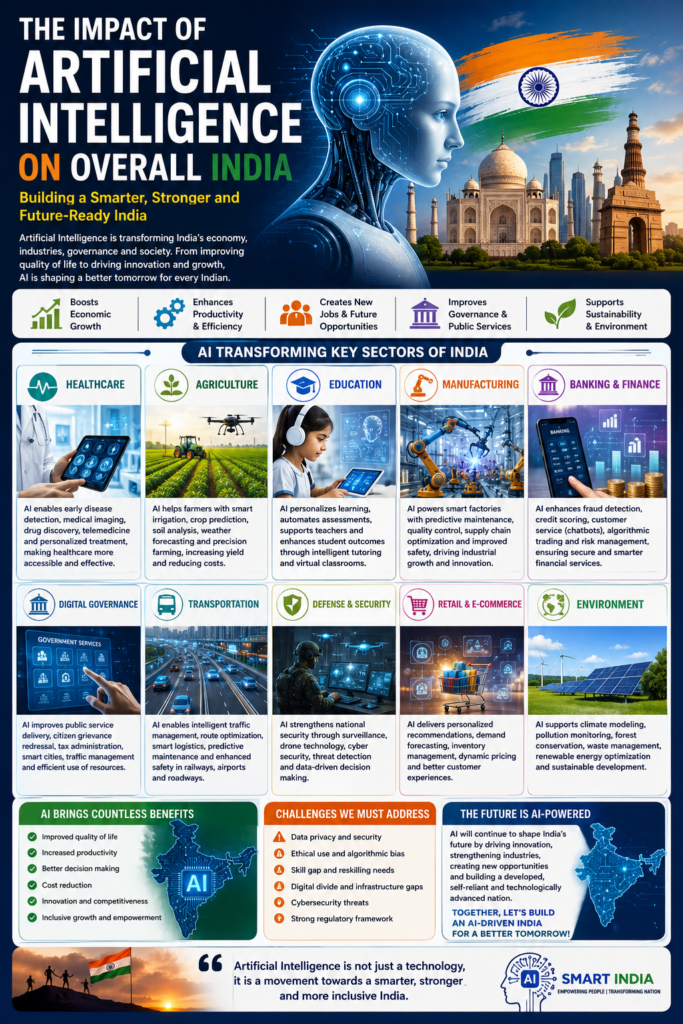
Artificial Intelligence: Understanding the Technology
Artificial Intelligence refers to computer systems capable of performing tasks that typically require human intelligence. These include:
- Learning from data
- Problem-solving
- Speech recognition
- Image analysis
- Language translation
- Decision-making
- Pattern recognition
- Predictive analytics
Modern AI technologies include Machine Learning (ML), Deep Learning, Natural Language Processing (NLP), Computer Vision, Robotics, and Generative AI.
These technologies are revolutionizing nearly every sector of the Indian economy.
AI Driving India’s Economic Growth
Artificial intelligence is expected to become one of the strongest contributors to India’s GDP over the coming decades.
AI contributes by:
- Increasing industrial productivity
- Reducing operational costs
- Improving business efficiency
- Automating repetitive tasks
- Enhancing customer experiences
- Supporting innovation
India possesses several competitive advantages:
- Large IT workforce
- Strong software industry
- Growing digital infrastructure
- Affordable internet connectivity
- Expanding startup ecosystem
- Increasing cloud computing adoption
These strengths position India as an emerging global AI innovation hub.
AI Revolution in Healthcare
Healthcare is among the sectors experiencing the greatest transformation through AI.
Major applications include:
Early Disease Detection
AI algorithms assist physicians in identifying diseases such as:
- Cancer
- Tuberculosis
- Diabetic retinopathy
- Heart disease
- Stroke
- Kidney disorders
Earlier diagnosis often improves treatment outcomes.
Medical Imaging
AI supports radiologists by interpreting:
- X-rays
- CT scans
- MRI images
- Ultrasound images
This reduces reporting time while improving diagnostic consistency.
Drug Discovery
AI accelerates pharmaceutical research by:
- Identifying drug targets
- Predicting molecular interactions
- Optimizing clinical trials
- Reducing research costs
Telemedicine
AI-powered virtual consultations increase healthcare access, particularly in rural and underserved regions.
Hospital Management
Hospitals use AI for:
- Patient scheduling
- Bed management
- Electronic health records
- Predictive resource allocation
- Clinical decision support
AI Transforming Agriculture
Agriculture remains the backbone of India’s rural economy.
AI enables:
- Precision farming
- Smart irrigation
- Crop disease prediction
- Soil health analysis
- Weather forecasting
- Yield prediction
- Fertilizer optimization
Drones combined with AI assist farmers in crop monitoring, pesticide spraying, and field mapping.
These technologies can increase productivity while reducing costs and environmental impact.
AI in Education
India’s education sector is undergoing rapid digital transformation.
AI supports:
- Personalized learning
- Adaptive testing
- Intelligent tutoring systems
- Automated assessments
- Learning analytics
- Virtual laboratories
- Language translation
Students receive customized learning experiences based on their strengths and weaknesses.
Teachers benefit from reduced administrative workloads and improved student performance tracking.
AI Revolutionizing Manufacturing
Manufacturing industries increasingly rely on AI-powered smart factories.
Applications include:
- Predictive maintenance
- Industrial robotics
- Automated quality inspection
- Supply chain optimization
- Inventory management
- Production forecasting
AI helps manufacturers improve efficiency while minimizing downtime and waste.
AI in Banking and Financial Services
Indian banks and financial institutions increasingly use AI to improve services.
Applications include:
- Fraud detection
- Credit risk assessment
- Customer support chatbots
- Digital banking
- Investment recommendations
- Loan processing
- Regulatory compliance
AI strengthens cybersecurity while delivering faster financial services.
AI and Digital Governance
Artificial intelligence is improving public administration across India.
Government agencies use AI for:
- Citizen grievance management
- Smart governance
- Traffic management
- Tax administration
- Digital identity verification
- Public service delivery
- Disaster response
AI enables more transparent, efficient, and data-driven governance.
AI in Transportation
Transportation systems are becoming smarter through AI.
Key developments include:
- Intelligent traffic management
- Route optimization
- Fleet monitoring
- Railway safety
- Airport operations
- Smart logistics
- Predictive vehicle maintenance
AI reduces congestion, fuel consumption, and operational inefficiencies.
AI in Defense and National Security
India’s defense sector increasingly incorporates AI technologies.
Applications include:
- Autonomous surveillance
- Drone technology
- Border monitoring
- Cybersecurity
- Intelligence analysis
- Battlefield simulations
- Decision support systems
AI enhances national security while improving operational readiness.
AI and India’s Startup Ecosystem
India has become one of the world’s fastest-growing startup ecosystems.
AI startups are developing innovations in:
- Healthcare
- FinTech
- AgriTech
- EdTech
- Cybersecurity
- Logistics
- Retail
- Manufacturing
Government support, venture capital investment, and skilled talent continue to drive AI entrepreneurship.
AI Creating New Employment Opportunities
Although automation may replace some repetitive tasks, AI is also generating new career opportunities.
Growing roles include:
- AI Engineers
- Machine Learning Engineers
- Data Scientists
- AI Researchers
- Robotics Engineers
- Prompt Engineers
- AI Product Managers
- Data Analysts
- AI Consultants
- Cybersecurity Specialists
Continuous upskilling will be essential for India’s workforce.
AI Supporting Environmental Sustainability
Artificial intelligence contributes to environmental protection through:
- Climate modeling
- Pollution monitoring
- Forest conservation
- Wildlife protection
- Smart energy grids
- Water management
- Renewable energy optimization
- Waste management
AI helps governments and industries make more sustainable decisions.
AI in Retail and E-Commerce
Indian retailers increasingly use AI for:
- Product recommendations
- Customer analytics
- Inventory optimization
- Dynamic pricing
- Personalized marketing
- Demand forecasting
Consumers benefit from faster, more personalized shopping experiences.
AI in Pharmaceuticals and Biotechnology
India’s pharmaceutical industry increasingly uses AI to improve:
- Drug discovery
- Clinical trial design
- Pharmacovigilance
- Manufacturing quality control
- Personalized medicine
- Regulatory documentation
- Supply chain management
AI is expected to significantly reduce the time and cost required to develop new medicines.
Challenges Facing AI Adoption in India
Despite significant progress, several challenges remain.
Data Privacy
Protecting citizens’ personal information is critical for responsible AI adoption.
Ethical Concerns
AI systems must remain transparent, fair, and free from harmful bias.
Skill Gap
India requires millions of professionals trained in AI, data science, and advanced digital technologies.
Digital Divide
Rural and remote regions still face infrastructure and connectivity limitations.
Cybersecurity Risks
Greater AI adoption increases exposure to cyberattacks and sophisticated digital threats.
Regulatory Framework
Balanced regulations are needed to encourage innovation while protecting public interests.
Government Initiatives Supporting AI
India has introduced several initiatives to accelerate AI adoption:
- IndiaAI Mission
- Digital India
- Startup India
- Make in India
- Skill India
- National Digital Health Mission
- National Education Policy 2020
- National Supercomputing Mission
- Semiconductor Mission
- PM Gati Shakti
These programs aim to strengthen India’s digital economy and technological leadership.
Future Outlook
Artificial intelligence will become an integral component of India’s economic and social development over the next decade. As AI technologies mature, they are expected to reshape industries, improve public services, enhance healthcare delivery, modernize agriculture, strengthen national security, and create new avenues for innovation and employment.
To fully realize these benefits, India must invest in high-quality education, digital infrastructure, ethical AI governance, cybersecurity, research and development, and workforce reskilling. Collaboration among government, academia, industry, startups, and civil society will be crucial to ensuring that AI is deployed responsibly and inclusively.
Conclusion
Artificial intelligence is no longer a technology of the future—it is a driving force behind India’s present transformation. From improving healthcare and agriculture to modernizing governance, strengthening manufacturing, advancing education, and accelerating economic growth, AI is reshaping nearly every aspect of the nation. While challenges related to ethics, privacy, regulation, and workforce adaptation remain, India’s strong digital ecosystem and innovation-driven economy provide a solid foundation for long-term success.
If harnessed responsibly, artificial intelligence has the potential to make India more productive, globally competitive, and socially inclusive. By fostering innovation, investing in human capital, and embracing responsible AI practices, India can position itself as a global leader in the next wave of technological advancement, delivering sustainable growth and improved quality of life for its citizens.