
Strategic Marketing for the Pharmaceutical Industry in India: A Comprehensive Guide to Sustainable Growth
Strategic Marketing for the Pharmaceutical Industry in India
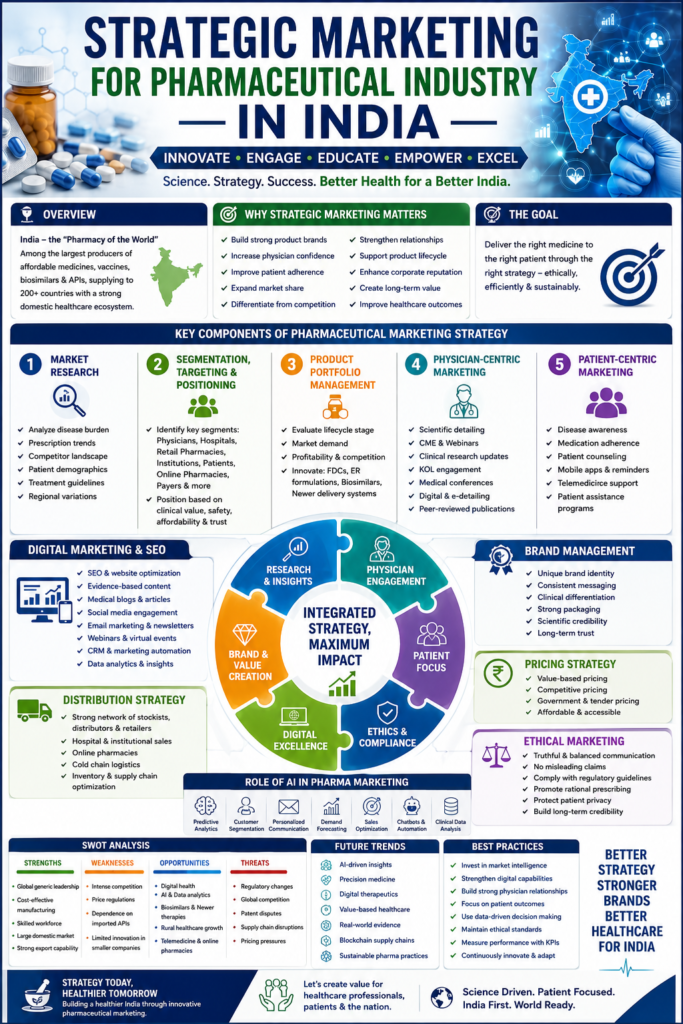
India has emerged as one of the world’s most influential pharmaceutical manufacturing and healthcare hubs. Often referred to as the “Pharmacy of the World,” the Indian pharmaceutical industry supplies affordable medicines to more than 200 countries while maintaining a strong domestic healthcare ecosystem. As competition intensifies and healthcare becomes increasingly patient-centric, strategic marketing has become an essential pillar for pharmaceutical companies seeking sustainable growth.
Strategic pharmaceutical marketing extends far beyond promoting medicines. It encompasses market research, product positioning, physician engagement, digital transformation, regulatory compliance, patient education, pricing strategy, and long-term brand development. Companies that successfully integrate these elements are better positioned to achieve market leadership and improve healthcare outcomes.
Overview of the Indian Pharmaceutical Industry
India is among the largest producers of generic medicines globally and has established itself as a major supplier of vaccines, biosimilars, active pharmaceutical ingredients (APIs), and specialty pharmaceuticals. The industry continues to benefit from:
- Growing healthcare expenditure
- Expanding middle-class population
- Government healthcare initiatives
- Digital health transformation
- Increasing health awareness
- Rising prevalence of chronic diseases
- Strong pharmaceutical manufacturing infrastructure
These factors create tremendous opportunities for pharmaceutical companies that adopt evidence-based marketing strategies.
What is Strategic Pharmaceutical Marketing?
Strategic pharmaceutical marketing is the systematic process of identifying healthcare needs, developing innovative products, creating value for healthcare professionals and patients, and building sustainable competitive advantages while complying with regulatory standards.
Unlike traditional marketing, pharmaceutical marketing emphasizes scientific evidence, ethical promotion, healthcare outcomes, and long-term trust rather than short-term sales.
Importance of Strategic Marketing in the Pharmaceutical Sector
A well-designed pharmaceutical marketing strategy helps organizations:
- Build strong product brands
- Increase physician confidence
- Improve patient adherence
- Expand market share
- Differentiate from generic competition
- Strengthen customer relationships
- Support product lifecycle management
- Enhance corporate reputation
Strategic marketing ultimately bridges the gap between scientific innovation and patient care.
Key Components of Pharmaceutical Marketing Strategy
1. Comprehensive Market Research
Market research forms the foundation of every successful pharmaceutical strategy.
Companies should analyze:
- Disease prevalence
- Prescription trends
- Competitor products
- Patient demographics
- Treatment guidelines
- Healthcare infrastructure
- Regional market variations
Data-driven insights enable organizations to identify unmet clinical needs and commercial opportunities.
2. Segmentation, Targeting, and Positioning (STP)
Effective pharmaceutical marketing begins with proper market segmentation.
Possible market segments include:
- Physicians
- Hospitals
- Government institutions
- Retail pharmacies
- Online pharmacies
- Patients
- Diagnostic centers
- Insurance providers
After segmentation, organizations should prioritize high-value target markets and clearly position their products based on therapeutic advantages, safety profile, affordability, and clinical evidence.
3. Product Portfolio Management
Companies should continuously evaluate their product portfolios by considering:
- Product lifecycle stage
- Market demand
- Profitability
- Competition
- Innovation potential
- Regulatory landscape
Introducing differentiated formulations, fixed-dose combinations, extended-release products, and biosimilars can strengthen market positioning.
Digital Marketing in the Indian Pharmaceutical Industry
Digital transformation has revolutionized pharmaceutical marketing.
Modern pharmaceutical companies utilize:
- Search Engine Optimization (SEO)
- Content marketing
- Medical blogs
- Educational webinars
- Email marketing
- Social media engagement
- Mobile applications
- Artificial Intelligence
- Marketing automation
- Customer Relationship Management (CRM)
Healthcare professionals increasingly rely on digital platforms for scientific information, making digital marketing an essential competitive advantage.
SEO for Pharmaceutical Companies
Search Engine Optimization enables pharmaceutical companies to improve online visibility while educating healthcare professionals and patients.
Important SEO strategies include:
- Publishing evidence-based medical articles
- Creating disease awareness content
- Optimizing website speed
- Mobile-friendly design
- Structured internal linking
- High-quality backlinks
- Local SEO for healthcare services
- Keyword optimization
- Frequently Asked Questions (FAQs)
- Technical SEO improvements
High-quality educational content enhances both search rankings and public trust.
Physician-Centric Marketing
Healthcare professionals remain the primary decision-makers for prescription medicines.
Successful physician engagement involves:
- Scientific detailing
- Continuing Medical Education (CME)
- Clinical research updates
- Digital detailing
- Product demonstrations
- Medical conferences
- Key Opinion Leader (KOL) engagement
- Peer-reviewed publications
Relationship building should always prioritize scientific accuracy and ethical communication.
Patient-Centric Marketing
Modern pharmaceutical companies increasingly focus on patient experience.
Patient-centered initiatives include:
- Disease awareness campaigns
- Medication adherence programs
- Patient counseling
- Mobile reminder applications
- Educational videos
- Telemedicine support
- Patient assistance programs
- Health monitoring solutions
Improving patient outcomes also enhances brand loyalty.
Brand Management in Pharmaceuticals
Strong pharmaceutical brands are built through consistency, quality, and scientific credibility.
Effective brand management includes:
- Unique brand identity
- Consistent messaging
- Clinical differentiation
- Strong packaging design
- Scientific publications
- Positive physician experiences
- Long-term customer engagement
Successful brands become trusted therapeutic partners rather than simply commercial products.
Pricing Strategy
Pricing significantly influences market penetration.
Common pharmaceutical pricing strategies include:
- Value-based pricing
- Competitive pricing
- Premium pricing
- Penetration pricing
- Government tender pricing
- Differential regional pricing
Pricing decisions must balance affordability with long-term profitability.
Distribution Strategy
India’s pharmaceutical supply chain is one of the largest globally.
Efficient distribution requires:
- Super stockists
- Distributors
- Retail pharmacies
- Hospital pharmacies
- Institutional sales
- Online pharmacies
- Cold chain logistics
- Inventory optimization
An efficient supply chain ensures product availability across urban and rural markets.
Ethical Pharmaceutical Marketing
Ethical marketing remains fundamental for maintaining public trust.
Companies should:
- Avoid misleading claims
- Provide balanced scientific evidence
- Respect promotional guidelines
- Ensure transparent communication
- Support rational prescribing
- Protect patient privacy
- Follow regulatory requirements
Ethical practices strengthen long-term corporate reputation.
Role of Artificial Intelligence
Artificial Intelligence is transforming pharmaceutical marketing through:
- Predictive analytics
- Customer segmentation
- Personalized communication
- Demand forecasting
- Sales optimization
- Chatbots
- Marketing automation
- Clinical data analysis
AI enables faster, more accurate decision-making while improving customer engagement.
Omnichannel Marketing
Healthcare professionals now interact through multiple communication channels.
A successful omnichannel strategy integrates:
- Medical representatives
- Email campaigns
- Webinars
- Mobile applications
- Scientific portals
- Social media
- Virtual conferences
- Customer support platforms
Consistent messaging across channels improves customer experience.
SWOT Analysis of Pharmaceutical Marketing in India
Strengths
- Global generic leadership
- Cost-effective manufacturing
- Skilled scientific workforce
- Strong export capability
- Large domestic market
Weaknesses
- Intense competition
- Price regulations
- Dependence on imported APIs
- Limited innovation among smaller companies
Opportunities
- Digital healthcare
- Personalized medicine
- Biosimilars
- Telemedicine
- Artificial Intelligence
- Rural healthcare expansion
Threats
- Regulatory changes
- Global competition
- Patent disputes
- Supply chain disruptions
- Pricing pressures
Future Trends
The future of pharmaceutical marketing in India will be shaped by:
- AI-driven customer engagement
- Precision medicine
- Digital therapeutics
- Predictive analytics
- Personalized healthcare
- Value-based healthcare
- Real-world evidence
- Blockchain-enabled supply chains
- Remote physician engagement
- Sustainable pharmaceutical practices
Companies embracing innovation while maintaining ethical standards will gain long-term competitive advantages.
Challenges Facing Pharmaceutical Marketing
Despite significant opportunities, organizations must overcome several challenges:
- Regulatory compliance
- Information overload
- Generic competition
- Rising customer expectations
- Digital transformation costs
- Data privacy concerns
- Talent shortages
- Rapid technological change
Addressing these challenges requires continuous innovation and strategic planning.
Best Practices for Pharmaceutical Companies
Successful organizations should:
- Invest in market intelligence
- Develop patient-centric solutions
- Strengthen physician relationships
- Build robust digital capabilities
- Utilize data analytics
- Improve supply chain resilience
- Encourage innovation
- Maintain ethical marketing standards
- Continuously train marketing teams
- Measure marketing performance using data-driven KPIs
Conclusion
Strategic marketing has become a critical success factor for the Indian pharmaceutical industry. In a rapidly evolving healthcare environment, companies can no longer rely solely on traditional sales models. Sustainable growth depends on integrating scientific excellence, digital innovation, patient-centricity, ethical practices, and data-driven decision-making into comprehensive marketing strategies.
As India continues to strengthen its position as a global pharmaceutical leader, organizations that invest in research, digital transformation, physician engagement, and value-based healthcare will be well positioned to achieve long-term commercial success while contributing meaningfully to public health. Strategic pharmaceutical marketing is therefore not merely a business function but a catalyst for innovation, improved healthcare access, and sustainable industry growth.
Frequently Asked Questions (FAQs)
1. What is strategic pharmaceutical marketing?
It is the process of planning, implementing, and evaluating marketing strategies that align pharmaceutical products with healthcare needs while ensuring regulatory compliance and ethical promotion.
2. Why is digital marketing important for pharmaceutical companies in India?
Digital marketing improves engagement with healthcare professionals and patients, increases online visibility, supports medical education, and generates qualified leads.
3. What are the key pillars of pharmaceutical marketing?
Market research, segmentation, product positioning, physician engagement, patient education, pricing, distribution, digital marketing, and ethical compliance.
4. How does AI benefit pharmaceutical marketing?
AI enables predictive analytics, personalized communication, customer segmentation, demand forecasting, and marketing automation, improving efficiency and outcomes.
5. What is the future of pharmaceutical marketing in India?
The future will focus on AI-driven insights, omnichannel engagement, precision medicine, digital health platforms, real-world evidence, and patient-centered healthcare delivery.