

The Complete Guide to Preparing for the CAT Examination for Admission to IIMs
Author: Devanssh Mehta
Abstract
The Common Admission Test (CAT) is India’s most prestigious management entrance examination and serves as the gateway to the Indian Institutes of Management (IIMs) and several leading business schools. Every year, hundreds of thousands of aspirants compete for a limited number of seats, making CAT one of the most competitive examinations in the country. Success requires not only academic ability but also strategic preparation, consistent practice, effective time management, and mental resilience. This guide provides a practical roadmap for CAT preparation, helping students understand the examination pattern, build strong fundamentals, and maximize their chances of securing admission to top management institutes.
Introduction
Management education in India has become increasingly important due to the rapid growth of the corporate sector, entrepreneurship, consulting, finance, analytics, and technology-driven businesses. The IIMs are regarded as the premier institutions for management education and consistently produce business leaders, policymakers, entrepreneurs, and executives.
Admission to these institutes primarily depends on CAT performance, followed by Written Ability Tests (WAT), Group Discussions (GD) where applicable, Personal Interviews (PI), academic profile, and work experience.
Preparing for CAT is not simply about studying mathematics or English; it is about developing analytical thinking, logical reasoning, and decision-making skills.
Understanding the CAT Examination
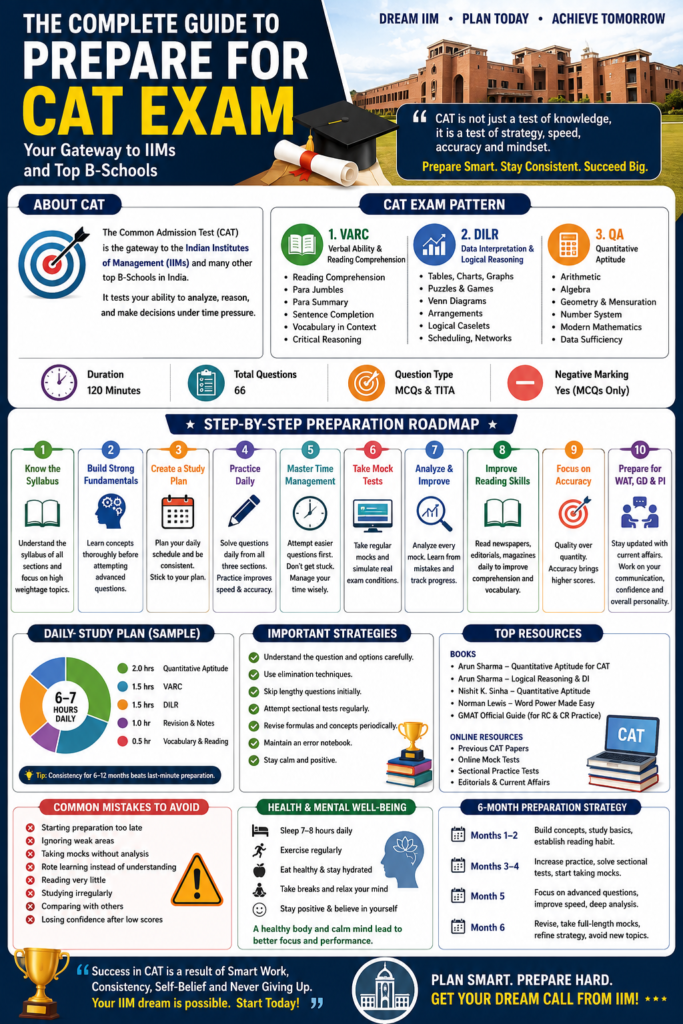
CAT generally consists of three major sections:
- Verbal Ability and Reading Comprehension (VARC)
- Data Interpretation and Logical Reasoning (DILR)
- Quantitative Aptitude (QA)
The examination is computer-based and includes a combination of Multiple Choice Questions (MCQs) and Type-in-the-Answer (TITA) questions.
Each section is time-bound, requiring candidates to balance speed with accuracy.
Step 1: Know the Syllabus Thoroughly
Although CAT does not prescribe an official syllabus, preparation generally includes:
Verbal Ability
- Reading Comprehension
- Para Jumbles
- Para Summary
- Sentence Completion
- Vocabulary in context
- Critical Reasoning
- Grammar fundamentals
Data Interpretation and Logical Reasoning
- Tables
- Charts
- Graphs
- Venn Diagrams
- Arrangements
- Puzzles
- Games and Tournaments
- Blood Relations
- Scheduling
- Networks
- Logical Caselets
Quantitative Aptitude
- Arithmetic
- Algebra
- Geometry
- Mensuration
- Number System
- Modern Mathematics
- Profit and Loss
- Time-Speed-Distance
- Time and Work
- Percentages
- Ratios
- Probability
- Permutation and Combination
Step 2: Build Strong Fundamentals
Students should first strengthen their conceptual understanding instead of directly solving advanced questions.
For Quantitative Aptitude:
- Learn formulas.
- Understand concepts.
- Solve basic questions.
- Gradually increase difficulty.
For English:
Develop reading habits by reading:
- Newspapers
- Business magazines
- Editorials
- Scientific articles
- Economics journals
Daily reading significantly improves comprehension speed.
Step 3: Develop a Structured Study Plan
A six to twelve-month preparation plan generally produces better outcomes than last-minute preparation.
A typical daily schedule may include:
- 2 hours Quantitative Aptitude
- 1.5 hours VARC
- 1.5 hours DILR
- 1 hour revision
- 30 minutes vocabulary and reading
Consistency is more valuable than studying excessively on a few days.
Step 4: Master Time Management
CAT is as much a test of time management as of knowledge.
Students should:
- Skip lengthy questions initially.
- Solve easier questions first.
- Avoid getting stuck.
- Allocate time wisely across sections.
- Maintain accuracy rather than attempting every question.
Step 5: Practice Daily
Regular practice helps improve speed and confidence.
Daily practice should include:
- Quantitative problems
- Reading comprehension passages
- Logical reasoning puzzles
- Data interpretation sets
- Previous-year CAT questions
Practice helps identify recurring question patterns.
Step 6: Take Mock Tests
Mock examinations are among the most effective preparation tools.
Initially:
- One mock every two weeks.
Three months before CAT:
- One to two mocks weekly.
Last month:
- Two to three mocks weekly.
Each mock should be followed by detailed analysis, including:
- Questions answered correctly
- Questions answered incorrectly
- Time spent
- Accuracy
- Weak topics
- Strong topics
Improvement comes more from analysing mocks than merely taking them.
Step 7: Strengthen Reading Skills
Reading Comprehension contributes significantly to CAT scores.
Students should regularly read:
- The Hindu
- The Indian Express
- Business Standard
- Financial newspapers
- Harvard Business Review articles
- Scientific American
- Aeon Essays
Reading diverse topics improves comprehension and critical thinking.
Step 8: Improve Calculation Speed
Mental calculation reduces dependence on calculators.
Practice:
- Squares
- Cubes
- Percentages
- Fractions
- Ratios
- Multiplication shortcuts
- Division shortcuts
Fast calculations save valuable time.
Step 9: Focus on Accuracy
CAT includes negative marking for incorrect MCQ responses.
Rather than maximizing attempts, candidates should prioritize:
- Correct selection of questions
- Careful reading
- Elimination techniques
- Logical reasoning
Accuracy often distinguishes top performers.
Step 10: Analyse Mistakes
Maintain an error notebook recording:
- Conceptual mistakes
- Calculation errors
- Guesswork errors
- Time management mistakes
Reviewing these regularly prevents repeated errors.
Step 11: Prepare for WAT, GD, and PI
After the CAT examination, shortlisted candidates undergo additional evaluation.
Preparation should include:
- Current affairs
- Business news
- Economic policies
- Government initiatives
- Personal introduction
- Academic knowledge
- Work experience discussions
- Leadership examples
Confidence and clarity are essential during interviews.
Useful Resources
Books:
- Arun Sharma – Quantitative Aptitude for CAT
- Arun Sharma – Logical Reasoning and Data Interpretation
- Nishit K. Sinha – Quantitative Aptitude
- Norman Lewis – Word Power Made Easy
- GMAT Official Critical Reasoning materials (for reasoning practice)
Online Resources:
- Previous CAT papers
- Sectional mock tests
- Online practice platforms
- Daily editorial reading
Common Mistakes to Avoid
- Beginning preparation too late
- Ignoring weak areas
- Taking mocks without analysis
- Memorizing formulas without understanding
- Reading very little
- Studying irregularly
- Comparing oneself excessively with others
- Losing confidence after poor mock scores
Health and Mental Well-being
A healthy body supports effective learning.
Candidates should:
- Sleep 7–8 hours daily.
- Exercise regularly.
- Maintain a balanced diet.
- Stay hydrated.
- Take short breaks while studying.
- Practice stress-management techniques such as mindfulness or deep breathing.
Mental well-being is an important contributor to sustained performance.
Sample Six-Month Preparation Strategy
Months 1–2: Build concepts in QA, DILR, and VARC; establish a reading routine.
Months 3–4: Increase practice intensity, solve sectional tests, and begin regular mock examinations.
Month 5: Focus on advanced problems, improve speed, and analyse mock test performance in depth.
Month 6: Revise all topics, take frequent full-length mocks, refine test-taking strategy, and avoid learning entirely new concepts.
Final Week Before CAT
- Revise formulas and concepts.
- Review error notes.
- Avoid excessive study hours.
- Sleep adequately.
- Stay confident.
- Take only light practice tests.
- Prepare documents required for the examination.
- Reach the test centre well before reporting time.
Conclusion
Preparing for the CAT examination is a journey that rewards discipline, consistency, and smart strategy rather than rote learning. Candidates who build strong conceptual foundations, practice regularly, analyse their mistakes, and remain mentally resilient significantly improve their chances of securing admission to the IIMs and other leading management institutes. Success in CAT is not determined by the number of hours studied but by the quality of preparation, continuous self-improvement, and effective execution on the examination day. With a structured plan, determination, and perseverance, aspiring management professionals can achieve their dream of studying at India’s premier business schools and embark on rewarding careers in management, entrepreneurship, consulting, finance, and leadership.