

Relevance of Quantum Computing in Healthcare: A Review
Author: Devanssh Mehta
Abstract
Quantum computing is an emerging technology that has the potential to revolutionize healthcare by solving complex computational problems much faster than conventional computers. Unlike classical computers that process information in binary bits (0 and 1), quantum computers use quantum bits (qubits), which can exist in multiple states simultaneously through the principles of superposition and entanglement. These capabilities allow quantum computers to perform calculations that would otherwise take years on classical systems. In healthcare, quantum computing is expected to accelerate drug discovery, improve disease diagnosis, enable precision medicine, optimize hospital operations, and enhance medical imaging. Although the technology is still in its early stages, ongoing research suggests that quantum computing could become a fundamental component of future healthcare systems. This review discusses the principles of quantum computing, its current and potential applications in healthcare, challenges, and future prospects.
Keywords: Quantum Computing, Healthcare, Drug Discovery, Precision Medicine, Artificial Intelligence, Medical Imaging, Hospital Administration
Introduction
Healthcare has entered an era driven by digital transformation, where technologies such as artificial intelligence (AI), machine learning, big data analytics, robotics, and genomics are reshaping patient care. However, modern healthcare generates enormous amounts of complex biological and clinical data that challenge the capabilities of traditional computing systems. Processing genomic sequences, simulating molecular interactions, optimizing treatment plans, and predicting disease progression often require computational resources beyond the limits of classical computers.
Quantum computing represents a promising solution to these challenges. By leveraging quantum mechanical principles, quantum computers can perform highly parallel computations and solve optimization problems more efficiently than classical machines. Although practical large-scale quantum computers are still under development, their potential applications in medicine have generated considerable interest among researchers, pharmaceutical companies, healthcare institutions, and policymakers.
Fundamentals of Quantum Computing
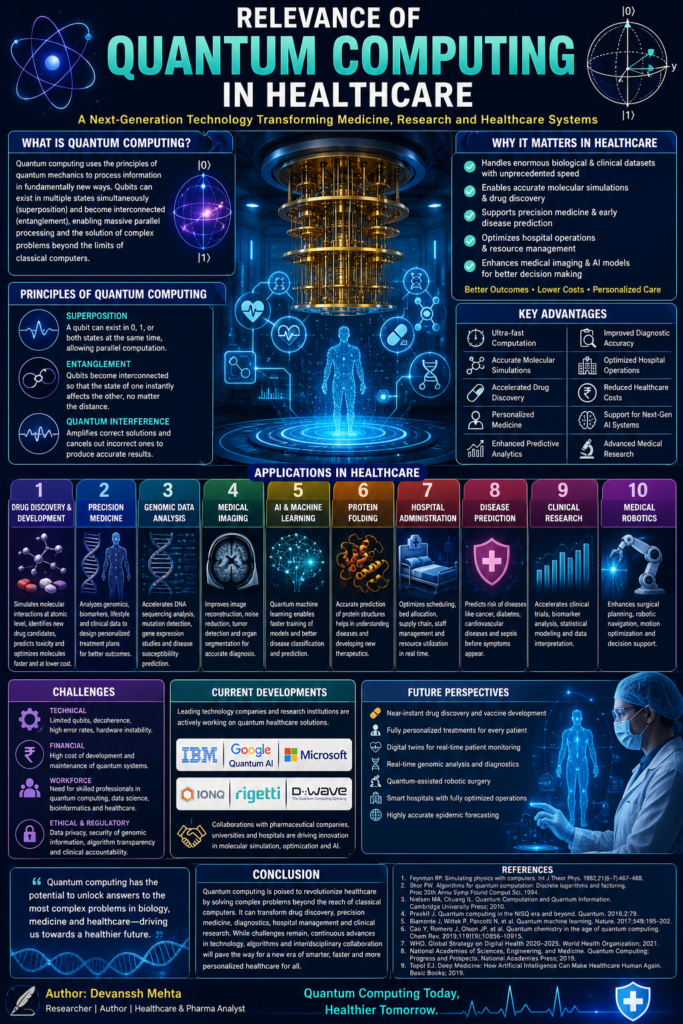
Quantum computing is based on the principles of quantum mechanics. Unlike classical computers that use bits, quantum computers use qubits. A qubit can simultaneously represent both 0 and 1 through a property known as superposition.
The major principles include:
Superposition
A quantum bit can exist in multiple states simultaneously, allowing massive parallel processing.
Entanglement
Two or more qubits become interconnected so that the state of one instantly influences another, regardless of distance.
Quantum Interference
Quantum algorithms manipulate probability amplitudes to increase the likelihood of obtaining correct solutions while minimizing incorrect outcomes.
Together, these principles enable computational capabilities far beyond those of traditional computers for selected complex problems.
Importance of Quantum Computing in Healthcare
Healthcare is becoming increasingly data-intensive. Advances in genomics, molecular biology, radiology, wearable devices, and electronic health records have created massive datasets requiring advanced computational approaches.
Quantum computing offers several advantages:
- Faster processing of biological datasets
- Accurate molecular simulations
- Rapid identification of drug candidates
- Improved disease prediction
- Personalized treatment recommendations
- Enhanced healthcare resource optimization
Applications of Quantum Computing in Healthcare
1. Drug Discovery and Drug Development
Drug discovery is one of the most promising applications of quantum computing.
Developing a new medicine often requires over 10 years and billions of dollars. Scientists must analyze millions of molecular interactions before identifying a successful drug candidate.
Quantum computers can simulate molecular structures at the atomic level with greater accuracy than classical systems.
Potential benefits include:
- Faster identification of therapeutic molecules
- Reduced research costs
- Better prediction of drug toxicity
- Optimization of molecular structures
- Rapid vaccine development
Pharmaceutical companies are already exploring quantum computing for protein folding and molecular simulations.
2. Precision Medicine
Every patient responds differently to medications due to variations in genetics, environment, and lifestyle.
Quantum computing can rapidly analyze:
- Whole genome sequences
- Gene mutations
- Biomarkers
- Clinical records
- Environmental factors
The result is highly individualized treatment plans tailored to each patient.
This may significantly improve outcomes in:
- Cancer
- Diabetes
- Cardiovascular diseases
- Rare genetic disorders
3. Genomic Data Analysis
Modern genome sequencing produces enormous datasets.
Analyzing these data using classical computers requires significant time and computational resources.
Quantum algorithms can accelerate:
- DNA sequencing analysis
- Mutation identification
- Disease susceptibility prediction
- Gene expression studies
This advancement supports personalized medicine and early disease detection.
4. Medical Imaging
Medical imaging technologies such as:
- MRI
- CT Scan
- PET Scan
- Ultrasound
generate large image datasets.
Quantum-enhanced image processing may improve:
- Image reconstruction
- Noise reduction
- Early tumor detection
- Organ segmentation
- Radiological diagnosis
This could improve diagnostic accuracy while reducing interpretation time.
5. Artificial Intelligence in Healthcare
Artificial intelligence requires enormous computational power for training deep learning models.
Quantum machine learning combines AI with quantum computing to enable:
- Faster model training
- Better disease classification
- Improved predictive analytics
- Enhanced clinical decision support
Potential applications include:
- Cancer diagnosis
- ECG interpretation
- Medical image analysis
- Intensive care monitoring
6. Protein Folding
Protein folding determines biological function.
Incorrect folding contributes to diseases including:
- Alzheimer’s disease
- Parkinson’s disease
- Huntington’s disease
Quantum simulations may provide more accurate predictions of protein structures, facilitating therapeutic development.
7. Hospital Administration
Quantum computing may also improve healthcare management.
Possible applications include:
- Patient scheduling
- Operating room optimization
- Bed allocation
- Supply chain management
- Ambulance routing
- Resource utilization
These improvements could reduce operational costs while improving patient satisfaction.
8. Disease Prediction
Quantum-enhanced predictive models may identify disease risks before symptoms develop.
Potential applications include:
- Cancer risk prediction
- Cardiovascular disease prediction
- Sepsis detection
- Diabetes progression
- Infectious disease outbreaks
Earlier interventions may significantly improve patient outcomes.
9. Clinical Research
Clinical trials involve analyzing complex datasets from thousands of participants.
Quantum computing could accelerate:
- Patient recruitment
- Biomarker analysis
- Statistical modeling
- Trial optimization
- Data interpretation
This may shorten drug approval timelines.
10. Medical Robotics
Future medical robots may use quantum-enhanced optimization for:
- Surgical planning
- Robotic navigation
- Motion optimization
- Decision support
Although still theoretical, these developments could improve surgical precision.
Quantum Computing and Artificial Intelligence
The integration of quantum computing with AI has given rise to Quantum Artificial Intelligence (QAI).
Potential healthcare applications include:
- Early diagnosis
- Predictive medicine
- Medical image interpretation
- Personalized drug selection
- Hospital workflow optimization
Quantum AI could significantly enhance computational efficiency compared with conventional AI systems for specific optimization and simulation tasks.
Advantages of Quantum Computing in Healthcare
Major benefits include:
- Extremely fast computation
- Improved molecular simulations
- Better diagnostic accuracy
- Accelerated drug discovery
- Reduced healthcare costs over time
- Personalized medicine
- Enhanced predictive analytics
- Improved hospital management
- Better medical research capabilities
- Support for next-generation AI systems
Challenges
Despite its promise, several challenges remain.
Technical Challenges
- Limited number of stable qubits
- Quantum decoherence
- High error rates
- Hardware instability
Financial Challenges
Quantum computers are expensive to build and maintain.
Healthcare institutions may initially struggle with implementation costs.
Workforce Challenges
Healthcare professionals need specialized training in:
- Quantum computing
- Data science
- Bioinformatics
- Quantum algorithms
Ethical Challenges
Patient privacy must remain protected when processing highly sensitive genomic information.
Regulatory frameworks must evolve to address:
- Data security
- Algorithm transparency
- Clinical accountability
Current Developments
Several technology companies and research institutions are actively developing quantum healthcare applications.
Examples include:
- IBM
- Google Quantum AI
- Microsoft
- IonQ
- Rigetti Computing
- D-Wave Systems
These organizations collaborate with pharmaceutical companies to explore quantum algorithms for molecular simulation, optimization, and machine learning.
Future Perspectives
Quantum computing is expected to transform healthcare over the next two decades.
Future developments may include:
- Near-instant drug discovery
- Fully personalized therapies
- Digital twins for patients
- Real-time genomic analysis
- Highly accurate disease prediction
- Quantum-assisted robotic surgery
- Smart hospitals with optimized operations
- Advanced epidemic forecasting
As hardware matures and quantum error correction improves, practical clinical applications are likely to expand.
Conclusion
Quantum computing represents one of the most promising technological innovations for the future of healthcare. Its ability to process complex biological, genomic, and clinical datasets at unprecedented speed has the potential to reshape drug discovery, precision medicine, medical imaging, disease prediction, and hospital administration. Although current limitations—including hardware constraints, high costs, and the need for specialized expertise—prevent widespread clinical adoption, continued advances in quantum hardware, algorithms, and hybrid quantum-classical computing are steadily moving the field toward practical applications. Successful integration of quantum computing with artificial intelligence and healthcare analytics could usher in a new era of faster diagnostics, more personalized therapies, and more efficient healthcare systems. Continued interdisciplinary collaboration among healthcare professionals, computer scientists, engineers, and policymakers will be essential to ensure that quantum technologies are implemented safely, ethically, and effectively for the benefit of patients worldwide.
References
- Feynman RP. Simulating physics with computers. International Journal of Theoretical Physics. 1982;21(6–7):467–488.
- Shor PW. Algorithms for quantum computation: Discrete logarithms and factoring. Proceedings of the 35th Annual Symposium on Foundations of Computer Science. 1994.
- Nielsen MA, Chuang IL. Quantum Computation and Quantum Information. Cambridge University Press; 2010.
- Preskill J. Quantum computing in the NISQ era and beyond. Quantum. 2018;2:79.
- Biamonte J, Wittek P, Pancotti N, et al. Quantum machine learning. Nature. 2017;549:195–202.
- Cao Y, Romero J, Olson JP, et al. Quantum chemistry in the age of quantum computing. Chemical Reviews. 2019;119(19):10856–10915.
- Arute F, Arya K, Babbush R, et al. Quantum supremacy using a programmable superconducting processor. Nature. 2019;574:505–510.
- WHO. Global Strategy on Digital Health 2020–2025. Geneva: World Health Organization; 2021.
- Topol EJ. Deep Medicine: How Artificial Intelligence Can Make Healthcare Human Again. Basic Books; 2019.
- IBM Research. Quantum computing applications in healthcare and life sciences. IBM Research Reports.
- National Academies of Sciences, Engineering, and Medicine. Quantum Computing: Progress and Prospects. Washington, DC: National Academies Press; 2019.
- Dunjko V, Briegel HJ. Machine learning and artificial intelligence in the quantum domain. Reports on Progress in Physics. 2018;81(7):074001.