

Importance of Artificial Intelligence in Healthcare Policy in India: A Review
Author: Devanssh Mehta
Abstract
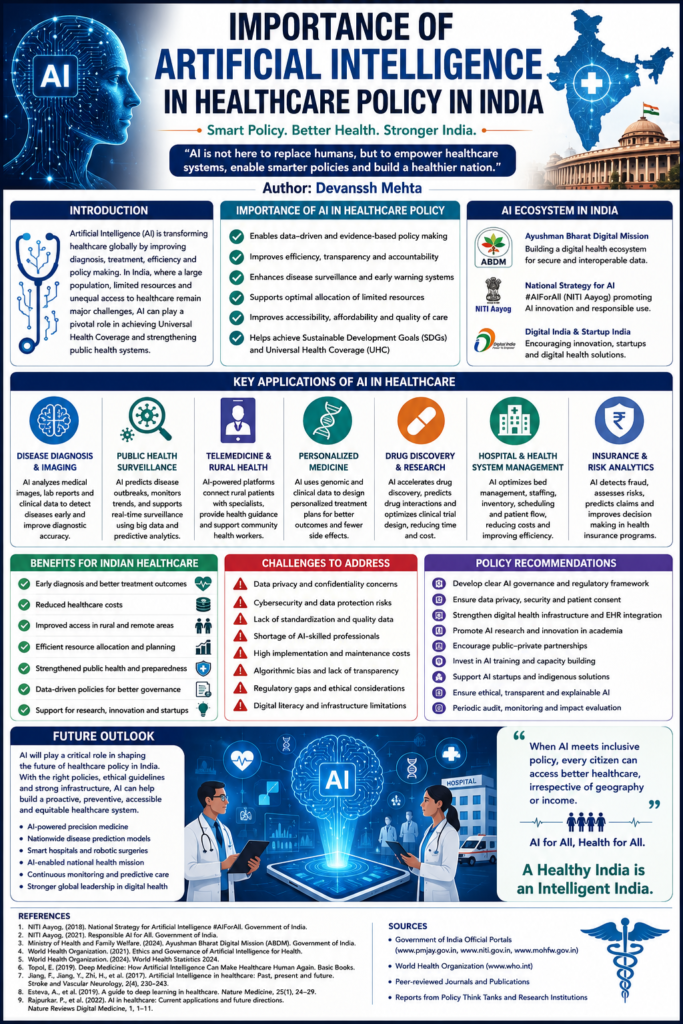
Artificial Intelligence (AI) has emerged as one of the most influential technologies in healthcare. It has the potential to transform disease diagnosis, treatment planning, drug discovery, hospital management, and healthcare policymaking. In India, where a large population and unequal healthcare infrastructure continue to challenge healthcare delivery, AI offers innovative solutions for improving accessibility, affordability, and quality of care. The Government of India has also recognized AI as a strategic technology through initiatives such as the National Digital Health Mission (now Ayushman Bharat Digital Mission), the National Strategy for Artificial Intelligence, and various digital health programs. AI can support policymakers by providing accurate health data, predicting disease outbreaks, improving resource allocation, and strengthening public health systems. However, concerns regarding data privacy, cybersecurity, ethical issues, algorithmic bias, and regulatory frameworks remain significant challenges. This review discusses the importance of AI in healthcare policy in India, its current applications, opportunities, challenges, and future prospects. It also highlights policy recommendations for responsible and effective AI implementation in the Indian healthcare system.
Keywords: Artificial Intelligence, Healthcare Policy, India, Digital Health, Public Health, Machine Learning, Health Informatics
Introduction
Artificial Intelligence refers to computer systems capable of performing tasks that normally require human intelligence, such as learning, reasoning, prediction, and decision-making (Russell & Norvig, 2021). AI technologies include machine learning, deep learning, natural language processing, robotics, and computer vision. These technologies are increasingly being adopted worldwide to improve healthcare delivery and health policy.
India has one of the world’s largest healthcare systems, serving more than 1.4 billion people. Despite remarkable improvements in healthcare infrastructure, the country continues to face shortages of healthcare professionals, unequal distribution of medical facilities, increasing disease burden, and rising healthcare costs (WHO, 2024). These challenges require innovative technological solutions that can support policymakers and healthcare providers.
Artificial Intelligence has the potential to become an essential component of India’s future healthcare policies. Rather than replacing healthcare professionals, AI serves as a decision-support system that enables faster diagnosis, personalized treatment, efficient management, and evidence-based policymaking.
Artificial Intelligence in India’s Healthcare System
The Government of India has actively promoted digital healthcare through several initiatives. The Ayushman Bharat Digital Mission (ABDM) aims to create an integrated digital health ecosystem by connecting hospitals, patients, laboratories, and healthcare providers through secure digital platforms (Government of India, 2024).
AI complements these initiatives by analyzing large healthcare datasets, identifying disease patterns, and supporting healthcare planning.
Some major AI applications include:
- Medical imaging
- Electronic Health Records (EHR)
- Telemedicine
- Predictive analytics
- Disease surveillance
- Clinical decision support
- Drug discovery
These technologies help healthcare systems become more efficient while reducing operational costs.
Importance of AI in Healthcare Policy
Healthcare policy requires accurate information for decision-making. Traditional policy decisions often depend upon delayed reports and manual analysis. AI can process millions of healthcare records within minutes and generate valuable insights.
AI helps policymakers by:
- Identifying disease trends
- Predicting future healthcare needs
- Monitoring public health emergencies
- Allocating healthcare resources efficiently
- Supporting evidence-based policymaking
This enables governments to respond more rapidly during disease outbreaks and health emergencies.
AI in Disease Diagnosis
One of the greatest contributions of AI is improving disease diagnosis.
AI systems can analyze X-rays, CT scans, MRI images, retinal photographs, pathology slides, and laboratory reports with remarkable accuracy.
Studies have shown that AI performs exceptionally well in detecting:
- Breast cancer
- Lung cancer
- Tuberculosis
- Diabetic retinopathy
- Stroke
- Skin diseases
- Cardiovascular disorders
In India, where radiologists and specialists are limited, AI-assisted diagnosis can significantly improve healthcare accessibility.
Early diagnosis also reduces treatment costs and improves patient survival.
AI and Public Health Surveillance
Public health surveillance is one of the most important responsibilities of healthcare policymakers.
AI can analyze data collected from:
- Hospitals
- Laboratories
- Pharmacies
- Mobile applications
- Wearable devices
- Social media
- Environmental monitoring systems
Machine learning algorithms can detect unusual disease patterns before they become large outbreaks.
During the COVID-19 pandemic, AI was widely used for:
- Predicting infection spread
- Contact tracing
- Hospital capacity planning
- Vaccine distribution
- Data visualization
Future healthcare policies can use AI for faster responses to infectious disease outbreaks.
AI in Rural Healthcare
India’s rural population faces several healthcare challenges, including limited access to doctors and diagnostic facilities.
AI-powered telemedicine platforms enable patients to consult specialists remotely.
AI chatbots can:
- Answer health-related questions
- Provide health education
- Guide patients
- Recommend appropriate medical consultation
AI-enabled portable diagnostic devices can help community health workers identify diseases in villages without requiring sophisticated hospitals.
This supports equitable healthcare delivery across India.
AI and Personalized Medicine
Traditional healthcare often follows a generalized treatment approach.
AI enables personalized medicine by analyzing:
- Genetic information
- Lifestyle
- Medical history
- Laboratory reports
- Environmental factors
Healthcare professionals can recommend individualized treatment plans that improve therapeutic outcomes while reducing adverse drug reactions.
Personalized medicine is expected to become increasingly important in future healthcare policies.
AI in Drug Discovery
Drug development is expensive and time-consuming.
Artificial Intelligence has transformed pharmaceutical research by:
- Identifying drug targets
- Screening millions of chemical compounds
- Predicting drug interactions
- Optimizing clinical trial design
- Repurposing existing medicines
AI significantly reduces research costs and accelerates drug development.
India’s pharmaceutical industry can benefit greatly from AI-driven research and innovation.
AI in Hospital Management
Hospitals generate enormous amounts of information every day.
AI assists hospital administrators in:
- Bed management
- Staff scheduling
- Patient flow optimization
- Inventory management
- Medical supply forecasting
- Appointment scheduling
These improvements reduce waiting times and increase operational efficiency.
Healthcare policies promoting AI adoption in hospitals can improve healthcare quality while lowering costs.
AI in Health Insurance
Health insurance companies increasingly use AI to:
- Detect fraudulent claims
- Process insurance applications
- Predict healthcare expenditure
- Improve customer services
- Assess risks
Government health insurance programs such as Ayushman Bharat may benefit from AI-based fraud detection and efficient claim management.
AI in Healthcare Resource Allocation
Healthcare resources are often limited.
AI can help governments determine:
- Where new hospitals are needed
- Which districts require additional doctors
- Vaccine demand forecasting
- Medicine distribution planning
- Emergency preparedness
Efficient resource allocation improves healthcare outcomes while minimizing unnecessary expenditure.
AI and Electronic Health Records
Electronic Health Records (EHRs) contain valuable patient information.
AI analyzes these records to identify:
- High-risk patients
- Disease progression
- Medication errors
- Treatment outcomes
These insights support evidence-based healthcare policymaking.
Integration of EHRs through the Ayushman Bharat Digital Mission further strengthens AI applications.
Ethical Challenges
Despite its benefits, AI also raises ethical concerns.
Important issues include:
- Patient privacy
- Data confidentiality
- Algorithmic bias
- Lack of transparency
- Informed consent
- Accountability
Healthcare policies must ensure that AI systems remain transparent, fair, and trustworthy.
Human oversight should remain essential for clinical decision-making.
Data Privacy and Cybersecurity
AI depends upon large volumes of patient data.
Healthcare databases are attractive targets for cybercriminals.
Strong cybersecurity policies should include:
- Data encryption
- Secure cloud infrastructure
- Multi-factor authentication
- Regular security audits
- Compliance with data protection regulations
Protecting patient privacy is essential for maintaining public trust.
Challenges in India
Although AI offers tremendous opportunities, several barriers remain.
Major challenges include:
- Limited digital infrastructure in rural regions
- Shortage of AI-trained healthcare professionals
- High implementation costs
- Poor data quality
- Interoperability issues
- Ethical concerns
- Regulatory uncertainty
- Digital literacy gaps
Addressing these challenges requires collaboration among government agencies, academic institutions, healthcare providers, and the private sector.
Policy Recommendations
India should adopt a comprehensive national AI healthcare policy that promotes innovation while ensuring patient safety.
Important recommendations include:
- Develop clear AI regulatory guidelines.
- Strengthen digital health infrastructure.
- Improve Electronic Health Record integration.
- Promote AI research in universities.
- Encourage public-private partnerships.
- Increase investment in AI-based healthcare startups.
- Provide AI training for healthcare professionals.
- Establish ethical review mechanisms.
- Strengthen cybersecurity standards.
- Promote explainable AI for transparent decision-making.
These measures will support responsible AI adoption across India’s healthcare system.
Future Prospects
Artificial Intelligence is expected to become an integral part of India’s healthcare ecosystem.
Future developments may include:
- AI-assisted robotic surgery
- Precision medicine
- Digital twins for patient care
- Predictive healthcare
- Smart hospitals
- Remote patient monitoring
- AI-powered national disease surveillance
- Automated health policy evaluation
India possesses strong information technology capabilities, a rapidly expanding digital infrastructure, and a growing startup ecosystem. These strengths position the country to become a global leader in AI-enabled healthcare if supported by appropriate policies and regulations.
Conclusion
Artificial Intelligence is transforming healthcare worldwide by improving diagnosis, treatment, hospital management, drug discovery, and healthcare policymaking. For India, AI provides a valuable opportunity to address long-standing challenges such as limited healthcare resources, unequal access to medical services, and rising healthcare costs. Government initiatives including the Ayushman Bharat Digital Mission and the National Strategy for Artificial Intelligence have laid the foundation for digital health transformation. However, responsible implementation requires strong governance, ethical safeguards, data privacy protections, cybersecurity measures, and regulatory oversight. Policymakers should promote innovation while ensuring transparency, fairness, and patient safety. With sustained investment, skilled human resources, and effective collaboration among stakeholders, Artificial Intelligence can significantly strengthen India’s healthcare system and contribute to achieving universal health coverage and improved public health outcomes.
References
- Government of India. (2024). Ayushman Bharat Digital Mission. Ministry of Health and Family Welfare.
- NITI Aayog. (2018). National Strategy for Artificial Intelligence #AIForAll.
- NITI Aayog. (2021). Responsible AI for All.
- World Health Organization. (2021). Ethics and Governance of Artificial Intelligence for Health.
- World Health Organization. (2024). World Health Statistics 2024.
- Russell, S., & Norvig, P. (2021). Artificial Intelligence: A Modern Approach (4th ed.). Pearson.
- Topol, E. (2019). Deep Medicine: How Artificial Intelligence Can Make Healthcare Human Again. Basic Books.
- Jiang, F., Jiang, Y., Zhi, H., et al. (2017). Artificial Intelligence in healthcare: Past, present and future. Stroke and Vascular Neurology, 2(4), 230–243.
- Esteva, A., et al. (2019). A guide to deep learning in healthcare. Nature Medicine, 25(1), 24–29.
- Rajpurkar, P., et al. (2022). AI in healthcare: Current applications and future directions. Nature Reviews Digital Medicine.