

Robust Connectivity Developments in India During the Last Ten Years: Building the Foundation of a Connected Nation
Abstract
Connectivity has emerged as one of the strongest pillars of India’s socio-economic transformation during the last decade. Between 2015 and 2025, India witnessed unprecedented investments in transport infrastructure, digital communication, logistics, aviation, maritime connectivity, and rural integration. These developments have significantly reduced geographical barriers, improved economic efficiency, enhanced national security, strengthened regional integration, and accelerated digital inclusion. Rather than viewing connectivity merely as road construction or internet expansion, India has increasingly adopted a multimodal and technology-driven approach that integrates highways, railways, airports, ports, fiber-optic networks, and digital platforms into a unified national infrastructure ecosystem. This article examines the major developments in India’s connectivity landscape over the last ten years, their economic and strategic significance, and the future challenges in sustaining this momentum.
Introduction
Connectivity forms the backbone of economic growth, social integration, and national competitiveness. Countries possessing efficient transport and communication networks generally experience higher industrial productivity, increased foreign investment, improved governance, and better quality of life. For a geographically diverse nation like India—with mountains, deserts, forests, islands, and vast rural populations—connectivity is not simply an infrastructure requirement but a strategic necessity.
During the last decade, India has witnessed one of the world’s largest infrastructure expansion programs. Government initiatives emphasizing integrated planning, digital governance, logistics optimization, and regional development have transformed connectivity into a national development priority. Investments across highways, railways, airports, ports, inland waterways, telecommunications, and digital infrastructure have significantly improved mobility for both citizens and businesses. National initiatives such as PM GatiShakti, Bharatmala, Sagarmala, UDAN, BharatNet, and the National Logistics Policy have aimed to create a seamless, multimodal transport ecosystem. (Press Information Bureau)
Expansion of National Highway Network
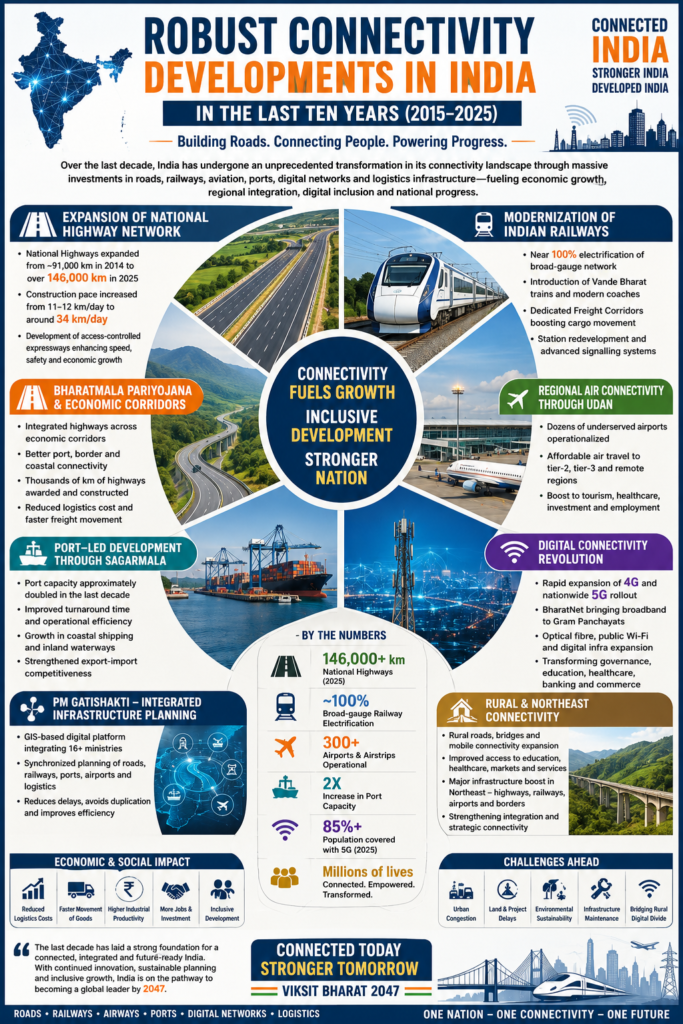
Road infrastructure has experienced remarkable growth over the past decade. India’s National Highway network expanded by approximately 60%, increasing from about 91,000 km in 2014 to over 146,000 km. Simultaneously, the pace of highway construction accelerated from roughly 11–12 km per day to around 34 km per day, reflecting substantial improvements in planning, funding, and execution. (Press Information Bureau)
Large-scale expressway projects—including the Delhi–Mumbai Expressway, Purvanchal Expressway, Bundelkhand Expressway, and Delhi–Meerut Expressway—have reduced travel times, improved freight movement, and enhanced regional economic integration.
The development of access-controlled expressways has also strengthened disaster response, emergency medical transport, tourism, and interstate commerce while reducing fuel consumption and logistics costs.
Bharatmala Pariyojana and Economic Corridors
The Bharatmala Pariyojana has transformed India’s highway planning from isolated road projects into an integrated logistics network. The programme focuses on:
- Economic corridors
- Border roads
- Coastal connectivity
- Port connectivity
- International trade routes
- Greenfield expressways
Thousands of kilometres of highways have been awarded and constructed under Bharatmala, improving freight efficiency and regional integration. (Press Information Bureau)
Modernization of Indian Railways
Indian Railways has undergone one of its most comprehensive modernization efforts in decades. Key achievements include:
- Large-scale electrification of the railway network
- Modern signalling systems
- Introduction of Vande Bharat trains
- Redevelopment of railway stations
- Dedicated Freight Corridors
- Improved passenger amenities
- Expansion of semi-high-speed rail services
By 2026, nearly the entire broad-gauge network had been electrified, reducing dependence on diesel while improving operational efficiency. Budgetary support for rail infrastructure increased substantially over the decade. (Press Information Bureau)
Dedicated Freight Corridors have enhanced cargo movement by separating freight traffic from passenger services, reducing delays and increasing logistics efficiency.
Regional Air Connectivity Through UDAN
The UDAN (Ude Desh ka Aam Nagrik) programme revolutionized regional aviation by making air travel more affordable and expanding services to underserved regions.
Major achievements include:
- Operationalization of dozens of previously underserved airports
- Expansion of regional routes
- Increased passenger accessibility
- Greater economic integration of remote regions
This initiative has supported tourism, healthcare access, investment, and employment generation in smaller cities. (Press Information Bureau)
Port-Led Development Through Sagarmala
India’s maritime infrastructure has also experienced significant expansion.
The Sagarmala Programme has focused on:
- Port modernization
- Port connectivity
- Coastal industrial development
- Coastal shipping
- Inland waterways
Port capacity has approximately doubled over the past decade, while vessel turnaround times have improved markedly. Inland waterway cargo movement has also grown substantially, supporting lower-cost freight transport. (Press Information Bureau)
Digital Connectivity Revolution
Perhaps the most transformative change has been India’s digital connectivity revolution.
Rapid expansion of:
- 4G networks
- Nationwide 5G deployment
- Optical fibre infrastructure
- Public Wi-Fi initiatives
- BharatNet
- Digital public infrastructure
has fundamentally changed governance, education, healthcare, banking, and commerce.
The BharatNet project continues to extend broadband connectivity to Gram Panchayats, while 5G deployment has rapidly expanded population coverage, supporting next-generation digital services. (The Times of India)
Digital Public Infrastructure
India has built one of the world’s largest Digital Public Infrastructure ecosystems through integration of:
- Aadhaar
- Unified Payments Interface (UPI)
- DigiLocker
- FASTag
- CoWIN
- Digital health initiatives
- E-governance platforms
These systems have improved public service delivery, financial inclusion, transparency, and digital access.
PM GatiShakti: Integrated Infrastructure Planning
One of the most important institutional reforms has been the PM GatiShakti National Master Plan.
This GIS-based platform integrates planning across multiple ministries and states to improve coordination among infrastructure projects. It aims to reduce project delays, avoid duplication, and support synchronized development across roads, railways, ports, airports, and logistics infrastructure. (DD News)
Rural Connectivity
Rural connectivity has improved significantly through:
- Pradhan Mantri Gram Sadak Yojana (PMGSY)
- Rural bridges
- Rural broadband
- Rural electrification
- Mobile tower expansion
These initiatives have improved access to healthcare, education, markets, banking, and government services for millions of rural citizens. Continued efforts remain important to close the remaining digital divide. (Press Information Bureau)
Northeast Connectivity
The northeastern states have witnessed major investments in:
- National highways
- Railway expansion
- Airport development
- Bridges
- Border infrastructure
These improvements have strengthened regional integration, economic opportunities, and strategic connectivity under initiatives such as the Act East Policy. (DD News)
Economic Impact
Improved connectivity has generated broad economic benefits:
- Reduced logistics costs
- Faster movement of goods
- Higher industrial productivity
- Increased tourism
- Enhanced agricultural market access
- Greater foreign investment
- Expansion of manufacturing clusters
- Improved ease of doing business
Integrated infrastructure also supports India’s ambition to become a global manufacturing and supply-chain hub.
Strategic and National Security Importance
Connectivity has strengthened India’s strategic posture by:
- Improving border infrastructure
- Enhancing military mobility
- Supporting disaster response
- Facilitating humanitarian relief
- Increasing resilience of supply chains
- Strengthening integration of remote regions
Transport and digital infrastructure have become critical components of national security as well as economic development.
Remaining Challenges
Despite significant progress, several challenges remain:
- Traffic congestion in metropolitan areas
- Land acquisition delays
- Environmental concerns
- Uneven rural broadband quality
- High maintenance requirements
- Urban transport bottlenecks
- Climate resilience of infrastructure
- Financing large-scale projects sustainably
Addressing these issues will require continued institutional reforms, technological innovation, and coordinated planning.
Future Outlook
India’s connectivity agenda is expected to evolve further through:
- Expansion of multimodal logistics parks
- High-speed rail projects
- Green mobility initiatives
- Electric vehicle infrastructure
- Smart cities
- AI-enabled traffic management
- Satellite internet
- 6G research
- Expanded inland waterways
- Enhanced regional air connectivity
Continued integration of physical and digital infrastructure will be central to achieving the vision of a developed India by 2047.
Conclusion
The last decade has marked a transformative phase in India’s connectivity journey. Through sustained investments in highways, railways, airports, ports, digital infrastructure, and multimodal logistics, the country has substantially improved mobility, accessibility, and economic integration. National initiatives such as Bharatmala, Sagarmala, PM GatiShakti, BharatNet, and UDAN have reshaped the infrastructure landscape and strengthened India’s competitiveness. While challenges related to sustainability, urban congestion, and equitable access remain, the progress achieved provides a strong foundation for future growth. Robust connectivity is no longer merely an infrastructure objective; it has become a strategic enabler of inclusive development, technological advancement, national security, and India’s aspiration to emerge as a leading global economy in the coming decades.