

Gaps in Nash Equilibrium Game Theory in Modern Times: Rethinking Strategic Decision-Making in the Age of Artificial Intelligence, Information Warfare, and Complex Global Systems
Author: Devanssh Mehta
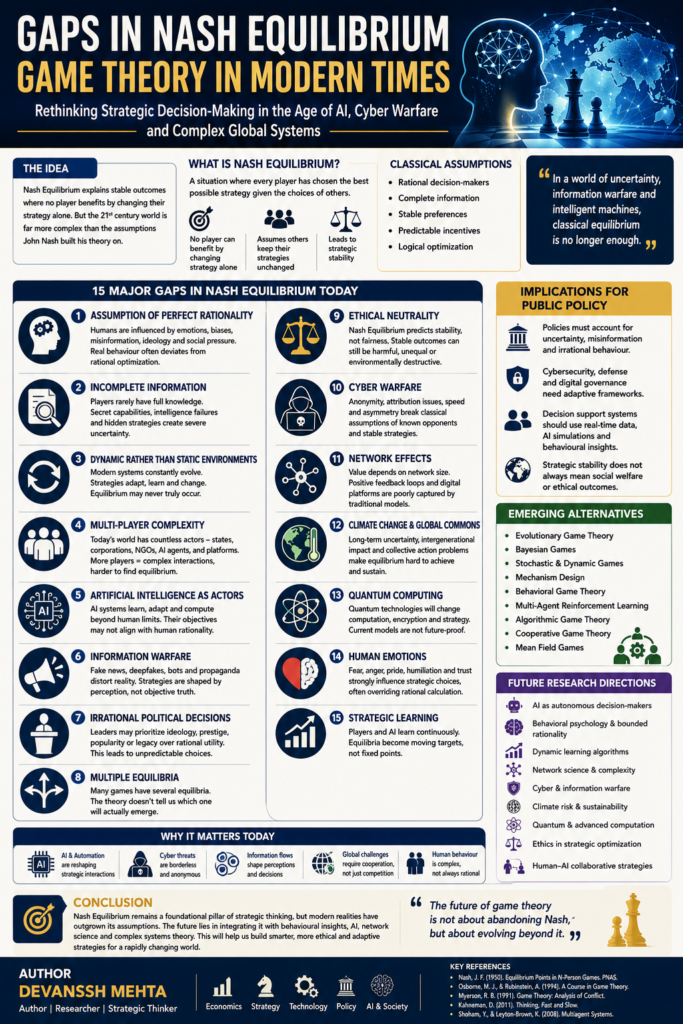
Abstract
Since its introduction by John Nash in 1950, the concept of Nash Equilibrium has become one of the most influential theories in economics, political science, military strategy, business management, and international relations. The theory explains how rational players arrive at stable strategic outcomes where no participant benefits by unilaterally changing their strategy. While mathematically elegant, modern geopolitical, technological, and socio-economic realities increasingly expose limitations in the traditional assumptions underlying Nash Equilibrium. Twenty-first century conflicts are characterized by artificial intelligence, cyber warfare, misinformation, behavioral irrationality, climate uncertainty, rapidly evolving technologies, decentralized actors, and incomplete information—conditions that frequently violate the assumptions of classical game theory. This article critically examines the theoretical gaps in Nash Equilibrium and proposes future directions toward more adaptive strategic models suitable for contemporary decision-making.
Introduction
Game theory revolutionized modern strategic thinking by providing a mathematical framework for analyzing interactions among rational decision-makers. Nash Equilibrium remains the cornerstone of this framework because it predicts stable strategic outcomes in competitive environments.
The theory has applications in economics, military planning, corporate competition, cybersecurity, diplomacy, environmental negotiations, healthcare, and political science.
However, the strategic environment of the 1950s differs profoundly from today’s interconnected world.
Modern strategic systems possess characteristics including uncertainty, irrational behavior, rapid technological disruption, autonomous artificial intelligence, social media influence, decentralized decision-making, and dynamic information flows. Consequently, many real-world situations no longer satisfy the assumptions necessary for Nash Equilibrium to produce optimal predictions.
Understanding these shortcomings is essential for policymakers, economists, military planners, corporate strategists, and AI researchers.
Foundations of Nash Equilibrium
A Nash Equilibrium exists when every participant has selected the best possible strategy given the choices of all other participants.
At equilibrium:
- No player benefits by changing strategy alone.
- Every player assumes others maintain their current strategies.
- Strategic stability is achieved.
The theory assumes:
- Rational decision-makers
- Complete understanding of available strategies
- Stable preferences
- Predictable incentives
- Logical optimization
These assumptions simplify mathematical analysis but often fail in complex real-world environments.
Gap 1: Assumption of Perfect Rationality
Perhaps the greatest limitation lies in assuming that individuals always behave rationally.
Behavioral economics demonstrates that humans routinely make decisions influenced by emotions, biases, misinformation, social pressure, ideology, and cognitive limitations.
Examples include:
- Panic buying during crises
- Financial bubbles
- Nationalistic political decisions
- Revenge-based military responses
- Electoral polarization
Psychologists such as Daniel Kahneman and Amos Tversky showed that human decisions systematically violate rational optimization.
Therefore, real-world equilibria frequently deviate from Nash predictions.
Gap 2: Incomplete Information
Traditional Nash Equilibrium assumes players possess sufficient information regarding strategies and payoffs.
Modern strategic environments rarely satisfy this condition.
Examples include:
- Intelligence failures
- Hidden cyber capabilities
- Secret diplomatic negotiations
- Classified military technologies
- Unknown AI capabilities
Decision-makers often operate under severe uncertainty.
Bayesian Game Theory partially addresses incomplete information but still relies upon probabilistic assumptions that may themselves be incorrect.
Gap 3: Dynamic Rather Than Static Environments
Classical Nash Equilibrium analyzes relatively static situations.
Modern systems evolve continuously.
Examples include:
- Cyber attacks
- Stock markets
- Cryptocurrency
- Social media narratives
- Terrorist networks
- Artificial intelligence learning systems
Strategies continuously adapt.
Equilibrium may never actually occur because players constantly revise decisions.
Evolutionary Game Theory attempts to address this issue but remains insufficient for highly dynamic digital ecosystems.
Gap 4: Multi-Player Complexity
Original formulations become increasingly difficult as the number of participants grows.
Today’s strategic environments include:
- Governments
- Multinational corporations
- NGOs
- Terrorist organizations
- Technology companies
- International institutions
- AI agents
- Social media platforms
Interactions among hundreds of actors create computational complexity that makes identifying equilibrium extremely difficult.
Many modern strategic systems possess thousands or even millions of interacting agents.
Gap 5: Artificial Intelligence as Strategic Actors
Classical game theory assumes human decision-makers.
Modern AI systems increasingly participate in strategic decisions.
Examples include:
- Algorithmic trading
- Military drones
- Autonomous cyber defense
- AI negotiation systems
- Smart logistics
- Recommendation algorithms
Unlike humans, AI:
- learns continuously,
- updates strategies,
- possesses superhuman computation,
- lacks emotional biases,
- may optimize objectives differently from humans.
Traditional Nash Equilibrium was never designed for autonomous machine intelligence.
Gap 6: Information Warfare
Information has become a strategic weapon.
Modern conflicts involve:
- fake news,
- psychological operations,
- deepfakes,
- bot networks,
- algorithmic propaganda,
- social media manipulation.
Players intentionally manipulate perceptions rather than objective reality.
Consequently, strategic decisions occur under distorted information environments.
Game theory rarely models perception manipulation adequately.
Gap 7: Irrational Political Decision-Making
Political leaders frequently prioritize:
- ideology,
- prestige,
- domestic popularity,
- historical narratives,
- religious motivations,
- personal legacy,
rather than purely rational utility maximization.
Examples include prolonged wars, economically costly sanctions, or symbolic actions undertaken despite predictable losses.
Such behavior challenges the predictive accuracy of Nash Equilibrium.
Gap 8: Multiple Equilibria
Many games possess several Nash Equilibria.
The theory often fails to identify which equilibrium will emerge.
Coordination problems therefore remain unresolved.
Countries negotiating climate agreements, businesses adopting new technologies, or firms selecting technical standards may settle on different equilibria depending on historical accidents or expectations.
Predictive ambiguity limits policy usefulness.
Gap 9: Ethical Neutrality
Nash Equilibrium predicts strategic stability rather than ethical desirability.
Stable outcomes may produce:
- inequality,
- environmental degradation,
- arms races,
- monopolies,
- exploitation,
- humanitarian crises.
Examples include:
- Prisoner’s Dilemma outcomes,
- overfishing,
- carbon emissions,
- nuclear deterrence.
Strategic stability does not necessarily maximize social welfare.
Gap 10: Cyber Warfare
Cyber conflict differs fundamentally from conventional warfare.
Characteristics include:
- anonymity,
- attribution problems,
- asymmetric capabilities,
- instantaneous attacks,
- continuous operations,
- low entry barriers.
Attackers frequently remain unidentified.
Without knowing opponents, equilibrium assumptions become unstable.
Gap 11: Network Effects
Modern economies are network-based.
Technology platforms such as social media, digital marketplaces, and cloud ecosystems generate positive feedback loops.
Value depends upon network size rather than individual strategy alone.
Traditional game theory inadequately models such interconnected systems.
Gap 12: Climate Change and Global Commons
Climate negotiations involve:
- uncertainty,
- long-term horizons,
- intergenerational impacts,
- collective action,
- political instability.
Countries continually adjust commitments.
Static equilibrium cannot capture evolving climate diplomacy.
Gap 13: Quantum Computing
Quantum technologies may fundamentally alter computational strategy.
Future optimization methods could solve strategic problems far beyond classical computation.
This raises important questions regarding:
- equilibrium computation,
- cryptographic security,
- strategic complexity.
Existing game-theoretic assumptions may require revision.
Gap 14: Human Emotions
Emotions strongly influence strategic choices.
Examples include:
- fear,
- anger,
- pride,
- humiliation,
- overconfidence,
- trust.
Military crises often escalate because emotional responses dominate rational calculation.
Traditional Nash models generally ignore emotional dynamics.
Gap 15: Strategic Learning
Players continuously learn.
Machine learning, reinforcement learning, and adaptive optimization enable strategies to evolve.
Modern equilibria become moving targets rather than fixed points.
Learning dynamics increasingly replace static optimization.
Emerging Alternatives
Researchers increasingly propose extensions beyond classical Nash Equilibrium.
These include:
- Evolutionary Game Theory
- Bayesian Games
- Stochastic Games
- Dynamic Games
- Mechanism Design
- Behavioral Game Theory
- Multi-Agent Reinforcement Learning
- Algorithmic Game Theory
- Cooperative Game Theory
- Mean Field Games
These approaches better accommodate uncertainty, adaptation, bounded rationality, and large-scale interactions.
Implications for Public Policy
Governments should avoid relying exclusively on classical equilibrium models when designing policies in areas such as cybersecurity, defense, healthcare, and digital regulation. Policymakers increasingly require adaptive frameworks that integrate behavioral insights, AI-driven simulations, and real-time data analysis. Decision support systems should account for uncertainty, misinformation, and rapidly changing strategic environments rather than assuming stable, fully informed actors.
Future Research Directions
Future game theory should incorporate:
- Artificial intelligence as autonomous decision-makers.
- Behavioral psychology and bounded rationality.
- Dynamic learning algorithms.
- Network science.
- Cybersecurity strategy.
- Information warfare.
- Climate risk modeling.
- Quantum computational approaches.
- Ethical considerations in strategic optimization.
- Human–AI collaborative decision-making.
These developments could lead to a next generation of strategic models better suited to twenty-first century challenges.
Conclusion
Nash Equilibrium remains one of the most influential concepts in modern economics and strategic analysis, offering a rigorous framework for understanding strategic interaction. Nevertheless, its core assumptions—perfect rationality, stable preferences, complete information, and static environments—are increasingly challenged by the realities of the contemporary world. Artificial intelligence, cyber conflict, behavioral biases, misinformation, decentralized networks, and global systemic risks create strategic landscapes that are adaptive, uncertain, and highly interconnected.
Rather than replacing Nash Equilibrium, future research should extend and integrate it with behavioral economics, machine learning, network science, and complex systems theory. Such an interdisciplinary evolution would preserve the mathematical elegance of Nash’s contribution while enhancing its explanatory and predictive power for modern governance, business strategy, and international security. In this sense, the future of game theory lies not in abandoning Nash’s insights but in building upon them to address the complexities of an increasingly intelligent, digital, and interconnected world.
References
- Nash, J. F. (1950). Equilibrium Points in N-Person Games. Proceedings of the National Academy of Sciences, 36(1), 48–49.
- Nash, J. F. (1951). Non-Cooperative Games. Annals of Mathematics, 54(2), 286–295.
- Osborne, M. J., & Rubinstein, A. (1994). A Course in Game Theory. MIT Press.
- Myerson, R. B. (1991). Game Theory: Analysis of Conflict. Harvard University Press.
- Kahneman, D. (2011). Thinking, Fast and Slow. Farrar, Straus and Giroux.
- Tversky, A., & Kahneman, D. (1974). Judgment under Uncertainty: Heuristics and Biases. Science, 185(4157), 1124–1131.
- von Neumann, J., & Morgenstern, O. (1944). Theory of Games and Economic Behavior. Princeton University Press.
- Shoham, Y., & Leyton-Brown, K. (2008). Multiagent Systems: Algorithmic, Game-Theoretic, and Logical Foundations. Cambridge University Press.
- Wooldridge, M. (2021). A Brief History of Artificial Intelligence. Flatiron Books.
- Nowak, M. A. (2006). Evolutionary Dynamics. Harvard University Press.