

Modern Economics for Modern India: Building a Resilient, Innovative, and Inclusive Economy
Abstract
India stands at a defining moment in its economic journey. As one of the world’s fastest-growing major economies, the nation possesses enormous demographic strength, technological capability, entrepreneurial energy, and strategic geopolitical importance. However, achieving sustained prosperity requires a transition from traditional economic approaches to a modern economic framework that prioritizes innovation, productivity, sustainability, digital transformation, industrial competitiveness, and inclusive growth. Modern economics for India must move beyond merely increasing Gross Domestic Product (GDP) and instead focus on creating high-quality employment, strengthening human capital, enhancing manufacturing competitiveness, promoting technological leadership, and ensuring equitable development across regions. This article explores the foundations, challenges, opportunities, and strategic priorities necessary for shaping a resilient and globally competitive Indian economy.
Introduction
The twenty-first century has fundamentally transformed the global economic landscape. Digital technologies, artificial intelligence, automation, renewable energy, biotechnology, advanced manufacturing, and global value chains are reshaping production, trade, employment, and competitiveness. Nations that rapidly adapt to these structural changes are emerging as economic leaders, while those relying solely on conventional growth models risk falling behind.
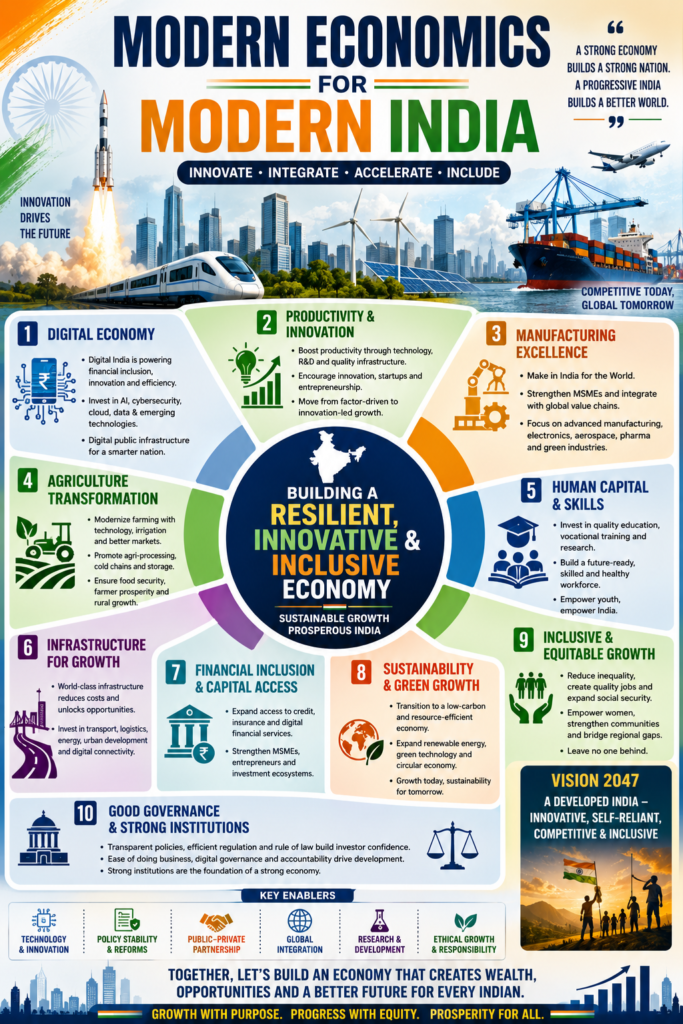
India has demonstrated remarkable economic resilience over the past three decades through economic liberalization, expansion of the services sector, digital innovation, and entrepreneurial growth. Yet significant structural challenges remain, including employment generation, infrastructure gaps, income inequality, agricultural modernization, urbanization pressures, and skill development. Modern economics for India therefore requires a holistic approach that balances rapid economic expansion with social inclusion, environmental sustainability, and technological advancement.
India’s Economic Transformation
Since the economic reforms of 1991, India has transitioned from a relatively closed economy to an increasingly integrated participant in the global marketplace. Liberalization, privatization, and globalization encouraged private investment, foreign direct investment (FDI), and export-oriented growth. The information technology sector, pharmaceuticals, telecommunications, financial services, and digital commerce have emerged as major contributors to national income and employment.
Today, India’s economy is increasingly driven by digital innovation, startup ecosystems, financial inclusion initiatives, manufacturing expansion, and infrastructure development. The challenge now is to sustain this momentum while improving productivity across agriculture, industry, and services.
The Importance of Productivity
Long-term economic prosperity depends not only on increasing investment but also on improving productivity. Productivity reflects how efficiently labor, capital, technology, and natural resources are utilized to produce goods and services.
Higher productivity leads to:
- Increased incomes
- Greater industrial competitiveness
- Lower production costs
- Higher exports
- Better living standards
- Sustainable economic growth
Investment in technology, research and development, workforce skills, logistics, and digital infrastructure significantly enhances national productivity.
Digital Economy as a Growth Engine
India’s digital transformation has become one of the strongest drivers of economic modernization. Digital payments, e-commerce, fintech, cloud computing, artificial intelligence, and online public services have expanded economic participation and improved efficiency.
Future priorities include:
- Artificial Intelligence
- Semiconductor manufacturing
- Quantum computing
- Cybersecurity
- Digital public infrastructure
- Data governance
- Digital entrepreneurship
Strengthening digital capabilities can improve productivity across manufacturing, agriculture, healthcare, education, and governance.
Manufacturing and Industrial Competitiveness
Manufacturing plays a critical role in creating large-scale employment and increasing exports. Modern industrial policy should emphasize advanced manufacturing, automation, robotics, electronics, pharmaceuticals, aerospace, renewable energy technologies, and precision engineering.
Key priorities include:
- Modern industrial corridors
- Smart logistics
- Research and innovation
- Export competitiveness
- Skilled workforce development
- Integration with global value chains
A competitive manufacturing sector can diversify India’s economic base while reducing dependence on imports in strategic industries.
Agricultural Modernization
Agriculture continues to support millions of livelihoods and remains central to food security. Modernizing the sector requires improved productivity, climate resilience, technology adoption, and better market access.
Areas of focus include:
- Precision farming
- Efficient irrigation
- Digital agricultural advisory services
- Improved storage and cold chains
- Food processing
- Crop diversification
- Agricultural biotechnology
Enhancing agricultural value addition can raise farmer incomes while strengthening rural economies.
Human Capital and Skill Development
Economic growth increasingly depends on knowledge, innovation, and skilled human resources. India possesses one of the world’s largest youth populations, presenting both an opportunity and a challenge.
Strategic investments are needed in:
- Quality education
- Vocational training
- Technical institutions
- Scientific research
- Entrepreneurship education
- Digital literacy
- Lifelong learning
A highly skilled workforce enhances innovation, attracts investment, and improves national competitiveness.
Innovation and Startup Ecosystem
Innovation has become a defining feature of modern economies. India’s startup ecosystem has expanded rapidly across sectors such as fintech, health technology, education technology, logistics, artificial intelligence, biotechnology, and clean energy.
Government support, venture capital, academic research, intellectual property protection, and industry collaboration can further strengthen innovation-led growth.
Developing globally competitive technology companies will enhance exports, employment, and strategic technological independence.
Sustainable Economic Development
Modern economics must integrate environmental sustainability into growth strategies. Climate change, resource constraints, pollution, and biodiversity loss present significant economic risks.
Priority areas include:
- Renewable energy
- Green hydrogen
- Electric mobility
- Circular economy
- Sustainable manufacturing
- Water conservation
- Climate-resilient infrastructure
Sustainable development ensures long-term economic resilience while protecting natural resources for future generations.
Infrastructure Development
Efficient infrastructure forms the backbone of economic growth. Investments in transportation, logistics, power, telecommunications, urban development, and digital connectivity reduce business costs and improve productivity.
Strategic infrastructure priorities include:
- High-speed rail
- Expressways
- Smart ports
- Modern airports
- Renewable energy grids
- Broadband connectivity
- Urban transit systems
Well-developed infrastructure enhances both domestic economic activity and international trade competitiveness.
Financial Inclusion and Capital Access
Inclusive financial systems promote entrepreneurship, investment, and household resilience. Expanding access to banking, credit, insurance, pensions, and digital financial services enables broader participation in economic growth.
Strengthening financial literacy and supporting micro, small, and medium enterprises (MSMEs) with responsible access to capital can accelerate job creation and innovation.
Trade and Global Integration
International trade remains a powerful engine of growth. India can strengthen its position in global markets by enhancing export competitiveness, improving product quality, simplifying trade procedures, and diversifying export destinations.
Greater participation in global value chains and strategic trade partnerships can improve resilience while supporting domestic industrial development.
Urbanization and Smart Cities
India’s urban population continues to grow rapidly. Well-planned urbanization can improve productivity through better infrastructure, efficient transportation, affordable housing, digital governance, and sustainable public services.
Smart cities that integrate technology with efficient planning can become centers of innovation, investment, and employment.
Governance and Institutional Reform
Strong institutions are fundamental to economic development. Transparent governance, regulatory efficiency, judicial effectiveness, predictable policies, and ease of doing business encourage both domestic and international investment.
Reducing bureaucratic delays, strengthening contract enforcement, and improving public service delivery can significantly enhance economic performance.
Inclusive Growth
Economic progress should benefit all sections of society. Inclusive development focuses on reducing poverty, expanding educational opportunities, improving healthcare, increasing women’s workforce participation, and supporting rural development.
Balanced regional development and targeted social investments contribute to long-term economic stability and social cohesion.
Future Economic Priorities
India’s economic strategy for the coming decades should focus on:
- Artificial Intelligence leadership
- Semiconductor manufacturing
- Biotechnology innovation
- Green energy transition
- Advanced manufacturing
- Digital infrastructure
- Research and development
- Skill-intensive employment
- Export competitiveness
- Climate resilience
- Rural transformation
- Strong institutions
These priorities can help India build a resilient, knowledge-driven, and globally competitive economy.
Conclusion
Modern economics for India is no longer solely about expanding national income; it is about building an economy that is innovative, productive, sustainable, and inclusive. By investing in human capital, technology, manufacturing, infrastructure, agriculture, financial inclusion, and institutional strength, India can harness its demographic dividend and reinforce its role in the global economy. A balanced development strategy that combines rapid growth with social equity, environmental responsibility, and technological advancement will enable the country to achieve long-term prosperity. As global economic dynamics continue to evolve, India’s ability to adapt, innovate, and strengthen its economic foundations will be the key to becoming a leading economic power in the twenty-first century.