

Strategic Counter-Insurgency Strategies for Modern Warfare
Abstract
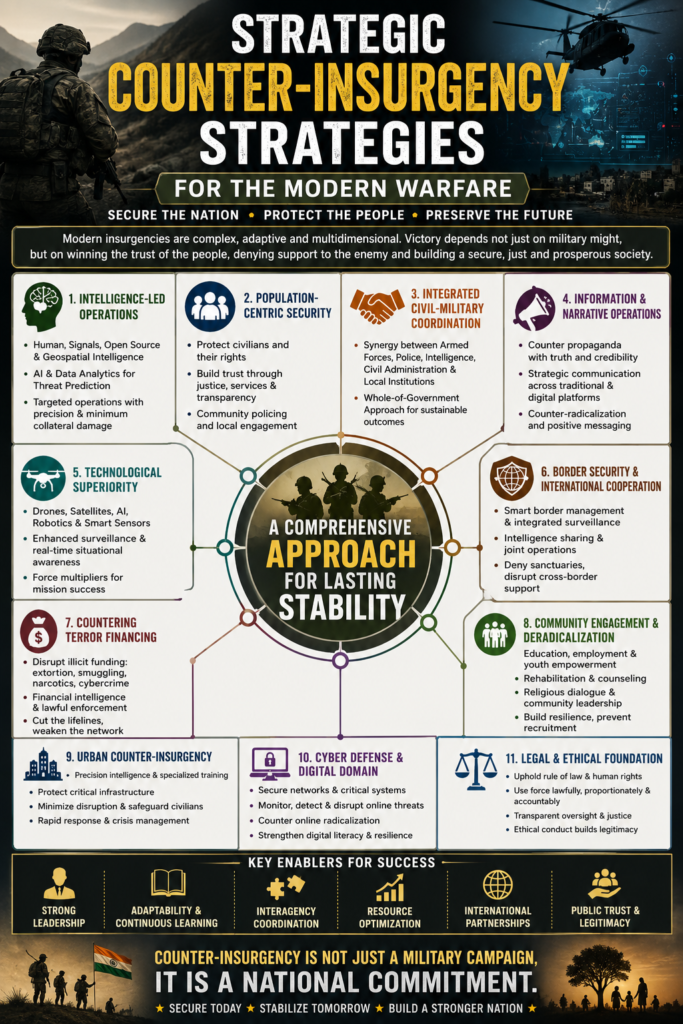
Counter-insurgency (COIN) remains one of the most complex dimensions of modern warfare. Unlike conventional military conflicts where success is often measured by territorial gains or destruction of enemy forces, insurgencies thrive through ideology, local grievances, asymmetric tactics, and the ability to influence civilian populations. Modern insurgent organizations increasingly exploit technological advancements, social media, cyber capabilities, drones, encrypted communications, and transnational support networks, making traditional military responses insufficient. Effective counter-insurgency therefore demands a multidimensional strategy integrating military operations with intelligence, governance, economic development, law enforcement, information operations, and technological innovation. This article explores the strategic principles, operational frameworks, and emerging trends shaping successful counter-insurgency in the twenty-first century.
Introduction
The nature of warfare has undergone a profound transformation over the past several decades. While interstate wars continue to exist, many nations increasingly confront irregular conflicts involving insurgent groups, extremist organizations, separatist movements, and hybrid warfare actors. These adversaries deliberately avoid conventional battlefield engagements, instead relying upon guerrilla tactics, psychological warfare, terrorism, cyber influence campaigns, and manipulation of local populations.
History demonstrates that insurgencies are rarely defeated solely through military force. Successful campaigns require governments to restore public confidence, strengthen institutions, improve governance, and deny insurgents both physical and ideological support. Consequently, modern counter-insurgency has evolved into a comprehensive national strategy rather than merely a military doctrine.
Understanding Modern Insurgency
An insurgency is an organized movement seeking to challenge governmental authority through political, military, social, or ideological means. Contemporary insurgencies often combine conventional guerrilla warfare with advanced technologies and sophisticated propaganda.
Modern insurgent organizations commonly employ:
- Guerrilla warfare
- Improvised explosive devices (IEDs)
- Drone-based reconnaissance
- Precision ambushes
- Cyber attacks
- Information warfare
- Social media radicalization
- Financial networks
- Cross-border logistics
- Criminal financing
Unlike conventional armies, insurgents often avoid decisive engagements and instead focus on exhausting government resources while influencing public perception.
Evolution of Counter-Insurgency
Traditional COIN emphasized military dominance and territorial control. However, experience from numerous conflicts has demonstrated that military victories alone rarely eliminate insurgent movements.
Modern counter-insurgency has shifted toward population-centric approaches where protecting civilians, improving governance, and addressing legitimate grievances become strategic priorities alongside security operations.
The modern battlefield therefore extends beyond physical terrain into:
- Information space
- Cyberspace
- Economic systems
- Social networks
- Political institutions
- International diplomacy
Victory depends upon securing legitimacy rather than simply defeating armed opponents.
Intelligence-Led Operations
High-quality intelligence remains the cornerstone of successful counter-insurgency.
Modern intelligence integrates:
- Human Intelligence (HUMINT)
- Signals Intelligence (SIGINT)
- Open Source Intelligence (OSINT)
- Geospatial Intelligence (GEOINT)
- Financial Intelligence (FININT)
- Cyber Intelligence
Artificial intelligence increasingly assists in identifying insurgent patterns, communication networks, financial transactions, and movement corridors.
Predictive analytics enable security agencies to anticipate threats before attacks occur, reducing collateral damage and improving operational efficiency.
Population-Centric Security
The population represents the decisive center of gravity in any insurgency.
Citizens support governments that provide:
- Security
- Justice
- Economic opportunity
- Essential services
- Political inclusion
Insurgents attempt to exploit fear, distrust, and governance failures. Therefore, protecting civilians becomes strategically more valuable than simply eliminating insurgents.
Community policing, local engagement, rapid grievance resolution, and responsive governance reduce insurgent recruitment opportunities.
Integrated Civil-Military Coordination
Military success must be synchronized with civilian governance.
An effective integrated framework includes collaboration among:
- Armed forces
- Police agencies
- Intelligence organizations
- Civil administration
- Judicial institutions
- Disaster management agencies
- Healthcare services
- Educational institutions
This whole-of-government approach ensures that security gains are translated into sustainable stability.
Information and Narrative Operations
Modern conflicts increasingly involve competition over narratives.
Insurgent groups frequently exploit:
- Social media
- Online videos
- Disinformation
- Propaganda
- Religious messaging
- Identity politics
Governments must proactively communicate accurate information, counter misinformation, and strengthen public trust through transparent engagement.
Strategic communication should emphasize:
- Credibility
- Timely information
- Community outreach
- Digital engagement
- Counter-radicalization messaging
Technological Superiority
Emerging technologies have become force multipliers in counter-insurgency.
These include:
- Artificial Intelligence
- Machine Learning
- Drone surveillance
- Satellite imagery
- Facial recognition (subject to legal safeguards)
- Smart sensors
- Battlefield analytics
- Robotics
- Quantum-secure communications
- Autonomous monitoring systems
Technology enhances situational awareness, enabling security forces to respond more effectively while minimizing risks to civilians.
Countering Terror Financing
Insurgencies cannot survive without financial resources.
Funding sources may include:
- Extortion
- Smuggling
- Illegal mining
- Narcotics trafficking
- Arms trafficking
- Kidnapping
- Cybercrime
- External sponsorship
Disrupting these financial networks through coordinated law enforcement, financial intelligence, and international cooperation significantly weakens insurgent capabilities.
Border Security and International Cooperation
Many insurgencies benefit from cross-border sanctuaries and transnational logistics.
Modern border management combines:
- Smart surveillance
- UAV patrols
- Satellite monitoring
- Integrated databases
- Biometric systems
- International intelligence sharing
- Joint border operations
Regional cooperation enhances the ability to disrupt insurgent movement and financing while respecting international law.
Community Engagement and Deradicalization
Long-term stability requires reducing the appeal of insurgent ideologies.
Effective deradicalization initiatives may involve:
- Education
- Vocational training
- Psychological counseling
- Religious dialogue
- Youth engagement
- Rehabilitation programs
- Employment opportunities
- Community leadership participation
Building resilience within communities helps prevent recruitment into extremist organizations.
Urban Counter-Insurgency
Rapid urbanization has shifted many insurgent activities into densely populated cities.
Urban operations demand:
- Precision intelligence
- Specialized training
- Surveillance technologies
- Close coordination with local authorities
- Protection of critical infrastructure
- Crisis response capabilities
Because civilian populations are concentrated in urban areas, minimizing collateral harm and maintaining public confidence are essential.
Cyber Dimension of Counter-Insurgency
Digital platforms have become central to modern insurgent operations.
Insurgent groups use cyberspace for:
- Recruitment
- Propaganda
- Fundraising
- Secure communication
- Intelligence gathering
- Psychological operations
Governments should strengthen cyber resilience by enhancing digital security, disrupting illicit online activities through lawful means, improving digital literacy, and working with technology platforms where appropriate.
Legal and Ethical Foundations
Successful counter-insurgency depends not only on operational effectiveness but also on adherence to the rule of law and human rights.
Professional security forces should:
- Follow applicable national and international law.
- Use force proportionately and accountably.
- Protect civilians.
- Investigate allegations of misconduct.
- Maintain transparent oversight.
Respect for legal and ethical standards strengthens public trust and reduces opportunities for insurgent propaganda.
Leadership and Institutional Adaptation
Counter-insurgency campaigns often extend over many years, requiring adaptive leadership.
Essential leadership qualities include:
- Strategic vision
- Interagency coordination
- Cultural understanding
- Evidence-based decision-making
- Organizational learning
- Crisis management
Regular assessment and adaptation help institutions respond to evolving threats.
Future Trends
Emerging developments likely to shape future counter-insurgency include:
- Artificial intelligence-assisted intelligence analysis
- Autonomous surveillance systems
- Enhanced cyber defense
- Data-driven resource allocation
- Advanced border monitoring technologies
- Greater international intelligence cooperation
- Improved resilience against disinformation
- Stronger integration of civil, law enforcement, and military capabilities
Future success will depend on balancing technological innovation with accountable governance and community trust.
Conclusion
Modern counter-insurgency is fundamentally a contest for legitimacy, security, and public confidence rather than a purely military confrontation. While capable security forces remain indispensable, enduring success requires an integrated strategy that combines intelligence, lawful security operations, effective governance, economic opportunity, strategic communication, technological innovation, and community engagement. Governments that address both immediate security threats and the underlying drivers of instability are better positioned to reduce violence, strengthen resilience, and achieve lasting peace. As warfare continues to evolve, counter-insurgency strategies must remain adaptable, multidisciplinary, and grounded in the rule of law to meet the challenges of the modern security environment.