

Improvement Strategies for Policy Makers in India Beyond 2026: Building a Resilient, Inclusive, and Globally Competitive Nation
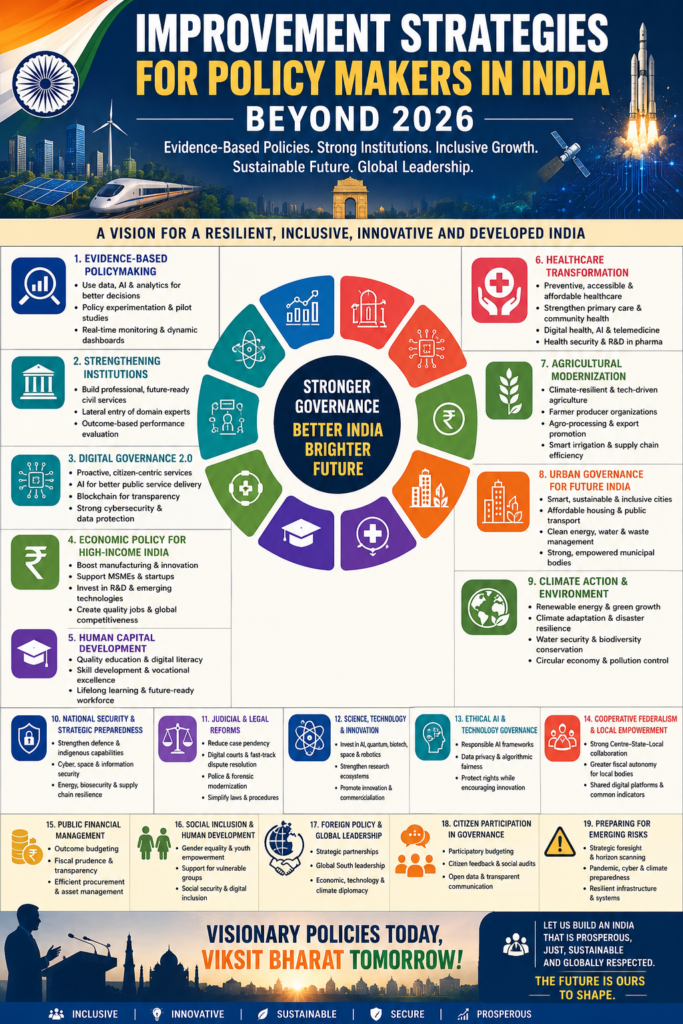
Introduction
India has entered a transformative phase in its developmental journey. Having emerged as one of the world’s fastest-growing major economies, the nation stands at a crucial policy crossroads beyond 2026. While impressive progress has been achieved in digital governance, infrastructure expansion, financial inclusion, healthcare access, defense modernization, renewable energy, and startup innovation, the coming decades will demand a new generation of policymaking that is proactive rather than reactive, evidence-driven rather than politically expedient, and future-oriented rather than merely problem-solving.
The global geopolitical environment is becoming increasingly uncertain. Artificial intelligence, biotechnology, quantum computing, climate change, demographic transitions, cyber warfare, supply chain realignments, and economic nationalism are redefining the priorities of governments worldwide. Countries that successfully anticipate these changes through adaptive governance will emerge as leaders of the twenty-first century. India possesses significant demographic advantages, technological capabilities, entrepreneurial strength, democratic institutions, and geopolitical relevance. However, realizing the vision of becoming a developed nation requires policy reforms that extend beyond incremental improvements.
Policy makers must therefore shift from short-term administrative management toward long-term national transformation. Future governance must integrate economic competitiveness, social equity, institutional accountability, environmental sustainability, technological leadership, and national security into a coherent development framework. The coming decades demand comprehensive reforms that strengthen governance while preparing India for emerging global challenges.
Towards Evidence-Based Policymaking
The complexity of modern governance makes intuition-based decision-making increasingly insufficient. Public policies must increasingly rely on rigorous evidence, real-time data analytics, artificial intelligence, behavioural economics, and predictive modelling.
India has already developed one of the world’s largest digital public infrastructures through Aadhaar, UPI, CoWIN, DigiLocker, and GST systems. These platforms generate enormous quantities of administrative data that can support evidence-based governance. Beyond 2026, government departments should establish integrated policy analytics units capable of continuously evaluating programme performance using machine learning and advanced statistical techniques.
Policy experimentation should become institutionalized. Before nationwide implementation, major reforms should undergo controlled pilot studies across diverse socioeconomic settings. Independent academic institutions, think tanks, and universities should actively participate in evaluating policy outcomes through randomized and quasi-experimental methods.
Furthermore, ministries should develop dynamic policy dashboards that continuously monitor implementation indicators, allowing rapid policy corrections whenever necessary.
Strengthening Institutional Capacity
Effective governance depends less upon policy announcements and more upon institutional capability. Administrative reforms should therefore focus on enhancing professional competence, reducing bureaucratic delays, and encouraging innovation within government.
Civil services require continuous professional development throughout their careers. Traditional administrative training should increasingly incorporate artificial intelligence, cybersecurity, climate governance, public health economics, digital transformation, behavioural science, negotiation, crisis management, systems thinking, and international diplomacy.
Specialized lateral entry of domain experts should complement career civil servants in technically complex sectors such as biotechnology, semiconductors, renewable energy, digital infrastructure, pharmaceuticals, financial regulation, and environmental policy.
Performance evaluation systems should shift toward measurable public outcomes rather than procedural compliance alone.
Digital Governance 2.0
India has become a global leader in digital public infrastructure. However, the next phase requires deeper digital transformation.
Government services should become proactive rather than reactive. Instead of requiring citizens to repeatedly apply for benefits, integrated government databases can automatically identify eligible beneficiaries while maintaining strong privacy protections.
Artificial intelligence can assist in:
- grievance redressal
- fraud detection
- tax administration
- judicial case prioritization
- healthcare planning
- agricultural forecasting
- disaster management
- urban planning
Blockchain technologies may strengthen land record management, procurement transparency, supply chain monitoring, educational credential verification, and welfare distribution.
Cybersecurity should become a national governance priority as digital dependence increases.
Economic Policy for High-Income India
India’s long-term economic strategy should move beyond GDP expansion toward sustainable productivity growth.
Future industrial policies should encourage:
- advanced manufacturing
- semiconductor production
- pharmaceutical innovation
- aerospace technologies
- defense manufacturing
- medical devices
- robotics
- quantum technologies
- biotechnology
- green hydrogen
- advanced materials
Research and development expenditure should gradually increase toward internationally competitive levels through stronger collaboration between academia, government laboratories, startups, and industry.
Small and medium enterprises require simplified regulations, improved access to finance, technology adoption support, export facilitation, and digital transformation assistance.
Labour-intensive manufacturing sectors should continue generating employment while simultaneously developing high-technology industries capable of competing globally.
Human Capital Development
India’s demographic dividend remains one of its greatest strategic advantages. However, demographic potential translates into economic growth only through sustained investments in education, healthcare, nutrition, and skill development.
Education reforms should increasingly emphasize:
- critical thinking
- scientific reasoning
- creativity
- entrepreneurship
- digital literacy
- financial literacy
- environmental awareness
- ethical leadership
- interdisciplinary learning
Universities should receive greater autonomy while simultaneously strengthening accountability through transparent quality indicators.
Vocational education should become socially prestigious and closely aligned with industrial demand.
Continuous lifelong learning must become central to workforce policy as automation transforms employment patterns.
Healthcare Policy Transformation
Healthcare should increasingly shift from disease treatment toward disease prevention.
India requires stronger investments in:
- preventive healthcare
- community medicine
- mental health
- nutrition
- epidemiological surveillance
- genomic medicine
- digital health
- telemedicine
- primary healthcare
Artificial intelligence can significantly improve diagnostics, radiology, pathology, hospital management, disease surveillance, and pharmaceutical research.
Domestic pharmaceutical innovation should receive greater policy support through research funding, intellectual property incentives, and academic-industry partnerships.
Health emergency preparedness should remain a permanent policy priority following lessons from global pandemics.
Agricultural Modernization
Agriculture continues supporting millions of livelihoods despite declining contribution to GDP.
Future agricultural policies should encourage:
- precision agriculture
- climate-resilient crops
- smart irrigation
- agricultural biotechnology
- digital advisory systems
- farmer producer organizations
- food processing
- export-oriented agriculture
- cold chain infrastructure
- supply chain modernization
Artificial intelligence, satellite imagery, drones, and remote sensing technologies can improve crop monitoring, weather forecasting, pest detection, and yield estimation.
Income diversification through allied sectors such as dairy, fisheries, horticulture, agro-tourism, and renewable energy should become increasingly important.
Urban Governance for Future India
India’s urban population will continue expanding rapidly.
Future cities should prioritize:
- affordable housing
- public transportation
- sustainable mobility
- clean energy
- green infrastructure
- intelligent traffic management
- waste recycling
- water conservation
- digital governance
- disaster resilience
Smart city initiatives should evolve beyond isolated technological projects toward integrated urban ecosystems focused on quality of life.
Municipal governments require greater fiscal autonomy, administrative capacity, and professional urban planning expertise.
Climate Change and Environmental Sustainability
Climate resilience will increasingly shape national development.
Policy priorities should include:
- renewable energy expansion
- climate adaptation
- carbon reduction
- biodiversity conservation
- afforestation
- circular economy
- sustainable industries
- water conservation
- pollution control
- climate-resilient infrastructure
India should continue balancing developmental priorities with environmental sustainability through innovative green technologies and international cooperation.
Water security deserves particular emphasis due to increasing climate variability and groundwater depletion.
National Security and Strategic Preparedness
Security challenges have become multidimensional.
Beyond traditional military preparedness, national security increasingly encompasses:
- cybersecurity
- space security
- information warfare
- supply chain resilience
- energy security
- biosecurity
- critical infrastructure protection
- technological sovereignty
Policy makers should encourage domestic production of critical technologies while strengthening international strategic partnerships.
Integrated intelligence sharing, advanced surveillance technologies, artificial intelligence, quantum communications, and indigenous defense innovation should remain national priorities.
Judicial and Legal Reforms
Efficient legal systems significantly influence investment, innovation, and public trust.
Policy reforms should address:
- judicial backlog reduction
- digital courts
- alternative dispute resolution
- commercial courts
- forensic modernization
- police modernization
- legal aid
- procedural simplification
Technology-assisted justice systems can significantly improve efficiency while maintaining fairness.
Science, Technology, and Innovation
Innovation increasingly determines national competitiveness.
India should significantly expand investments in:
- artificial intelligence
- quantum computing
- biotechnology
- space technologies
- advanced materials
- robotics
- cybersecurity
- precision medicine
- nanotechnology
- high-performance computing
Universities should strengthen research ecosystems while encouraging commercialization of scientific discoveries.
Public-private partnerships should accelerate translation of research into globally competitive industries.
Ethical Artificial Intelligence Governance
Artificial intelligence will transform every sector.
Future policy frameworks should ensure:
- transparency
- accountability
- fairness
- privacy protection
- algorithmic governance
- workforce transition
- responsible innovation
- cybersecurity
Regulatory approaches should encourage innovation while minimizing societal risks associated with algorithmic bias, misinformation, surveillance, and automation.
India can emerge as a global leader in responsible AI governance through balanced regulation.
Strengthening Federal Cooperation
India’s diversity necessitates cooperative federalism.
Policy coordination between Union, State, and local governments should improve through:
- shared digital platforms
- common performance indicators
- transparent fiscal transfers
- collaborative planning
- intergovernmental policy councils
Local governments should receive greater administrative authority alongside stronger accountability mechanisms.
Public Financial Management
Efficient resource allocation remains central to effective governance.
Future reforms should strengthen:
- outcome budgeting
- expenditure reviews
- public procurement transparency
- fiscal sustainability
- tax administration
- public asset management
- infrastructure financing
- sovereign wealth strategies
Artificial intelligence can improve financial fraud detection, audit efficiency, and expenditure monitoring.
Social Inclusion and Human Development
Economic growth alone cannot guarantee societal progress.
Policies should continuously strengthen:
- gender equality
- disability inclusion
- tribal development
- rural transformation
- elderly care
- youth empowerment
- social security
- affordable housing
- digital inclusion
Inclusive development enhances social stability while expanding economic productivity.
Foreign Policy and Global Leadership
India’s international influence continues expanding.
Future diplomatic priorities should include:
- strategic partnerships
- Global South leadership
- economic diplomacy
- technology partnerships
- climate negotiations
- healthcare diplomacy
- educational cooperation
- cultural diplomacy
- maritime security
India should continue positioning itself as a responsible global stakeholder capable of contributing to international peace, sustainable development, humanitarian assistance, and technological cooperation.
Governance Through Citizen Participation
Modern governance increasingly depends upon public trust.
Policy makers should encourage:
- participatory budgeting
- citizen feedback platforms
- public consultations
- social audits
- transparent communication
- open government data
- digital civic engagement
Trust-based governance strengthens democratic legitimacy while improving policy implementation.
Preparing for Emerging Risks
The coming decades will present increasingly complex risks, including pandemics, cyberattacks, financial instability, climate disasters, misinformation campaigns, and technological disruptions. Governments should institutionalize strategic foresight through dedicated horizon-scanning units capable of identifying emerging challenges before they become crises. Scenario planning, stress testing, and resilience assessments should become standard components of national policymaking.
Leadership Development Within Government
Future governance requires leaders capable of navigating uncertainty, managing interdisciplinary teams, and communicating effectively with citizens. Leadership development programmes should cultivate strategic thinking, ethical decision-making, innovation management, emotional intelligence, and international collaboration among public officials. Recognizing and rewarding innovation within the civil service can foster a culture of continuous improvement.
Conclusion
India’s journey beyond 2026 represents an opportunity to redefine governance for a rapidly changing world. The next generation of policymaking must be characterized by evidence-based decision-making, institutional excellence, technological innovation, sustainable development, fiscal prudence, social inclusion, and strategic foresight. Rather than responding to crises after they emerge, policymakers should build anticipatory governance systems capable of identifying opportunities and mitigating risks before they escalate.
The convergence of digital technologies, demographic potential, entrepreneurial dynamism, and democratic institutions provides India with a unique foundation for long-term national advancement. By strengthening institutional capacity, investing in human capital, modernizing public administration, promoting scientific innovation, enhancing environmental resilience, and deepening cooperative federalism, India can accelerate its transition toward a developed, inclusive, and globally influential nation.
Ultimately, the success of India’s future will depend not only on the scale of its ambitions but also on the quality, adaptability, and integrity of its policymaking. Policies that are transparent, evidence-driven, citizen-centric, and resilient will enable the country to navigate emerging global uncertainties while ensuring that economic progress translates into improved quality of life for all citizens. Beyond 2026, India’s greatest strategic asset will be its ability to govern with vision, innovation, accountability, and an unwavering commitment to sustainable and inclusive national development.