

Policing 2.0: The Imperative of Advanced Policing for Advancing India in the Twenty-First Century
Abstract
The twenty-first century has witnessed unprecedented transformations in the global security environment driven by rapid technological advancement, urbanization, digitalization, globalization, artificial intelligence, cyber connectivity, and transnational criminal networks. These developments have fundamentally altered the nature of crime, making conventional policing models increasingly inadequate for addressing emerging security challenges. India, as the world’s largest democracy and one of the fastest-growing economies, stands at a critical juncture where sustainable development, economic prosperity, technological innovation, and social stability are intrinsically linked to the effectiveness of its policing institutions. The vision of Viksit Bharat 2047 requires not only economic reforms and infrastructural development but also a comprehensive modernization of law enforcement through the adoption of advanced policing strategies collectively referred to as Policing 2.0. This new policing paradigm integrates artificial intelligence, predictive analytics, big data, digital forensics, cyber intelligence, smart surveillance, community participation, scientific investigation, and integrated criminal justice systems into a cohesive framework that enables proactive, intelligence-led, and citizen-centric policing. Rather than reacting to crimes after they occur, Policing 2.0 emphasizes anticipation, prevention, rapid response, and evidence-based decision-making while simultaneously strengthening transparency, accountability, and public trust. This article critically examines the necessity of advanced policing in India, explores the technological, institutional, legal, and ethical dimensions of Policing 2.0, and argues that modern law enforcement is an indispensable pillar for achieving India’s aspirations of becoming a secure, innovative, and globally competitive developed nation.
Keywords: Policing 2.0, India, Artificial Intelligence, Smart Policing, Cybercrime, Digital Forensics, Law Enforcement, Public Safety, National Security, Criminal Justice.
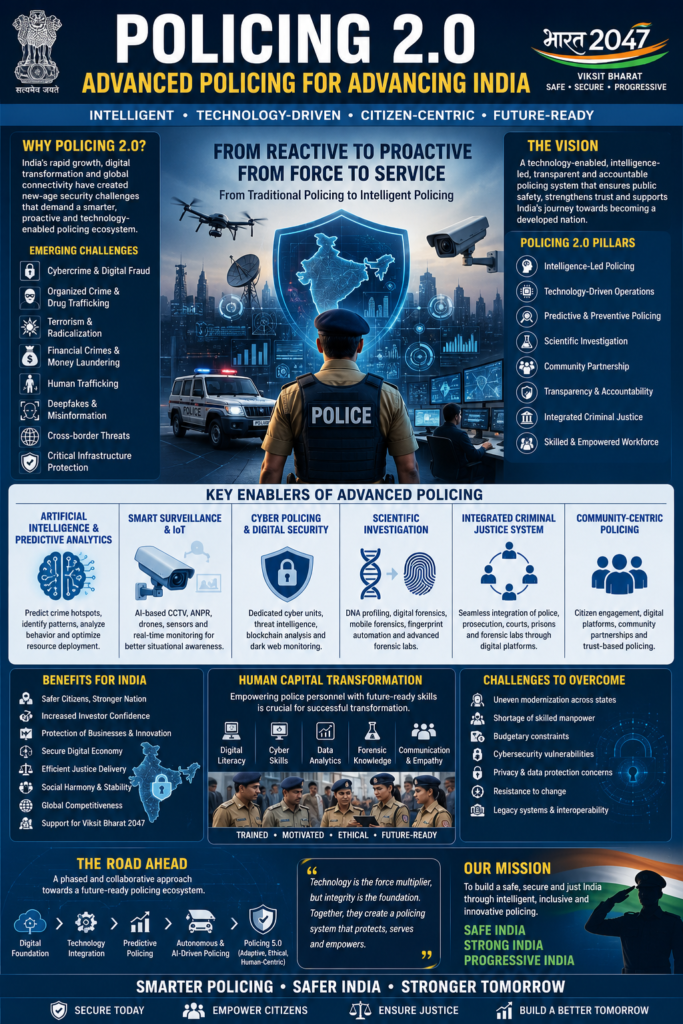
Policing 2.0: The Imperative of Advanced Policing for Advancing India
India is presently experiencing one of the most transformative periods in its modern history. Rapid economic expansion, digital governance, smart city initiatives, industrial modernization, financial inclusion, technological innovation, expanding internet penetration, and increasing global integration have collectively reshaped the country’s developmental trajectory. Simultaneously, these transformative developments have also generated an increasingly sophisticated and multidimensional crime landscape that extends far beyond the capabilities of conventional policing systems designed several decades ago. Criminal enterprises have evolved into technologically sophisticated organizations that utilize encrypted communication platforms, artificial intelligence, cryptocurrency, anonymous digital identities, drones, cyber infrastructure, deepfake technologies, and transnational financial networks to conduct criminal activities across jurisdictions. Consequently, policing can no longer remain confined to traditional patrols, manual investigations, reactive law enforcement, and paper-based administration. Instead, India requires an advanced policing ecosystem capable of integrating technology, intelligence, scientific investigation, digital governance, and community participation into every aspect of law enforcement. This comprehensive transformation represents the essence of Policing 2.0, a strategic evolution that seeks to redefine policing as an intelligent, predictive, transparent, accountable, and citizen-centric institution capable of supporting India’s ambitions of becoming a developed nation by 2047.
The concept of Policing 2.0 extends far beyond the mere adoption of technological tools. It represents a complete paradigm shift in policing philosophy, organizational culture, operational methodologies, leadership approaches, investigative procedures, and public engagement mechanisms. Traditional policing has historically emphasized responding to crimes after they occur through patrol deployment, criminal investigations, arrests, and prosecution. While these foundational responsibilities remain indispensable, the rapidly evolving criminal environment necessitates a transition towards proactive policing that identifies risks before crimes materialize, predicts emerging criminal patterns through advanced analytics, enhances situational awareness through integrated surveillance systems, and facilitates evidence-based decision-making supported by artificial intelligence and scientific investigation. Such transformation does not diminish the importance of human judgment but rather augments the capabilities of police officers by equipping them with technologically advanced decision-support systems capable of processing enormous volumes of information far beyond human analytical capacity.
One of the defining characteristics of modern crime is its increasing complexity. Cybercrime has emerged as one of the fastest-growing categories of criminal activity worldwide, encompassing financial fraud, ransomware attacks, identity theft, cryptocurrency laundering, cyber espionage, online radicalization, phishing campaigns, child exploitation, intellectual property theft, and attacks on critical national infrastructure. Unlike conventional crimes, cyber offences transcend geographical boundaries, allowing offenders to operate anonymously across multiple jurisdictions while targeting victims located thousands of kilometers away. India’s rapidly expanding digital economy, which supports digital banking, e-commerce, online education, telemedicine, and digital governance, has consequently become increasingly vulnerable to cyber threats. Addressing these challenges requires highly specialized cyber policing capabilities supported by digital forensic laboratories, blockchain analysis, malware intelligence, cyber threat monitoring, ethical hacking expertise, artificial intelligence, and international law enforcement cooperation. The modernization of India’s cyber policing infrastructure is therefore not merely an institutional necessity but an essential prerequisite for safeguarding national economic development and digital sovereignty.
Artificial intelligence represents one of the most transformative technologies shaping the future of policing. AI-powered systems possess the capacity to analyze millions of criminal records, surveillance images, social media interactions, financial transactions, geospatial datasets, and communication patterns within seconds, generating actionable intelligence that significantly enhances investigative efficiency. Predictive policing algorithms can identify crime hotspots by analyzing historical crime patterns, demographic changes, environmental variables, public events, transportation networks, and socioeconomic indicators. Such predictive capabilities enable law enforcement agencies to optimize resource allocation, strategically deploy patrol units, strengthen preventive policing initiatives, and reduce criminal opportunities before offences occur. However, the integration of artificial intelligence into policing must always remain accompanied by transparent governance, judicial oversight, algorithmic accountability, ethical safeguards, and respect for constitutional rights to ensure that technological advancement strengthens rather than compromises democratic values.
The emergence of smart cities further reinforces the necessity of Policing 2.0. India’s Smart Cities Mission envisions technologically integrated urban environments equipped with intelligent transportation systems, digital governance platforms, integrated command and control centres, sensor-based infrastructure, and real-time public service delivery. These urban ecosystems generate enormous quantities of digital information through surveillance cameras, traffic management systems, environmental sensors, emergency communication platforms, and Internet of Things (IoT) devices. Policing agencies capable of integrating these diverse data streams into unified command centres gain unprecedented situational awareness that enables rapid emergency response, efficient traffic management, crowd monitoring during public events, disaster coordination, and enhanced public safety. Intelligent surveillance technologies equipped with computer vision, behavioural analytics, automatic number plate recognition, and anomaly detection significantly improve law enforcement’s ability to identify potential threats while simultaneously increasing operational efficiency. Nevertheless, widespread deployment of surveillance technologies also necessitates comprehensive legal frameworks governing data privacy, proportionality, transparency, and independent oversight to preserve citizens’ civil liberties.
Scientific investigation constitutes another fundamental pillar of advanced policing. Modern criminal investigations increasingly rely upon forensic science rather than witness testimony alone. DNA profiling, digital forensics, fingerprint automation, facial recognition technologies, ballistic examination, toxicological analysis, voice recognition, mobile device extraction, cloud forensic analysis, and biometric identification collectively enhance the accuracy, reliability, and credibility of criminal investigations. Scientific evidence not only strengthens prosecution but also minimizes wrongful convictions by providing objective and verifiable proof. As criminal methodologies become increasingly sophisticated, corresponding investments in forensic laboratories, skilled forensic professionals, digital evidence management systems, and standardized investigative protocols become indispensable components of an effective criminal justice ecosystem.
Equally important is the integration of policing within the broader criminal justice system. Traditionally, fragmented communication between police agencies, prosecution departments, forensic laboratories, judicial institutions, and correctional facilities has contributed to procedural delays, duplication of efforts, and inefficiencies in justice delivery. Policing 2.0 advocates the establishment of fully interoperable digital platforms capable of securely exchanging information across all criminal justice stakeholders. Integrated criminal justice systems enable real-time access to case records, forensic reports, warrants, court proceedings, criminal histories, and evidence databases, thereby accelerating investigations, improving case management, reducing administrative burdens, and enhancing institutional coordination. Such digital integration also promotes transparency, accountability, and evidence-based judicial decision-making.
Human resource development remains central to the successful implementation of advanced policing. Technology alone cannot modernize policing without corresponding investments in human capital. Contemporary police officers must possess competencies extending beyond traditional law enforcement skills to include digital literacy, cyber investigation, artificial intelligence awareness, forensic evidence management, data analytics, behavioural psychology, crisis negotiation, financial investigation, community engagement, leadership, ethical decision-making, and emotional resilience. Continuous professional education, multidisciplinary training programmes, simulation-based learning, international collaboration, and specialized certification programmes are essential for preparing future police leaders capable of navigating increasingly complex operational environments.
Community participation continues to remain indispensable despite technological advancements. Public trust represents one of the most valuable assets available to any policing institution. Advanced technologies cannot replace the importance of constructive relationships between police organizations and the communities they serve. Community policing encourages collaborative problem-solving, citizen participation in crime prevention, neighbourhood partnerships, youth engagement, victim support mechanisms, and transparent communication. Digital platforms, mobile applications, emergency reporting systems, anonymous complaint mechanisms, and social media engagement further strengthen citizen-police collaboration by facilitating rapid communication and increasing institutional responsiveness. Trust-based policing ultimately enhances intelligence gathering, encourages public cooperation, reduces social tensions, and reinforces democratic legitimacy.
Economic development and policing are deeply interconnected. Investors, entrepreneurs, multinational corporations, financial institutions, tourists, and skilled professionals are more likely to engage with jurisdictions characterized by political stability, effective governance, public safety, legal certainty, and efficient law enforcement. Advanced policing contributes directly to economic growth by reducing organized crime, protecting critical infrastructure, preventing financial fraud, securing digital commerce, safeguarding intellectual property, supporting tourism, and maintaining law and order during periods of rapid urbanization and industrial expansion. Consequently, investments in policing modernization should be viewed not merely as expenditures on public security but as strategic investments in national economic competitiveness and sustainable development.
Despite its transformative potential, the implementation of Policing 2.0 presents several significant challenges. Financial constraints, uneven technological capacity across states, shortages of skilled personnel, cybersecurity vulnerabilities, fragmented legacy systems, institutional resistance to organizational change, privacy concerns, algorithmic bias, and varying levels of digital infrastructure collectively complicate modernization efforts. Addressing these challenges requires coordinated policy reforms, sustained government investment, public-private partnerships, indigenous technological innovation, academic collaboration, legislative modernization, and continuous evaluation of policing outcomes. Importantly, modernization must remain guided by constitutional principles, human rights protections, judicial accountability, and democratic oversight to ensure that technological advancement enhances both security and civil liberties.
Looking toward the future, the evolution of policing is likely to progress beyond Policing 2.0 toward increasingly intelligent, autonomous, and interconnected policing ecosystems incorporating quantum computing, advanced robotics, autonomous surveillance platforms, predictive behavioural modelling, digital twins of urban environments, satellite-enabled monitoring, edge computing, augmented reality operational systems, and AI-assisted command decision support. However, regardless of technological sophistication, the fundamental mission of policing will remain unchanged: protecting life, preserving liberty, enforcing the rule of law, ensuring justice, and maintaining public confidence. Technology should therefore serve as an instrument that strengthens human judgment rather than replacing the ethical responsibility, professionalism, and compassion that define effective democratic policing.
In conclusion, India’s emergence as a global economic, technological, and strategic power necessitates a corresponding transformation of its policing institutions. Advanced policing represents far more than technological modernization; it embodies a comprehensive institutional evolution encompassing governance, intelligence, scientific investigation, community partnership, legal reform, ethical accountability, and human capital development. Policing 2.0 provides the strategic framework through which India can effectively address emerging criminal threats while simultaneously promoting public trust, economic prosperity, national security, and democratic governance. As India advances toward the vision of Viksit Bharat 2047, the modernization of policing must be recognized as one of the nation’s highest strategic priorities. A secure society forms the indispensable foundation upon which innovation, investment, education, healthcare, entrepreneurship, and inclusive development can flourish. The future of India’s progress will therefore depend not only upon economic growth and technological innovation but equally upon the creation of a resilient, intelligent, transparent, and citizen-centric policing system capable of safeguarding the aspirations of more than 1.4 billion people.