

Effective Education Policies for India: Building a Knowledge-Driven Nation for the Twenty-First Century
Abstract
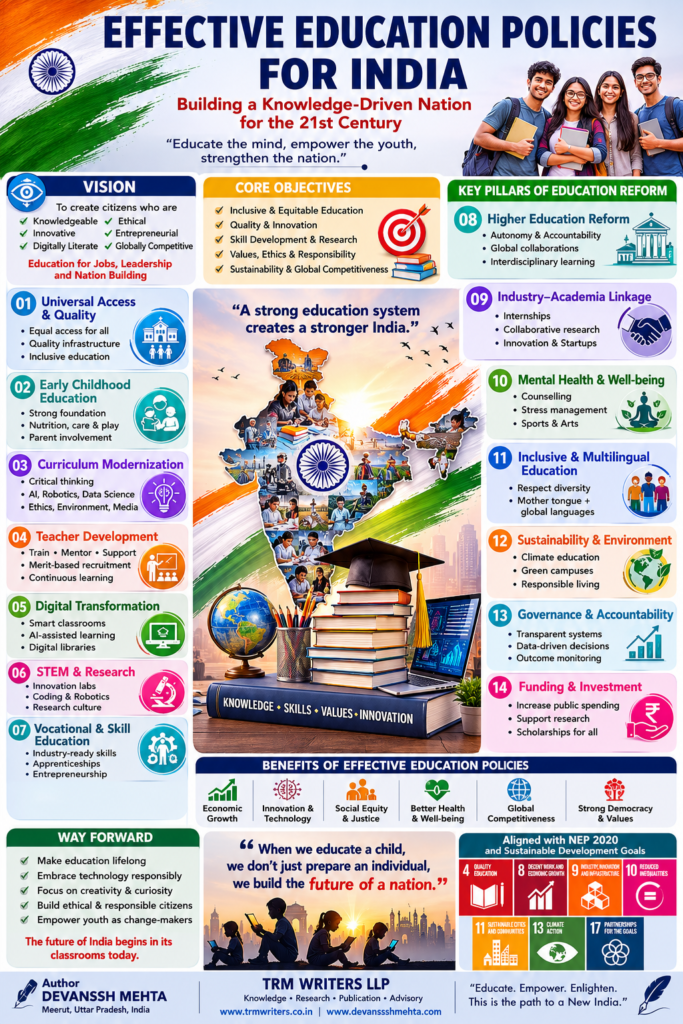
Education is the cornerstone of national development. It determines a country’s economic competitiveness, technological advancement, social harmony, democratic values, healthcare outcomes, and national security. India, with one of the world’s largest youth populations, possesses an extraordinary demographic advantage. However, transforming this demographic dividend into sustainable national prosperity requires an education system that is inclusive, innovative, equitable, technologically advanced, and aligned with future workforce requirements.
Although India has made substantial progress through initiatives such as universal elementary education, expansion of higher education institutions, digital learning platforms, and the implementation of the National Education Policy (NEP) 2020, significant challenges remain. Learning gaps, unequal access, teacher shortages, outdated curricula, inadequate research funding, skill mismatches, and regional disparities continue to hinder educational outcomes.
This article presents a comprehensive framework of effective education policies that can transform India into a global knowledge leader over the coming decades.
Introduction
Education is not merely the transmission of knowledge; it is the systematic development of human potential. Nations that invest consistently in education experience stronger economic growth, improved healthcare, higher innovation, reduced crime, greater social cohesion, and enhanced global competitiveness.
India educates more than 250 million students across millions of schools and thousands of higher education institutions. Managing such a vast educational ecosystem requires long-term strategic planning, evidence-based policymaking, and continuous reform.
The future of Indian education should focus not only on increasing enrollment but also on improving learning quality, creativity, research capacity, employability, ethical values, and lifelong learning.
Vision for Indian Education
An effective education policy should aim to create citizens who are:
- Knowledgeable
- Ethical
- Innovative
- Entrepreneurial
- Digitally literate
- Environmentally conscious
- Physically healthy
- Emotionally resilient
- Globally competitive
- Proud of India’s cultural heritage
Education must prepare learners not only for jobs but also for responsible citizenship and leadership.
Universal Access to Quality Education
Every child, regardless of socioeconomic status, geography, gender, disability, religion, or language, should have access to high-quality education.
Policy priorities include:
- Modern school infrastructure
- Safe transportation
- Digital classrooms
- Functional libraries
- Science laboratories
- Inclusive facilities for children with disabilities
- Nutritious mid-day meals
- Clean drinking water
- Separate sanitation facilities for girls and boys
Equal access should translate into equal learning opportunities.
Strengthening Early Childhood Education
The first six years of life are critical for cognitive, emotional, and social development.
Policy reforms should include:
- Universal preschool education
- Play-based learning
- Nutrition and health integration
- Parent education programmes
- Language development initiatives
- Early identification of developmental disorders
- Professional training for preschool educators
Strong foundations improve lifelong educational outcomes.
Curriculum Modernization
The curriculum should move beyond rote memorization and promote analytical thinking, creativity, and practical application.
Core components should include:
- Critical thinking
- Scientific reasoning
- Mathematics
- Languages
- Indian history
- Constitutional values
- Environmental education
- Financial literacy
- Entrepreneurship
- Digital literacy
- Artificial Intelligence
- Robotics
- Data science
- Climate science
- Cybersecurity
- Ethics
- Media literacy
Regular curriculum updates should keep pace with technological and societal changes.
Reforming Assessment Systems
Traditional examinations often emphasize memorization over understanding.
Assessment reforms should include:
- Competency-based evaluation
- Continuous assessment
- Project-based learning
- Practical examinations
- Open-book assessments where appropriate
- Digital portfolios
- Research assignments
- Communication skills evaluation
- Innovation challenges
- Teamwork assessment
Assessment should measure the application of knowledge rather than recall alone.
Teacher Development
Teachers are central to educational success.
Policy initiatives should focus on:
- Merit-based recruitment
- Competitive salaries
- Continuous professional development
- Digital teaching skills
- Research opportunities
- Leadership training
- Performance support
- Rural service incentives
- Mental health support
Teachers should be recognized as knowledge professionals and lifelong learners.
Digital Transformation of Education
Technology can bridge educational gaps if implemented thoughtfully.
Key initiatives include:
- High-speed internet connectivity for schools
- Affordable student devices
- AI-assisted personalized learning
- Digital laboratories
- Virtual classrooms
- Learning management systems
- Adaptive assessments
- Cloud-based educational resources
- Multilingual digital content
- National digital libraries
Digital infrastructure should complement, not replace, effective teaching.
Strengthening STEM Education
India’s aspirations in advanced manufacturing, biotechnology, semiconductors, space, and artificial intelligence require a robust STEM ecosystem.
Policies should promote:
- Hands-on laboratory learning
- Coding from middle school
- Robotics competitions
- Innovation clubs
- Research internships
- Mathematics enrichment
- Engineering design challenges
- Collaboration with industry
- National science fairs
STEM education should also encourage creativity and interdisciplinary thinking.
Promoting Research and Innovation
Research universities are engines of national progress.
Key policy measures include:
- Increased research funding
- Industry-academia collaboration
- Innovation grants
- International partnerships
- Research commercialization
- Intellectual property awareness
- Technology transfer offices
- Undergraduate research opportunities
- Interdisciplinary research centers
A vibrant research ecosystem strengthens economic and scientific leadership.
Vocational and Skill-Based Education
Many graduates lack job-ready skills despite holding academic qualifications.
Policy reforms should integrate:
- Apprenticeships
- Industry certifications
- Technical education
- Entrepreneurship training
- Digital skills
- Manufacturing skills
- Healthcare skills
- Agricultural technology
- Renewable energy technologies
- Service sector competencies
Vocational education should be viewed as equally prestigious as academic pathways.
Higher Education Reform
Universities should become centers of innovation, research, and societal impact.
Policy recommendations include:
- Greater institutional autonomy
- Transparent governance
- International collaborations
- Flexible degree structures
- Interdisciplinary programmes
- Credit mobility
- Academic freedom
- Global faculty recruitment
- Research excellence incentives
Quality should be prioritized over expansion alone.
Industry-Academia Collaboration
Educational institutions should maintain close engagement with employers.
Mechanisms include:
- Internship programmes
- Industry advisory boards
- Collaborative research
- Joint curriculum design
- Startup incubation
- Corporate-sponsored laboratories
- Faculty exchange programmes
- Innovation parks
Graduates should possess both theoretical knowledge and practical skills.
Entrepreneurship Education
India requires more job creators alongside job seekers.
Schools and universities should teach:
- Business planning
- Financial management
- Marketing
- Leadership
- Innovation
- Intellectual property
- Venture financing
- Startup ecosystems
- Social entrepreneurship
Entrepreneurship education should encourage responsible risk-taking and problem-solving.
Mental Health and Student Well-being
Academic excellence should not come at the expense of psychological health.
Educational policies should include:
- Professional counsellors
- Stress management programmes
- Anti-bullying initiatives
- Peer support systems
- Sports and physical activity
- Arts education
- Mindfulness practices
- Emotional intelligence training
Healthy students learn more effectively.
Inclusive Education
Every learner deserves equal educational opportunities.
Policies should strengthen support for:
- Girls’ education
- Children with disabilities
- Tribal communities
- Rural populations
- Economically disadvantaged students
- Linguistic minorities
- Migrant families
Accessibility and equity must remain central to policy implementation.
Multilingual Education
India’s linguistic diversity is a national strength.
Policies should promote:
- Strong foundational learning in the mother tongue where feasible
- High proficiency in Hindi and English as appropriate to regional contexts
- Opportunities to learn additional Indian and foreign languages
- High-quality multilingual educational resources
- Teacher preparation for multilingual classrooms
Language education should expand opportunities while respecting cultural diversity.
Environmental Education
Future citizens must understand sustainability.
Schools should integrate:
- Climate science
- Biodiversity conservation
- Waste management
- Renewable energy
- Water conservation
- Sustainable agriculture
- Disaster preparedness
- Green technologies
Learning should include community-based environmental projects.
Governance and Accountability
Strong institutions require transparent governance.
Policy measures include:
- Real-time education dashboards
- Data-driven planning
- Independent quality audits
- Learning outcome monitoring
- Financial transparency
- Community participation
- School development plans
- Outcome-based funding where appropriate
Evidence-based decision-making should guide reforms.
Financing Education
Sustained investment is essential for long-term success.
Public expenditure should prioritize:
- Infrastructure
- Teacher training
- Digital connectivity
- Research
- Scholarships
- Inclusive education
- Rural schools
- Innovation programmes
- Library modernization
Public-private partnerships can complement government efforts while maintaining equity and accountability.
Leveraging Artificial Intelligence
Artificial Intelligence can enhance educational quality by enabling:
- Personalized learning pathways
- Early identification of learning gaps
- Intelligent tutoring systems
- Automated administrative tasks
- Predictive analytics for student support
- AI-assisted translation for multilingual education
- Virtual science laboratories
AI should be deployed with strong safeguards for privacy, transparency, and fairness.
Strengthening Global Competitiveness
India should aspire to become a global education destination by:
- Attracting international students
- Establishing world-class research universities
- Encouraging faculty mobility
- Expanding international collaborations
- Supporting global exchange programmes
- Promoting Indian knowledge systems alongside modern science
International engagement can enrich India’s educational ecosystem while enhancing its global influence.
Policy Recommendations
A comprehensive national strategy should include:
- Universal access to quality education.
- Strong early childhood development.
- Competency-based curricula.
- Continuous teacher professional development.
- Nationwide digital education infrastructure.
- Robust STEM and research ecosystems.
- Expanded vocational education and apprenticeships.
- Greater university autonomy with accountability.
- Stronger industry-academia partnerships.
- Entrepreneurship education across all levels.
- Comprehensive mental health support.
- Inclusive education for marginalized communities.
- Multilingual learning opportunities.
- Sustainability and environmental literacy.
- Transparent governance supported by educational data.
- Increased investment in education and research.
- Responsible integration of Artificial Intelligence.
- Internationalization of higher education.
Conclusion
India stands at a pivotal moment in its educational journey. With a young population, expanding digital infrastructure, and growing economic aspirations, the nation has a unique opportunity to build one of the world’s most dynamic education systems. Effective education policies must focus on quality, equity, innovation, research, teacher empowerment, and lifelong learning while preserving India’s rich cultural and intellectual heritage.
An education system that equips learners with knowledge, skills, ethical values, creativity, and resilience will not only strengthen individual lives but also accelerate India’s progress toward becoming a developed, inclusive, and globally competitive nation. Sustained political commitment, adequate financing, collaborative governance, and evidence-based reforms will be essential to realizing this vision and ensuring that education remains the most powerful catalyst for India’s long-term prosperity.