

Introduction
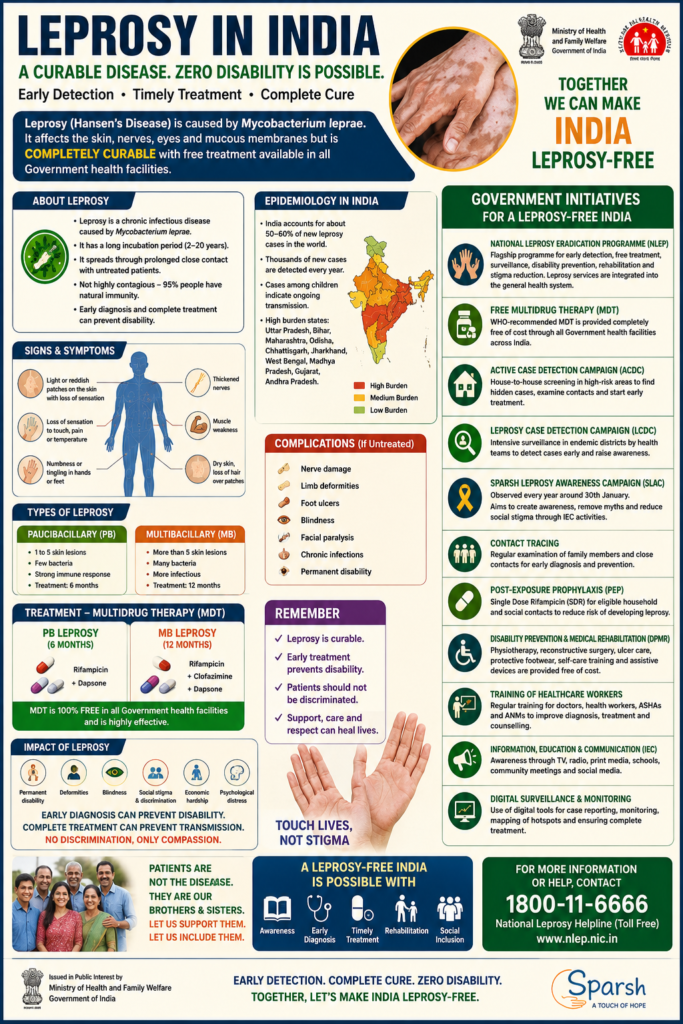
Leprosy, also known as Hansen’s disease, remains one of the oldest infectious diseases known to humanity. Despite remarkable advances in medicine and public health, leprosy continues to be a significant public health concern in several developing countries, particularly India. Caused by Mycobacterium leprae, the disease primarily affects the skin, peripheral nerves, upper respiratory tract mucosa, and eyes. If left untreated, it can lead to irreversible disability, deformity, blindness, and profound social stigma.
India has made extraordinary progress in reducing the prevalence of leprosy through sustained governmental efforts, international collaboration, and widespread implementation of multidrug therapy (MDT). In 2005, the country achieved the World Health Organization (WHO) target of eliminating leprosy as a public health problem at the national level, defined as a prevalence of less than one case per 10,000 population. However, elimination at the national level does not imply complete eradication. India continues to report the largest number of new leprosy cases globally, accounting for nearly half of all newly detected cases each year. This highlights the continuing need for early diagnosis, uninterrupted treatment, active surveillance, disability prevention, and community awareness.
This article provides a comprehensive overview of leprosy in India, its epidemiology, clinical manifestations, diagnosis, treatment, socio-economic impact, and the numerous government initiatives aimed at achieving a leprosy-free India.
Understanding Leprosy
Leprosy is a chronic infectious disease caused by the acid-fast bacillus Mycobacterium leprae. The bacterium has an exceptionally slow growth rate, with an incubation period ranging from two to twenty years, making early diagnosis particularly challenging.
The disease primarily affects:
- Skin
- Peripheral nerves
- Eyes
- Nasal mucosa
- Hands and feet
Contrary to common misconceptions, leprosy is not highly contagious. Approximately 95% of humans possess natural immunity against the disease. Transmission generally occurs through prolonged close contact with untreated patients via respiratory droplets.
Epidemiology of Leprosy in India
India continues to bear the highest burden of leprosy worldwide despite decades of successful control measures.
Key epidemiological observations include:
- India contributes approximately 50–60% of newly detected global leprosy cases annually.
- Thousands of new patients are diagnosed every year.
- Cases continue to occur among children, indicating ongoing transmission.
- Certain states and districts remain endemic despite national elimination.
- Disabilities among newly detected patients indicate delayed diagnosis.
High-burden states include:
- Uttar Pradesh
- Bihar
- Maharashtra
- Odisha
- Chhattisgarh
- Jharkhand
- West Bengal
- Madhya Pradesh
- Gujarat
- Andhra Pradesh
Urban migration, overcrowding, poor socioeconomic conditions, malnutrition, and limited healthcare accessibility contribute to continued disease transmission.
Clinical Features
The symptoms depend upon the immune response of the infected individual.
Common manifestations include:
Skin lesions
- Hypopigmented patches
- Reddish lesions
- Dry skin
- Loss of sweating
- Hair loss over lesions
Nerve involvement
- Numbness
- Tingling sensation
- Muscle weakness
- Loss of sensation
- Thickened peripheral nerves
Advanced disease
- Hand deformities
- Foot drop
- Claw hand
- Facial paralysis
- Blindness
- Chronic ulcers
Permanent disability develops mainly because of delayed diagnosis rather than bacterial destruction alone.
Classification of Leprosy
Paucibacillary (PB)
- One to five skin lesions
- Few bacteria
- Strong immune response
- Shorter treatment duration
Multibacillary (MB)
- More than five lesions
- Numerous bacteria
- Greater infectivity
- Longer treatment duration
Diagnosis
Diagnosis remains primarily clinical but is supported by laboratory investigations.
Diagnostic approaches include:
- Clinical examination
- Sensory testing
- Peripheral nerve assessment
- Skin smear examination
- Skin biopsy
- Histopathology
- Molecular diagnostic techniques (PCR in selected centers)
Early diagnosis remains the cornerstone of disability prevention.
Treatment
The introduction of Multidrug Therapy (MDT) revolutionized leprosy management worldwide.
WHO-recommended MDT includes:
Paucibacillary disease
- Rifampicin
- Dapsone
Treatment duration:
- Six months
Multibacillary disease
- Rifampicin
- Clofazimine
- Dapsone
Treatment duration:
- Twelve months
Treatment is provided completely free of cost through the public health system across India.
Complications
Untreated disease may result in:
- Permanent disability
- Limb deformities
- Blindness
- Chronic ulcers
- Secondary infections
- Psychological trauma
- Depression
- Social isolation
- Economic hardship
Social Stigma
One of the greatest challenges associated with leprosy is stigma.
Patients frequently experience:
- Social exclusion
- Employment discrimination
- Educational barriers
- Marital difficulties
- Psychological distress
- Community rejection
Even after complete cure, deformities may persist, leading to lifelong discrimination.
Addressing stigma remains as important as treating the infection itself.
Government Initiatives Against Leprosy in India
India has implemented one of the world’s largest leprosy control programmes.
National Leprosy Eradication Programme (NLEP)
The National Leprosy Eradication Programme (NLEP) is the flagship initiative of the Government of India.
Major objectives include:
- Early case detection
- Prompt treatment
- Disability prevention
- Surveillance
- Community awareness
- Rehabilitation
- Reduction of disease transmission
The programme integrates leprosy services into the general healthcare system, ensuring wider accessibility.
Free Multidrug Therapy
The Government supplies WHO-recommended MDT free of cost through all government health facilities.
Benefits include:
- Improved treatment compliance
- Reduced transmission
- Prevention of drug resistance
- Better cure rates
Active Case Detection Campaign (ACDC)
The Active Case Detection Campaign focuses on house-to-house screening in high-risk districts.
Objectives include:
- Early diagnosis
- Identification of hidden cases
- Contact screening
- Immediate treatment initiation
This strategy significantly reduces diagnostic delays.
Leprosy Case Detection Campaign (LCDC)
The Leprosy Case Detection Campaign targets endemic districts with intensive surveillance.
Healthcare workers:
- Visit households
- Examine suspected patients
- Refer confirmed cases
- Educate communities
Sparsh Leprosy Awareness Campaign (SLAC)
Observed annually around 30 January, the Sparsh Leprosy Awareness Campaign aims to eliminate misconceptions about leprosy.
Major activities include:
- Public awareness drives
- School education
- Community meetings
- Gram Sabha participation
- Information, Education and Communication (IEC) activities
- Stigma reduction campaigns
The campaign emphasizes that leprosy is completely curable if diagnosed early.
Contact Tracing
Family members and close contacts of diagnosed patients are regularly screened.
Benefits include:
- Early diagnosis
- Reduced transmission
- Prevention of disability
- Better surveillance
Post-Exposure Prophylaxis (PEP)
India has introduced Single Dose Rifampicin (SDR) for eligible household and social contacts of newly diagnosed patients in selected settings.
This preventive intervention reduces the risk of developing leprosy among close contacts and complements active surveillance strategies.
Disability Prevention and Medical Rehabilitation (DPMR)
The Government provides comprehensive rehabilitation services.
These include:
- Physiotherapy
- Reconstructive surgery
- Protective footwear
- Ulcer management
- Self-care training
- Assistive devices
Training of Healthcare Workers
Continuous training programmes are conducted for:
- Medical officers
- Community health officers
- Accredited Social Health Activists (ASHAs)
- Auxiliary Nurse Midwives (ANMs)
- Multipurpose health workers
Training improves diagnostic accuracy and treatment quality.
Information, Education and Communication (IEC)
Awareness campaigns are conducted through:
- Television
- Radio
- Newspapers
- Social media
- Schools
- Village meetings
- Health camps
These campaigns emphasize that:
- Leprosy is curable.
- Early treatment prevents disability.
- Patients should not be discriminated against.
Integration into Primary Healthcare
Leprosy services are integrated with primary healthcare under the public health system.
Patients can receive:
- Diagnosis
- Medicines
- Follow-up
- Disability care
- Counseling
at nearby government health facilities.
Digital Surveillance
Modern surveillance systems increasingly support:
- Case reporting
- Monitoring treatment completion
- Geographic mapping of cases
- Programme evaluation
- Supply-chain management of MDT
Digital tools help identify persistent hotspots and improve resource allocation.
Role of the WHO and International Collaboration
India collaborates closely with international partners, including the WHO, for technical guidance, drug supply support, surveillance, and implementation of global strategies aimed at achieving zero leprosy.
Challenges Remaining
Despite considerable achievements, several obstacles remain:
- Persistent transmission in endemic pockets
- Late diagnosis
- Social stigma
- Hidden cases
- Childhood infections
- Disabilities among newly detected patients
- Migrant populations
- Limited awareness
- Inadequate rehabilitation services in some areas
- Shortage of trained personnel in remote regions
Future Directions
To achieve a leprosy-free India, the following priorities are essential:
- Intensified surveillance in endemic districts
- Universal early diagnosis
- Strengthening contact tracing
- Wider implementation of post-exposure prophylaxis
- Expanded rehabilitation services
- Enhanced community participation
- Continued public awareness campaigns
- Research on vaccines, diagnostics, and transmission dynamics
- Integration of digital technologies for monitoring and follow-up
- Strong intersectoral collaboration involving health, education, social welfare, and local governance
Conclusion
India has made remarkable progress in controlling leprosy through sustained political commitment, scientific advances, free multidrug therapy, nationwide surveillance, and community-based interventions. The integration of leprosy services into the primary healthcare system, combined with initiatives such as the National Leprosy Eradication Programme, Active Case Detection Campaigns, Sparsh Leprosy Awareness Campaign, disability prevention services, and post-exposure prophylaxis, has substantially reduced the disease burden and improved access to care.
Nevertheless, the continued detection of new cases, including among children, demonstrates that transmission persists in certain regions. Delayed diagnosis, social stigma, and disability remain significant challenges. Achieving the vision of a leprosy-free India will require sustained investments in early detection, community education, rehabilitation, research, digital surveillance, and equitable access to healthcare. By combining robust public health strategies with social inclusion and scientific innovation, India can move closer to interrupting transmission, preventing disability, and ensuring dignity and quality of life for every person affected by leprosy.