

India in the Last 30 Days (June–July 2026): A Comprehensive Review of Political, Economic, Strategic, Scientific, and Social Developments
By Author Devanssh Mehta Mode
Introduction
The past thirty days have been particularly significant for India, reflecting the country’s evolving position as one of the world’s fastest-growing major economies and an increasingly influential geopolitical actor. During this period, developments have ranged from parliamentary preparations and macroeconomic challenges to infrastructure expansion, technological achievements, transportation modernization, defence preparedness, and international diplomacy.
While India’s long-term growth trajectory remains positive, recent events also highlight persistent challenges such as inflationary pressures, energy security concerns, climate-related disruptions, and domestic political debates. This article provides a detailed analysis of India’s major developments during the last month.
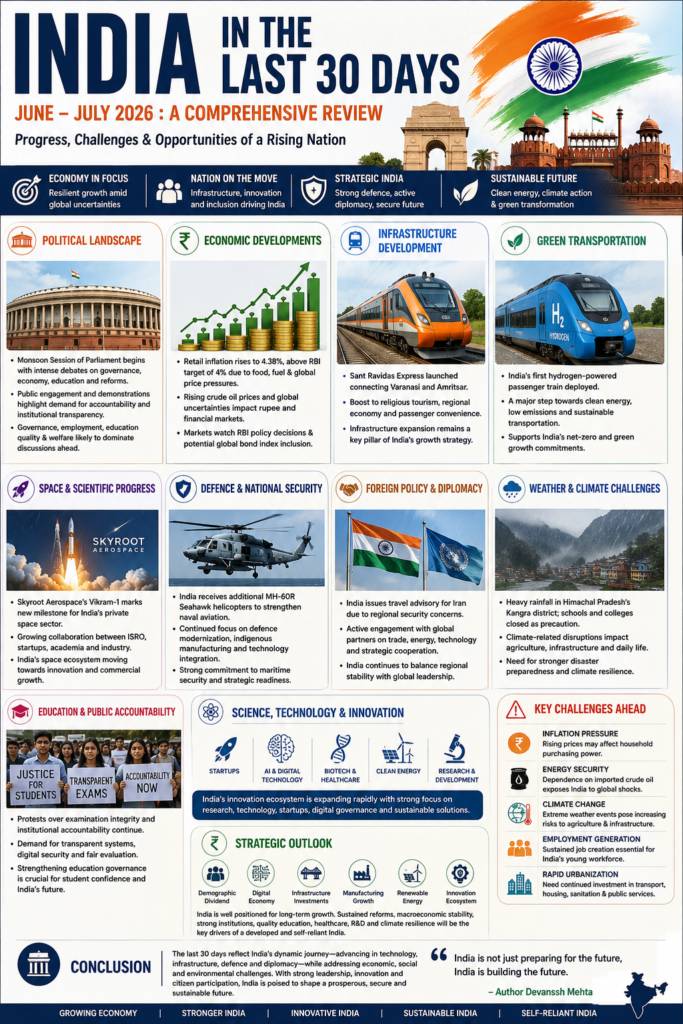
Political Landscape
The commencement of the Monsoon Session of Parliament has once again placed governance and legislative priorities at the centre of national attention. Political discourse has intensified, with both the government and opposition preparing to debate economic conditions, examination-related issues, governance reforms, and national security. Public demonstrations and political mobilization around education and governance also drew significant attention in New Delhi. (Reuters)
Key observations include:
- Intensified parliamentary activity.
- Renewed focus on governance reforms.
- Greater public engagement through demonstrations.
- Continued emphasis on accountability and institutional functioning.
The political climate indicates that governance reforms, employment generation, education quality, and public welfare are likely to dominate policy discussions throughout the remainder of the parliamentary session.
Economic Developments
Inflation Returns Above RBI Target
One of the most significant economic developments has been the increase in India’s retail inflation to 4.38%, exceeding the Reserve Bank of India’s medium-term target of 4% for the first time in many months. The increase has largely been attributed to:
- Rising food prices
- Fuel inflation
- Higher crude oil prices
- Uneven monsoon conditions
- Global geopolitical tensions affecting energy markets (Reuters)
This development has increased expectations that the Reserve Bank of India may adopt a more cautious monetary policy in the coming months.
Currency and Financial Markets
The Indian Rupee experienced pressure due to:
- Rising international crude oil prices
- West Asian geopolitical instability
- Market expectations regarding RBI intervention
Financial markets are also closely watching decisions regarding India’s inclusion in major global bond indices, which could influence foreign investment flows. (Reuters)
Infrastructure Development
India continued expanding its transportation infrastructure.
A notable development was the launch of the Sant Ravidas Express, improving connectivity between Varanasi and Amritsar. The project supports:
- Religious tourism
- Economic connectivity
- Regional development
- Passenger convenience (The Times of India)
Railway modernization remains a key component of India’s long-term infrastructure strategy.
Green Transportation
India also witnessed the deployment of its first hydrogen-powered passenger train, representing an important milestone toward sustainable transportation and reduced carbon emissions. (The Times of India)
Potential benefits include:
- Lower carbon footprint
- Reduced dependence on fossil fuels
- Promotion of clean energy technologies
- Advancement toward India’s net-zero commitments
Space and Scientific Progress
The Indian private space sector achieved another milestone with Skyroot Aerospace’s Vikram-1, marking further progress in commercial space capabilities. (The Times of India)
India’s growing space ecosystem now increasingly features collaboration between:
- ISRO
- Private aerospace companies
- Startups
- Academic institutions
This reflects the country’s transition toward a more innovation-driven space economy.
Defence and National Security
India continued strengthening defence preparedness through:
- Expansion of naval aviation capabilities with additional MH-60R Seahawk helicopters.
- Continued modernization of strategic infrastructure. (The Times of India)
India’s defence strategy increasingly emphasizes:
- Maritime security
- Indigenous defence manufacturing
- Technology integration
- Regional deterrence
Foreign Policy
India’s external affairs remained active amid geopolitical uncertainty.
The government issued updated travel advisories urging citizens to avoid travel to Iran and advising those already there to leave due to regional security concerns. (The Indian Express)
This reflects India’s balancing act between:
- Protecting overseas citizens
- Maintaining strategic partnerships
- Safeguarding energy security
- Responding to rapidly changing geopolitical developments
Weather and Climate Challenges
Extreme weather continued affecting several parts of India.
Heavy rainfall led authorities in Himachal Pradesh’s Kangra district to temporarily close schools and colleges as a precautionary measure. (The Times of India)
Climate-related challenges continue to influence:
- Agriculture
- Disaster management
- Urban planning
- Infrastructure resilience
Education and Public Accountability
Education remained an important public issue, with protests highlighting concerns about examination integrity and accountability in public institutions. (Reuters)
These discussions underscore the need for:
- Transparent examination systems
- Stronger institutional governance
- Digital security
- Student confidence in competitive examinations
Science, Technology and Innovation
India’s innovation ecosystem continues expanding through:
- Startup growth
- Space technology
- Clean energy
- Digital governance
- Artificial intelligence
- Biotechnology
Government initiatives promoting research commercialization and technology transfer are helping strengthen India’s knowledge economy.
Challenges Facing India
Despite positive developments, several structural challenges remain:
Inflation: Rising prices may affect household purchasing power.
Energy Security: Dependence on imported crude oil continues to expose India to global geopolitical shocks.
Climate Change: Extreme rainfall and weather variability pose increasing risks to agriculture and infrastructure.
Employment: Sustained job creation remains essential to support India’s young workforce.
Urbanization: Rapid urban growth requires continued investment in transport, housing, sanitation, and public services.
Strategic Outlook
India appears well positioned to sustain long-term growth due to:
- Strong demographic dividend
- Expanding digital economy
- Infrastructure investments
- Manufacturing initiatives
- Renewable energy transition
- Growing innovation ecosystem
However, continued progress will depend on maintaining macroeconomic stability, strengthening institutions, improving education and healthcare, fostering research and development, and enhancing climate resilience.
Conclusion
The last thirty days have illustrated India’s dynamic trajectory as a nation balancing rapid economic growth with complex domestic and global challenges. Advances in transportation, clean energy, space technology, and defence modernization highlight the country’s ambition to become a leading global power. At the same time, inflationary pressures, climate-related disruptions, energy security concerns, and demands for institutional accountability remind policymakers that sustained progress requires continuous reforms and resilient governance. (The Times of India)
India’s future will depend not only on its economic performance but also on its ability to translate technological progress, social inclusion, environmental sustainability, and effective governance into long-term national development. The developments of the past month demonstrate both the opportunities and the responsibilities that accompany India’s rise on the global stage.