

Strengthening the Backbone of India’s Internal Security
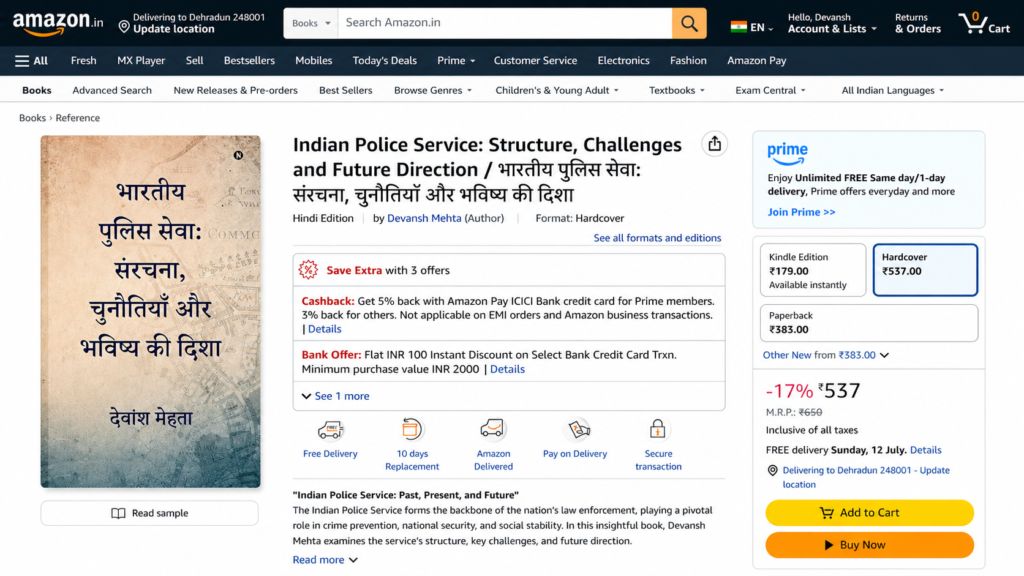
By Devansh Mehta
Introduction
The Indian Police Service (IPS) occupies a central position in India’s governance and security architecture. As one of the three All India Services established under Article 312 of the Constitution of India, the IPS plays a vital role in maintaining law and order, preventing crime, combating terrorism, safeguarding national security, and ensuring the effective implementation of the rule of law. In a nation as vast, diverse, and dynamic as India, policing extends beyond crime control; it encompasses public trust, democratic governance, disaster response, cyber security, intelligence gathering, community engagement, and crisis management.
The twenty-first century presents unprecedented challenges to policing. Rapid urbanization, digital transformation, cybercrime, organized crime, transnational terrorism, misinformation campaigns, economic offences, artificial intelligence-enabled criminal activities, and social polarization have significantly altered the security landscape. Consequently, the traditional policing model must evolve into a technologically advanced, intelligence-driven, citizen-centric, and professionally managed institution capable of addressing both conventional and emerging threats.
This article provides a comprehensive examination of the structure of the Indian Police Service, its major operational and administrative challenges, and the future reforms required to build a modern policing ecosystem for an emerging global power.
Historical Evolution
Modern policing in India has its roots in the Police Act of 1861, enacted following the Revolt of 1857. The British colonial administration designed the police primarily as an instrument of maintaining imperial authority rather than serving the public. Although India achieved independence in 1947, many structural features of the colonial policing framework continue to influence policing philosophy even today.
The creation of the Indian Police Service in 1948 represented a significant institutional reform aimed at establishing a professional leadership cadre responsible for maintaining national integrity while respecting constitutional values. Since then, the IPS has evolved considerably, expanding its role from traditional law enforcement to include intelligence, border management, disaster management, counter-insurgency, cyber investigations, anti-corruption operations, financial crime investigations, and international policing cooperation.
Organizational Structure of the Indian Police Service
The Indian Police Service functions through a well-defined hierarchical structure that ensures operational command, administrative accountability, and coordination across states and the central government.
At the apex is the Ministry of Home Affairs, Government of India, which formulates national policing policies and oversees internal security. IPS officers serve in both the Central Government and State Governments, making the service unique in maintaining administrative integration across the country.
The hierarchy generally includes:
- Director General of Police (DGP)
- Additional Director General of Police (ADGP)
- Inspector General of Police (IGP)
- Deputy Inspector General of Police (DIG)
- Superintendent of Police (SP)
- Additional Superintendent of Police
- Deputy Superintendent of Police (DSP)/Assistant Superintendent of Police (ASP)
- Inspectors
- Sub-Inspectors
- Assistant Sub-Inspectors
- Head Constables
- Constables
IPS officers are recruited through the Civil Services Examination conducted by the Union Public Service Commission (UPSC), one of the world’s most competitive examinations. After selection, officers undergo rigorous professional training at the Sardar Vallabhbhai Patel National Police Academy, Hyderabad, where they receive education in criminal law, forensic science, leadership, weapons handling, cybercrime investigation, counter-terrorism, intelligence operations, ethics, human rights, and public administration.
Major Functional Responsibilities
The responsibilities of the Indian Police Service are multidimensional and continuously expanding.
Law and Order
Maintaining peace remains the primary responsibility of the police. This includes crowd management, riot control, communal harmony, VIP security, election security, and public order during festivals and emergencies.
Crime Prevention and Investigation
The police investigate offences ranging from theft and homicide to financial fraud, cybercrime, organized crime, and human trafficking. Scientific investigation has become increasingly important with the integration of forensic technologies and digital evidence.
Counter-Terrorism
India faces diverse security threats including cross-border terrorism, radicalization, insurgency, and extremist violence. IPS officers coordinate with intelligence agencies, central armed police forces, and state police units to neutralize these threats.
Intelligence Collection
Modern policing increasingly depends on intelligence-led operations. Information gathering, surveillance, criminal profiling, and predictive policing have become essential components of effective law enforcement.
Cyber Security
Digital transformation has created entirely new categories of criminal activity including ransomware attacks, online financial fraud, cryptocurrency scams, identity theft, child exploitation, and cyber espionage. Specialized cyber police stations are now becoming indispensable.
Disaster Management
Police personnel play a critical role during floods, earthquakes, pandemics, industrial disasters, and humanitarian emergencies by coordinating evacuation, rescue operations, relief distribution, and maintaining public order.
Strengths of the Indian Police Service
Despite operational challenges, the Indian Police Service possesses several significant strengths.
The service maintains one of the largest policing networks globally, enabling nationwide administrative coordination.
Its officers receive high-quality professional training in leadership, investigation, crisis management, and national security.
The IPS enjoys considerable operational diversity, allowing officers to gain experience in intelligence, investigation, counter-insurgency, administration, international policing, disaster response, and public policy.
India’s police have demonstrated remarkable resilience during terrorism, natural disasters, pandemics, elections, and large-scale public events involving millions of participants.
Increasing adoption of digital policing platforms such as the Crime and Criminal Tracking Network and Systems (CCTNS), facial recognition technologies, drone surveillance, integrated emergency response systems, and forensic laboratories reflects progressive modernization.
Major Challenges Facing Indian Policing
Political Interference
One of the most widely discussed concerns is political influence over transfers, investigations, and administrative decision-making. Institutional autonomy remains an important requirement for impartial policing.
Manpower Shortages
Many states experience substantial vacancies in police forces. Insufficient personnel increase workload, reduce investigation quality, and affect public service delivery.
Outdated Infrastructure
Several police stations continue to operate with inadequate buildings, obsolete equipment, limited forensic support, and insufficient digital infrastructure.
Increasing Cybercrime
Cybercriminals often operate across jurisdictions and international borders. Police organizations require continuous technological upgrades and specialized expertise to effectively combat these sophisticated threats.
Judicial Delays
Lengthy investigations, overloaded courts, and delayed trials reduce deterrence and weaken public confidence in the criminal justice system.
Stress and Mental Health
Police personnel frequently work under extremely stressful conditions with long working hours, limited leave, exposure to violence, and high public expectations. Mental health support remains insufficient.
Public Trust
Building trust requires transparent investigations, respectful public interactions, accountability mechanisms, and community participation. Allegations of excessive force or custodial misconduct can damage institutional credibility.
Technology and the Future of Policing
The future Indian police force will increasingly become technology-enabled.
Artificial Intelligence can assist in crime prediction, facial recognition, digital evidence analysis, traffic management, and criminal pattern identification.
Big data analytics will support predictive policing by identifying emerging crime trends and resource deployment strategies.
Drone technology will enhance surveillance during disasters, border security, crowd management, and anti-smuggling operations.
Digital forensics will become central to investigating cyber offences, financial crimes, and electronic evidence.
Body-worn cameras can improve transparency, accountability, and evidence collection while reducing allegations of misconduct.
Integrated command-and-control centres will facilitate real-time coordination between police, emergency services, disaster management authorities, and intelligence agencies.
Human Resource Reforms
The future success of Indian policing depends significantly upon human resource development.
Continuous professional education should become mandatory throughout an officer’s career.
Specialization in cybercrime, financial investigation, artificial intelligence, digital forensics, behavioural sciences, hostage negotiation, and strategic intelligence should receive greater institutional support.
Leadership development programmes should focus on ethics, emotional intelligence, crisis communication, conflict resolution, and evidence-based decision-making.
Improved welfare measures, better housing, healthcare, counselling services, and work-life balance will enhance morale and operational effectiveness.
Community Policing
Modern policing cannot succeed without active public participation.
Community policing encourages partnerships between citizens and law enforcement agencies to prevent crime proactively. Educational institutions, resident welfare associations, industry groups, civil society organizations, and local communities should collaborate with police in awareness campaigns, youth engagement, cyber safety education, women’s safety initiatives, and neighbourhood security programmes.
Citizen trust remains the most valuable asset of any democratic police organization.
Policy Recommendations
A comprehensive modernization strategy should include several key reforms:
- Police reforms emphasizing operational independence and accountability.
- Full implementation of technology-driven smart policing.
- Strengthening forensic infrastructure nationwide.
- Greater recruitment to reduce manpower shortages.
- Enhanced cybercrime investigation capabilities.
- Better police welfare and mental health support.
- Improved training in artificial intelligence and digital investigation.
- Stronger community policing initiatives.
- Faster judicial coordination through digital case management.
- Increased investment in research, innovation, and policing education.
Vision for 2047
As India progresses toward becoming a developed nation by 2047, the Indian Police Service must evolve into a globally respected institution characterized by professionalism, integrity, innovation, and constitutional commitment.
Future police officers will increasingly function as strategic leaders capable of integrating technology, intelligence, public administration, and ethical governance. Artificial intelligence, predictive analytics, autonomous surveillance systems, advanced forensic science, and integrated national security networks will reshape policing over the coming decades.
However, technological advancement alone cannot ensure effective policing. The defining qualities of the future IPS officer will continue to be courage, integrity, empathy, impartiality, professionalism, and dedication to public service. Public trust, constitutional values, and respect for human rights must remain the foundation of every policing initiative.
Conclusion
The Indian Police Service is far more than a law enforcement organization; it is a guardian of constitutional democracy, national security, and social stability. While significant challenges such as political interference, manpower shortages, cyber threats, infrastructure deficits, and public trust remain, they also present opportunities for transformative reform.
A future-ready police force must combine advanced technology with ethical leadership, scientific investigation with community engagement, and operational efficiency with accountability. Investment in modernization, continuous training, institutional independence, and citizen partnership will determine the effectiveness of policing in the decades ahead.
A strong, transparent, technologically advanced, and people-centric Indian Police Service will be indispensable for safeguarding India’s democratic institutions, supporting sustainable economic growth, protecting national security, and realizing the vision of a secure, inclusive, and developed India.